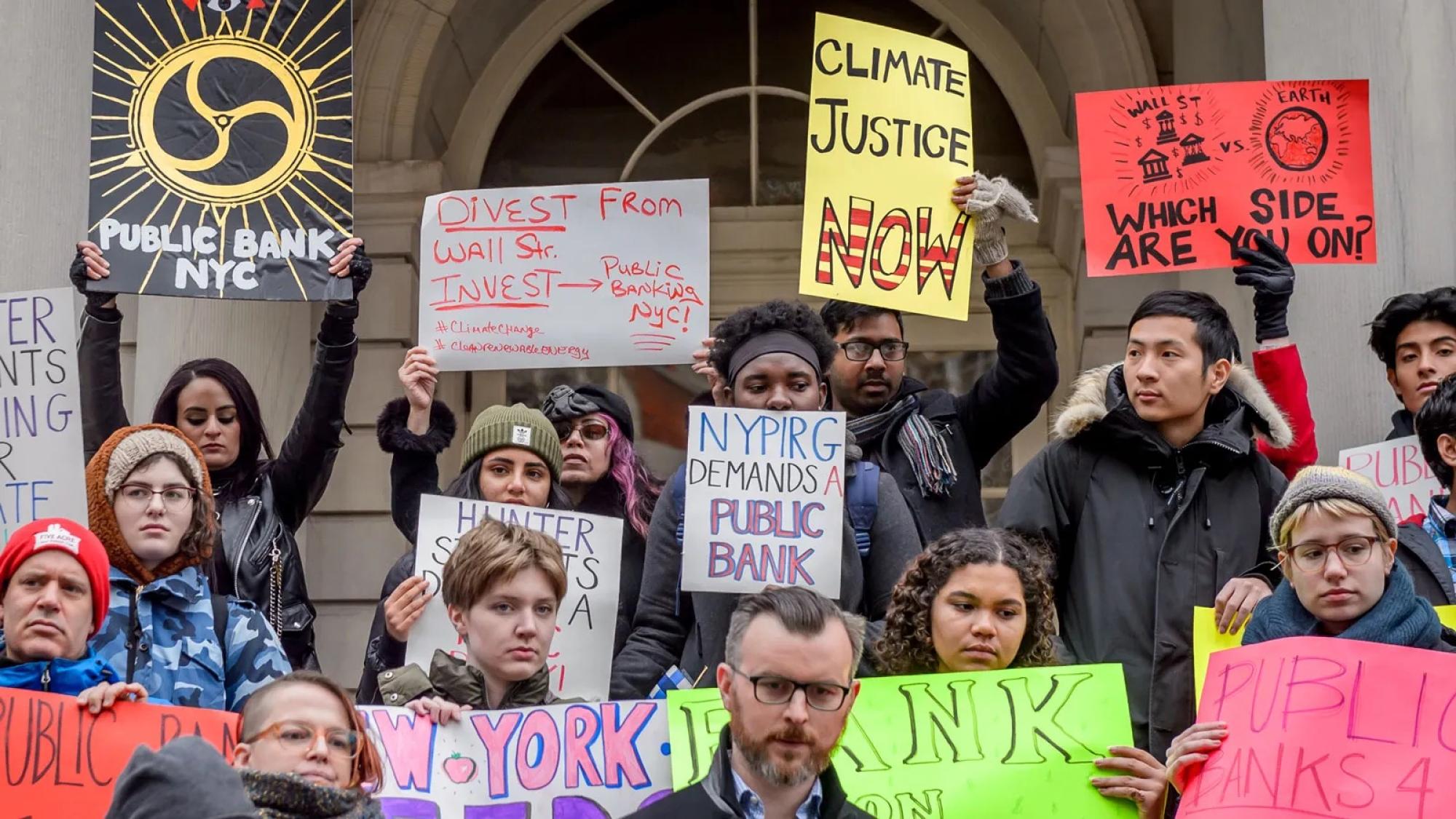
Public banks are typically operated by government or tribal authorities and, in theory, would be chartered to achieve social good and invest in communities. Only two public banks currently operate in the United States: the Bank of North Dakota, founded in 1919, and the Territorial Bank of American Samoa, founded in 2018. Organizations pushing for a public banking option exist in 37 states, according to the Public Banking Institute. In contrast to private banks, which are responsible to their shareholders, public banks are responsible to their boards and are chartered to invest in public needs. The Bank of North Dakota, for instance, is chartered to offer a "revolving loan fund" to farmers, and profits from loans are directed back into the fund to keep interest rates low. The modern movement to invest in public banks grew out of the 2008 financial crisis and was galvanized during the pandemic, fueled by a populist distrust of the banking and finance sectors. In October 2020, Representatives Alexandria Ocasio-Cortez and Rashida Tlaib introduced the federal Public Banking Act, which would allow state and local governments across the country to create public banks. In the first two months of 2021 there were sixteen bills across the country designed to pave the way for public banks. Supporters of public banks are hoping that any deposits from state and local governments can be used to fund community-based projects that have trouble getting funded by private banks.
Latest
Latest News
Each news summary is created according to strict standards. Here's how we do it.
Each summary is created using a consistent editorial procedure. The target length is approximately 16 lines of 11-point Arial text in a 650-pixel-wide column. Up to 25% of a summary may be set in bold to emphasize the most important ideas. Summaries are composed of verbatim excerpts presented in the same sequence as they appear in the original news source, with very minor editorial additions. Where material has been omitted between excerpts, the omission is indicated with ellipses (...). Any words added by an editor for clarity or context appear in [brackets]. Our original news editor was Fred Burks. Tod Fletcher edited most summaries from 2007 through 2014, and Mark Bailey has served as news editor since 2014.