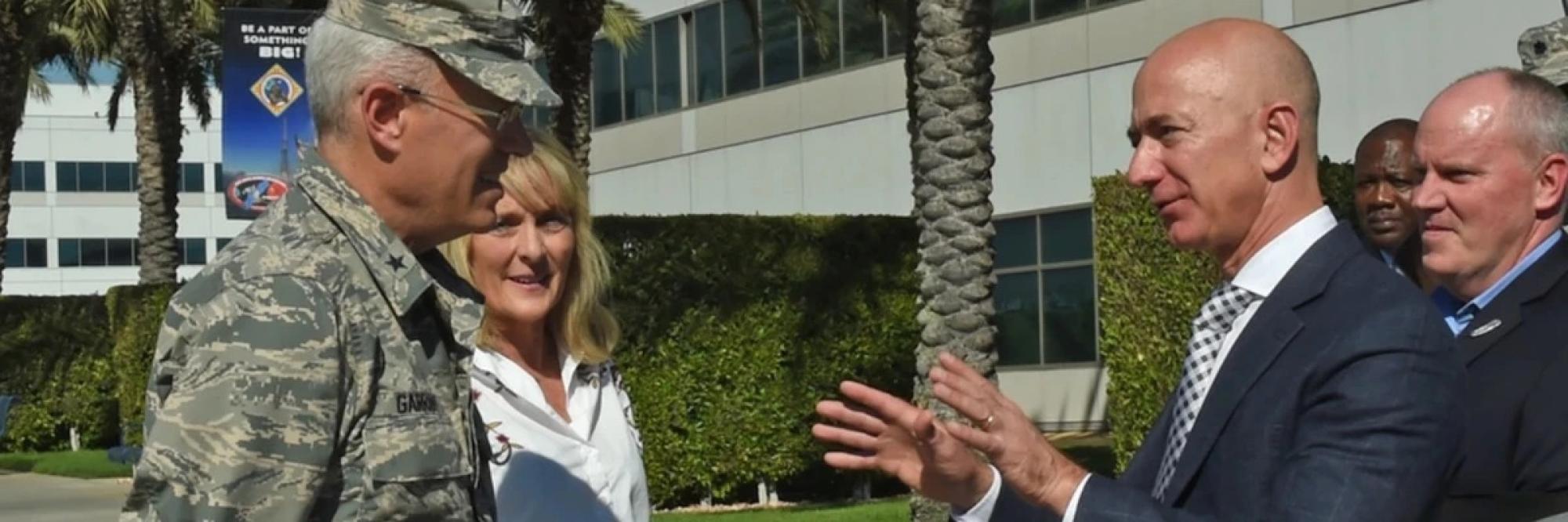
The center of the U.S. military-industrial complex has been shifting over the past decade from the Washington, D.C. metropolitan area to Northern Californiaa shift that is accelerating with the rise of artificial intelligence-based systems, according to a report published Wednesday. "Although much of the Pentagon's $886 billion budget is spent on conventional weapon systems and goes to well-established defense giants such as Lockheed Martin, RTX, Northrop Grumman, General Dynamics, Boeing, and BAE Systems, a new political economy is emerging, driven by the imperatives of big tech companies, venture capital (VC), and private equity firms," [report author Roberto J.] González wrote. "Defense Department officials have ... awarded large multibillion-dollar contracts to Microsoft, Amazon, Google, and Oracle." González found that the five largest military contracts to major tech firms between 2018 and 2022 "had contract ceilings totaling at least $53 billion combined." There's also the danger of a "revolving door" between Silicon Valley and the Pentagon as many senior government officials "are now gravitating towards defense-related VC or private equity firms as executives or advisers after they retire from public service." "Members of the armed services and civilians are in danger of being harmed by inadequately tested"or algorithmically flawed"AI-enabled technologies. By nature, VC firms seek rapid returns on investment by quickly bringing a product to market, and then 'cashing out' by either selling the startup or going public. This means that VC-funded defense tech companies are under pressure to produce prototypes quickly and then move to production before adequate testing has occurred."
Latest
Latest News
Each news summary is created according to strict standards. Here's how we do it.
Each summary is created using a consistent editorial procedure. The target length is approximately 16 lines of 11-point Arial text in a 650-pixel-wide column. Up to 25% of a summary may be set in bold to emphasize the most important ideas. Summaries are composed of verbatim excerpts presented in the same sequence as they appear in the original news source, with very minor editorial additions. Where material has been omitted between excerpts, the omission is indicated with ellipses (...). Any words added by an editor for clarity or context appear in [brackets]. Our original news editor was Fred Burks. Tod Fletcher edited most summaries from 2007 through 2014, and Mark Bailey has served as news editor since 2014.