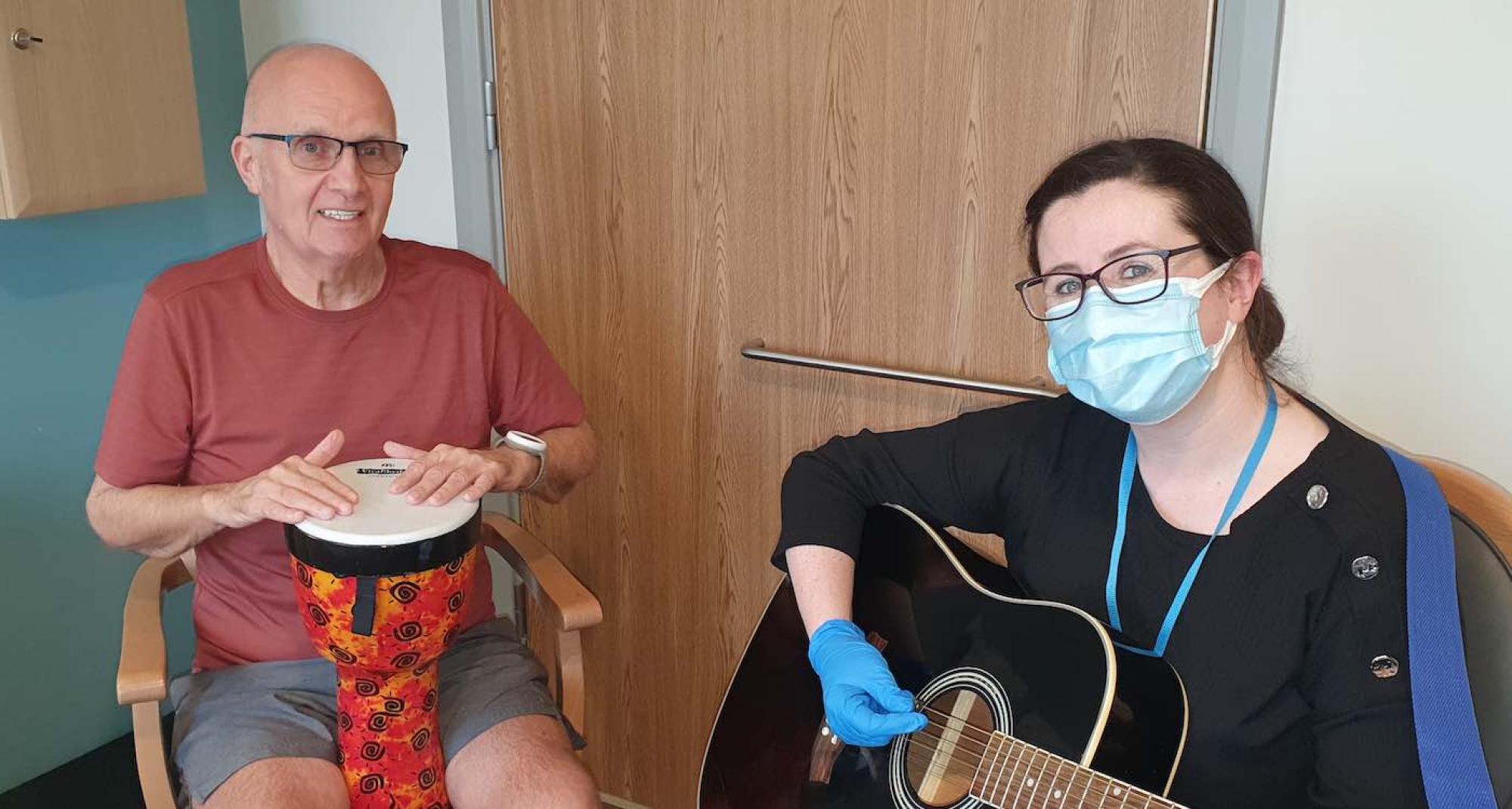
A patient who was left almost completely paralyzed from a rare disease is now walking and talking again, after a music therapist prescribed mindful listening to his favorite song every nightin this case, a tune by The Carpenters. 71 year-old Ian Palmer was struck down with Guillain-Barr© syndrome last June, forcing him to spend seven months in a hospital where he was unable to walk or speak properly. The rare condition happens when a person's own immune system attacks their body's motor nerves, causing muscle weakness and sometimes paralysis. But when Ian was transferred to Sue Ryder Neurological Care Centre, a state-of-the-art care unit in Lancashire, England, clinicians used music therapy techniques to overcome 'near total paralysis of his body'. His specialist, Clare, taught him mindfulness techniques using his favorite records"and he began listening to The Carpenters each night. Ian was admittedly skeptical, but he can now walk 2 miles a day (3k) and have conversations with his family after the exercises "opened up" his brain. He's never been very musical, so when Sue Ryder first suggested music therapy he said, 'What good is that going to do?' "I'm a typical Northern man, and I thought, 'What's a girl with a guitar going to do for me"get me to the gym.'" "But it really worked. Clare sat me down and explained the process. I learned that music is very unlike other therapies, as it opens up all of the brain."
Latest
Latest News
Each news summary is created according to strict standards. Here's how we do it.
Each summary is created using a consistent editorial procedure. The target length is approximately 16 lines of 11-point Arial text in a 650-pixel-wide column. Up to 25% of a summary may be set in bold to emphasize the most important ideas. Summaries are composed of verbatim excerpts presented in the same sequence as they appear in the original news source, with very minor editorial additions. Where material has been omitted between excerpts, the omission is indicated with ellipses (...). Any words added by an editor for clarity or context appear in [brackets]. Our original news editor was Fred Burks. Tod Fletcher edited most summaries from 2007 through 2014, and Mark Bailey has served as news editor since 2014.