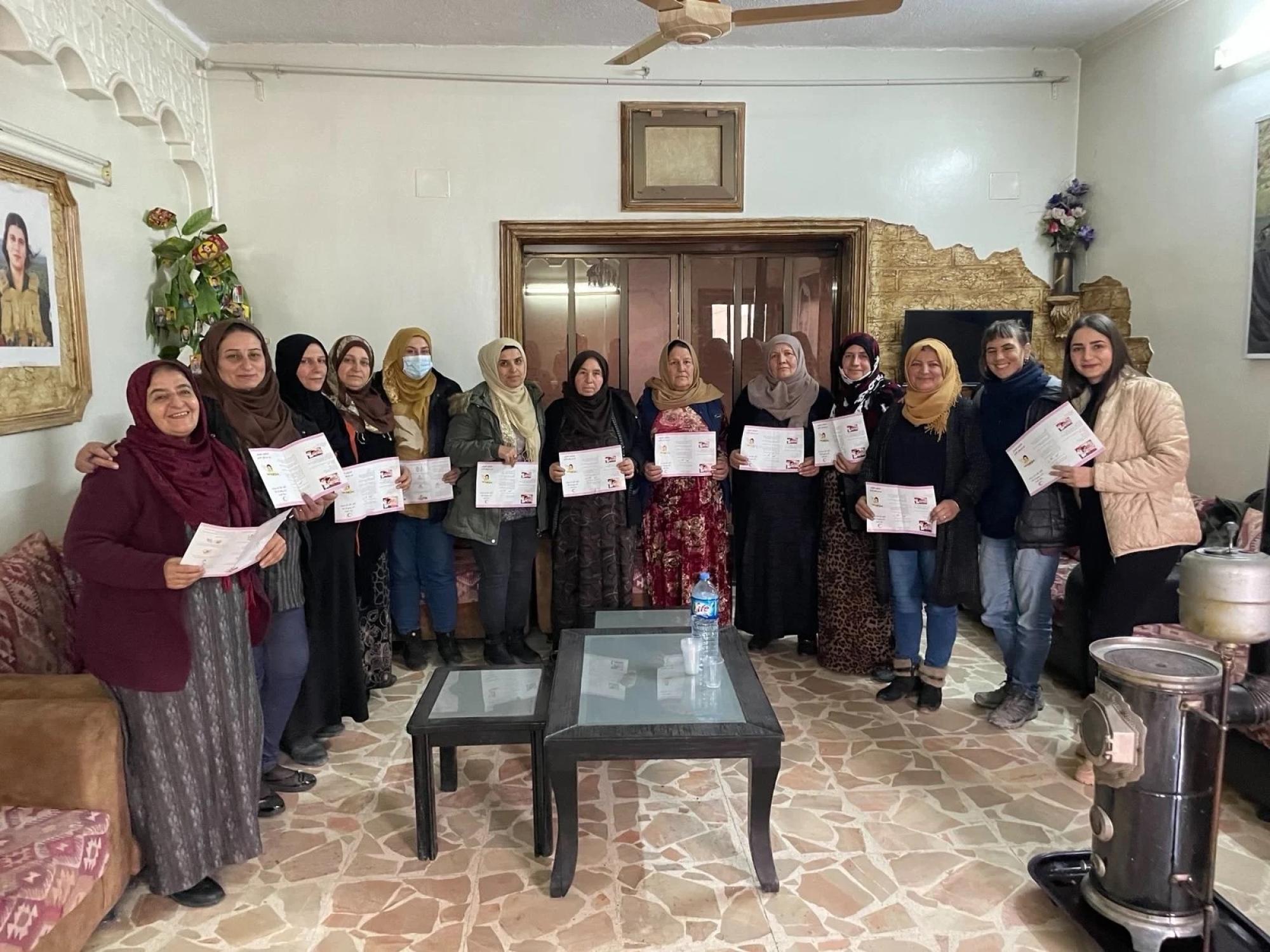
A growing women-led restorative justice system ... operates within the territory of the Autonomous Administration of North and East Syria (AANES), also known as Rojava, a revolutionary social experiment involving more than 4.5 million people. The system features a network, autonomous from the AANES, of more than 60 Mala Jin, or "women's houses," which allow people to solve disputes at the community level, instead of through courts or police, by offering reconciliation and mediation processes for domestic and family situations. Activist and independent researcher Clara Moore ... recently returned from spending two years in the region, working at both the Rojava Information Center and at Mala Jin. "Essentially, they're trying to build a system around the political philosophy of Democratic Confederalism, which was initially inspired by the ideas of [the American intellectual] Murray Bookchin and theorized by [Kurdish leader] Abdullah -calan from prison in Turkey," [said Moore]. "It's based on ideas of pluralism, direct democracy, decentralization, gender equality and self-defense. In practice, this means that all communities have the ability and right to defend themselves and provide for their own needs. The idea of the justice system in Rojava, in North and East Syria in general, is that it's possible to solve a dispute without going to court. There are laws in Rojava and courts. Ideally, those only become relevant when people can't come to a resolution together outside of court."
Latest
Latest News
Each news summary is created according to strict standards. Here's how we do it.
Each summary is created using a consistent editorial procedure. The target length is approximately 16 lines of 11-point Arial text in a 650-pixel-wide column. Up to 25% of a summary may be set in bold to emphasize the most important ideas. Summaries are composed of verbatim excerpts presented in the same sequence as they appear in the original news source, with very minor editorial additions. Where material has been omitted between excerpts, the omission is indicated with ellipses (...). Any words added by an editor for clarity or context appear in [brackets]. Our original news editor was Fred Burks. Tod Fletcher edited most summaries from 2007 through 2014, and Mark Bailey has served as news editor since 2014.