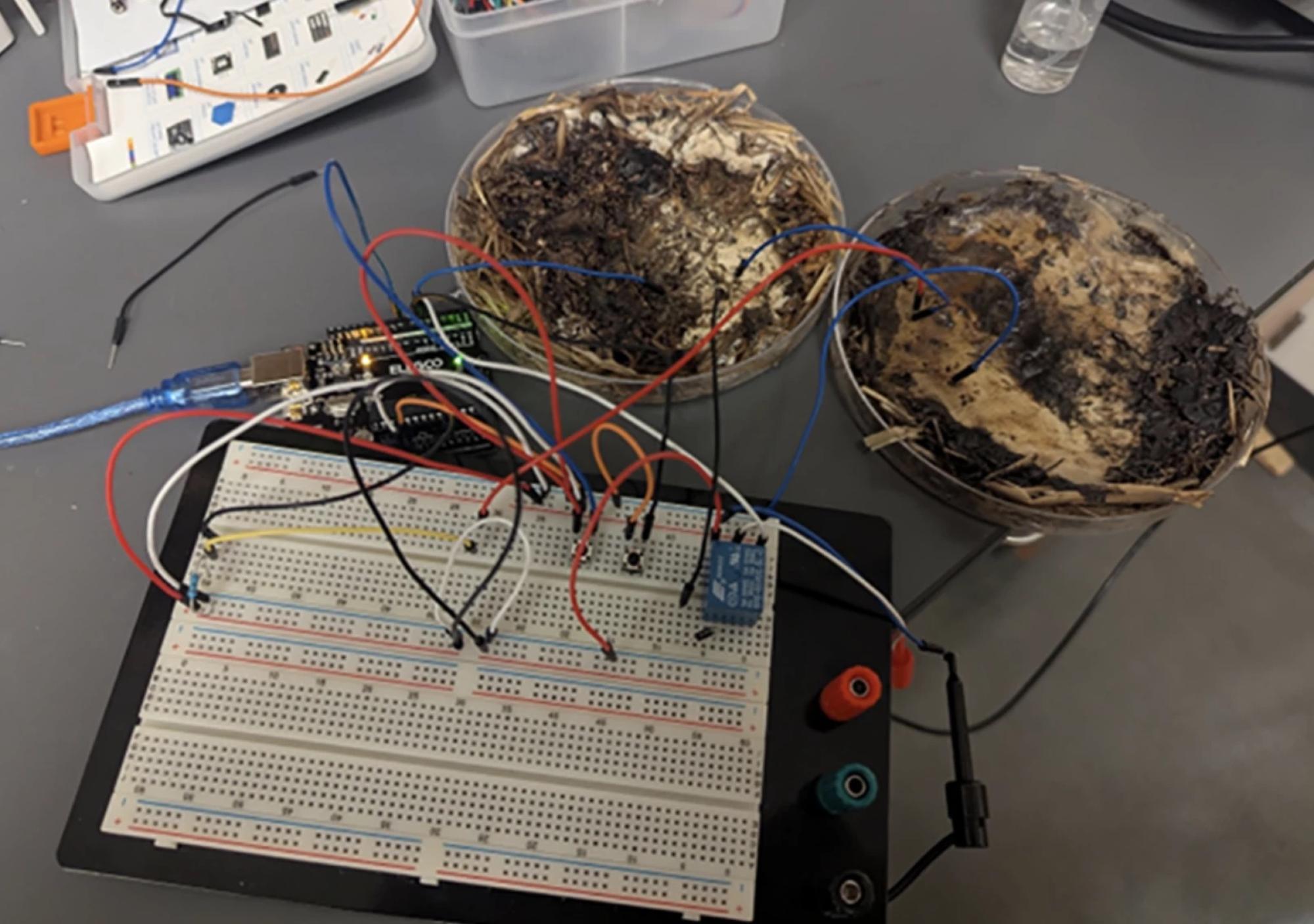
Scientists have just built working computer components out of shiitake mushrooms. As described in a paper published in PLOS One, using mycelium"the threadlike roots of fungi"researchers created memristors, the circuitry elements that remember past electrical states. You'd imagine such a feat would yield a memristor that performs terribly, but the researchers say its performance wasn't too far off from that inside your laptop. These organic circuits can store information, process signals, and maybe even help future computers behave more like organic brains, all while being low-cost, biodegradable, and probably compostable when you're done with them. The team grew nine batches of shiitake mycelium in petri dishes. They let them sprawl and stretch into mildly disturbing, gross, tangled networks of roots. Then, they dried them out in the sunlight until they were ready to handle electricity. Once wired up to a circuit, the fungal fibers responded to voltage like living synapses. They were firing off signals at about 5,850 hertz with 90 percent accuracy. The researchers found they could boost power by wiring more mushrooms together, creating an even larger fungal network that improved circuit stability and speed. It's still very early on, but the implications here are wild and potentially game-changing. Imagine being able to grow the components for, say, a new iPhone or the aforementioned high-end gaming rig, from just some dirt and a lot of humidity.
Latest
Latest News
Each news summary is created according to strict standards. Here's how we do it.
Each summary is created using a consistent editorial procedure. The target length is approximately 16 lines of 11-point Arial text in a 650-pixel-wide column. Up to 25% of a summary may be set in bold to emphasize the most important ideas. Summaries are composed of verbatim excerpts presented in the same sequence as they appear in the original news source, with very minor editorial additions. Where material has been omitted between excerpts, the omission is indicated with ellipses (...). Any words added by an editor for clarity or context appear in [brackets]. Our original news editor was Fred Burks. Tod Fletcher edited most summaries from 2007 through 2014, and Mark Bailey has served as news editor since 2014.