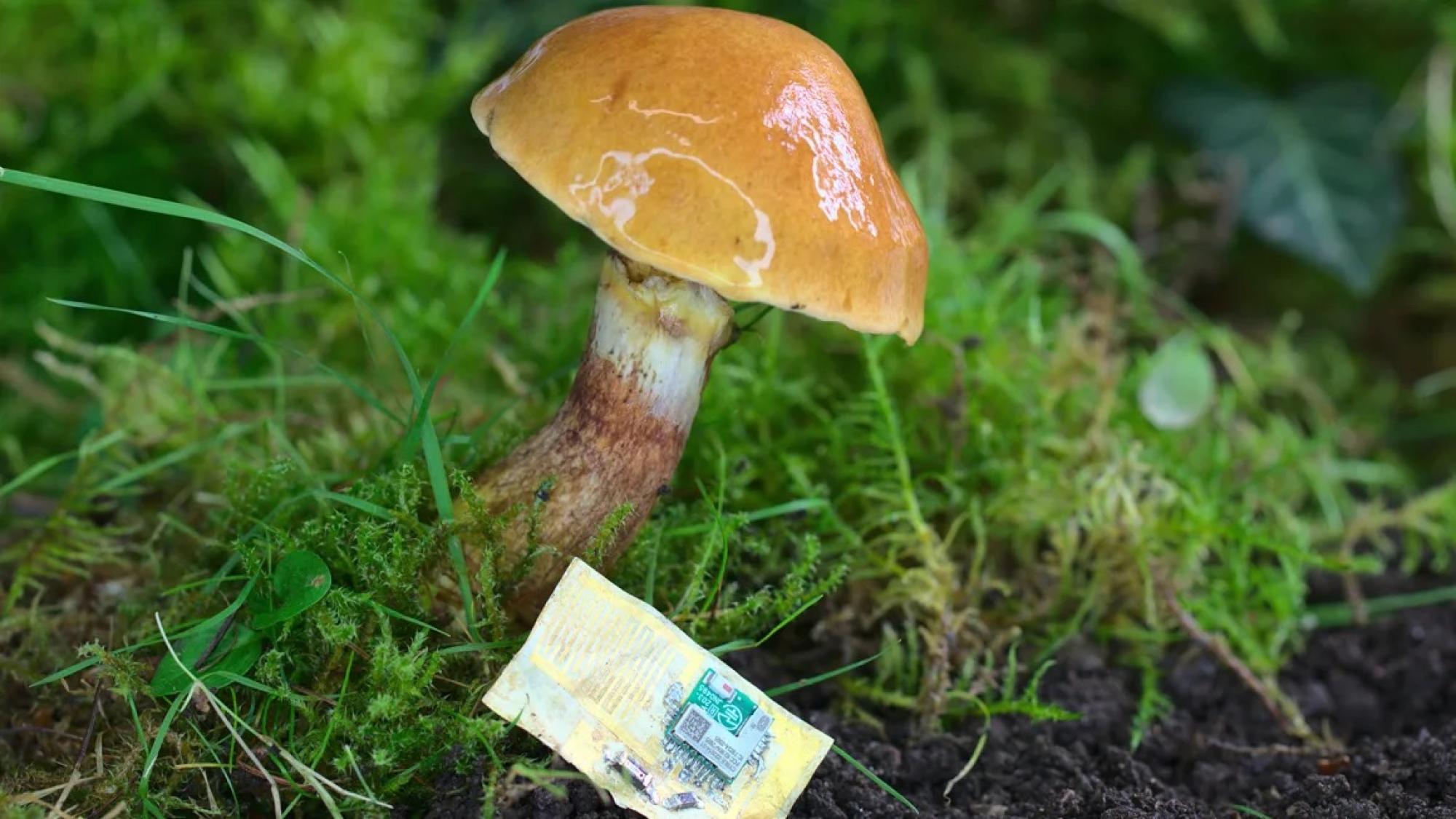
New research has shown that mushroom skins could provide a biodegradable alternative to some plastics used in batteries and computer chips, making them easier to recycle. Researchers from the Johannes Kepler University in Austria were working on flexible and stretchable electronics, with a focus on sustainable materials to replace non-degradable materials, when they made their discovery, published in the journal Science Advances. "There was a fair share of serendipity involved," Martin Kaltenbrunner ... co-author of the paper, told CNN. At the time, a member of the team had been looking at using fungus-derived materials for use in other areas. This work led to the latest study, which shows how Ganoderma lucidum mushroom skin could work as a substitute for the substrate used in electrical circuits. A substrate is the base of a circuit that insulates and cools the conductive metals sitting on top of it. Typically, they are made of non-degradable plastics, which are discarded after use. The mushroom ... forms a compact protective skin made of mycelium, a root-like network, to protect its growth medium (the wood). The skin has many properties that set it apart from other biodegradable materials, Kaltenbrunner said, "but most importantly, it can simply be grown from waste wood and does not need energy or cost intensive processing." "Our mycelium ... can last a long time if kept dry, but in just a standard household compost, it would degrade entirely within two weeks or less," he added.
Latest
Latest News
Each news summary is created according to strict standards. Here's how we do it.
Each summary is created using a consistent editorial procedure. The target length is approximately 16 lines of 11-point Arial text in a 650-pixel-wide column. Up to 25% of a summary may be set in bold to emphasize the most important ideas. Summaries are composed of verbatim excerpts presented in the same sequence as they appear in the original news source, with very minor editorial additions. Where material has been omitted between excerpts, the omission is indicated with ellipses (...). Any words added by an editor for clarity or context appear in [brackets]. Our original news editor was Fred Burks. Tod Fletcher edited most summaries from 2007 through 2014, and Mark Bailey has served as news editor since 2014.