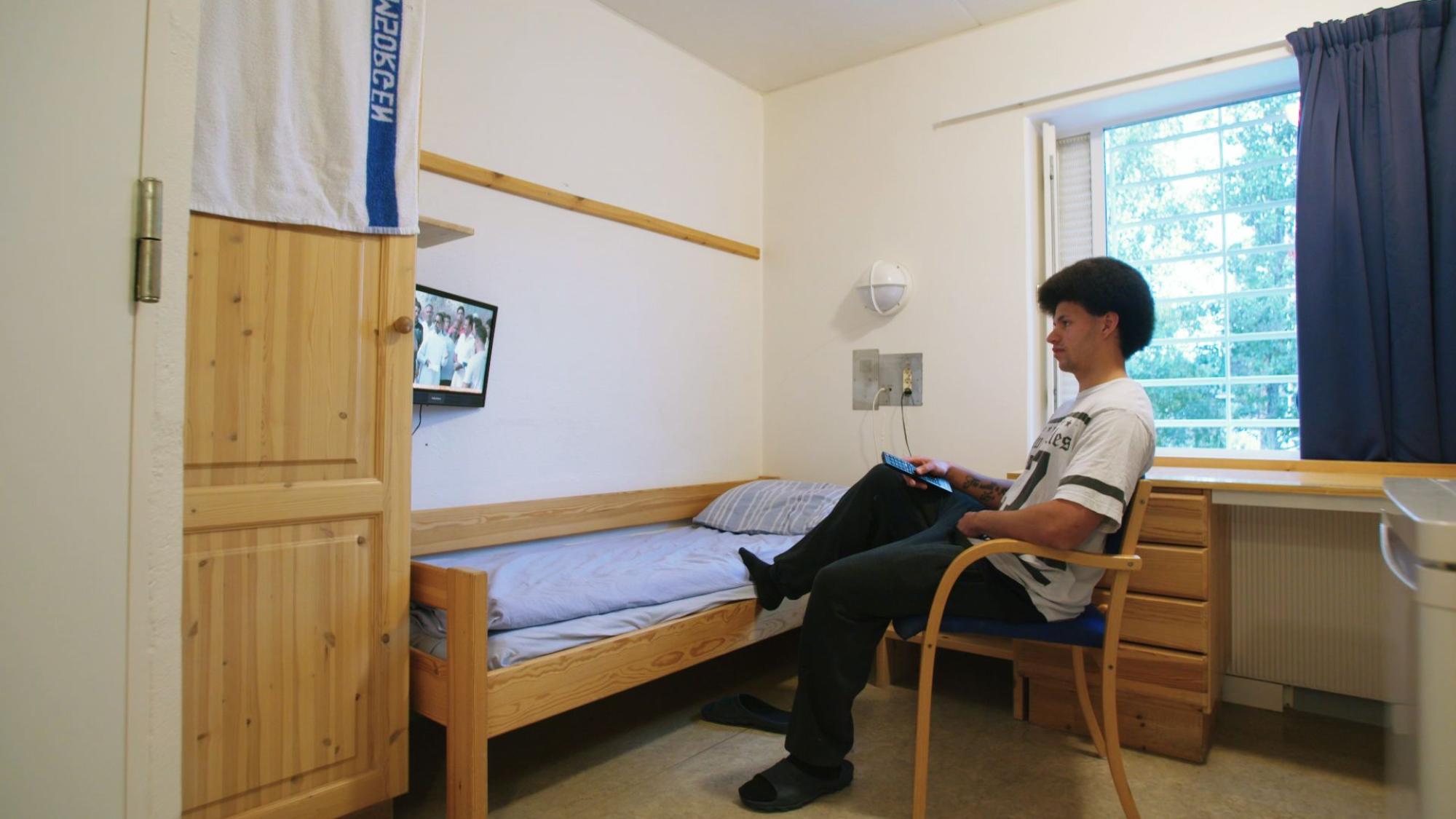
On Bastoy, an island 46 miles south of Oslo, [125] residents live in brightly colored wooden chalets, spread over one square mile of forest and gently sloping hills. They go horseback riding and throw barbecues, and have access to a movie theater, tanning bed and, during winter, two ski jumps. Despite all its trappings, Bastoy island isn't an exclusive resort: it's a prison. Bastoy's governor ... describes it as the world's first human-ecological prison a place where inmates learn to take responsibility for their actions by caring for the environment. Prisoners grow their own organic vegetables, turn their garbage into compost and tend to chickens, cows, horses and sheep. The prison generally emphasizes trust and self-regulation: Bastoy has no fences, the windows have no bars, and only five guards remain on the island after 3 p.m. In an age when countries from Britain to the U.S. cope with exploding prison populations by building ever larger and, many would say, ever harsher prisons, Bastoy seems like an unorthodox, even bizarre, departure. But Norwegians see the island as the embodiment of their country's long-standing penal philosophy: that traditional, repressive prisons do not work, and that treating prisoners humanely boosts their chances of reintegrating into society. Norway's system produces overwhelmingly positive results. Within two years of their release, 20% of Norway's prisoners end up back in jail. In the U.K. and the U.S., the figure hovers between 50% and 60%. Of course, Norway's ... prison roll lists a mere 3,300 inmates, a rate of 70 per 100,000 people, compared with 2.3 million in the U.S., or 753 per 100,000 the highest rate in the world.
Latest
Latest News
Each news summary is created according to strict standards. Here's how we do it.
Each summary is created using a consistent editorial procedure. The target length is approximately 16 lines of 11-point Arial text in a 650-pixel-wide column. Up to 25% of a summary may be set in bold to emphasize the most important ideas. Summaries are composed of verbatim excerpts presented in the same sequence as they appear in the original news source, with very minor editorial additions. Where material has been omitted between excerpts, the omission is indicated with ellipses (...). Any words added by an editor for clarity or context appear in [brackets]. Our original news editor was Fred Burks. Tod Fletcher edited most summaries from 2007 through 2014, and Mark Bailey has served as news editor since 2014.