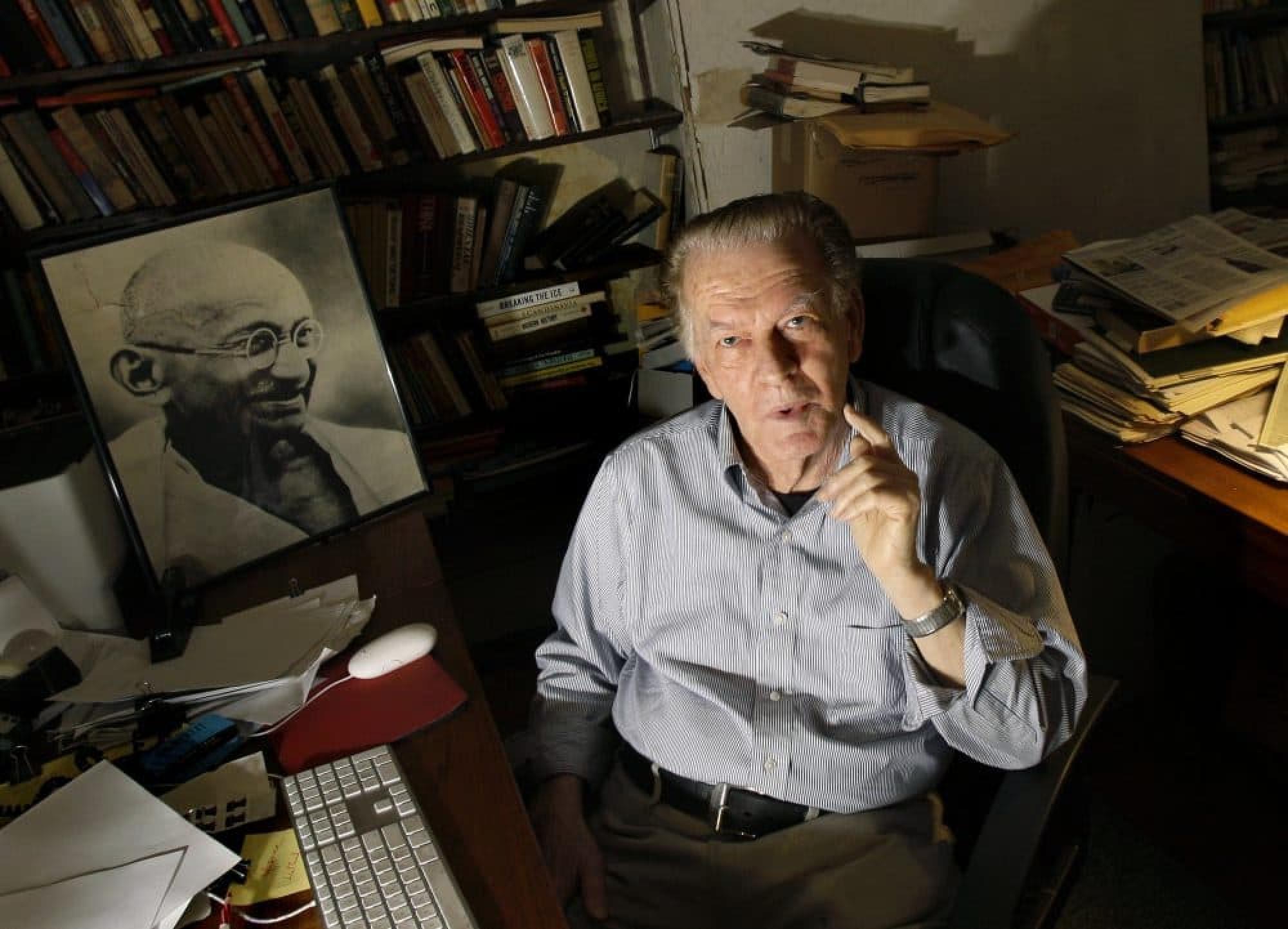
Stoop-shouldered and white-haired at 83, [Gene Sharp] grows orchids, has yet to master the Internet and hardly seems like a dangerous man. But for the world's despots, his ideas can be fatal. For decades, his practical writings on nonviolent revolution most notably "From Dictatorship to Democracy," a 93-page guide to toppling autocrats, available for download in 24 languages " have inspired dissidents around the world, including in Burma, Bosnia, Estonia and Zimbabwe, and now Tunisia and Egypt. When Egypt's April 6 Youth Movement was struggling ... its leaders tossed around "crazy ideas" about bringing down the government. They stumbled on Mr. Sharp. When the nonpartisan International Center on Nonviolent Conflict, which trains democracy activists, slipped into Cairo several years ago ... among the papers it distributed was Mr. Sharp's "198 Methods of Nonviolent Action," a list of tactics that range from hunger strikes to "protest disrobing." Dalia Ziada, an Egyptian blogger and activist who attended the workshop ... said trainees were active in both the Tunisia and Egypt revolts. She said that some activists translated excerpts of Mr. Sharp's work into Arabic, and that his message of "attacking weaknesses of dictators" stuck with them. He has concluded that advancing freedom takes careful strategy and meticulous planning, advice that ... resonated among youth leaders in Egypt. Peaceful protest is best, he says " not for any moral reason, but because violence provokes autocrats to crack down. "If you fight with violence," Mr. Sharp said, "you are fighting with your enemy's best weapon, and you may be a brave but dead hero." He was struck by the Egyptian protesters' discipline in remaining peaceful, and especially by their lack of fear. "If people are not afraid of the dictatorship, that dictatorship is in big trouble."
Latest
Latest News
Each news summary is created according to strict standards. Here's how we do it.
Each summary is created using a consistent editorial procedure. The target length is approximately 16 lines of 11-point Arial text in a 650-pixel-wide column. Up to 25% of a summary may be set in bold to emphasize the most important ideas. Summaries are composed of verbatim excerpts presented in the same sequence as they appear in the original news source, with very minor editorial additions. Where material has been omitted between excerpts, the omission is indicated with ellipses (...). Any words added by an editor for clarity or context appear in [brackets]. Our original news editor was Fred Burks. Tod Fletcher edited most summaries from 2007 through 2014, and Mark Bailey has served as news editor since 2014.