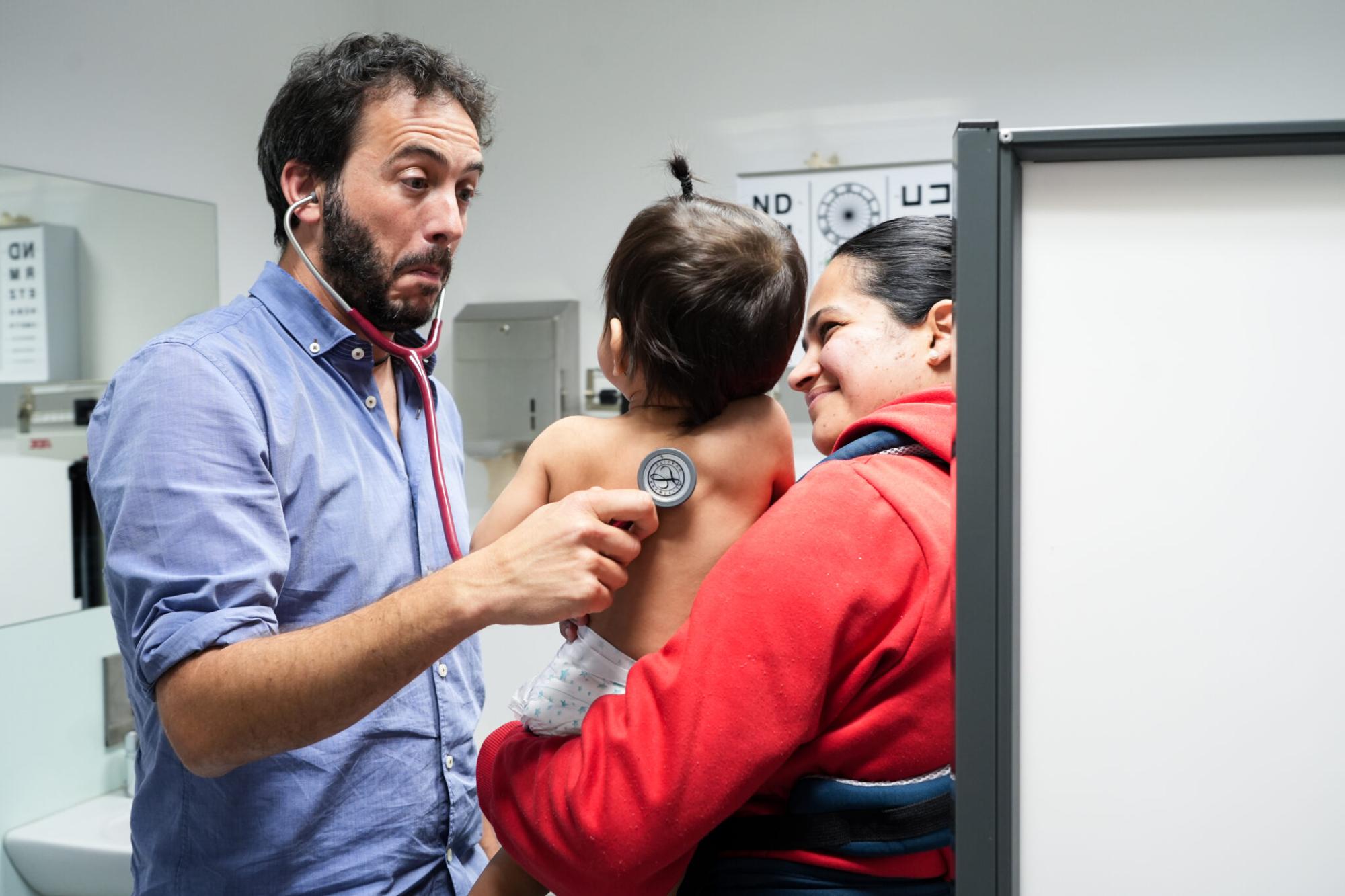
Portugal has a life expectancy nearly four years longer than the U.S. despite spending 20% of what the U.S. does on health care per person. According to the 2021 Global Security Index, which measures the ability to respond to pandemics, Portugal ranked third out of 195 countries in providing access to affordable health care. The United States ranked 183rd. Portugal has a national health care system, entitling every resident to free or very low-cost health care. It embraces innovative programs such as "social prescribing" that expand the boundaries of what is considered health care, while progressive laws on drug use and treatment have been credited with driving down overdose deaths, even as they rose in the U.S. Central to its success is a network of primary health care clinics embedded in neighborhoods, working alongside regional public health units. Their care teams become part of the community. They include doctors, nurses, social workers, and often most critically, front desk staff who calmly work to help coordinate appointments and keep streams of patients flowing. On a recent day at the Baixa Family Health Unit, in Lisbon's lively historic center, patients of all ages from a panoply of nations flowed through, receiving what truly is family care. "We follow the whole family, from pregnancy until they're dead," said Martino Gliozzi, the physician who coordinates the center. His oldest patient is 104. The clinic embraces what Gliozzi calls "out of the box" ideas, like Walk with a Doc: Early in the evening, physicians stroll city streets with patients to encourage exercise. Under the leadership of another young doctor, Cristiano Figueiredo, the clinic was the first in the country to embrace "social prescribing" " using patient visits to ask about social issues affecting their health and start to address them by linking patients with the community resources they need. In the 1990s, Portugal had one of the highest rates of heroin use and fatal overdoses anywhere. In 2001, the country not only decriminalized the use and possession of drugs, but also, in partnership with several non-governmental organizations such as Crescer, created a network of mostly free inpatient and outpatient treatment centers and mobile street teams that seek out drug users to provide medical care, clean needles, and support to enter addiction programs. Two decades later, drug overdose deaths have fallen sharply, from one per day to about 70 to 80 per year. New Jersey, with a smaller population than Portugal, sees 3,000 a year. HIV infection rates have dropped dramatically, too.
Latest
Latest News
Each news summary is created according to strict standards. Here's how we do it.
Each summary is created using a consistent editorial procedure. The target length is approximately 16 lines of 11-point Arial text in a 650-pixel-wide column. Up to 25% of a summary may be set in bold to emphasize the most important ideas. Summaries are composed of verbatim excerpts presented in the same sequence as they appear in the original news source, with very minor editorial additions. Where material has been omitted between excerpts, the omission is indicated with ellipses (...). Any words added by an editor for clarity or context appear in [brackets]. Our original news editor was Fred Burks. Tod Fletcher edited most summaries from 2007 through 2014, and Mark Bailey has served as news editor since 2014.