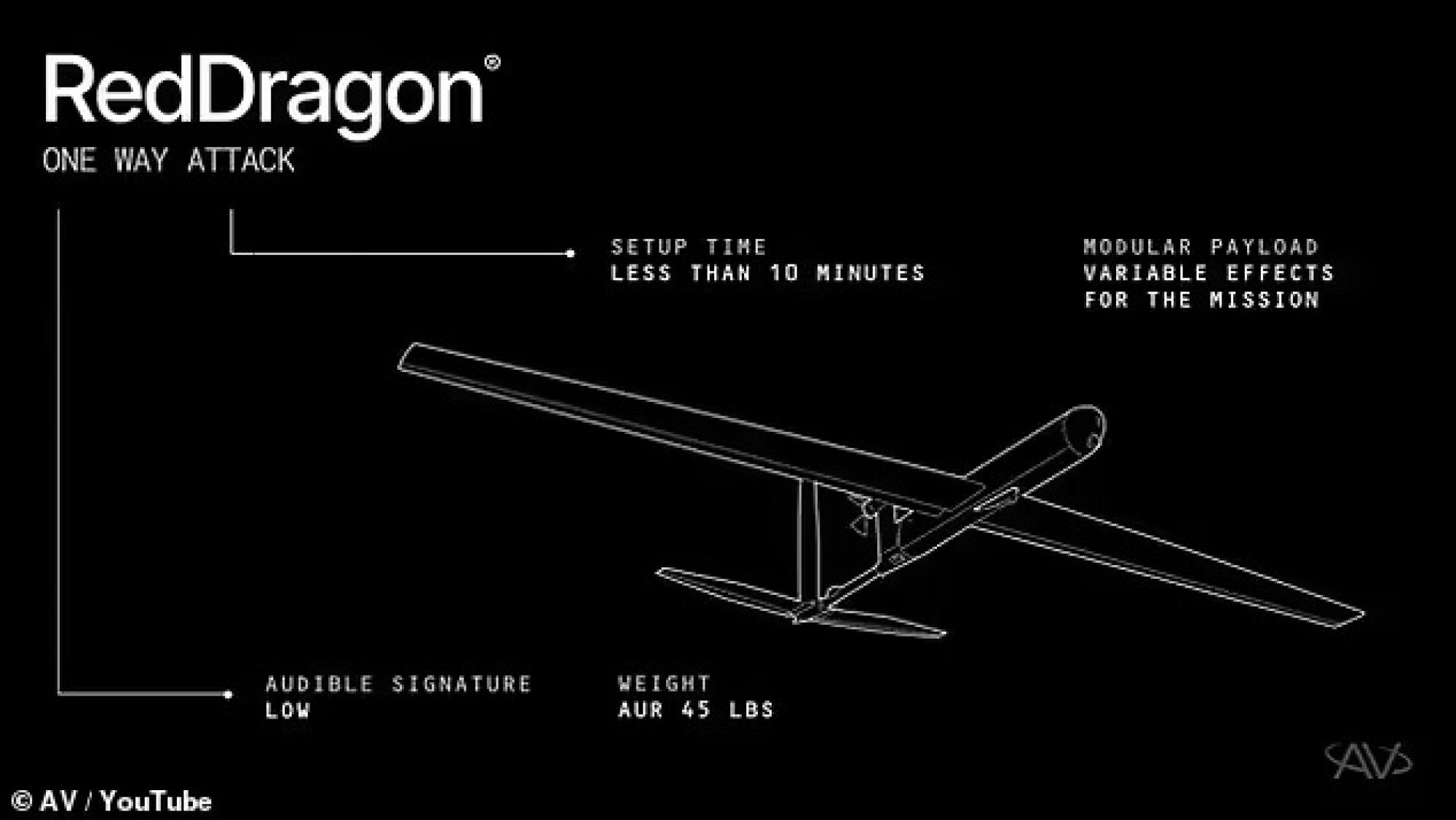
The US military may soon have an army of faceless suicide bombers at their disposal, as an American defense contractor has revealed their newest war-fighting drone. AeroVironment unveiled the Red Dragon in a video on their YouTube page, the first in a new line of 'one-way attack drones.' This new suicide drone can reach speeds up to 100 mph and can travel nearly 250 miles. The new drone takes just 10 minutes to set up and launch and weighs just 45 pounds. Once the small tripod the Red Dragon takes off from is set up, AeroVironment said soldiers would be able to launch up to five per minute. Since the suicide robot can choose its own target in the air, the US military may soon be taking life-and-death decisions out of the hands of humans. Once airborne, its AVACORE software architecture functions as the drone's brain, managing all its systems and enabling quick customization. Red Dragon's SPOTR-Edge perception system acts like smart eyes, using AI to find and identify targets independently. Simply put, the US military will soon have swarms of bombs with brains that don't land until they've chosen a target and crash into it. Despite Red Dragon's ability to choose a target with 'limited operator involvement,' the Department of Defense (DoD) has said it's against the military's policy to allow such a thing to happen. The DoD updated its own directives to mandate that 'autonomous and semi-autonomous weapon systems' always have the built-in ability to allow humans to control the device.
Latest
Latest News
Each news summary is created according to strict standards. Here's how we do it.
Each summary is created using a consistent editorial procedure. The target length is approximately 16 lines of 11-point Arial text in a 650-pixel-wide column. Up to 25% of a summary may be set in bold to emphasize the most important ideas. Summaries are composed of verbatim excerpts presented in the same sequence as they appear in the original news source, with very minor editorial additions. Where material has been omitted between excerpts, the omission is indicated with ellipses (...). Any words added by an editor for clarity or context appear in [brackets]. Our original news editor was Fred Burks. Tod Fletcher edited most summaries from 2007 through 2014, and Mark Bailey has served as news editor since 2014.