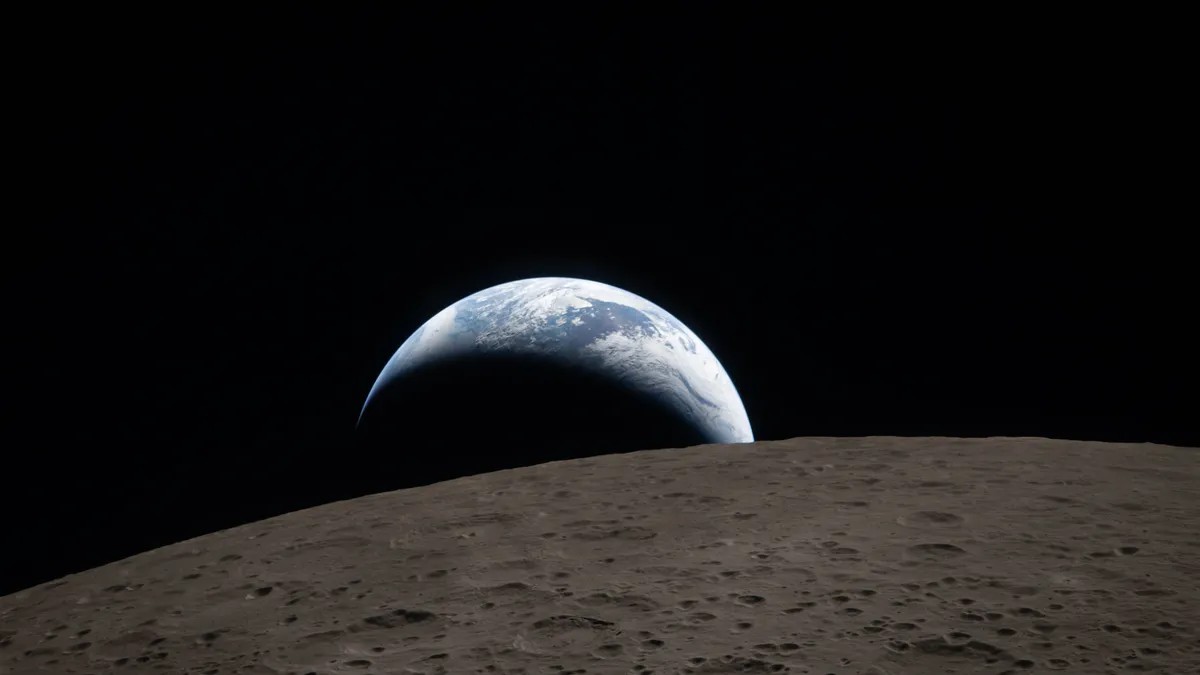
The U.S. military must be ready to engage the enemy farther from home than ever before, according to its highest-ranking officer. "Today's modern battlefield operates from the seabed to cislunar space," Gen. Dan Caine, the chairman of the Joint Chiefs of Staff, said Wednesday (Sept. 16) during a keynote address at the Air & Space Forces Association's Air, Space & Cyber Conference. Cislunar space extends from Earth all the way out to the orbit of the moon and includes the lunar surface. For several years now, military officials have been stressing the strategic importance of this huge region, which could get quite a bit busier in the next decade or so. For example, both the United States and China plan to build bases near the moon's south pole, which is thought to harbor large amounts of water ice. Winning this new moon race is critical, U.S. officials have stressed, because whoever does so will be able to establish norms of behavior on and around Earth's nearest neighbor. part of the Space Force's strategy for maintaining that crucial superiority is the operation of weapons in Earth orbit. The branch's chief, Gen. Douglas Schiess, admitted as much ... at the same conference. "Let me be crystal clear: Today, guardians operate on-orbit weapons that can defend the joint force against space-enabled attacks,” Schiess said. Schiess provided few details about these weapons but ... implied that they are electromagnetic rather than kinetic in nature.
Latest
Latest News
Each news summary is created according to strict standards. Here's how we do it.
Each summary is created using a consistent editorial procedure. The target length is approximately 16 lines of 11-point Arial text in a 650-pixel-wide column. Up to 25% of a summary may be set in bold to emphasize the most important ideas. Summaries are composed of verbatim excerpts presented in the same sequence as they appear in the original news source, with very minor editorial additions. Where material has been omitted between excerpts, the omission is indicated with ellipses (...). Any words added by an editor for clarity or context appear in [brackets]. Our original news editor was Fred Burks. Tod Fletcher edited most summaries from 2007 through 2014, and Mark Bailey has served as news editor since 2014.