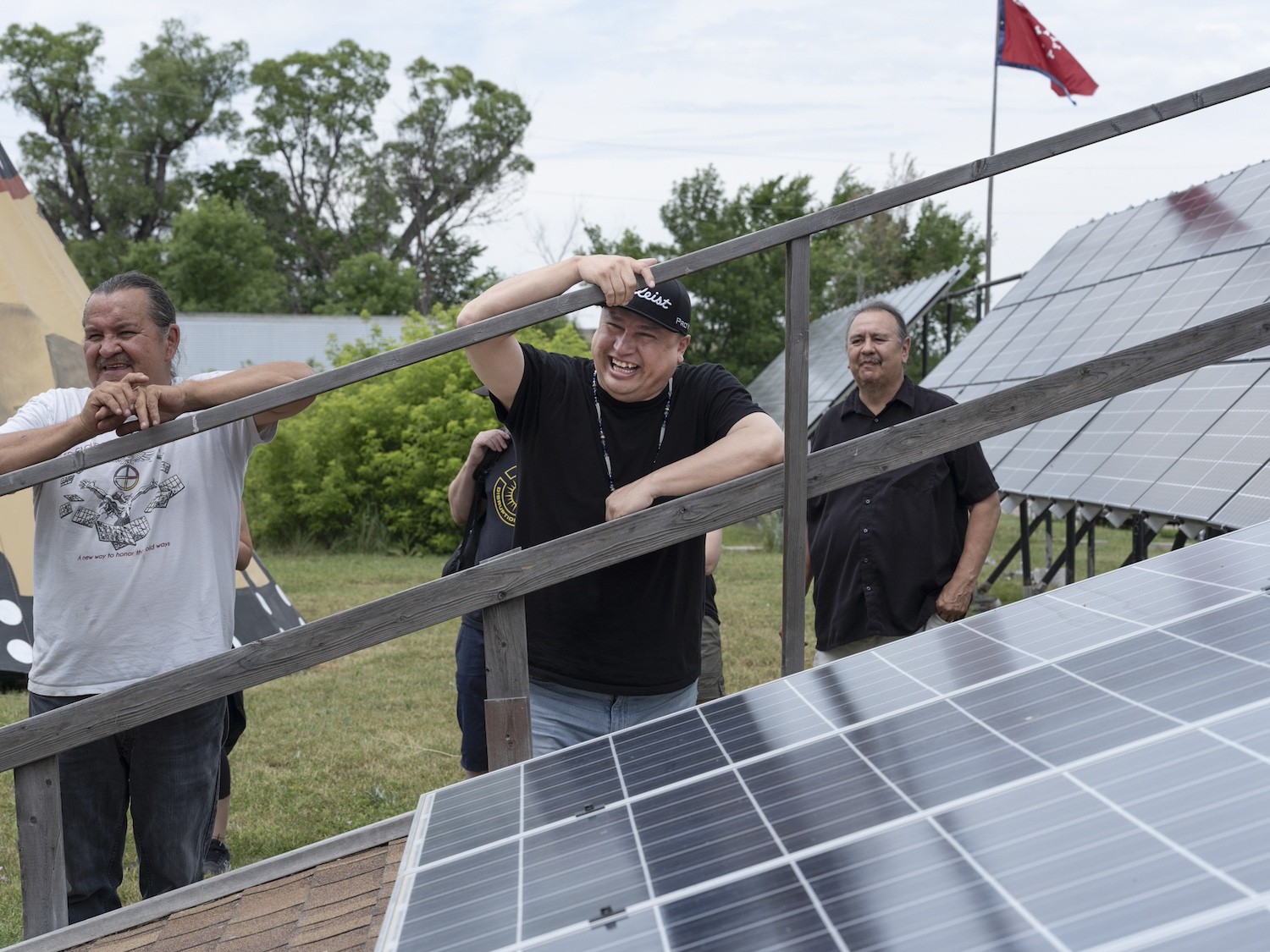
Cody Two Bears knows a thing or two about coalitions. “I wanted to change to a new way for Native communities that would really allow us to stop playing defense so much, but allow us to play offense,” said Two Bears. “We’ve always protested, protested, protested and been against something. But now with this new initiative, Indigenized Energy, it gives us the opportunity to fight for something for native tribes.” Two Bears, who is an enrolled member of the Standing Rock Sioux Tribe, was the youngest leader to ever be elected to its tribal council in 2013. “Like food sovereignty, traditional medicines, culture and language, energy to Indigenous and native people in this country now is one of those main pillars that we need to focus on moving forward,” he said. That’s why he launched Indigenized Energy, which aims to develop energy sovereignty on tribal lands via renewable energy. In 2019, the nonprofit debuted a 300-kilowatt solar farm in Two Bears’ hometown of Cannon Ball, North Dakota, just three miles from the Dakota Access Pipeline. To this day, it’s the largest solar farm in the state, he said. “I told myself, if we can see solar there, we can do it anywhere,” he said. When it comes to fossil fuel development, North Dakota is second only to Texas. Renewable energy faces strong opposition in the state. But Two Bears insists “energy in itself should never be political.” Two Bears sees energy independence as a way to save lives today and safeguard his community.
Latest
Latest News
Each news summary is created according to strict standards. Here's how we do it.
Each summary is created using a consistent editorial procedure. The target length is approximately 16 lines of 11-point Arial text in a 650-pixel-wide column. Up to 25% of a summary may be set in bold to emphasize the most important ideas. Summaries are composed of verbatim excerpts presented in the same sequence as they appear in the original news source, with very minor editorial additions. Where material has been omitted between excerpts, the omission is indicated with ellipses (...). Any words added by an editor for clarity or context appear in [brackets]. Our original news editor was Fred Burks. Tod Fletcher edited most summaries from 2007 through 2014, and Mark Bailey has served as news editor since 2014.