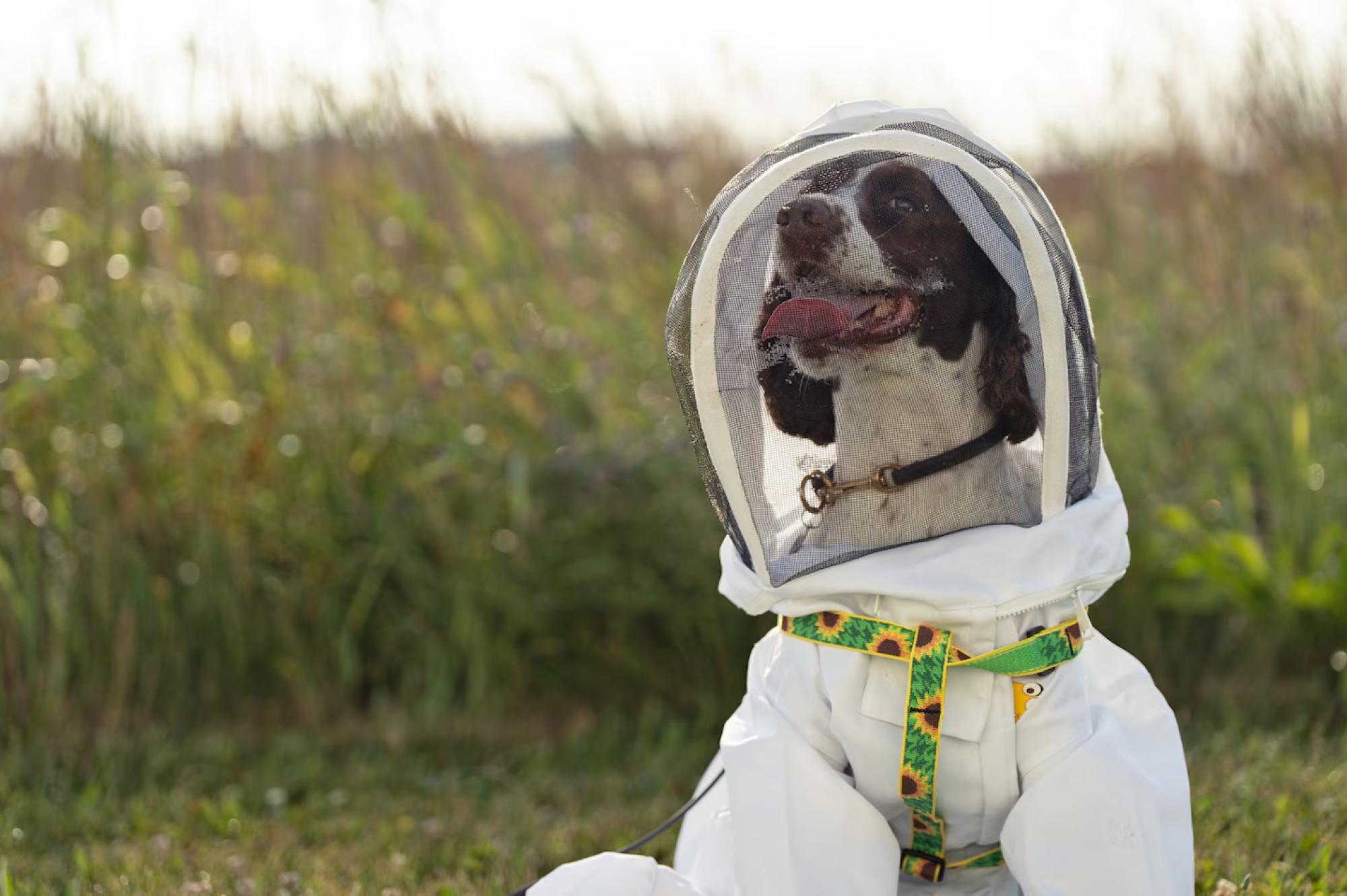
Equipped with her own tailored bee suit and a hood to cover her floppy ears, Maple a former police dog " has an important retirement task: helping save thousands of honeybee hives. The canine has spent the past five months sniffing Michigan bee colonies for American foulbrood, a highly contagious bacteria that's fatal to the insects. Maple, an English springer spaniel, uses her extraordinary sense of smell as a "high-speed screening tool" to prevent beekeepers from having to manually inspect every hive. American foulbrood only becomes detectable to humans by smell when it reaches severe infection, at which point the colony risks death, said Meghan Milbrath, a researcher and assistant professor of entomology at Michigan State University. The ultimate goal is for Maple's work to serve as a blueprint for teaching canines to detect honeybee diseases. It's part of a larger bee conservation effort in a record-breaking year for colony death in the United States ... primarily driven by pesticides, pathogens, poor nutrition and pests. Although Maple's new "target odor" is distinct from her previous job ... the fundamentals remain the same. Handlers expose the canines to a scent, offer a reward and teach the dog to conduct an action that means they've found the odor they're looking for. In Maple's case, she sits when she detects the smell. [Handler, Sue] Stejskal said she has to train Maple to be familiar and comfortable with the new environment so the pup can focus on the target odor.
Latest
Latest News
Each news summary is created according to strict standards. Here's how we do it.
Each summary is created using a consistent editorial procedure. The target length is approximately 16 lines of 11-point Arial text in a 650-pixel-wide column. Up to 25% of a summary may be set in bold to emphasize the most important ideas. Summaries are composed of verbatim excerpts presented in the same sequence as they appear in the original news source, with very minor editorial additions. Where material has been omitted between excerpts, the omission is indicated with ellipses (...). Any words added by an editor for clarity or context appear in [brackets]. Our original news editor was Fred Burks. Tod Fletcher edited most summaries from 2007 through 2014, and Mark Bailey has served as news editor since 2014.