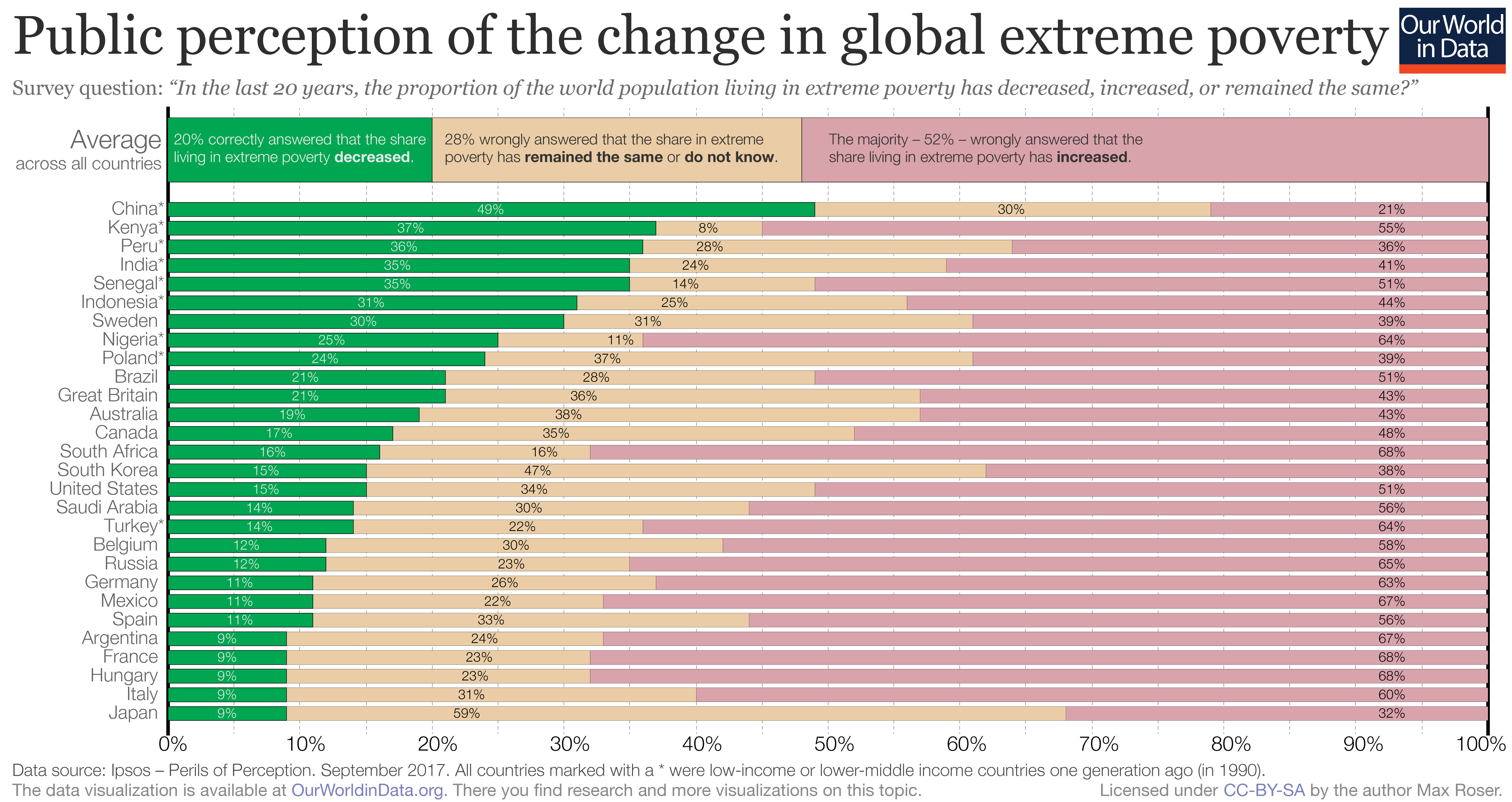
If you're depressed by the state of the world, let me toss out an idea: In the long arc of human history, 2019 has been the best year ever. The bad things that you fret about are true. But it's also true that since modern humans emerged about 200,000 years ago, 2019 was probably the year in which children were least likely to die, adults were least likely to be illiterate and people were least likely to suffer excruciating and disfiguring diseases. Perhaps the greatest calamity for anyone is to lose a child. That used to be common: Historically, almost half of all humans died in childhood. As recently as 1950, 27 percent of all children still died by age 15. Now that figure has dropped to about 4 percent. The news media and the humanitarian world focus so relentlessly on the bad news that we leave the public believing that every trend is going in the wrong direction. A majority of Americans say in polls that the share of the world population living in poverty is increasing - yet one of the trends of the last 50 years has been a huge reduction in global poverty. The proportion of the world's population subsisting on about $2 a day or less has dropped by more than 75 percent in less than four decades. Every day for a decade, newspapers could have carried the headline "Another 170,000 Moved Out of Extreme Poverty Yesterday." Or if one uses a higher threshold, the headline could have been: "The Number of People Living on More Than $10 a Day Increased by 245,000 Yesterday."
Latest
Latest News
Each news summary is created according to strict standards. Here's how we do it.
Each summary is created using a consistent editorial procedure. The target length is approximately 16 lines of 11-point Arial text in a 650-pixel-wide column. Up to 25% of a summary may be set in bold to emphasize the most important ideas. Summaries are composed of verbatim excerpts presented in the same sequence as they appear in the original news source, with very minor editorial additions. Where material has been omitted between excerpts, the omission is indicated with ellipses (...). Any words added by an editor for clarity or context appear in [brackets]. Our original news editor was Fred Burks. Tod Fletcher edited most summaries from 2007 through 2014, and Mark Bailey has served as news editor since 2014.