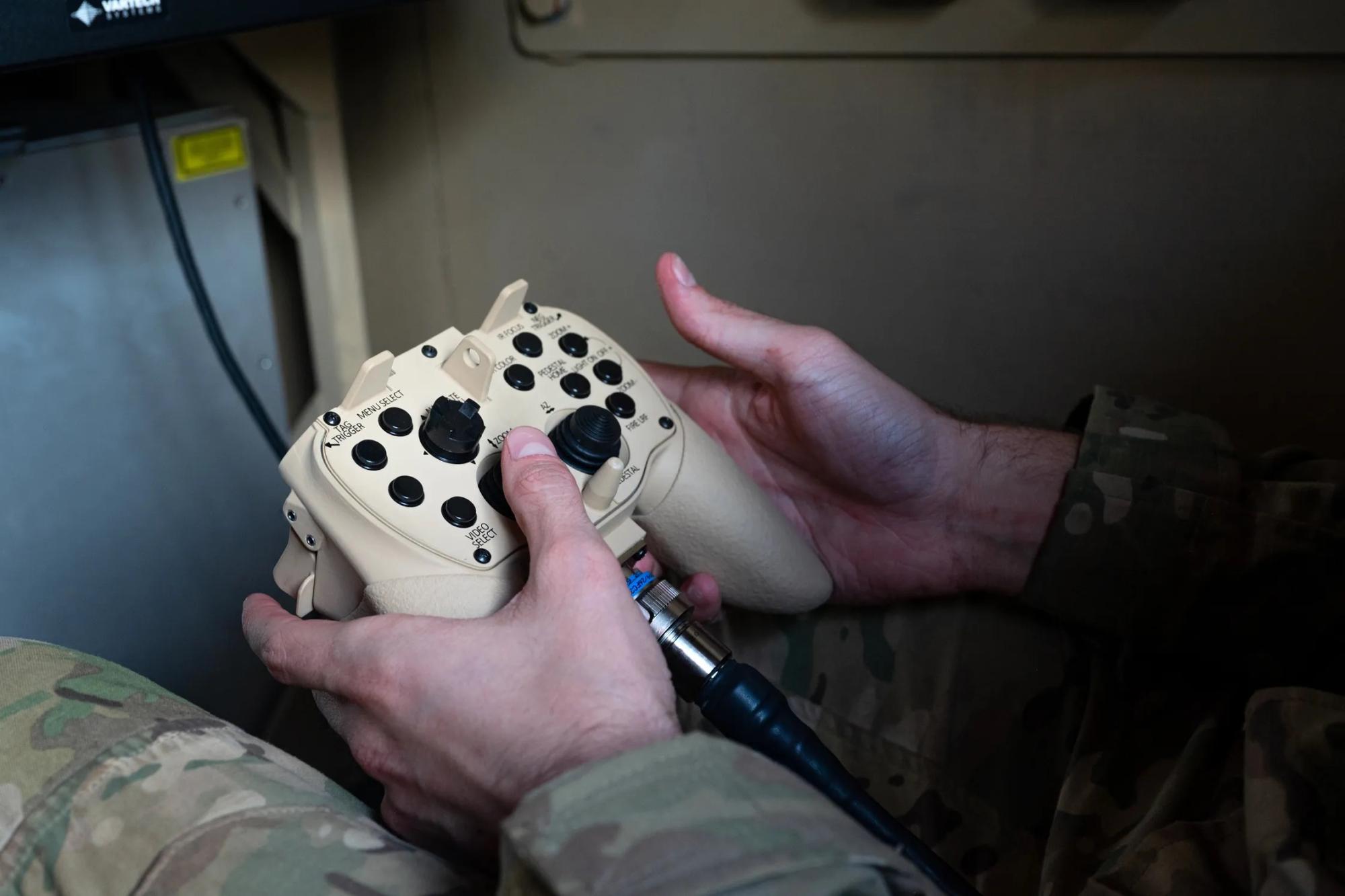
Over the past several years, the US Defense Department has been gradually integrating what appear to be variants of the Freedom of Movement Control Unit (FMCU) handsets as the primary control units for a variety of advanced weapons systems. Produced since 2008 by Measurement Systems Inc. (MSI), a subsidiary of British defense contractor Ultra that specializes in human-machine interfaces, the FMCU offers a similar form factor to the standard Xbox or PlayStation controller but with a ruggedized design intended to safeguard its sensitive electronics against whatever hostile environs American service members may find themselves in. A longtime developer of joysticks used on various US naval systems and aircraft, MSI has served as a subcontractor to major defense "primes" like General Atomics, Boeing, Lockheed Martin, and BAE Systems to provide the handheld control units for "various aircraft and vehicle programs," according to information compiled by federal contracting software GovTribe. At the moment, it's unclear how exactly many US military systems use the FMCU. When reached for comment, the Pentagon confirmed the use of the system on the NMESIS, M-SHORAD, and RADBO weapons platforms and referred WIRED to the individual service branches for additional details. The Marine Corps confirmed the handset's use with the GBOSS, while the Air Force again confirmed the same for the RADBO.
Latest
Latest News
Each news summary is created according to strict standards. Here's how we do it.
Each summary is created using a consistent editorial procedure. The target length is approximately 16 lines of 11-point Arial text in a 650-pixel-wide column. Up to 25% of a summary may be set in bold to emphasize the most important ideas. Summaries are composed of verbatim excerpts presented in the same sequence as they appear in the original news source, with very minor editorial additions. Where material has been omitted between excerpts, the omission is indicated with ellipses (...). Any words added by an editor for clarity or context appear in [brackets]. Our original news editor was Fred Burks. Tod Fletcher edited most summaries from 2007 through 2014, and Mark Bailey has served as news editor since 2014.