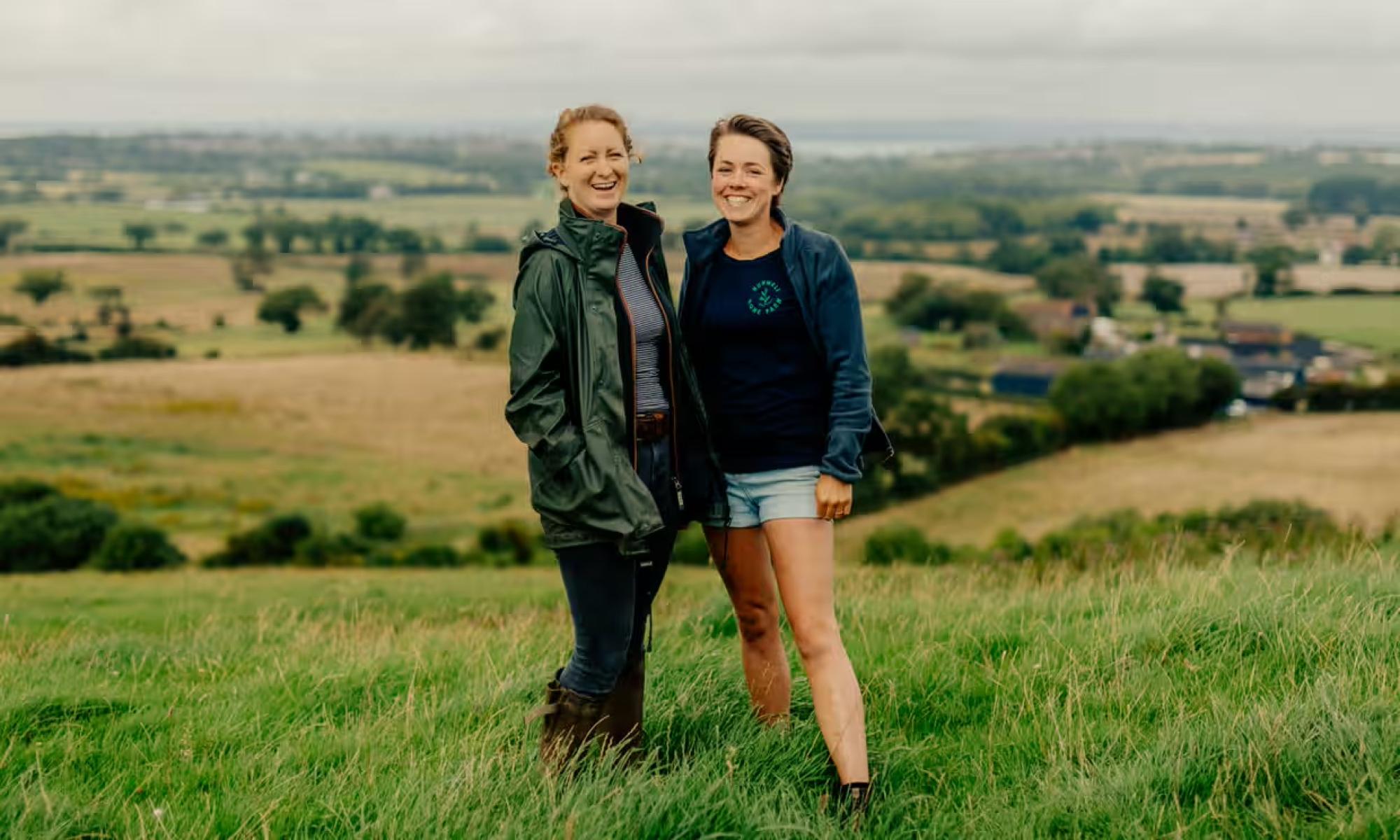
Hollie Fallick looks over Brading on the Isle of Wight, at a patchwork of fields bordered by ancient oaks. She farms with her best friend, Francesca Cooper. The friends ... are part of a growing global movement practising regenerative agriculture or regen ag for short. "Regenerative agriculture is nature-friendly farming," says Fallick. "It's thinking about the health of soil, animals, humans and how they all link together." On Nunwell home farm, which sits alongside land the pair manage for the Wildlife Trust and produces meat and eggs for their direct-to-consumer business, chickens peck away alongside belted Galloway cows, nomadic pigs graze on grass as well as kale and bean "cover crops" sown to boost nutrients in the soil. The idea is that by following the basic principles of regen ag " not disturbing the soil, keeping it covered, maintaining living roots, growing a diverse range of crops and the use of grazing animals " they can regenerate tired and depleted soil and produce nutritious food. The work, they argue, is urgent. Up to 40% of the world's land is now degraded by industrial and harmful farming methods, according to the UN. Barnes Edwards, co-director of the Garlic Farm ... argues that regen ag farmers recognise the "hideously negative impact" of badly managed livestock farming. But they also argue "it's the how, not the cow", and say that cows pooing and trampling in diversely planted fields boosts soil health, micronutrients and attracts insects, birds and butterflies.
Latest
Latest News
Each news summary is created according to strict standards. Here's how we do it.
Each summary is created using a consistent editorial procedure. The target length is approximately 16 lines of 11-point Arial text in a 650-pixel-wide column. Up to 25% of a summary may be set in bold to emphasize the most important ideas. Summaries are composed of verbatim excerpts presented in the same sequence as they appear in the original news source, with very minor editorial additions. Where material has been omitted between excerpts, the omission is indicated with ellipses (...). Any words added by an editor for clarity or context appear in [brackets]. Our original news editor was Fred Burks. Tod Fletcher edited most summaries from 2007 through 2014, and Mark Bailey has served as news editor since 2014.