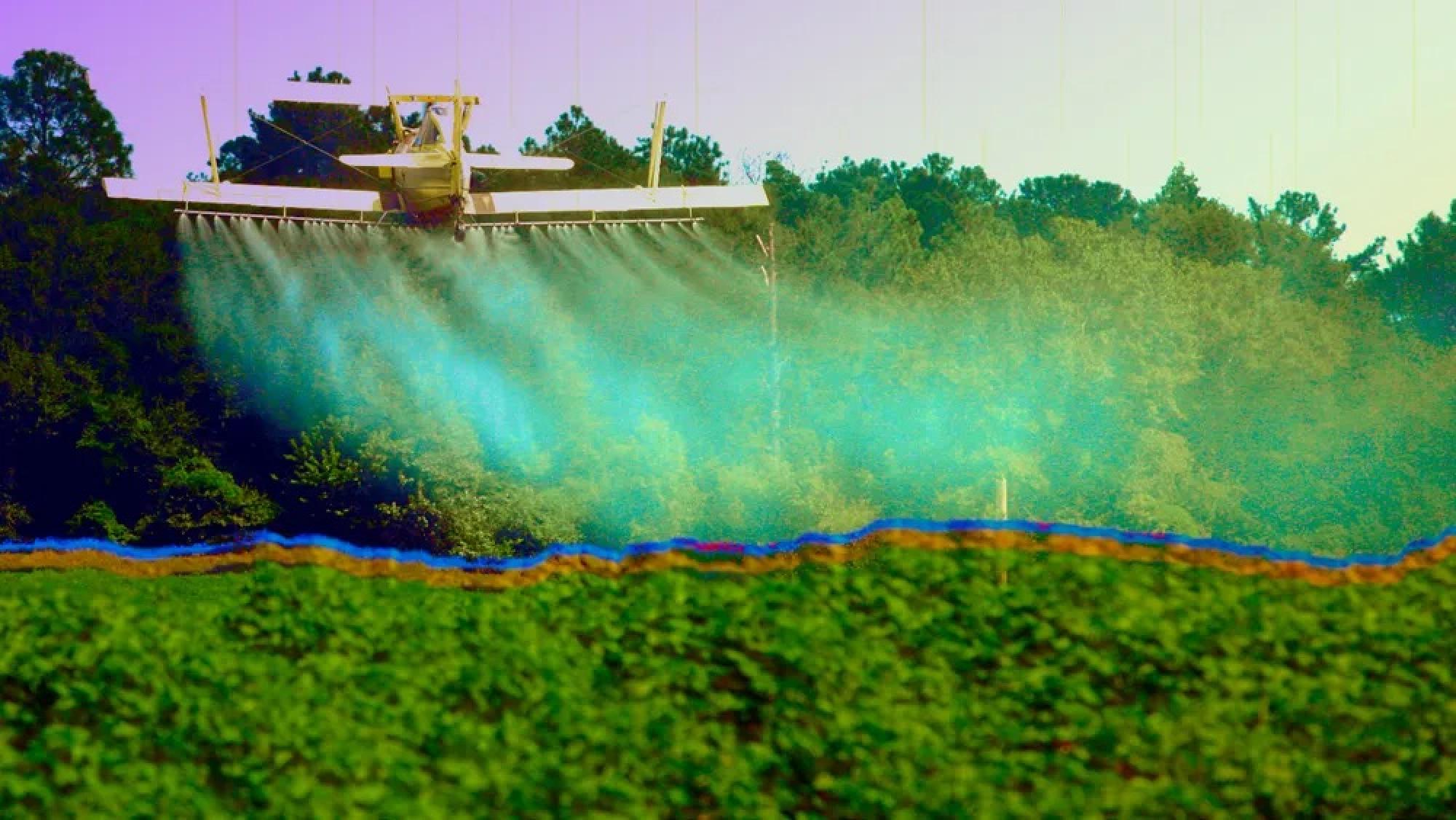
A new study found the amount of pesticides used on farms was strongly associated with the incidence of many cancers " not only for farmers and their families, but for entire communities. The just-released analysis showed that "agricultural pesticides can increase your risk for some cancers just as much as smoking," says co-author Isain Zapata. Living in places with high pesticide use increased the risk of colon and pancreatic cancers by more than 80 percent. Pesticides are currently an integral part of the country's industrialized agricultural system. About a million pounds of pesticides are used each year, across nearly every state in the country. These chemicals make their way through the food system: a pesticide linked to infertility, for example, is widely found in household staples like Cheerios. When a pesticide is first registered with federal regulators, the vast majority of the information available about it is science conducted by the company who made it. "The presumption in the U.S. is in favor of the safety of the chemical," Burd says. Elsewhere, like the European Union, "chemicals are not presumed safe, they adopt a much more precautionary approach." There's also a revolving door between the [Environmental Protection Agency] and the industry it regulates. Alexandra Dunn, the former assistant administrator for the Office of Chemical Safety and Pollution Prevention, for example, is now running CropLife America, the pesticide industry's leading lobbying group. She's only the latest; since 1974, all of the office's directors went on to work for pesticide companies.
Latest
Latest News
Each news summary is created according to strict standards. Here's how we do it.
Each summary is created using a consistent editorial procedure. The target length is approximately 16 lines of 11-point Arial text in a 650-pixel-wide column. Up to 25% of a summary may be set in bold to emphasize the most important ideas. Summaries are composed of verbatim excerpts presented in the same sequence as they appear in the original news source, with very minor editorial additions. Where material has been omitted between excerpts, the omission is indicated with ellipses (...). Any words added by an editor for clarity or context appear in [brackets]. Our original news editor was Fred Burks. Tod Fletcher edited most summaries from 2007 through 2014, and Mark Bailey has served as news editor since 2014.