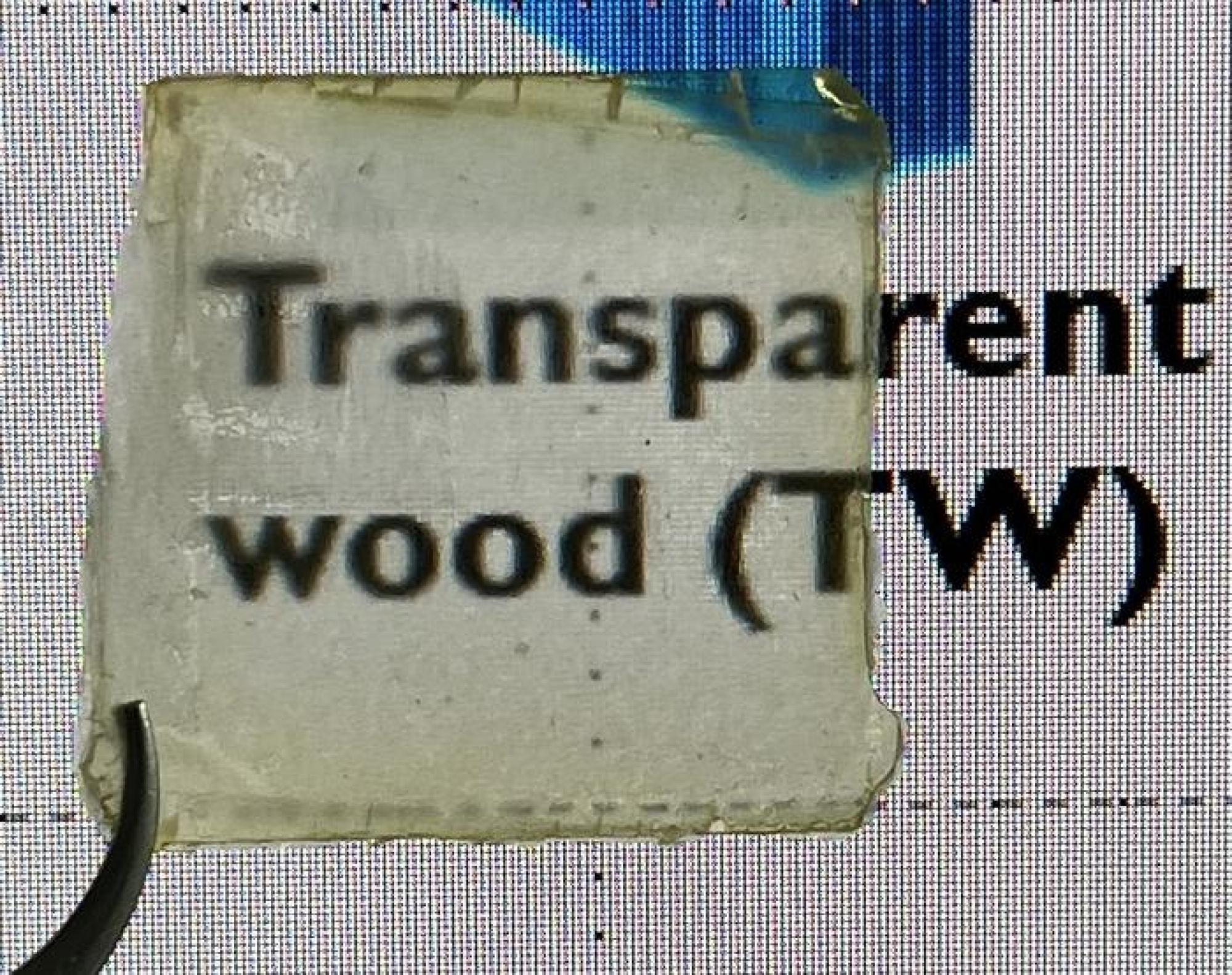
A team of researchers searching for safe, sustainable, and biodegradable alternatives to plastics presented a new type of transparent material at the American Chemical Society (ACS) spring meeting. Unlike previous transparent "wood" designs that sacrifice some biodegradability for strength by including certain types of plastics, the team said its eco-friendly see-through material is made with all natural components. Potential applications for the plastic alternative include electronic device screens, wearable sensors, coatings on solar cells, and transparent wood windows. Bharat Baruah, a professor of chemistry ... said his woodworking hobby led him to research efforts to create transparent wood. He quickly discovered that successfully created transparent wood materials were enhanced with epoxy, a type of plastic, to increase its strength, sacrificing some biodegradability. The professor decided he should see if there were better alternatives. After enlisting Ridham Raval, a Kenneshaw State undergraduate student, to help, the duo used a vacuum chamber, sodium sulfite, sodium hydroxide, and bleach to remove lignin and hemicellulose, two of wood's three components, from a sample of balsa wood. What remained was a paper-like layer of cellulose filled with tiny pores. Instead of refilling the pores with epoxy, the team soaked the cellulose layer in a mixture of egg whites and rice extract. They were "left with semi-transparent slices of wood that were durable and flexible."
Latest
Latest News
Each news summary is created according to strict standards. Here's how we do it.
Each summary is created using a consistent editorial procedure. The target length is approximately 16 lines of 11-point Arial text in a 650-pixel-wide column. Up to 25% of a summary may be set in bold to emphasize the most important ideas. Summaries are composed of verbatim excerpts presented in the same sequence as they appear in the original news source, with very minor editorial additions. Where material has been omitted between excerpts, the omission is indicated with ellipses (...). Any words added by an editor for clarity or context appear in [brackets]. Our original news editor was Fred Burks. Tod Fletcher edited most summaries from 2007 through 2014, and Mark Bailey has served as news editor since 2014.