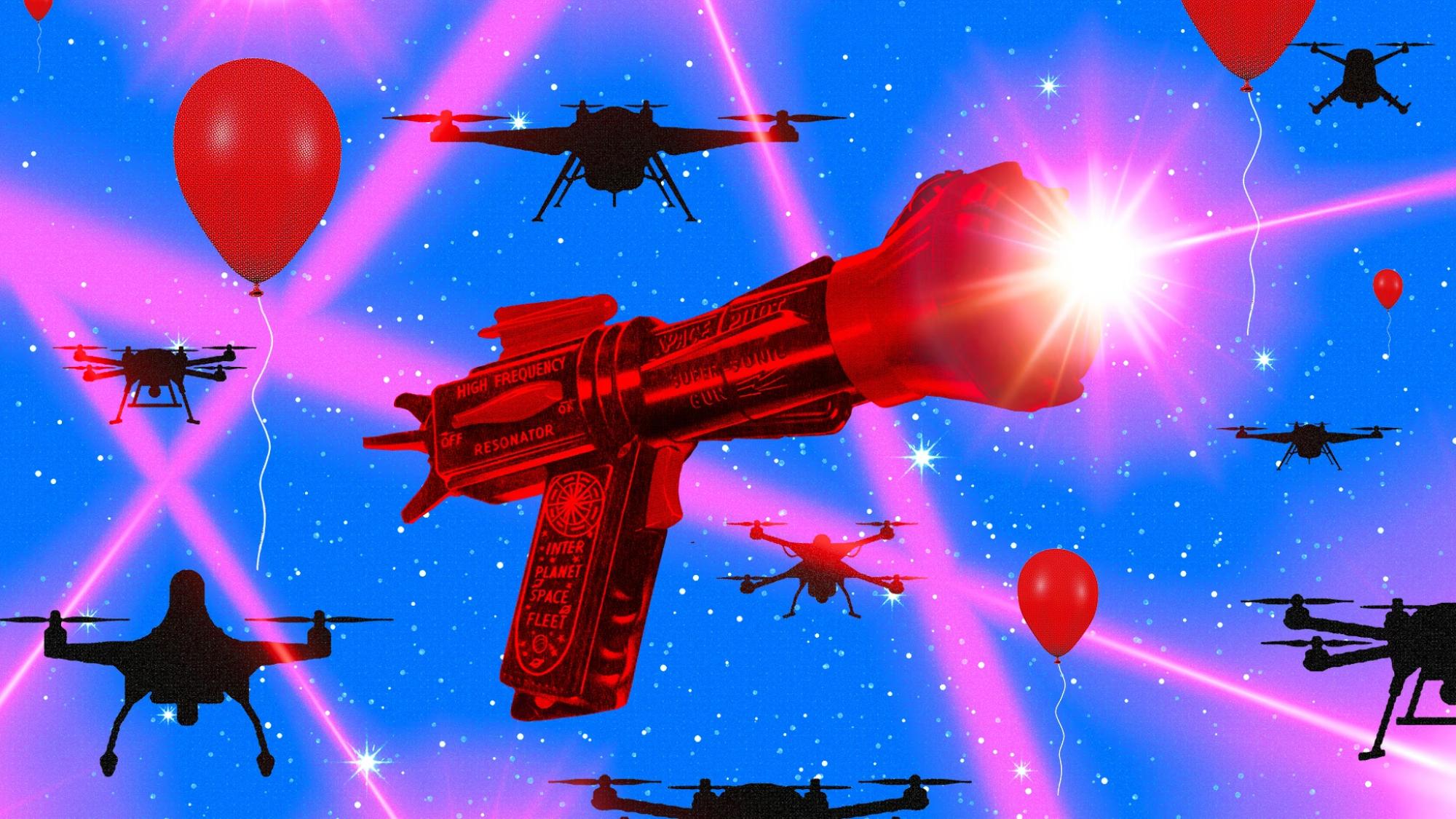
Laser guns are real now. Actual militaries are deploying actual lasers in actual combat. "This is a technology that has been under development for decades," [said] Iain Boyd, an aerospace engineer. "And it's only really now just really starting to enter the public view." The Army has outfitted trucks with anti-drone lasers, and the Air Force has added ground-based lasers to its arsenal. Russia, China, and the United Kingdom are all developingand in some cases already deploying"laser weapons, and last year, Israel became the first country to use a laser in combat to destroy a drone. The very real lasers now being deployed on battlefields around the world have some notable differences from most of their science-fictional forebears. They're silent, for one thing"no pew pew sound effects"and the beam they produce is invisible. Real lasers have a number of other advantages. $13 a shot is pretty good compared with the Navy's standard missile interceptors, which cost $2 million apiece. Another advantage of lasers is that they just keep going. Last year, Chinese scientists successfully beamed a precision non-weapon laser all the way to the moon. But infinite range is also a drawback. If a laser missed a drone, Boyd said, the beam could continue for hundreds of miles and hit, say, a commercial airliner. Even if a laser beam did hit its target, Boyd said, its light could still scatter and cause all manner of collateral damage.
Latest
Latest News
Each news summary is created according to strict standards. Here's how we do it.
Each summary is created using a consistent editorial procedure. The target length is approximately 16 lines of 11-point Arial text in a 650-pixel-wide column. Up to 25% of a summary may be set in bold to emphasize the most important ideas. Summaries are composed of verbatim excerpts presented in the same sequence as they appear in the original news source, with very minor editorial additions. Where material has been omitted between excerpts, the omission is indicated with ellipses (...). Any words added by an editor for clarity or context appear in [brackets]. Our original news editor was Fred Burks. Tod Fletcher edited most summaries from 2007 through 2014, and Mark Bailey has served as news editor since 2014.