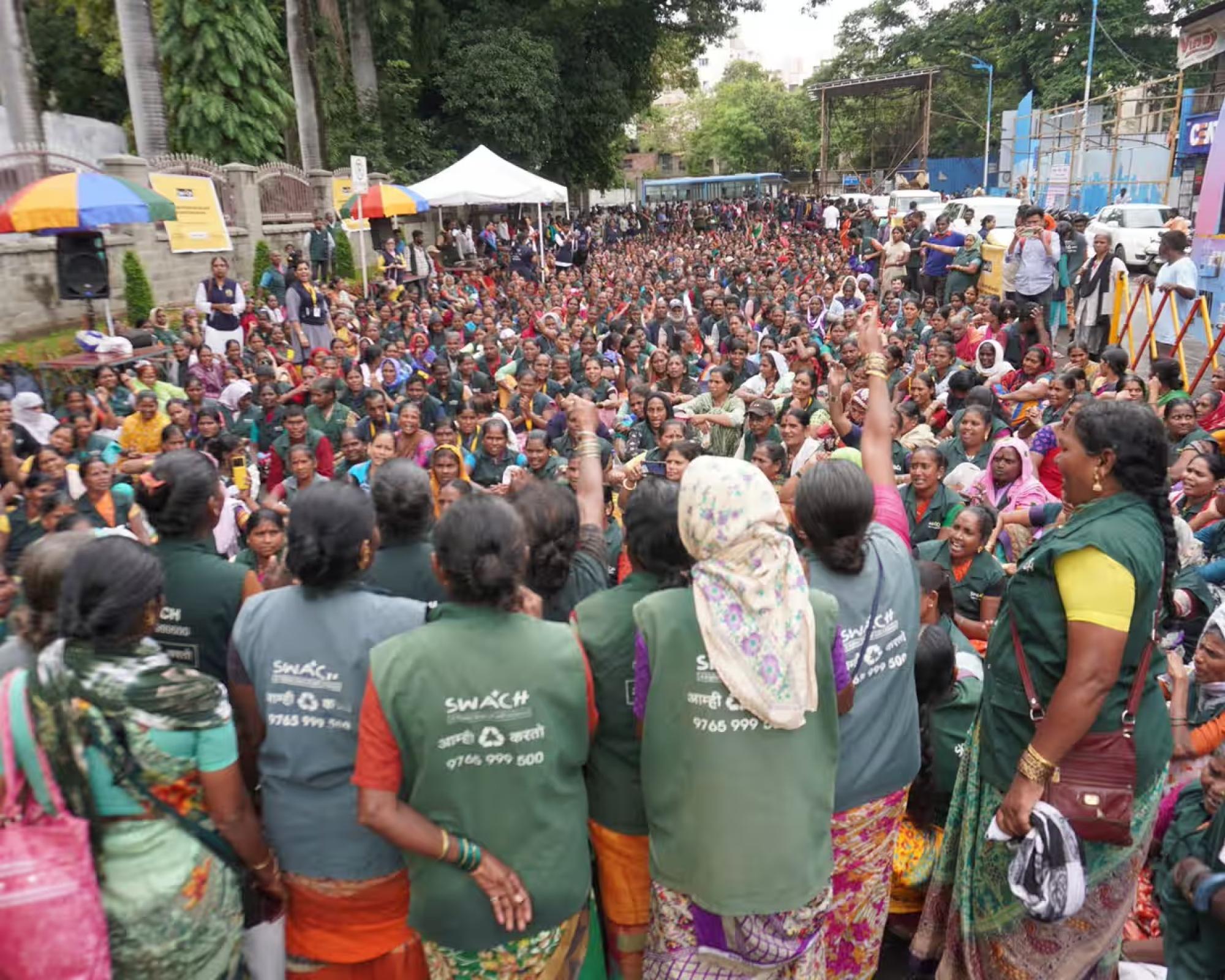
Rajabai Sawant used to pick and sort waste on the streets of Pune with a sack on her back. The plastic she collected from a public waste site would be sold for some money that saved her children from begging. Today, dressed in a dark green jacket monogrammed with the acronym Swach (solid waste collection and handling) over a colourful sari, the 53-year-old is one among an organised group of waste collectors and climate educators who teach residents in urban Pune how to segregate and manage waste, based on a PPPP a pro-poor private public partnership. Swach was set up in 2005 by a trade union of waste pickers, Kagad Kach Patra Kashtakari Panchayat (KKPKP), which was ... envisioned a scheme that enhanced waste collectors' work instead of displacing them. These [PPPP] partnerships are contracts between the state or local authority and a group of private individuals that aim to provide a public service while simultaneously alleviating poverty. Of the waste generated by the city, Swach sorts and recycles about 227 tonnes a day (82,891 tonnes a year) that is diverted away from landfills. It saves the city £10m that would have been needed for processing, transportation and human resources. Today, Swach has more than 3,850 self-reliant waste picker members, who provide daily doorstep waste collection services to citizens of Pune who pay a small monthly fee. Under the PPPP, each member is a shareholder and earns about 16,000 rupees (£140) a month.
Latest
Latest News
Each news summary is created according to strict standards. Here's how we do it.
Each summary is created using a consistent editorial procedure. The target length is approximately 16 lines of 11-point Arial text in a 650-pixel-wide column. Up to 25% of a summary may be set in bold to emphasize the most important ideas. Summaries are composed of verbatim excerpts presented in the same sequence as they appear in the original news source, with very minor editorial additions. Where material has been omitted between excerpts, the omission is indicated with ellipses (...). Any words added by an editor for clarity or context appear in [brackets]. Our original news editor was Fred Burks. Tod Fletcher edited most summaries from 2007 through 2014, and Mark Bailey has served as news editor since 2014.