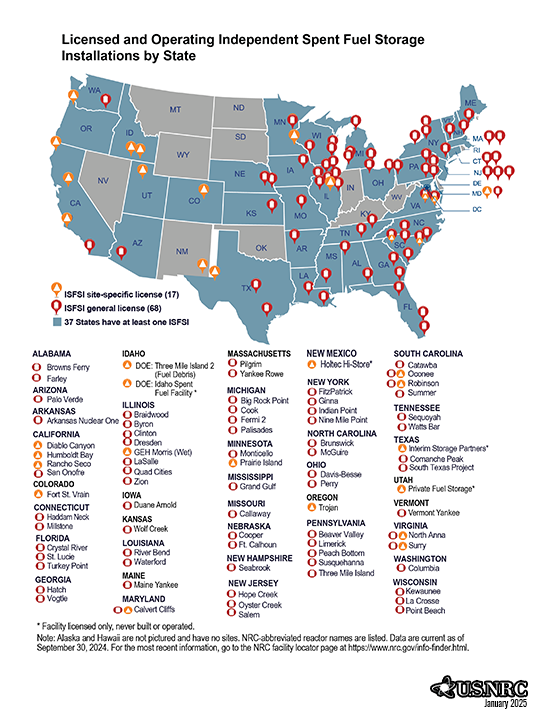
In 2013, [Southern California Edison] announced that San Onofre [Nuclear Generating Station] would be decommissioned. Activists realized that all of the high-level radioactive waste that had accumulated at the plant over the course of its lifetime 1,600 tons of spent fuel rods " would remain at the site for the foreseeable future. Although the federal government is legally responsible for disposing of commercial spent nuclear fuel in a permanent underground repository, there has been no plan for fulfilling that obligation since the Obama administration halted the project at Nevada's Yucca Mountain in 2010. There are currently about 80 locations in 35 states " mostly at operational and decommissioned nuclear plants " where spent fuel is being stored indefinitely. Among scientific experts and government officials, there is broad consensus that the optimal solution is to eventually bury nuclear waste in a deep geological repository. But that is a long-term goal, and in the near future, [U.S. Rep. Mike] Levin and many others are pushing for "consolidated interim storage." This would mean that the spent fuel scattered at sites across the country would be moved to one or more facilities, in appropriate settings, that would be devoted entirely to safely storing the fuel until a geological disposal facility is ready. "Frankly we have a real problem in the U.S., not just at San Onofre," Levin told me. "San Onofre is just the symptom. The actual problem is that we've got nowhere to move it to."
Latest
Latest News
Each news summary is created according to strict standards. Here's how we do it.
Each summary is created using a consistent editorial procedure. The target length is approximately 16 lines of 11-point Arial text in a 650-pixel-wide column. Up to 25% of a summary may be set in bold to emphasize the most important ideas. Summaries are composed of verbatim excerpts presented in the same sequence as they appear in the original news source, with very minor editorial additions. Where material has been omitted between excerpts, the omission is indicated with ellipses (...). Any words added by an editor for clarity or context appear in [brackets]. Our original news editor was Fred Burks. Tod Fletcher edited most summaries from 2007 through 2014, and Mark Bailey has served as news editor since 2014.