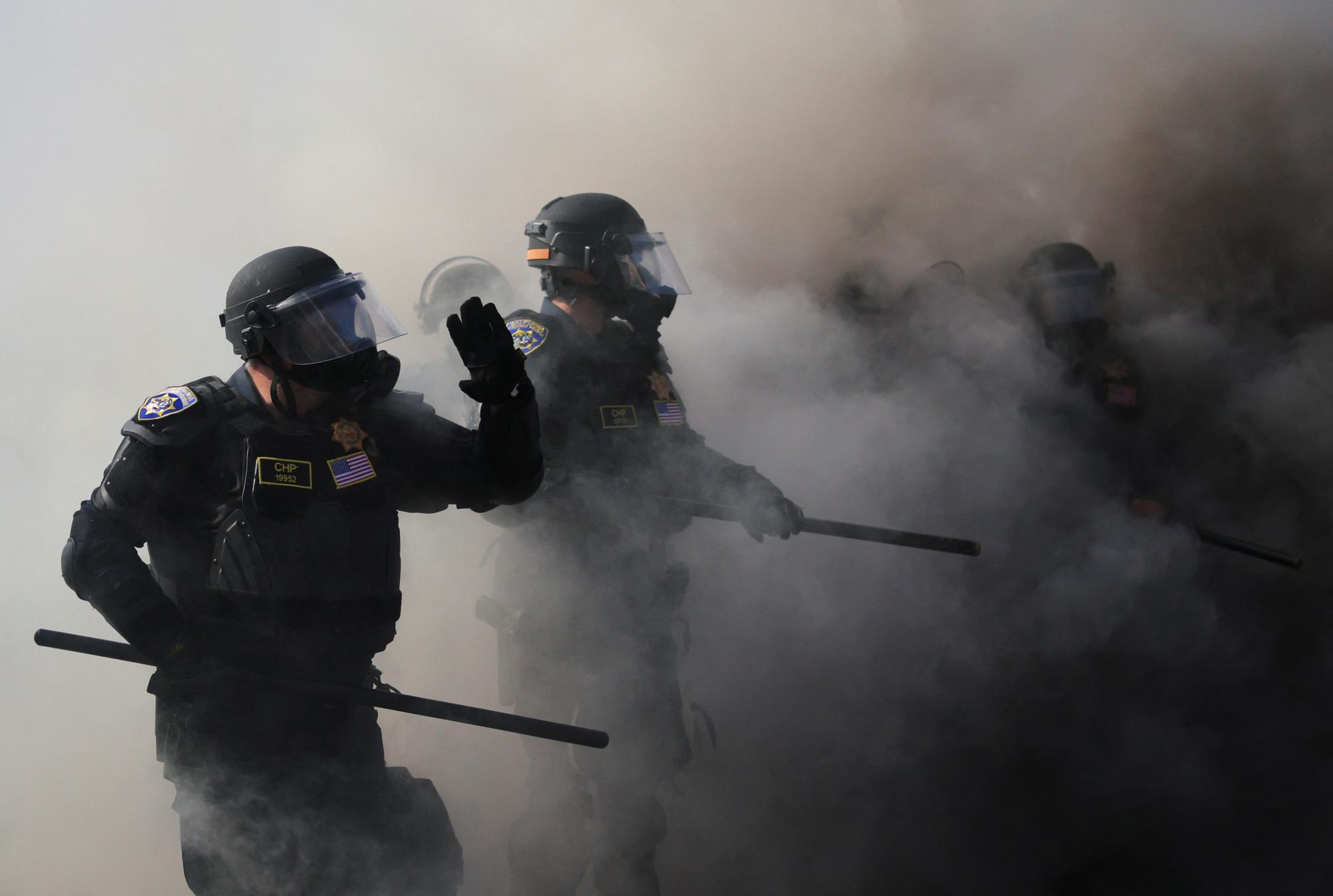
Law enforcement officials in Los Angeles began deploying "less lethal" munitions on June 8 as they clashed with crowds protesting federal immigration raids. "Less lethal" or "less-than-lethal" weapons ... have caused serious injury and death in the past. Chemical irritants include tear gas and pepper spray, which cause sensations of burning, pain and inflammation of the airways. Bystanders and individuals other than the intended targets can be exposed to the chemicals. Pepper balls mirror the effects of pepper spray, but are delivered in a projectile similar to a paint ball. On impact, it bursts open, releasing powdered OC into the air. Kinetic impact projectiles include a range of projectiles such as "sponger" bullets and beanbag rounds, which are shot from launchers and guns. They can severely bruise or penetrate the skin. A 2017 survey published by the British Medical Journal found that injuries from such kinetic impact projectiles caused death in 2.7% of cases. Media outlets, and a reporter hit in the leg by a projectile on June 8, have said LAPD officers have been firing rubber bullets. Flash bangs, otherwise known as "distraction devices" or "noise flash diversionary devices," produce an ear-piercing bang and bright light to disorient targets. One type of flash bang device that has been used in Los Angeles has been the 40mm aerial flash bang. These are launched into the air and ignite above the heads of protesters.
Latest
Latest News
Each news summary is created according to strict standards. Here's how we do it.
Each summary is created using a consistent editorial procedure. The target length is approximately 16 lines of 11-point Arial text in a 650-pixel-wide column. Up to 25% of a summary may be set in bold to emphasize the most important ideas. Summaries are composed of verbatim excerpts presented in the same sequence as they appear in the original news source, with very minor editorial additions. Where material has been omitted between excerpts, the omission is indicated with ellipses (...). Any words added by an editor for clarity or context appear in [brackets]. Our original news editor was Fred Burks. Tod Fletcher edited most summaries from 2007 through 2014, and Mark Bailey has served as news editor since 2014.