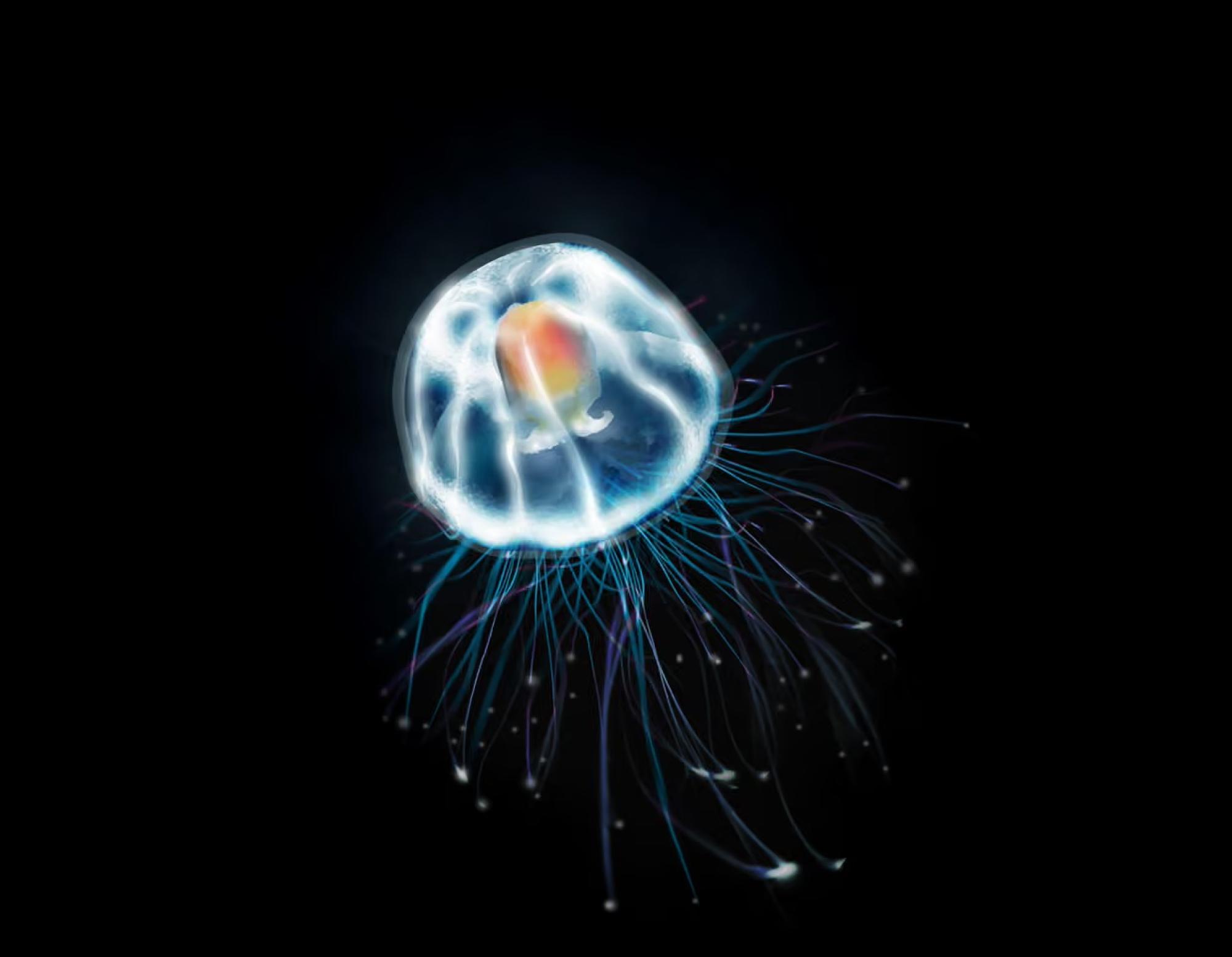
As associate professor Maria Pia Miglietta, a marine biologist at A&M University in Texas, explains, Turritopsis dohrnii has an incredible ability to cheat death. "Turritopsis is unique, because when faced with unfavourable conditions and I mean high temperature, physical cutting, starvation, chemicals in the water, you name it " when you try to kill the jellyfish, it doesn't die." Most normal jellyfish start off life as larvae. They metamorphose into polyps (tiny, stationary soft bodies) that bud off swimming medusas, which grow up to become adult jellies. Eventually, after reproducing, most will stop swimming, crumble a little and then die. But the immortal jellyfish escapes that fate. It reverts to a juvenile form, and starts its life cycle again. The process is called "cellular transdifferentiation", Miglietta says. The jellyfish looks like it's dying and sinks to the bottom. Then " like a butterfly returning to a caterpillar " it shrinks into a ball, and within 24 to 48 hours, buds off a new polyp with the same identical genome, she says. It's one of "nature's coolest tricks", says ... Raquel López-Aragón. "When this jellyfish gets old or gets hurt, instead of just dying like most animals, it transforms itself back into a baby jellyfish and grows up all over again. It can do this as many times as it wants, which means theoretically it never has to die from getting old, it just keeps hitting the reset button on its life."
Latest
Latest News
Each news summary is created according to strict standards. Here's how we do it.
Each summary is created using a consistent editorial procedure. The target length is approximately 16 lines of 11-point Arial text in a 650-pixel-wide column. Up to 25% of a summary may be set in bold to emphasize the most important ideas. Summaries are composed of verbatim excerpts presented in the same sequence as they appear in the original news source, with very minor editorial additions. Where material has been omitted between excerpts, the omission is indicated with ellipses (...). Any words added by an editor for clarity or context appear in [brackets]. Our original news editor was Fred Burks. Tod Fletcher edited most summaries from 2007 through 2014, and Mark Bailey has served as news editor since 2014.