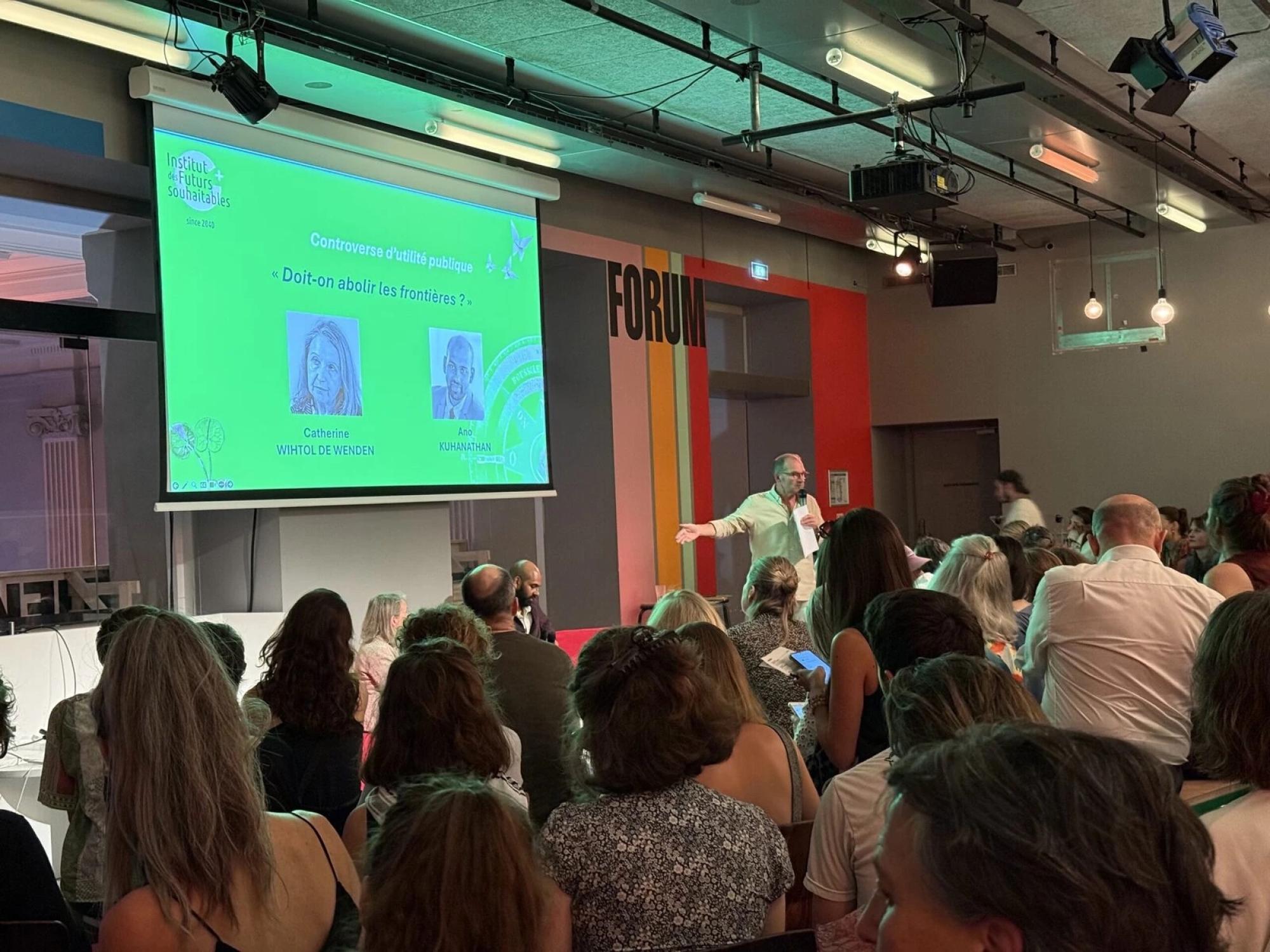
Known as the Night of Controversies, the Paris-based event featured about a dozen different sessions including debates ... as well as workshops on the art of the argument and non-violent communication. Run by the Institute of Desirable Futures, an organization working on corporate innovation and leadership, the project aims to "enrich us from our disagreements" and to "joyfully cast doubt on our certainties" in an era of growing polarization. The Night of Controversies was the institute's first all-out, multi-session event dedicated to disagreement, with more than 600 Parisians attending. The initiative is part of a wider movement that sees finding common ground and learning to "disagree well" as a potent remedy to many of today's societal and political woes. A study by researchers at the University of Cambridge in February 2026 found that divisions on social and political issues in the U.S. have increased by 64 percent since 1988, with most polarization after 2008. Julia Minson, a Harvard Kennedy School professor and behavioral scientist [said:] "When it comes to the U.S., people on the other side of the political spectrum are seen as unmoral, untrustworthy, not worthy of debate." The French institute has run "controversy" events for over a decade, predominantly as part of its work with small and large companies and even politicians. More than 2,000 people have participated in the institute's trainings on disagreement to date, spanning topics such as food production, climate change, AI, biomimetics and governance. The training might be intensively over a week or spread over several months of sessions. "I don't think we are fundamentally in disagreement," said one man. "Where we differ is our understanding of the political context." As a society, we have three choices when confronted with different opinions. First, we can withdraw from interaction and keep to our inner circle. Second, we can try to dominate and impose our beliefs on others. Or thirdly, we can learn to live and grow with them. "Listening to opposing opinions can enrich us," [Jean-Luc Verreaux, director-general of the institute] elaborates. "A diversity of perspectives can only improve how we build the world of tomorrow."
Latest
Latest News
Each news summary is created according to strict standards. Here's how we do it.
Each summary is created using a consistent editorial procedure. The target length is approximately 16 lines of 11-point Arial text in a 650-pixel-wide column. Up to 25% of a summary may be set in bold to emphasize the most important ideas. Summaries are composed of verbatim excerpts presented in the same sequence as they appear in the original news source, with very minor editorial additions. Where material has been omitted between excerpts, the omission is indicated with ellipses (...). Any words added by an editor for clarity or context appear in [brackets]. Our original news editor was Fred Burks. Tod Fletcher edited most summaries from 2007 through 2014, and Mark Bailey has served as news editor since 2014.