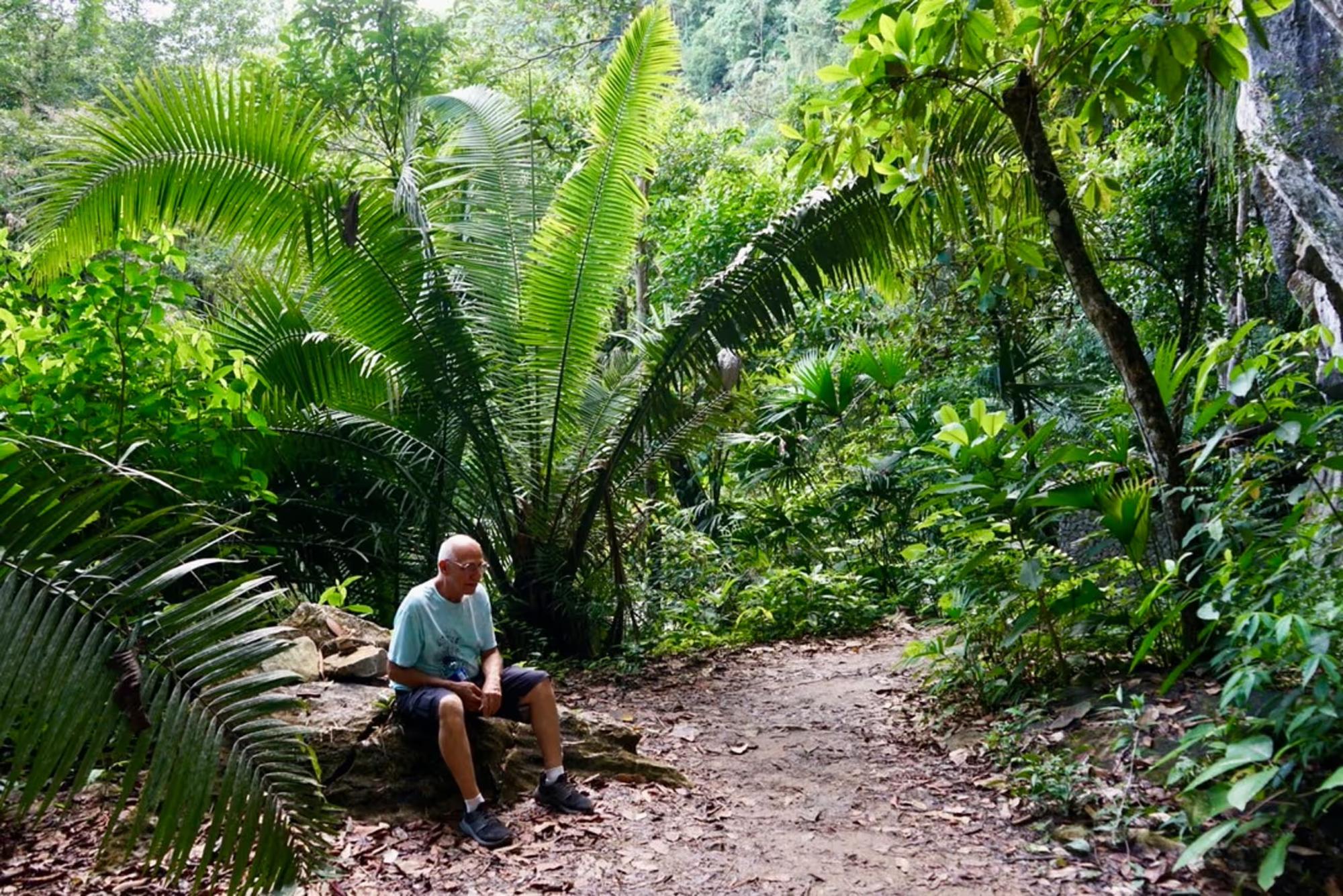
Juan Guillermo Garcés remembers coming face to face with death at age 17. Garcés and his brother started the fire that nearly killed them to clear a large stretch of land. The brothers survived, but the fire destroyed the little remaining patch of virgin forest on the family's 2,500-hectare (6,200-acre) ranch, nestled along Colombia's Magdalena River. In an attempt to undo the damage he caused in his youth, the 74-year-old created the Rio Claro nature reserve, a 3,000-hectare (7,400-acre) oasis teeming with wildlife. Today, Garcés's reserve marks him as one of Colombia's most successful environmental protectors. The Rio Claro basin is home to almost 850 species of fauna and more than 3,000 of flora. "More than 100 new species have been discovered in Rio Claro … and counting," says Saúl E Hoyos-Gómez, a botanical biologist. "It is a very special place one of the few where you can find this level of biodiversity." His method is simple. He buys plots of land from peasant farmers, often deforested pastures, and then lets them rest. Recovery in the region's hot and humid climate is fast. Left alone, pasture reverts to jungle within decades. About 80% of Garcés' reserve consists of land reforested in this way. To build his reserve, Garcés has had to navigate complex relationships with peasant farmers, the government and armed groups. Growing numbers of Colombian landowners are following Garcés's lead, turning pastures into reserves.
Latest
Latest News
Each news summary is created according to strict standards. Here's how we do it.
Each summary is created using a consistent editorial procedure. The target length is approximately 16 lines of 11-point Arial text in a 650-pixel-wide column. Up to 25% of a summary may be set in bold to emphasize the most important ideas. Summaries are composed of verbatim excerpts presented in the same sequence as they appear in the original news source, with very minor editorial additions. Where material has been omitted between excerpts, the omission is indicated with ellipses (...). Any words added by an editor for clarity or context appear in [brackets]. Our original news editor was Fred Burks. Tod Fletcher edited most summaries from 2007 through 2014, and Mark Bailey has served as news editor since 2014.