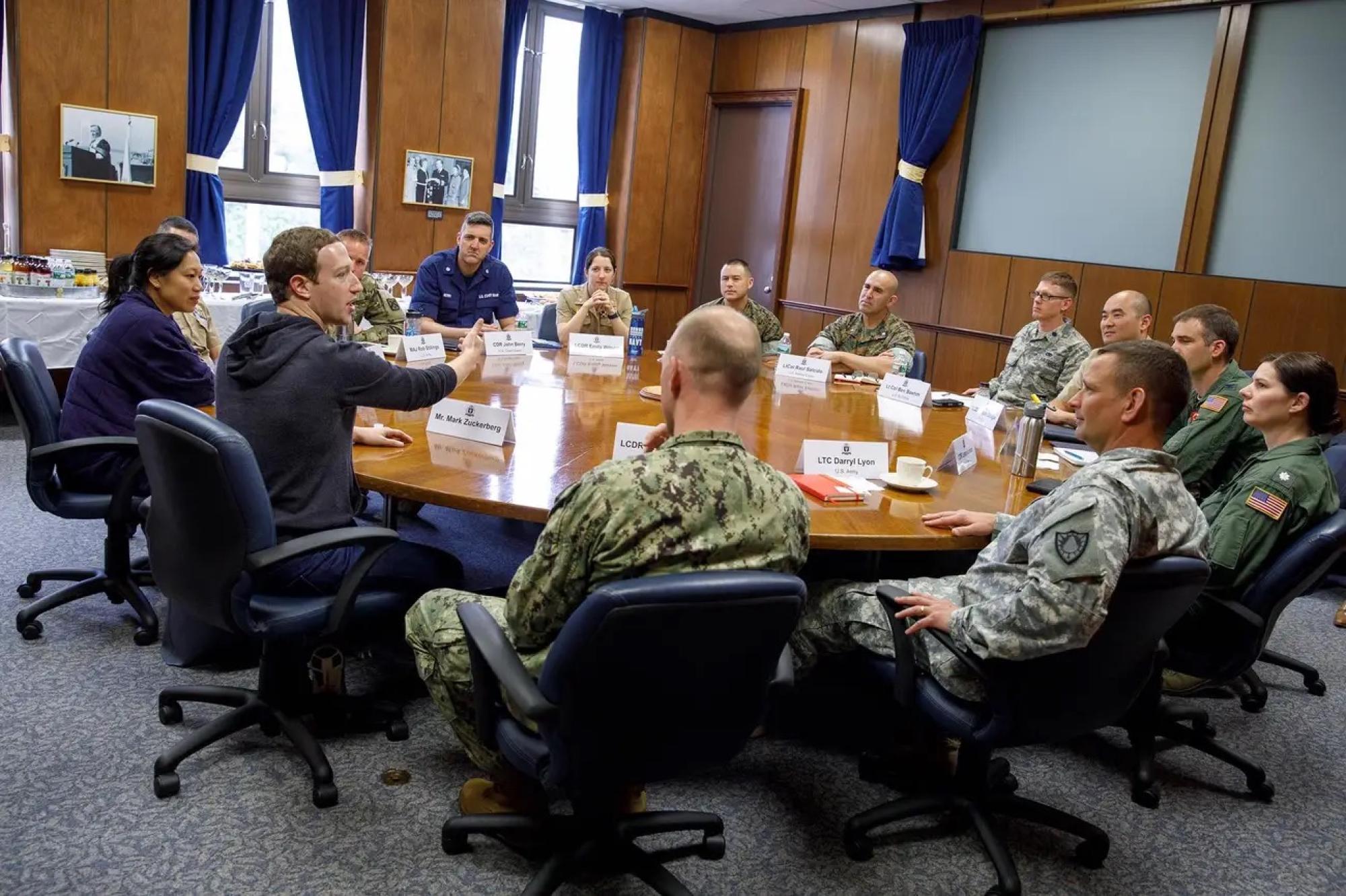
While Facebook has long sought to portray itself as a town square" that allows people from across the world to connect, a deeper look into its apparently military origins and continual military connections reveals that the world's largest social network was always intended to act as a surveillance tool to identify and target domestic dissent. LifeLog was one of several controversial post-9/11 surveillance programs pursued by the Pentagon's Defense Advanced Research Projects Agency (DARPA) that threatened to destroy privacy and civil liberties in the United States. LifeLog sought to .. build a digital record of "everything an individual says, sees, or does." In 2015, [DARPA architect Douglas] Gage told VICE that "Facebook is the real face of pseudo-LifeLog." He tellingly added, "We have ended up providing the same kind of detailed personal information without arousing the kind of opposition that LifeLog provoked." A few months into Facebook's launch, in June 2004, Facebook cofounders Mark Zuckerberg and Dustin Moskovitz [had] its first outside investor, Peter Thiel. Thiel, in coordination with the CIA, was actively trying to resurrect controversial DARPA programs. Thiel formally acquired $500,000 worth of Facebook shares and was added its board. Thiel's longstanding symbiotic relationship with Facebook cofounders extends to his company Palantir, as the data that Facebook users make public invariably winds up in Palantir's databases and helps drive the surveillance engine Palantir runs for a handful of US police departments, the military, and the intelligence community.
Latest
Latest News
Each news summary is created according to strict standards. Here's how we do it.
Each summary is created using a consistent editorial procedure. The target length is approximately 16 lines of 11-point Arial text in a 650-pixel-wide column. Up to 25% of a summary may be set in bold to emphasize the most important ideas. Summaries are composed of verbatim excerpts presented in the same sequence as they appear in the original news source, with very minor editorial additions. Where material has been omitted between excerpts, the omission is indicated with ellipses (...). Any words added by an editor for clarity or context appear in [brackets]. Our original news editor was Fred Burks. Tod Fletcher edited most summaries from 2007 through 2014, and Mark Bailey has served as news editor since 2014.