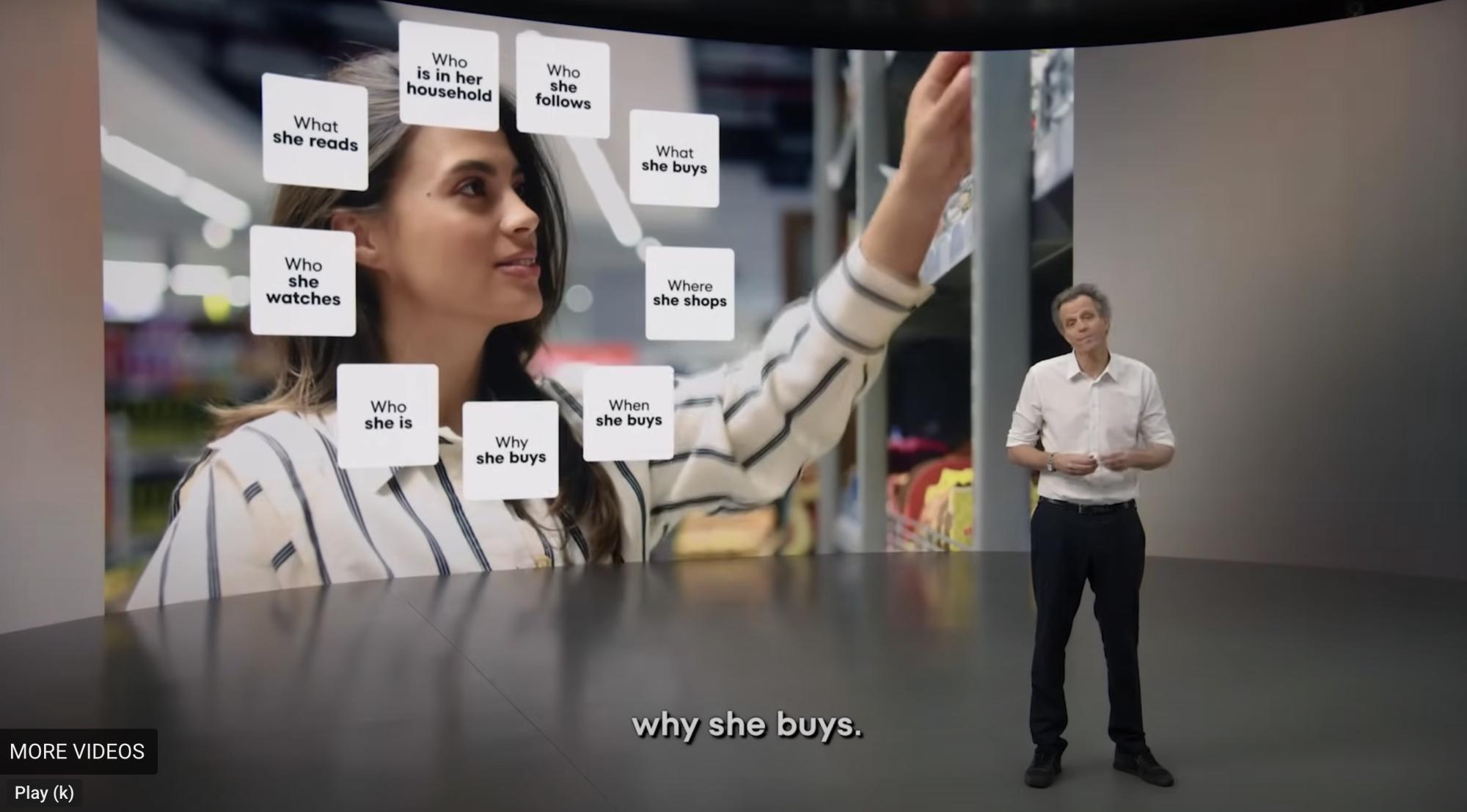
The owner of a data brokerage business recently ... bragged about the degree to which his industry could collect and analyze data on the habits of billions of people. Publicis CEO Arthur Sadoun said that ... his company [can] deliver "personalized messaging at scale" to some 91 percent of the internet's adult web users. To deliver that kind of "personalized messaging" (i.e., advertising), Publicis must gather an extraordinary amount of information on the people it serves ads to. Lena Cohen, a technologist with the Electronic Frontier Foundation, said that data brokers like Publicis collect "as much information as they can" about web users. "The data broker industry is under-regulated, opaque, and dangerous, because as you saw in the video, brokers have detailed information on billions of people, but we know relatively little about them," Cohen said. "You don't know what information a data broker has on you, who they're selling it to, and what the people who buy your data are doing with it. There's a real power/knowledge asymmetry." Even when state-level privacy regulations are passed (such as the California Consumer Privacy Law), those cases are often not given enough focus or resources for the laws to be enforced effectively. "Most government agencies don't have the resources to enforce privacy laws at the scale that they're being broken," Cohen said. Cohen added that she felt online behavioral advertisingthat is, advertising that is based on an individual web user's specific browsing activity"should be illegal. Banning behavioral ads would "fundamentally change the financial incentive for online actors to constantly surveil" web users and share their data with brokers, Cohen said.
Latest
Latest News
Each news summary is created according to strict standards. Here's how we do it.
Each summary is created using a consistent editorial procedure. The target length is approximately 16 lines of 11-point Arial text in a 650-pixel-wide column. Up to 25% of a summary may be set in bold to emphasize the most important ideas. Summaries are composed of verbatim excerpts presented in the same sequence as they appear in the original news source, with very minor editorial additions. Where material has been omitted between excerpts, the omission is indicated with ellipses (...). Any words added by an editor for clarity or context appear in [brackets]. Our original news editor was Fred Burks. Tod Fletcher edited most summaries from 2007 through 2014, and Mark Bailey has served as news editor since 2014.