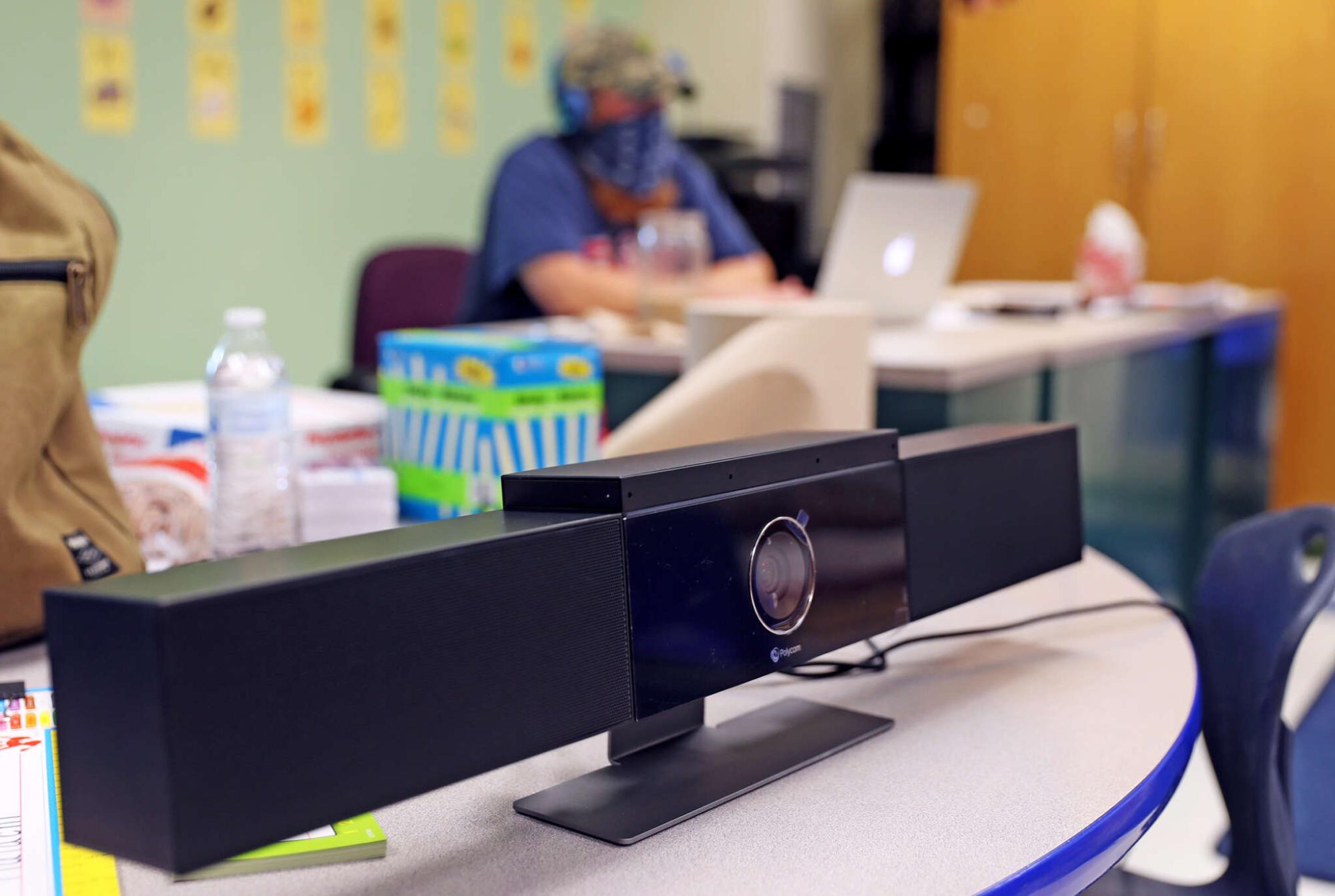
Tech companies have outfitted classrooms across the U.S. with devices and technologies that allow for constant surveillance and data gathering. Firms such as Gaggle, Securly and Bark (to name a few) now collect data from tens of thousands of K-12 students. They are not required to disclose how they use that data, or guarantee its safety from hackers. In their new book, Surveillance Education: Navigating the Conspicuous Absence of Privacy in Schools, Nolan Higdon and Allison Butler show how all-encompassing surveillance is now all too real, and everything from basic privacy rights to educational quality is at stake. The tech industry has done a great job of convincing us that their platforms " like social media and email " are "free." But the truth is, they come at a cost: our privacy. These companies make money from our data, and all the content and information we share online is basically unpaid labor. So, when the COVID-19 lockdowns hit, a lot of people just assumed that using Zoom, Canvas and Moodle for online learning was a "free" alternative to in-person classes. In reality, we were giving up even more of our labor and privacy to an industry that ended up making record profits. Your data can be used against you ... or taken out of context, such as sarcasm being used to deny you a job or admission to a school. Data breaches happen all the time, which could lead to identity theft or other personal information becoming public.
Latest
Latest News
Each news summary is created according to strict standards. Here's how we do it.
Each summary is created using a consistent editorial procedure. The target length is approximately 16 lines of 11-point Arial text in a 650-pixel-wide column. Up to 25% of a summary may be set in bold to emphasize the most important ideas. Summaries are composed of verbatim excerpts presented in the same sequence as they appear in the original news source, with very minor editorial additions. Where material has been omitted between excerpts, the omission is indicated with ellipses (...). Any words added by an editor for clarity or context appear in [brackets]. Our original news editor was Fred Burks. Tod Fletcher edited most summaries from 2007 through 2014, and Mark Bailey has served as news editor since 2014.