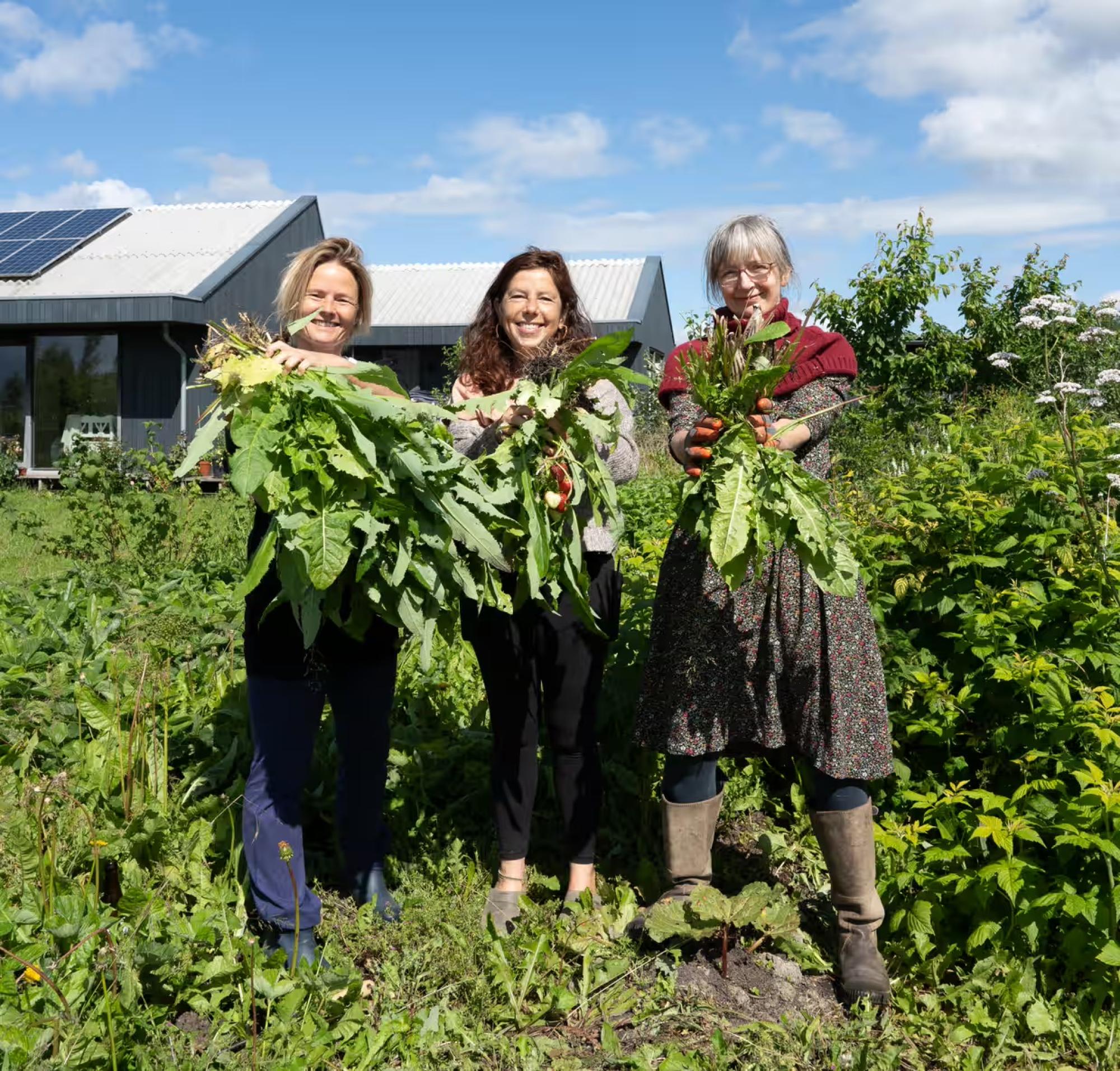
When Marco de Kat starts planning his meals, he doesn't need to travel far for fresh food. Right outside his house is an 800 square metre plot with all sorts of produce apples, pears, peppers, basil, beets and cauliflower, to name a few. Oosterwold, where de Kat has lived since 2017, is a 4,300 hectare (10,625 acre) urban experiment located east of Amsterdam, in a suburb of the city of Almere, where de Kat works as a municipal councillor. The area, which has about 5,000 residents and a growing waiting list, is completely self-sufficient. Residents can build houses however they like, and must collaborate with others to figure out things such as street names, waste management, roads, and even schools. But the local government has included one extremely unusual requirement: about half of each plot must be devoted to urban agriculture. Some, like de Kat, have turned their gardens into an Eden of sorts to provide for their own household unit. Other residents just plant a few apple trees or outsource by owning plots of land on site that are tended to by professional farmers. Others, such as Jalil Bekkour, have been able to capitalise on it. "I never had experience gardening my own food or anything like that," he said. But he taught himself how to garden, and three years ago he opened his own restaurant, Atelier Feddan, where 80% of the food is directly from Oosterwold. His newfound excitement for gardening and agriculture is palpable.
Latest
Latest News
Each news summary is created according to strict standards. Here's how we do it.
Each summary is created using a consistent editorial procedure. The target length is approximately 16 lines of 11-point Arial text in a 650-pixel-wide column. Up to 25% of a summary may be set in bold to emphasize the most important ideas. Summaries are composed of verbatim excerpts presented in the same sequence as they appear in the original news source, with very minor editorial additions. Where material has been omitted between excerpts, the omission is indicated with ellipses (...). Any words added by an editor for clarity or context appear in [brackets]. Our original news editor was Fred Burks. Tod Fletcher edited most summaries from 2007 through 2014, and Mark Bailey has served as news editor since 2014.