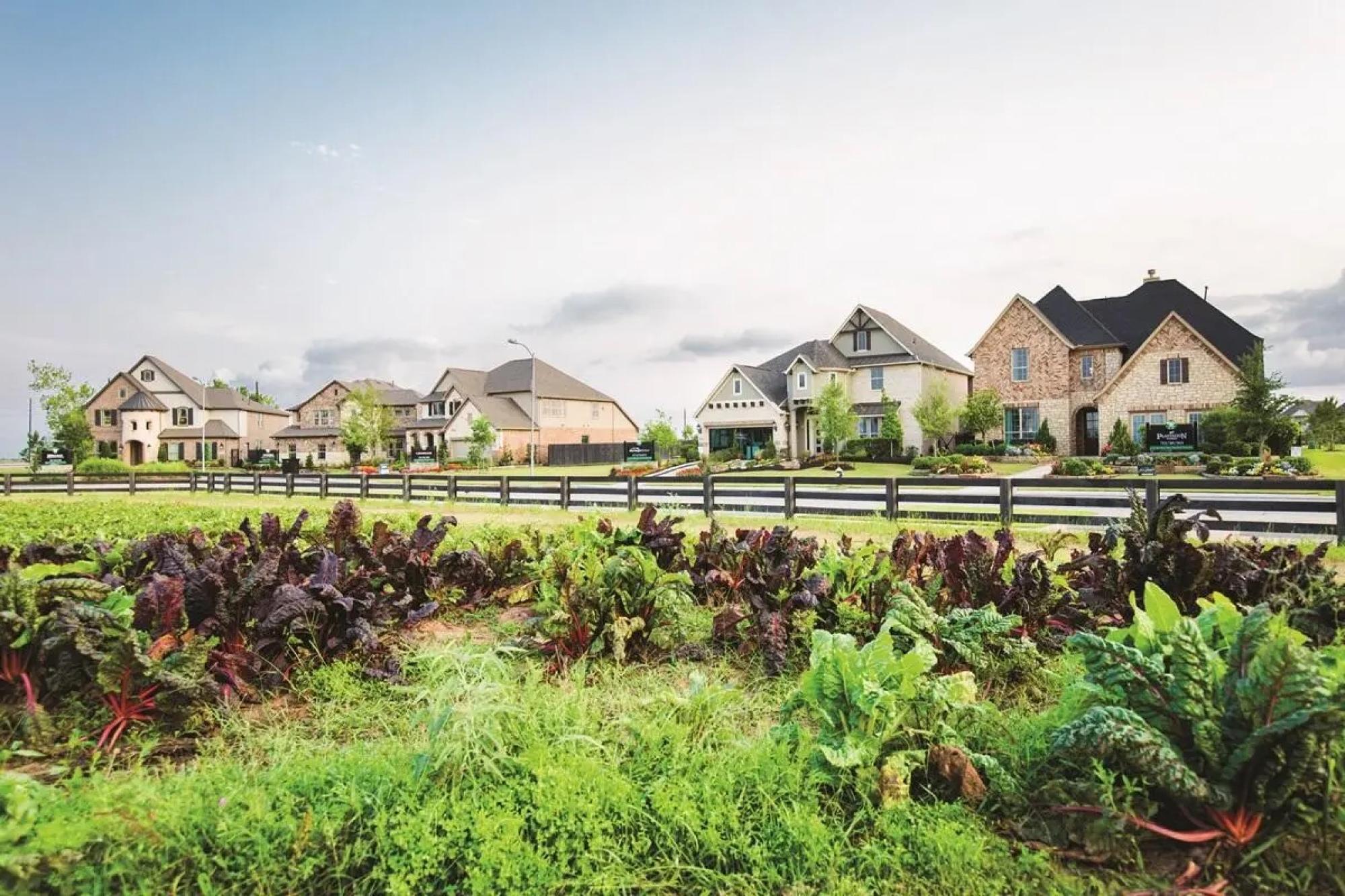
"Agrihoods" [are] communities designed around a central farm. Like a garden in a big city, agrihoods promise to boost food security, reduce temperatures, capture rainwater and increase biodiversity. As climate change intensifies heat, flooding and pressure on food systems, agrihoods could be a way to make urban living more resilient not just more picturesque. "Developers have a hard time offering open space, because they would like to build more housing," said Vincent Mudd, a partner at the architectural firm Steinberg Hart, which designs agrihoods. "One of the few ways to kind of bridge that gap is to be able to use active open space that actually generates commerce." On paper, an agrihood is a simple concept: A working farm surrounded by single- or multifamily housing. Steinberg Hart recently finished two of them in California " one in Santa Clara and another, called Fox Point Farms, in Encinitas. Scale that food production up across a city, and the impact could be huge: One study found that Los Angeles could meet a third of its need for vegetables by converting vacant lots into gardens. These green spaces help cool the neighborhood because their plants release water vapor, making summer more comfortable for the surrounding community. An agrihood can also support local biodiversity. Planting native flowering species, for instance, simultaneously beautifies the landscape and attracts pollinating insects, hummingbirds and bats.
Latest
Latest News
Each news summary is created according to strict standards. Here's how we do it.
Each summary is created using a consistent editorial procedure. The target length is approximately 16 lines of 11-point Arial text in a 650-pixel-wide column. Up to 25% of a summary may be set in bold to emphasize the most important ideas. Summaries are composed of verbatim excerpts presented in the same sequence as they appear in the original news source, with very minor editorial additions. Where material has been omitted between excerpts, the omission is indicated with ellipses (...). Any words added by an editor for clarity or context appear in [brackets]. Our original news editor was Fred Burks. Tod Fletcher edited most summaries from 2007 through 2014, and Mark Bailey has served as news editor since 2014.