










































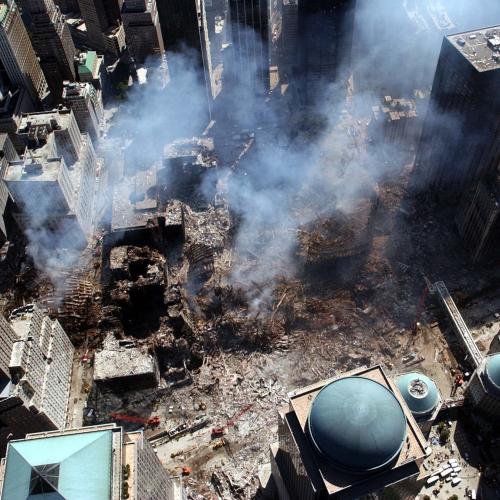


Security Officials Shocked Over 9/11 Use of Aircraft as Missiles
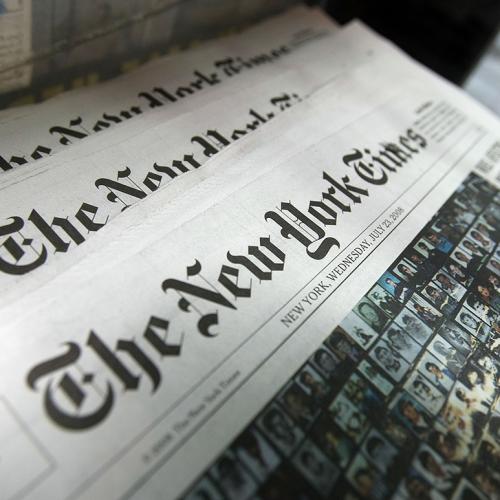
New York Times
Website Requires Payment to View Article
Free
Copy Given Below
This is one of the articles on the 9/11 summary for which the media website requires payment. For the New York Times website, you must both register as a member (which is free), and then pay a small fee by credit card on line in order to be able to view or download the full article. Once registered, you can view an abstract of the article for no cost. First, go to:
http://select.nytimes.com/gst/abstract.html?res=F20E13FE3A590C708CDDA90994D9404482
If you haven't previously signed up as a user, fill in the required information. Once complete, you will see the abstract and have the option to view and download the full article with payment. We provide a copy of the article below for free. The quote about officials being shocked that terrorists had hijacked airliners and crashed them into landmark buildings is in the first sentence.
October 3, 2001, Wednesday
NATIONAL DESK
A NATION CHALLENGED: WARNINGS
Earlier Hijackings Offered Signals That
Were Missed
By MATTHEW L. WALD (NYT) 1083 words
WASHINGTON, Oct. 2 -- Over and over since Sept. 11, aviation and security officials have said they were shocked that terrorists had hijacked airliners and crashed them into landmark buildings.
''This is a whole new world for us,'' Jane F. Garvey, the administrator of the Federal Aviation Administration, said in testimony before a House subcommittee on Sept. 20.
But the record shows that for her and others, there were numerous warnings.
In 1994, two jetliners were hijacked by people who wanted to crash them into buildings, one of them by an Islamic militant group. And the 2000 edition of the F.A.A.'s annual report on Criminal Acts Against Aviation, published this year, said that although Osama bin Laden ''is not known to have attacked civil aviation, he has both the motivation and the wherewithal to do so,'' adding, ''Bin Laden's anti-Western and anti-American attitudes make him and his followers a significant threat to civil aviation, particularly to U.S. civil aviation.''
The previous year's edition of that report said that an exiled Islamic leader in Britain proclaimed in August 1998 that Mr. bin Laden would ''bring down an airliner, or hijack an airliner to humiliate the United States.'' The report did not identify the leader.
The failure to heed these signs is ''an indication of failure to put the pieces together,'' said Gerald B. Kauvar, who was the staff director of the commission headed by Vice President Al Gore on aviation security and safety after the crash of T.W.A. Flight 800 off Long Island in July 1996.
The authorities appeared to draw no lessons from the two attacks in 1994. But one of them, in hindsight, had striking similarities to those of Sept. 11.
That was the December 1994 hijacking of an Air France flight in Algiers. The sponsor of the hijacking was an organization called the Armed Islamic Group, which said it was trying to rid Muslim Algeria of Western influence, specifically from France. Four young Algerians, members of a subgroup called Phalange of the Signers in Blood, commandeered the plane at the airport and ordered it to fly to Marseille, from which they said they wanted to fly to Paris.
But they demanded that it be loaded with 27 tons of fuel -- about three times as much as required for the flight to Paris. The plane was an Airbus A300, which is nearly as large as the Boeing 767's that struck the World Trade Center. The French authorities determined from hostages who had been released and from other sources that the group planned to explode the plane over Paris or crash it into the Eiffel Tower.
After French troops stormed the plane and killed the hijackers, they found 20 sticks of dynamite.
Eight months earlier, in April 1994, a flight engineer at Federal Express who was facing a disciplinary hearing that could have ended his career, boarded a DC-10 as a passenger and stormed into the cockpit with a hammer, hitting each of the three members of the cockpit crew in the head and severely injuring all of them. They wrestled him to the deck and regained control of the plane. Prosecutors said only that the man wanted to crash the plane, but company employees have said he was trying to hit the building in Memphis where the company sorts packages.
In between those two incidents, in September 1994, a lone pilot crashed a stolen single-engine Cessna into a tree on the White House grounds just short of the president's bedroom.
But aviation security officials never extrapolated any sort of pattern from those incidents.
Airlines take pride in their ability to spot patterns and take appropriate action in the separate field of flight safety field. Safety officers say the technique could help security, too. In September 1996, when many people suspected that the crash of T.W.A. Flight 800 two months earlier had been caused by a bomb, the industry's trade association set out to establish principles of security, which again stressed pattern recognition. Security required continuous assessment of what it called ''evolving threats,'' the group said, but suggested that the assessment was a government task.
Even now, three weeks after the Sept. 11 attacks, most people in the aviation business are still confounded.
''I haven't talked to a person in aviation or government who is less than dumbfounded at the scope of this act,'' said David A. Fuscus, president of Xenophon Strategies, which advises airlines on crisis communications. Mr. Fuscus was formerly the chief spokesman for the main airline trade association.
Aviation security ''is a threat-based system,'' Mr. Fuscus added. Actions are taken ''based on the threat as perceived and interpreted by the U.S. government.''
But the government, by all accounts, was focused on threats like the one to Pan Am Flight 103, destroyed by a terrorist bomb over Lockerbie, Scotland, in December 1988, and T.W.A. Flight 847, the plane taken to Beirut in June 1985. The passengers were taken as hostages.
Despite the history and precedents, some security experts say the possibility of an airliner attack like those of Sept. 11 was too outlandish to have been believed in advance.
''Someone expressing that view probably would have gotten short shrift, because it was generally considered just sort of outlandish, not feasible, not real,'' said Richard F. Lally, who was the top security official at the F.A.A. until 1981 and spent the next 10 years doing the same work at the Air Transport Association, the big carriers' trade group.
International aviation experts say that most aviation security problems are solved only after catastrophes. For example, El Al is legendary for strong aircraft and airport security. But Lior Zouker, who began his career as an El Al sky marshal and is now president of International Consultants on Targeted Security, which serves several American carriers, said those resulted from Israel's own catastrophes.
But extrapolation may be a key lesson of Sept. 11. According to one executive at an aviation trade organization, ''now we need to do that in every element of our life; that's how we fight this new war.''
FAIR USE NOTICE: This site contains copyrighted material the use of which has not always been specifically authorized by the copyright owner. We are making such material available in our efforts to advance understanding of criminal justice, political, human rights, economic, democracy, scientific, and social justice issues, etc. We believe this constitutes a 'fair use' of any such copyrighted material as provided for in section 107 of the US Copyright Law. In accordance with Title 17 U.S.C. Section 107, the material on this site is distributed without profit to those who have expressed a prior interest in receiving the included information for research and educational purposes. For more information go to: http://www.law.cornell.edu/uscode/17/107.shtml. If you wish to use copyrighted material from this site for purposes of your own that go beyond 'fair use', you must obtain permission from the copyright owner.
- Inform your media and political representatives of this vital information on 9/11. To contact those close to you, click here. Urge them to call for the release of classified documents and videos and to press for a new, impartial investigation.
- Explore the wealth of reliable, verifiable information on 9/11, including several excellent documentaries, in our 9/11 Information Center available here.
- Learn more about 9/11 and the secret societies likely involved in this powerful lesson from the free Insight Course.
- Explore inspiring ideas on building a brighter future by reading this short essay.
- Spread this news to your friends and colleagues, and recommend this article on key social networking websites so that we can fill the role at which the major media is sadly failing. Together, we can make a difference.
See our exceptional archive of revealing news articles.
Please support this important work: Donate here.
www.momentoflove.org - Every person in the world has a heart
www.personalgrowthcourses.net - Dynamic online courses powerfully expand your horizons
www.WantToKnow.info - Reliable, verifiable information on major cover-ups
www.weboflove.org - Strengthening the Web of Love that interconnects us all
Subscribe here to the WantToKnow.info email list (two messages a week)
Security Officials Shocked Over 9/11 Use of Aircraft as Missiles




