









































9/11 Hijackers' Visas
Missing Washington Post Article: To see our downloaded version of original, click here
Hijackers Got Visas With Little Scrutiny, GAO Reports
By Dan Eggen
Washington Post Staff Writer
Tuesday, October 22, 2002; Page A07
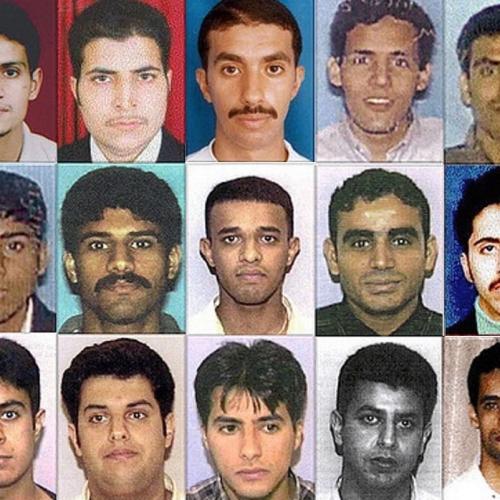
At least 13 of the Sept. 11, 2001, hijackers were never interviewed by U.S. consular officials before being granted visas to enter the United States, according to a congressional report issued yesterday. The finding contradicts previous assurances from the State Department that most of them had been thoroughly screened.
The General Accounting Office also found that, for 15 hijackers whose applications could be found, none had filled in the documents properly. Overall, few applicants from Saudi Arabia or the United Arab Emirates were required to submit to interviews.
The GAO added that more than a year after the attacks on the World Trade Center and the Pentagon, the State Department still does not adequately train consular officials and has yet to establish clear guidelines on reviewing visa applications.
Attempts to change have been hobbled by a dispute between the State and Justice departments, which disagree about the evidence required to bar suspected terrorists from the United States, according to the report.
"Weaknesses remain in visa policies and procedures that limit the effectiveness of the visa process as an antiterrorism tool," the study concluded.
State Department spokesman Richard Boucher declined to comment yesterday on specifics of the report because department officials had not seen it.
"We look forward to any suggestions the General Accounting Office has about how we can improve and strengthen the visa process, something we've been trying to do since September 11th," Boucher said.
Boucher said ensuring that applications were properly filled out "was one of the things that should have been done that wasn't done."
The findings by GAO, the nonpartisan investigative arm of Congress, represent the latest evidence of problems within the State Department's visa program, which has been criticized as lax and focused on diplomatic concerns. Earlier this year, the chief of the department's Bureau of Consular Affairs was fired, and a program permitting travel agents in Saudi Arabia to forward visa applications was scrapped.
State Department officials said previously that 12 of the Sept. 11 hijackers from Saudi Arabia had been interviewed by consular officials, and that the others probably would not have been denied if they had been interviewed. None of the hijackers' names was included on a terrorist watch list before their entry into the United States.
The GAO report found that all 15 of the hijackers from Saudi Arabia applied for visas in Jeddah or Riyadh; two others applied in their native United Arab Emirates. The remaining two, including ringleader Mohamed Atta, an Egyptian citizen, applied as "third-country" applicants in Berlin.
None of 18 separate visa applications by 15 of the hijackers was completed properly, the report said. Thirteen of the 15, who were from Saudi Arabia or UAE, were never interviewed before being approved for a visa, the report found. Investigators were unable to review the applications for four other hijackers, including Atta, because they were destroyed.
The GAO report provides a revealing glimpse into a continuing feud between officials at State and Justice over visa policy. Robert F. Diegelman, an acting assistant attorney general, told GAO investigators in a letter that the State Department believes that an applicant must be granted a visa unless there is "specific evidence of activities or associations" linking the applicant to terrorists, and that placement on a terrorist tracking list alone is insufficient.
Justice officials say U.S. law "places the burden of proof on the applicant to establish his admissibility," Diegelman wrote.
FAIR USE NOTICE: This site contains copyrighted material the use of which has not always been specifically authorized by the copyright owner. We are making such material available in our efforts to advance understanding of criminal justice, political, human rights, economic, democracy, scientific, and social justice issues, etc. We believe this constitutes a 'fair use' of any such copyrighted material as provided for in section 107 of the US Copyright Law. In accordance with Title 17 U.S.C. Section 107, the material on this site is distributed without profit to those who have expressed a prior interest in receiving the included information for research and educational purposes. For more information go to: http://www.law.cornell.edu/uscode/17/107.shtml. If you wish to use copyrighted material from this site for purposes of your own that go beyond 'fair use', you must obtain permission from the copyright owner.
- Inform your media and political representatives of this vital information on 9/11. To contact those close to you, click here. Urge them to call for the release of classified documents and videos and to press for a new, impartial investigation.
- Explore the wealth of reliable, verifiable information on 9/11, including several excellent documentaries, in our 9/11 Information Center available here.
- Learn more about 9/11 and the secret societies likely involved in this powerful lesson from the free Insight Course.
- Explore inspiring ideas on building a brighter future by reading this short essay.
- Spread this news to your friends and colleagues, and recommend this article on key social networking websites so that we can fill the role at which the major media is sadly failing. Together, we can make a difference.
See our exceptional archive of revealing news articles.
Please support this important work: Donate here.
www.momentoflove.org - Every person in the world has a heart
www.personalgrowthcourses.net - Dynamic online courses powerfully expand your horizons
www.WantToKnow.info - Reliable, verifiable information on major cover-ups
www.weboflove.org - Strengthening the Web of Love that interconnects us all
Subscribe here to the WantToKnow.info email list (two messages a week)