




































David Rubenstein in Washington Post
Bush Met bin Laden's Brother on Sept 10, 2001
To order this article on David Rubenstein from the Washington Post archives, click here

Connections And Then Some
David Rubenstein Has Made Millions
Pairing the Powerful With the Rich
Greg Schneider Washington Post Staff
Writer
March 16, 2003; Page F1
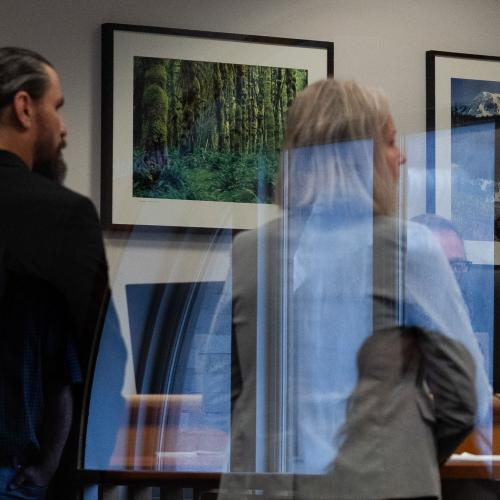
David M. Rubenstein is exasperated, and he blurts something that a quick look around the room proves is outrageous: "We're not," he nearly shouts, "that well connected!" Behind him is a picture of Rubenstein on a plane with then-Gov. George W. Bush. Across the room, a photo of Rubenstein with the president's father and mother. Next to that, Rubenstein and Mikhail Gorbachev. Elsewhere: Rubenstein and Jimmy Carter. On a bookshelf: Rubenstein and the pope.
This is not some honor wall in Rubenstein's office on Pennsylvania Avenue, this is his wood-paneled den at home in Bethesda. The snapshots are nearly hidden among books and trinkets and family photos -- the decorating restraint of the truly, deeply connected.
Rubenstein, after all, is co-founder of the Carlyle Group, an investment house famous as one of the most well-connected companies anywhere. Former president George H.W. Bush is a Carlyle adviser. Former British prime minister John Major heads its European arm. Former secretary of state James Baker is senior counselor, former White House budget chief Richard Darman is a partner, former SEC chairman Arthur Levitt is senior adviser -- the list goes on.
Those associations have brought Carlyle enormous success. Founded in 1987 with $5 million, the Washington-based merchant bank controls nearly $14 billion in investments, making it the largest private equity manager in the world. It buys and sells whole companies the way some firms trade shares of stock.
But the connections also have cost Carlyle, in ways that are hard to measure. It has developed a reputation as the CIA of the business world -- omnipresent, powerful, a little sinister. Media outlets from the Village Voice to BusinessWeek have depicted Carlyle as manipulating the levers of government from shadowy back rooms. "The Iron Triangle," a book about the company due out next month, promises to take readers into "a world that few of us can even imagine, full of clandestine meetings [and] quid pro quo deals."
Last year, then-congresswoman Cynthia McKinney (D-Ga.) even suggested that Carlyle's and Bush's ties to the Middle East made them somehow complicitous in the Sept. 11 terror attacks. While her comments were widely dismissed as irresponsible, the publicity highlighted Carlyle's increasingly notorious reputation. Internet sites with headlines such as "The Axis of Corporate Evil" purport to link Carlyle to everything from Enron to al Qaeda.
"We've actually replaced the Trilateral Commission" as the darling of conspiracy theorists, says Rubenstein -- who, truth be told, happens to be a member of the Trilateral Commission.
It didn't help that as the World Trade Center burned on Sept. 11, 2001, the news interrupted a Carlyle business conference at the Ritz-Carlton Hotel here attended by a brother of Osama bin Laden. Former president Bush, a fellow investor, had been with him at the conference the previous day.
But even if you believe the conspiracy theories that Carlyle luminaries are pulling strings on the company's behalf, there is evidence they haven't been very good at it lately. The current Bush administration has sloughed off advice from Baker calling for restraint in the Middle East, where Carlyle has investors, and from former president Bush on the need for calm on the Korean peninsula, where Carlyle owns banks. Defense Secretary Donald Rumsfeld even canceled the $11 billion Crusader howitzer program, a crucial contract for the Carlyle-owned United Defense company.
Rubenstein resents the suggestion that Carlyle's bigwigs shape public policy for private gain -- it's what made him erupt in an interview about his lack of connections. "Do you really think the current president of the United States would ruin his reputation and potentially hurt the United States because of his father's business interests? It's ludicrous," he says. "Do you really think because your father's making speeches in Saudi Arabia you're going to tilt U.S. policy one way or the other? It's ridiculous, it's absurd."
Still, he knows why people believe that about Carlyle. He even takes the blame for it. "I probably failed in conveying the idea that we're not using this company in an inappropriate way," he says.
Now, bit by bit, Rubenstein wants to change that image. A year ago he hired his first public relations specialist. Then, in November, he replaced former defense secretary Frank Carlucci as Carlyle's chairman with a different type of heavyweight: Louis V. Gerstner Jr., the former chairman of IBM.
It is Carlyle's first marquee hire from the world of business instead of government. It's only a step, and Carlyle has a long way to go to overcome its shadowy reputation. But Rubenstein has experience with transformation. His own career took a curious twist, as Rubenstein transformed himself from a young Carter White House policy wonk into a tycoon whose family safaris with Barbara Bush.
"His ideology was compatible with mine -- dedicated to human rights, civil rights, environmental quality, better education," Carter says in an interview. "I have been truly amazed by what David has done since the White House years."
Carlyle, in its early days, was a far humbler creature than it is now. In fact, the company's first successful venture sounds like something from a spam e-mail. Rubenstein had discovered a legal loophole allowing Native Americans in Alaska to sell their tax losses, and he did a brief, brisk business connecting Eskimos with corporations in search of a write-off. Congress quickly closed the loophole, and Carlyle moved on in search of companies to buy. It made an abortive stab at the Chi-Chi's restaurant chain, and bought the Caterair International airline food service -- putting George W. Bush on the board, but later selling it at a huge loss.
The whole venture was something of a midlife crisis for Rubenstein, who had read somewhere that people rarely start businesses after they are in their late thirties. He had been treading water in a Washington law office, and through old friend Ed Mathias, then of Legg Mason, hooked up with a few other men of similar age looking to get into something new.
What they started was a private equity firm, aimed at using money from rich people or institutions to buy companies, run them for a while and sell them, hopefully at a profit. Carlyle was named for the swanky-sounding New York hotel, but that city's elite derided the little company for being based in a financial backwater like Washington.
Rubenstein craved legitimacy, so he paid attention when a former law partner passed on the tip that a big name in government, Carlucci, was about to leave office and was looking for opportunities. Rubenstein resolved to hire him.
"He was a person of some prominence. We were a 10-person firm, we thought hiring a person who was better known than we were might help us get our calls returned more. It was nothing more nefarious than that, or more intelligent than that," Rubenstein says.
It worked. Carlucci is one of the world's great networkers. He got insight into business deals all over the country by serving on a long list of corporate boards. With his Pentagon background, he pushed Carlyle to buy defense contractors at a time when such companies were out of favor with investors. When the defense industry later consolidated, Carlyle minted money by selling its pieces to the dominant new corporations.
Carlucci became chairman, and Rubenstein realized he had hit on a winning formula: If you put powerful people next to rich people, some of the power rubs off on the rich guys and some of the money rubs off on the powerful guys. Rubenstein began hiring other statesmen like a football owner stocking his team with stars, and the company steered its investments into government-regulated industries.
He got Baker, the former secretary of state, in a twofer with Darman, the former White House budget director. Former FCC chairman William Kennard signed on to oversee telecommunications and media investing. Former SEC chairman Levitt is helping Carlyle find companies to buy and advising on corporate ethics. Baker helped land Bush, whose primary function is to give speeches for Carlyle that attract wealthy foreigners in places where the former president is especially revered, such as Asia.
After Bush speaks, Rubenstein and others close in to get the wowed attendees to entrust them with their riches.
The company has rewarded its faithful with a 36 percent average annual rate of return. It has done so through deals such as its $165 million purchase of Magnavox Electronic Systems in 1993, which it sold two years later for $370 million. Or its 1997 purchase of United Defense for $180 million. Four years later -- just before Rumsfeld canceled its Crusader howitzer program -- Carlyle took United Defense public and sold about half the stock for $588 million.
Such deals are the province of co-founders Daniel D'Anielo, who runs daily operations, and William Conway, who oversees investments. Rubenstein is the people person. He travels 300 days a year recruiting investors, visiting employees, scouting for opportunities. He is a Jew who sips tea in Arabian palaces, the son of a Baltimore postal worker who buys pinstripe suits -- all alike -- in London.
His role would suggest some- one with a chamber-of-commerce smile, a two-handed handshake. Rubenstein is not that guy. "I'm a pretty serious person," he says, cataloguing the sins he avoids: "I don't drink alcohol, I don't smoke, I don't play golf."
At 53, he manages to look boyish even though his hair has gone white. His eyebrows are still dark, a{grv} la Steve Martin, and his mannerisms -- the palms-up shrug, the fast blinking when he makes a point -- evoke a less-hyper Woody Allen.
One of the most complicated things about Rubenstein is his sense of humor, which is pervasive but so bone-dry and understated that it's almost sneaky. When he greets someone for the first time with the stony-faced line "You were promised lunch, but the truth is, we don't actually have any lunch," the effect is off-putting and then amusing, a kind of barbed-wire charm.
Rubenstein also is relentlessly self-deprecating. Being a reporter must be a fascinating job, he'll say -- "with the exception of this interview." President Bush would no doubt love to have his advice, he deadpans, "so he could get inflation to 18 percent" the way Carter did with Rubenstein's help.
He speed-reads 10 newspapers a day and six books a week. Among the clutter on his coffee table one Saturday afternoon: Gulf Business magazine, the book "What Went Wrong: Western Impact and Middle Eastern Response" by Bernard Lewis and "The Lexus and the Olive Tree" by New York Times columnist Thomas Friedman.
Despite his drive to stay informed, Rubenstein also nurses an image as someone apart from the modes of the day. He hasn't seen a movie "in a dozen years." He carries a cell phone for emergencies, but doesn't know its number. He gets some 200 e-mails daily and responds to them all -- though he writes the responses on a legal pad and has an assistant type them into the computer.
Rubenstein's only real indulgence is gossip, which he uses both to reward and to milk his global network of big names. Otherwise, the man has no diversions. Work is his hobby.
"If I were forced to relax in conventional ways I'm convinced I'd have a heart attack," he says. "I came from a very modest background, worked very hard and now I've achieved something -- not a Nobel Peace Prize, not Bill Gates, but something."
An only child, Rubenstein was raised in a working-class Jewish neighborhood in the Pikesville section of Baltimore. "It was a rigidly segregated place by religion," he says. But everything changed for him when he went to Baltimore's enormous City College public high school.
There Rubenstein became friends with a charismatic football star named Kurt Schmoke, who one day would become the first elected black mayor of Baltimore. The two were members of the Lancers, a club for boys founded and still operated by retired Baltimore judge Robert I.H. Hammerman.
"I didn't think David was a leader in the sense of Kurt being a leader, in the sense of being president of a class or president of a school," says Hammerman, who recalls urging the teenage Rubenstein to believe in himself. "I didn't think David at that time had that in him because he was too shy and too unsure of himself. . . . He did not have much self-confidence then, [though] he might feel he always bristled with confidence, because he certainly bristles with it now."
Rubenstein went on to Duke University and won a scholarship to the University of Chicago Law School. After a couple of years working at a law firm in New York City, Rubenstein signed on as legal counsel to the presidential campaign of Birch Bayh.
When Jimmy Carter won the Democratic presidential nomination in 1976, Rubenstein won a job crafting domestic policy with campaign adviser Stuart Eizenstat. The two formed a close working relationship, and after the election Rubenstein found himself as the president's deputy domestic policy adviser at the age of only 27.
Intoxicated by the job, Rubenstein made himself indispensable through sheer labor. "He devoted probably more hours to his work in the White House than anyone on my staff, so far as I ever knew," Carter says. "He was a reticent person as far as putting himself forward. He was very modest, and never claimed credit for successes when they did materialize. . . . And he never betrayed me."
Newsweek magazine profiled Rubenstein in 1978 as the prototypical hyper-committed young policy wonk -- eating dinner from a vending machine, all but sleeping in his office. As the last one out of the West Wing most nights, Rubenstein would put his and Eizenstat's memos at the top of the pile in the president's private study, ensuring Carter always knew their positions. A jealous staffer with the Office of Management and Budget eventually got a Secret Service agent to sniff out his technique and put that agency's memo on top, Rubenstein says.
He likes to add that he didn't speak to that staffer for months, but later married her. Alice Rogoff Rubenstein went on to become an assistant to Donald Graham, then publisher of The Washington Post, and she later spent eight years as chief financial officer of U.S. News & World Report.
Rubenstein also recruited his old friend Schmoke to the White House staff. "All the legends about him and how hard he worked are absolutely correct," Schmoke says. "He was somebody that I never heard anybody say anything critical or a bad word about. He was always somebody concerned about community. . . . He was very much interested in public policy concerns, and broad societal issues."
Then, to Rubenstein's surprise, Carter failed to win a second term.
Lawyers who had once dangled job offers now didn't return Rubenstein's calls. He eventually hired on at the firm of Shaw, Pittman, Potts & Trowbridge, but found that he didn't really enjoy the work. Eizenstat, who remains a close friend, didn't worry about Rubenstein, because he figured he would follow a path similar to his own -- practice law, write papers for think tanks, step in and out of Democratic administrations.
But Walter Mondale's big loss in 1984 soured Rubenstein on politics. And as he entered his late thirties, he was restless for something to focus all that intense drive upon. Something that might carry a significant paycheck.
So he took the leap and formed Carlyle. Not long after the firm started up, Rubenstein met Judge Hammerman for lunch at Duke Zeibert's. "I just want you to know," he said to his old mentor, "I'm not selling out."
Rubenstein got his payday, and then some. He has lost track of his net worth, he says, because Carlyle's structure gives him an interest in each of the firm's 250-plus investments, and those values fluctuate. But it's safe to say he has many millions.
The Rubensteins remodeled their Georgian-style home in Bethesda -- assessed last year at $1.7 million -- then bought the place next door and renovated it as a guesthouse. They built a 10,000-square-foot chalet in Beaver Creek, Colo., and a compound that sleeps 30 on Nantucket.
For all that, Rubenstein spends most of his time on airplanes or in hotels. He likes to point out that he neither skis nor sails, and visits those getaway homes maybe one week apiece each year.
"I'm kind of fascinated with his acquisition of houses," says Arthur Levitt, the former SEC chairman. "I'm not convinced that he likes any of these houses a great deal. . . . He talks about them, but I certainly don't have the feeling that he has any commitment to them whatsoever."
Despite his riches, Rubenstein has hung on to the persona of the earnest staffer laboring to make the marquee names look good. He hates the spotlight so much, associates say, he'll rearrange place cards at dinner to get himself off the head table. But what he's really doing is putting big potential investors next to the guest of honor, softening them up.
One thing that has changed about Rubenstein is his politics. He hasn't let go of his roots -- his wife, Alice Rogoff Rubenstein, is on the board of the Carter Center, and the Carters were overnight guests at the Rubensteins' Nantucket home this summer. But George and Barbara Bush are more common houseguests. Rubenstein's wife and three children went along on a safari with Mrs. Bush, and the Rubensteins were among a select group invited to the former first lady's 75th-birthday party.
"Spending time with them has affected my political views," Rubenstein says. Rather than Democrat or Republican, he now sees himself as a capital-C Capitalist. And he says he wants to position his company the same way.
Rubenstein has refused to let Carlyle form its own political action committee, and he has all but stopped making political donations. Since 1999 Rubenstein has contributed a total of about $2,500 to political campaigns, all Republican, according to the Center for Responsive Politics.
Others associated with Carlyle have given far more. From 1999 to 2000, people affiliated with the firm gave nearly $224,000 to Democratic candidates and groups and nearly $248,000 to Republicans, according to the center's numbers. Carlucci and co-founder William Conway are the company's most generous givers.
Numbers were way down in the post-presidential 2000 to 2001 cycle: $27,350 to Democrats and $81,285 to Republicans.
Rubenstein says he voted for the current president but did not raise money for him, and that he has visited this Bush White House only once, when a friend was involved in staging a Kennedy Center event.
Critics argue that the Carlyle magic can't be gauged by such traditional standards. "My concern is the influence that Carlyle has that is not accountable or monitored," says Charles Lewis of the Center for Public Integrity watchdog group. "This is a company that doesn't register for the most part in terms of its activities in Washington. It clearly has enormous influence, I mean astonishing influence."
Even Rubenstein, for all his protests that Carlyle doesn't consciously lobby the government, concedes that "maybe you get this influence by people thinking you have it."
How do you measure the impact, Lewis asks, when a company's top executive -- Carlucci -- chats at a cocktail party with Donald Rumsfeld about their wrestling days at Princeton? Or when its top adviser is not only a former president but once changed the diapers of the current president?
It's not just in Washington that such questions arise. Last year when the British government decided to privatize its secret technology lab by selling a stake to Carlyle, commentators and even some of the lab's employees expressed outrage about the company's ties to former British prime minister Major and to U.S. power brokers.
Also last year, Carlyle made the seemingly innocuous purchase of a Hong Kong company that is the world's biggest manufacturer of artificial Christmas trees. Shareholders in the Chinese company who opposed the sale pointed out that one of its top executives kept a picture of Major in his office, implying that once again Carlyle's connections had given it an unfair advantage.
One Carlyle insider, while vigorously defending the company's ethics, concedes that there is often an unsaid component to overseas dealings in which "certain types of investors" will assume Carlyle's big names mean big influence. "No matter how much you try to tell them, they think it's like their system," the source says.
That's also why the Internet hosts a robust strain of Carlyle-bashing. A British musical act calling itself the Carlyle Group has posted songs online with titles like "Vast Right-Wing Conspiracy" and "Blinded by the Right." One Web site offers a "Carlyle Casino" slot machine that uses pictures of Bush, Baker and Carlucci in place of cherries, bells and bars. Pull the handle, line up the photos and find out "Who's making billions from the War on Terror?"
The characterization infuriates some of Carlyle's biggest names. "I say that's bull[expletive], and you can print it!" snaps Baker. "Somebody would say, well, you had one of the bin Laden brothers as an investor. Well, that's exactly right," he says, adding that the bin Ladens are one of the wealthiest families in the Middle East and have disowned Osama.
Still, to deflect criticism, Rubenstein returned the bin Ladens' $2 million investment, and said that while Carlyle still has other investors in the Middle East, it no longer owns any companies there.
But even people who aren't looking for sinister conspiracies have questioned Rubenstein's approach with Carlyle. Rep. Marcy Kaptur (D-Ohio) was once a junior member of Carter's domestic policy staff and is amazed by her former colleague's career.
"I sort of saw David as the ultimate public servant. He was so selfless. He gave all that effort over all that period of time," she says. But now he has become something else: "I want to use a complimentary word here, I don't want to say a shadowy figure," Kaptur says. "Kind of a translucent figure."
Using former statesmen such as Bush and Baker to pursue private gain just seems inherently wrong, she says. "I think that using your public-sector contacts to aggrandize yourself when you leave . . . creates a view that the public sector is for sale."
Rubenstein understands the negative way some people view what he's done. Democrats, especially, "often consider the making of money in this kind of private-equity business as not as socially significant as working in a foundation or in government," he says. But he argues that Carlyle has contributed to the social good: it has created jobs and generated wealth for investors that include the California Public Employees Retirement System and other major pension funds.
Former president Carter says he finds no fault in Carlyle's stable of statesmen. "I think each public official, once leaving office, is as completely free as all other citizens of the United States to shape their own careers, within the bounds of ethical proprieties," he says.
But he is quick to add that Carlyle is something "in which, by the way, I have never been involved at all. I have never been in the commercial life at all." He did make one speech at a Carlyle conference, he says, but only to promote the Carter Center.
Times are changing, though. It's no longer valid to assume that Carlyle's golden roll of all-stars automatically opens doors in certain parts of the world, says Youssef M. Ibrahim of the Council on Foreign Relations in New York. "George Bush junior is kind of screwing his father up, slowly but surely, in terms of securing relationships in the region," Ibrahim says of the Mideast. The current administration's support for Israel, its hostility toward Iraq and its rocky dealings with the Saudi royal family have soured business and political relationships alike, he says.
In that light, it was especially good timing last year when Levitt introduced Rubenstein to Gerstner. The legendary IBM executive was planning to retire, and Rubenstein, much as he did 15 years before with Carlucci, resolved to hire him.
It was past time for Carlyle to work on its image, Rubenstein decided. Frustrated by the conspiracy theories, burned by the Sept. 11-bin Laden situation, Rubenstein viewed hiring Gerstner as the beginning of the next stage for his company.
"Maybe you would say it's an evolution," he says. Political connections got them started, but now Rubenstein would like Carlyle to take the next step -- becoming part of the bedrock of American finance, an institution that outlives its founders, the "Goldman Sachs of private equity."
As for his own future, Rubenstein has been thinking about someday getting his hand back into an administration. Not as a staffer or appointee -- that would be too restrictive, he says. No, Rubenstein now understands that if you want to do something to affect public policy, being the rich buddy of a sitting president would be the way to do it.
"I'm not as convinced as I once was when my hair was dark and I was 27 that all public-policy achievements are accomplished within government," he says. "I can have influence, if I want to, on the outside."
Note: For another revealing article in The Economist on President George H.W. Bush meeting with bin Laden's brother, click here.
FAIR USE NOTICE: This site contains copyrighted material the use of which has not always been specifically authorized by the copyright owner. We are making such material available in our efforts to advance understanding of criminal justice, political, human rights, economic, democracy, scientific, and social justice issues, etc. We believe this constitutes a 'fair use' of any such copyrighted material as provided for in section 107 of the US Copyright Law. In accordance with Title 17 U.S.C. Section 107, the material on this site is distributed without profit to those who have expressed a prior interest in receiving the included information for research and educational purposes. For more information go to: http://www.law.cornell.edu/uscode/17/107.shtml. If you wish to use copyrighted material from this site for purposes of your own that go beyond 'fair use', you must obtain permission from the copyright owner.
- Inform your media and political representatives of this vital information on 9/11. To contact those close to you, click here. Urge them to call for the release of classified documents and videos and to press for a new, impartial investigation.
- Explore the wealth of reliable, verifiable information on 9/11, including several excellent documentaries, in our 9/11 Information Center available here.
- Learn more about 9/11 and the secret societies likely involved in this powerful lesson from the free Insight Course.
- Explore inspiring ideas on building a brighter future by reading this short essay.
- Spread this news to your friends and colleagues, and recommend this article on key social networking websites so that we can fill the role at which the major media is sadly failing. Together, we can make a difference.
See our exceptional archive of revealing news articles.
Please support this important work: Donate here.
www.momentoflove.org - Every person in the world has a heart
www.personalgrowthcourses.net - Dynamic online courses powerfully expand your horizons
www.WantToKnow.info - Reliable, verifiable information on major cover-ups
www.weboflove.org - Strengthening the Web of Love that interconnects us all
Subscribe here to the WantToKnow.info email list (two messages a week)