



































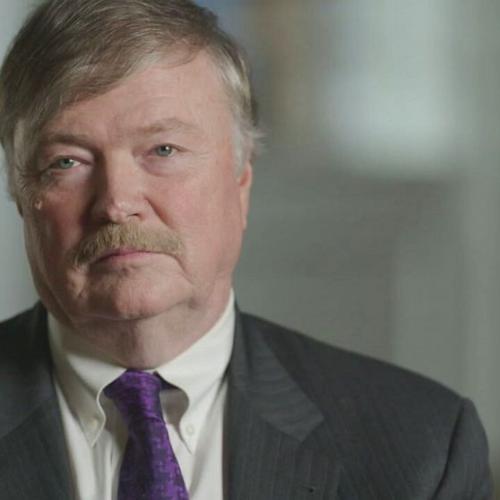

Robert McNamara
- Former US Secretary of Defense
Apocalypse Soon
"What is shocking
is that today, more than a decade after the end of the Cold War, the basic
US nuclear policy is unchanged. Of the 8,000 active or operational US warheads,
2,000 are on hair-trigger alert, ready to be launched on 15 minutes' warning.
On any given day, as we go about our business, the president is prepared to
make a decision within 20 minutes that could launch one of the most devastating
weapons in the world. To declare war requires an act of congress, but to launch
a nuclear holocaust requires 20 minutes' deliberation by the president and
his advisors."
--
Former US Secretary of Defense Robert McNamara, May 2005
Former US Secretary of Defense (under President John Kennedy) Robert McNamara has written a powerful essay exposing an outdated policy that puts our entire nation and world at risk of annihilation at any moment. After 13 years as the president of the World Bank, McNamara risked his career and reputation by going public with his concerns about the policy giving the president the authority to initiate a nuclear holocaust, even when the threat to the US might be based on faulty information. He claims it is long past time to change this dangerous policy in order to avert a future apocalypse.
For another eye-opening article on how the media has been complicit in concealing the dangers of nuclear weapons ever since WWII, see https://www.WantToKnow.info/atomicbombcoverup And for more powerful information revealing how the military/industrial complex promotes war in order to pad the wallets of the corporate elite, see our War Information Center at https://www.WantToKnow.info/warinformation By educating ourselves and those around us on the risks that are a result of greed and secrecy, we can more effectively work together to build a brighter future for us all.
With best
wishes,
Fred Burks for WantToKnow.info
http://www.foreignpolicy.com/story/cms.php?story_id=2829
Foreign Policy magazine (Page 1 of 5)
Apocalypse
Soon
By Robert
S. McNamara
May/June 2005
Robert McNamara is worried. He knows how close we've come. His counsel helped
the Kennedy administration avert nuclear catastrophe during the Cuban Missile
Crisis. Today, he believes the United States must no longer rely on nuclear
weapons as a foreign-policy tool. To do so is immoral, illegal, and dreadfully
dangerous.
It is time - well past time, in my view - for the United States to cease its Cold War-style reliance on nuclear weapons as a foreign-policy tool. At the risk of appearing simplistic and provocative, I would characterize current US nuclear weapons policy as immoral, illegal, militarily unnecessary, and dreadfully dangerous. The risk of an accidental or inadvertent nuclear launch is unacceptably high. Far from reducing these risks, the Bush administration has signaled that it is committed to keeping the US nuclear arsenal as a mainstay of its military power - a commitment that is simultaneously eroding the international norms that have limited the spread of nuclear weapons and fissile materials for 50 years. Much of the current US nuclear policy has been in place since before I was secretary of defense, and it has only grown more dangerous and diplomatically destructive in the intervening years.
Today, the United States has deployed approximately 4,500 strategic, offensive nuclear warheads. Russia has roughly 3,800. The strategic forces of Britain, France, and China are considerably smaller, with 200–400 nuclear weapons in each state's arsenal. The new nuclear states of Pakistan and India have fewer than 100 weapons each. North Korea now claims to have developed nuclear weapons, and US intelligence agencies estimate that Pyongyang has enough fissile material for 2–8 bombs.
How destructive are these weapons? The average US warhead has a destructive power 20 times that of the Hiroshima bomb. Of the 8,000 active or operational US warheads, 2,000 are on hair-trigger alert, ready to be launched on 15 minutes' warning. How are these weapons to be used? The United States has never endorsed the policy of "no first use," not during my seven years as secretary or since. We have been and remain prepared to initiate the use of nuclear weapons - by the decision of one person, the president - against either a nuclear or nonnuclear enemy whenever we believe it is in our interest to do so. For decades, US nuclear forces have been sufficiently strong to absorb a first strike and then inflict "unacceptable" damage on an opponent. This has been and (so long as we face a nuclear-armed, potential adversary) must continue to be the foundation of our nuclear deterrent.
In my time as secretary of defense, the commander of the US Strategic Air Command (SAC) carried with him a secure telephone, no matter where he went, 24 hours a day, seven days a week, 365 days a year. The telephone of the commander, whose headquarters were in Omaha, Nebraska, was linked to the underground command post of the North American Defense Command, deep inside Cheyenne Mountain, in Colorado, and to the US president, wherever he happened to be. The president always had at hand nuclear release codes in the so-called football, a briefcase carried for the president at all times by a US military officer.
The SAC commander's orders were to answer the telephone by no later than the end of the third ring. If it rang, and he was informed that a nuclear attack of enemy ballistic missiles appeared to be under way, he was allowed 2 to 3 minutes to decide whether the warning was valid (over the years, the United States has received many false warnings), and if so, how the United States should respond. He was then given approximately 10 minutes to determine what to recommend, to locate and advise the president, permit the president to discuss the situation with two or three close advisors (presumably the secretary of defense and the chairman of the Joint Chiefs of Staff), and to receive the president's decision and pass it immediately, along with the codes, to the launch sites. The president essentially had two options: He could decide to ride out the attack and defer until later any decision to launch a retaliatory strike. Or, he could order an immediate retaliatory strike, from a menu of options, thereby launching US weapons that were targeted on the opponent's military-industrial assets. Our opponents in Moscow presumably had and have similar arrangements.
The whole situation seems so bizarre as to be beyond belief. On any given day, as we go about our business, the president is prepared to make a decision within 20 minutes that could launch one of the most devastating weapons in the world. To declare war requires an act of congress, but to launch a nuclear holocaust requires 20 minutes' deliberation by the president and his advisors. But that is what we have lived with for 40 years. With very few changes, this system remains largely intact, including the "football," the president's constant companion.
I was able to change some of these dangerous policies and procedures. My colleagues and I started arms control talks; we installed safeguards to reduce the risk of unauthorized launches; we added options to the nuclear war plans so that the president did not have to choose between an all-or-nothing response, and we eliminated the vulnerable and provocative nuclear missiles in Turkey. I wish I had done more, but we were in the midst of the Cold War, and our options were limited.
The United States and our NATO allies faced a strong Soviet and Warsaw Pact conventional threat. Many of the allies (and some in Washington as well) felt strongly that preserving the US option of launching a first strike was necessary for the sake of keeping the Soviets at bay. What is shocking is that today, more than a decade after the end of the Cold War, the basic US nuclear policy is unchanged. It has not adapted to the collapse of the Soviet Union. Plans and procedures have not been revised to make the United States or other countries less likely to push the button. At a minimum, we should remove all strategic nuclear weapons from "hair-trigger" alert, as others have recommended, including Gen. George Lee Butler, the last commander of SAC. That simple change would greatly reduce the risk of an accidental nuclear launch. It would also signal to other states that the United States is taking steps to end its reliance on nuclear weapons.
We pledged to work in good faith toward the eventual elimination of nuclear arsenals when we negotiated the Nuclear Non-Proliferation Treaty (NPT) in 1968. In May, diplomats from more than 180 nations are meeting in New York City to review the NPT and assess whether members are living up to the agreement. The United States is focused, for understandable reasons, on persuading North Korea to rejoin the treaty and on negotiating deeper constraints on Iran's nuclear ambitions. Those states must be convinced to keep the promises they made when they originally signed the NPT - that they would not build nuclear weapons in return for access to peaceful uses of nuclear energy. But the attention of many nations, including some potential new nuclear weapons states, is also on the United States. Keeping such large numbers of weapons, and maintaining them on hair-trigger alert, are potent signs that the United States is not seriously working toward the elimination of its arsenal and raises troubling questions as to why any other state should restrain its nuclear ambitions.
A Preview of the Apocalypse
The destructive power of nuclear weapons is well known, but given the United States' continued reliance on them, it's worth remembering the danger they present. A 2000 report by the International Physicians for the Prevention of Nuclear War describes the likely effects of a single 1 megaton weapon - dozens of which are contained in the Russian and US inventories. At ground zero, the explosion creates a crater 300 feet deep and 1,200 feet in diameter. Within one second, the atmosphere itself ignites into a fireball more than a half-mile in diameter. The surface of the fireball radiates nearly three times the light and heat of a comparable area of the surface of the sun, extinguishing in seconds all life below and radiating outward at the speed of light, causing instantaneous severe burns to people within one to three miles. A blast wave of compressed air reaches a distance of three miles in about 12 seconds, flattening factories and commercial buildings. Debris carried by winds of 250 mph inflicts lethal injuries throughout the area. At least 50 percent of people in the area die immediately, prior to any injuries from radiation or the developing firestorm.
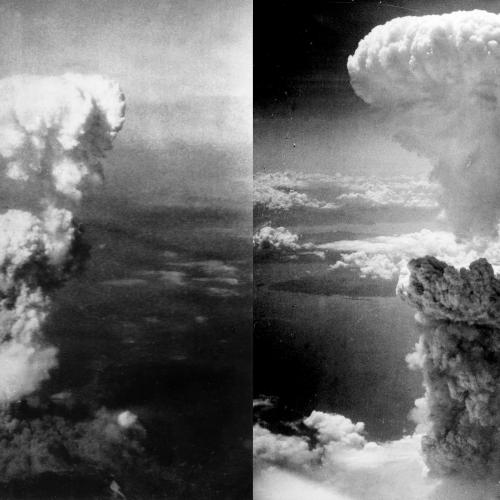
Of course, our knowledge of these effects is not entirely hypothetical. Nuclear weapons, with roughly one seventieth of the power of the 1 megaton bomb just described, were twice used by the United States in August 1945. One atomic bomb was dropped on Hiroshima. Around 80,000 people died immediately; approximately 200,000 died eventually. Later, a similar size bomb was dropped on Nagasaki. On Nov. 7, 1995, the mayor of Nagasaki recalled his memory of the attack in testimony to the International Court of Justice:
Nagasaki became a city of death where not even the sound of insects could be heard. After a while, countless men, women and children began to gather for a drink of water at the banks of nearby Urakami River, their hair and clothing scorched and their burnt skin hanging off in sheets like rags. Begging for help they died one after another in the water or in heaps on the banks.... Four months after the atomic bombing, 74,000 people were dead, and 75,000 had suffered injuries, that is, two-thirds of the city population had fallen victim to this calamity that came upon Nagasaki like a preview of the Apocalypse.
Why did so many civilians have to die? Because the civilians, who made up nearly 100 percent of the victims of Hiroshima and Nagasaki, were unfortunately "co-located" with Japanese military and industrial targets. Their annihilation, though not the objective of those dropping the bombs, was an inevitable result of the choice of those targets. It is worth noting that during the Cold War, the United States reportedly had dozens of nuclear warheads targeted on Moscow alone, because it contained so many military targets and so much "industrial capacity."
Presumably, the Soviets similarly targeted many US cities. The statement that our nuclear weapons do not target populations per se was and remains totally misleading in the sense that the so-called collateral damage of large nuclear strikes would include tens of millions of innocent civilian dead.
This in a nutshell is what nuclear weapons do: They indiscriminately blast, burn, and irradiate with a speed and finality that are almost incomprehensible. This is exactly what countries like the United States and Russia, with nuclear weapons on hair-trigger alert, continue to threaten every minute of every day in this new 21st century.
No Way to Win
I have worked on issues relating to US and NATO nuclear strategy and war plans for more than 40 years. During that time, I have never seen a piece of paper that outlined a plan for the United States or NATO to initiate the use of nuclear weapons with any benefit for the United States or NATO. I have made this statement in front of audiences, including NATO defense ministers and senior military leaders, many times. No one has ever refuted it. To launch weapons against a nuclear-equipped opponent would be suicidal. To do so against a nonnuclear enemy would be militarily unnecessary, morally repugnant, and politically indefensible.
I reached these conclusions very soon after becoming secretary of defense. Although I believe Presidents John F. Kennedy and Lyndon Johnson shared my view, it was impossible for any of us to make such statements publicly because they were totally contrary to established NATO policy. After leaving the Defense Department, I became president of the World Bank. During my 13-year tenure, from 1968 to 1981, I was prohibited, as an employee of an international institution, from commenting publicly on issues of US national security. After my retirement from the bank, I began to reflect on how I, with seven years' experience as secretary of defense, might contribute to an understanding of the issues with which I began my public service career.
At that time, much was being said and written regarding how the United States could, and why it should, be able to fight and win a nuclear war with the Soviets. This view implied, of course, that nuclear weapons did have military utility; that they could be used in battle with ultimate gain to whoever had the largest force or used them with the greatest acumen. Having studied these views, I decided to go public with some information that I knew would be controversial, but that I felt was needed to inject reality into these increasingly unreal discussions about the military utility of nuclear weapons. In articles and speeches, I criticized the fundamentally flawed assumption that nuclear weapons could be used in some limited way. There is no way to effectively contain a nuclear strike - to keep it from inflicting enormous destruction on civilian life and property, and there is no guarantee against unlimited escalation once the first nuclear strike occurs. We cannot avoid the serious and unacceptable risk of nuclear war until we recognize these facts and base our military plans and policies upon this recognition. I hold these views even more strongly today than I did when I first spoke out against the nuclear dangers our policies were creating. I know from direct experience that US nuclear policy today creates unacceptable risks to other nations and to our own.
What Castro Taught Us
Among the costs of maintaining nuclear weapons is the risk - to me an unacceptable risk - of use of the weapons either by accident or as a result of misjudgment or miscalculation in times of crisis. The Cuban Missile Crisis demonstrated that the United States and the Soviet Union - and indeed the rest of the world - came within a hair's breadth of nuclear disaster in October 1962.
Indeed, according to former Soviet military leaders, at the height of the crisis, Soviet forces in Cuba possessed 162 nuclear warheads, including at least 90 tactical warheads. At about the same time, Cuban President Fidel Castro asked the Soviet ambassador to Cuba to send a cable to Soviet Premier Nikita Khrushchev stating that Castro urged him to counter a US attack with a nuclear response. Clearly, there was a high risk that in the face of a US attack, which many in the US government were prepared to recommend to President Kennedy, the Soviet forces in Cuba would have decided to use their nuclear weapons rather than lose them. Only a few years ago did we learn that the four Soviet submarines trailing the US Naval vessels near Cuba each carried torpedoes with nuclear warheads. Each of the sub commanders had the authority to launch his torpedoes. The situation was even more frightening because, as the lead commander recounted to me, the subs were out of communication with their Soviet bases, and they continued their patrols for four days after Khrushchev announced the withdrawal of the missiles from Cuba.
The lesson, if it had not been clear before, was made so at a conference on the crisis held in Havana in 1992, when we first began to learn from former Soviet officials about their preparations for nuclear war in the event of a US invasion. Near the end of that meeting, I asked Castro whether he would have recommended that Khrushchev use the weapons in the face of a US invasion, and if so, how he thought the United States would respond. "We started from the assumption that if there was an invasion of Cuba, nuclear war would erupt," Castro replied. "We were certain of that.... [W]e would be forced to pay the price that we would disappear." He continued, "Would I have been ready to use nuclear weapons? Yes, I would have agreed to the use of nuclear weapons." And he added, "If Mr. McNamara or Mr. Kennedy had been in our place, and had their country been invaded, or their country was going to be occupied ... I believe they would have used tactical nuclear weapons."
I hope that President Kennedy and I would not have behaved as Castro suggested we would have. His decision would have destroyed his country. Had we responded in a similar way the damage to the United States would have been unthinkable. But human beings are fallible. In conventional war, mistakes cost lives, sometimes thousands of lives. However, if mistakes were to affect decisions relating to the use of nuclear forces, there would be no learning curve. They would result in the destruction of nations. The indefinite combination of human fallibility and nuclear weapons carries a very high risk of nuclear catastrophe. There is no way to reduce the risk to acceptable levels, other than to first eliminate the hair-trigger alert policy and later to eliminate or nearly eliminate nuclear weapons. The United States should move immediately to institute these actions, in cooperation with Russia. That is the lesson of the Cuban Missile Crisis.
A Dangerous Obsession
On Nov. 13, 2001, President George W. Bush announced that he had told Russian President Vladimir Putin that the United States would reduce "operationally deployed nuclear warheads" from approximately 5,300 to a level between 1,700 and 2,200 over the next decade. This scaling back would approach the 1,500 to 2,200 range that Putin had proposed for Russia. However, the Bush administration's Nuclear Posture Review, mandated by the US Congress and issued in January 2002, presents quite a different story. It assumes that strategic offensive nuclear weapons in much larger numbers than 1,700 to 2,200 will be part of US military forces for the next several decades. Although the number of deployed warheads will be reduced to 3,800 in 2007 and to between 1,700 and 2,200 by 2012, the warheads and many of the launch vehicles taken off deployment will be maintained in a "responsive" reserve from which they could be moved back to the operationally deployed force. The Nuclear Posture Review received little attention from the media. But its emphasis on strategic offensive nuclear weapons deserves vigorous public scrutiny. Although any proposed reduction is welcome, it is doubtful that survivors - if there were any - of an exchange of 3,200 warheads (the US and Russian numbers projected for 2012), with a destructive power approximately 65,000 times that of the Hiroshima bomb, could detect a difference between the effects of such an exchange and one that would result from the launch of the current US and Russian forces totaling about 12,000 warheads.
In addition to projecting the deployment of large numbers of strategic nuclear weapons far into the future, the Bush administration is planning an extensive and expensive series of programs to sustain and modernize the existing nuclear force and to begin studies for new launch vehicles, as well as new warheads for all of the launch platforms. Some members of the administration have called for new nuclear weapons that could be used as bunker busters against underground shelters (such as the shelters Saddam Hussein used in Baghdad). New production facilities for fissile materials would need to be built to support the expanded force. The plans provide for integrating a national ballistic missile defense into the new triad of offensive weapons to enhance the nation's ability to use its "power projection forces" by improving our ability to counterattack an enemy. The Bush administration also announced that it has no intention to ask congress to ratify the Comprehensive Test Ban Treaty (CTBT), and, though no decision to test has been made, the administration has ordered the national laboratories to begin research on new nuclear weapons designs and to prepare the underground test sites in Nevada for nuclear tests if necessary in the future. Clearly, the Bush administration assumes that nuclear weapons will be part of US military forces for at least the next several decades.
Good faith participation in international negotiation on nuclear disarmament - including participation in the CTBT - is a legal and political obligation of all parties to the NPT that entered into force in 1970 and was extended indefinitely in 1995. The Bush administration's nuclear program, alongside its refusal to ratify the CTBT, will be viewed, with reason, by many nations as equivalent to a US break from the treaty. It says to the nonnuclear weapons nations, "We, with the strongest conventional military force in the world, require nuclear weapons in perpetuity, but you, facing potentially well-armed opponents, are never to be allowed even one nuclear weapon."
If the United States continues its current nuclear stance, over time, substantial proliferation of nuclear weapons will almost surely follow. Some, or all, of such nations as Egypt, Japan, Saudi Arabia, Syria, and Taiwan will very likely initiate nuclear weapons programs, increasing both the risk of use of the weapons and the diversion of weapons and fissile materials into the hands of rogue states or terrorists. Diplomats and intelligence agencies believe Osama bin Laden has made several attempts to acquire nuclear weapons or fissile materials. It has been widely reported that Sultan Bashiruddin Mahmood, former director of Pakistan's nuclear reactor complex, met with bin Laden several times. Were al Qaeda to acquire fissile materials, especially enriched uranium, its ability to produce nuclear weapons would be great. The knowledge of how to construct a simple gun-type nuclear device, like the one we dropped on Hiroshima, is now widespread. Experts have little doubt that terrorists could construct such a primitive device if they acquired the requisite enriched uranium material. Indeed, just last summer, at a meeting of the National Academy of Sciences, former Secretary of Defense William J. Perry said, "I have never been more fearful of a nuclear detonation than now.... There is a greater than 50 percent probability of a nuclear strike on US targets within a decade." I share his fears.
A Moment of Decision
We are at a critical moment in human history - perhaps not as dramatic as that of the Cuban Missile Crisis, but a moment no less crucial. Neither the Bush administration, the congress, the American people, nor the people of other nations have debated the merits of alternative, long-range nuclear weapons policies for their countries or the world. They have not examined the military utility of the weapons; the risk of inadvertent or accidental use; the moral and legal considerations relating to the use or threat of use of the weapons; or the impact of current policies on proliferation. Such debates are long overdue. If they are held, I believe they will conclude, as have I and an increasing number of senior military leaders, politicians, and civilian security experts: We must move promptly toward the elimination - or near elimination - of all nuclear weapons. For many, there is a strong temptation to cling to the strategies of the past 40 years. But to do so would be a serious mistake leading to unacceptable risks for all nations.
See the exceptional collection of resources in our Inspiration Center
Kindly support this work: Donate here
www.momentoflove.org - Every person in the world has a heart
www.personalgrowthcourses.net - Dynamic online courses powerfully expand your horizons
www.WantToKnow.info - Reliable, verifiable information on major cover-ups
www.weboflove.org - Strengthening the Web of Love that interconnects us all
Subscribe/Unsubscribe/Change email address: The WantToKnow.info email list (two messages a week)
Robert McNamara - Apocalypse Soon