





















9/11 Attacks
Verifiable Media Reports on 9/11 Attacks
25-Page Summary of 9/11 Attacks Timeline Developed by Paul Thompson
For an excellent two-page summary of the best of this 9/11 attacks timeline, click here
For excerpts from 20 of the most revealing major media articles on 9/11 attacks, click here
To verify 9/11 attacks information below, use links to original articles on mass media websites
Join in powerfully building a better world for all by spreading the word
The 9/11 attack was one of the most pivotal events in world history. Its impact will be felt for years to come. You owe it to yourself to go beyond the sound bites and the simplified official story. This is an extremely complicated story with numerous players and motives. The information on the 9/11 attacks doesn't all make sense or fit neatly together. It's a story full of espionage, deceit, and lies. But if forces out there are tricking us, they can only succeed if we, the public, remain ignorant and passive.
We limit our sources on this 9/11 attacks timeline to the mainstream media. It's not that one can only trust the major media. Much of the best reporting today is coming from alternative media. Yet many people are initially very skeptical. Some of the 9/11 attacks information below is very hard to believe. Yet remember that each entry is reported by respected mainstream media sources and can easily be verified by clicking on the links provided to the original source. After seeing the importance of what's being hidden, you will very likely want to join in working together to build a brighter future.
Important Note: To skip directly to the 9/11 attacks timeline for the actual day of 9/11, click here. And for any link not active on this 9/11 timeline, you can use the Internet archive to search for the original article. For instructions on how to do this, click here.
1984: Osama Bin Laden moves to a Pakistani town bordering Afghanistan, and is running a front organization for the mujaheddin known as MAK, which funnels money, arms and fighters from the outside world into the Afghan war. [New Yorker, 1/24/00] "MAK was nurtured by Pakistan's state security services, the Inter-Services Intelligence agency, or ISI, the CIA's primary conduit for conducting the covert war against Moscow's occupation." [MSNBC, 8/24/98] He becomes closely tied to the warlord Gulbuddin Hekmatyar, and greatly strengthens Hekmatyar's opium smuggling operations. [Le Monde, 9/14/01] Hekmatyar had ties with the CIA and drug running, and has also been called "an ISI stooge and creation" by the Wall Street Journal. [Atlantic, 5/96, Asia Times, 11/15/01]
Mid-1980's: The ISI starts a special cell of agents who use profits from heroin production for covert actions "at the insistence of the CIA." This cell promotes the cultivation of opium and extraction of heroin in territory under mujaheddin control for being smuggled into Soviet controlled areas, in order to turn the Soviet troops into heroin addicts. After the withdrawal of the Soviet troops, the ISI's heroin cell started smuggling heroin to the Western countries and using the money as a supplement to its legitimate economy. [Financial Times, Asian edition, 8/10/01] The ISI grows so powerful on this money, that Time magazine later states, "Even by the shadowy standards of spy agencies, the ISI is notorious. It is commonly branded 'a state within the state,' or Pakistan's 'invisible government.'" [Time, 5/6/02]
March 1985: The US escalates the war in Afghanistan. The CIA, British MI6 and the ISI agree to launch guerrilla attacks from Afghanistan into then Soviet-controlled Tajikistan and Uzbekistan. The CIA also begins supporting the ISI in recruiting radical Muslims from around the world to come to Pakistan and fight with the Afghan mujaheddin. The CIA gives subversive literature and Korans to the ISI, who carry them into the Soviet Union. Eventually, around 35,000 Muslim radicals from 43 Islamic countries will fight with the Afghan mujaheddin. [Washington Post, 7/19/92, Pittsburgh Post-Gazette, 9/23/01, Honolulu Star-Bulletin, 9/23/01, The Hindu, 9/27/01, Taliban: Militant Islam, Oil and Fundamentalism in Central Asia, Ahmed Rashid, 3/01] In the late 1980's, Pakistan's Prime Minister Benazir Bhutto, feeling the mujaheddin network has grown too strong, tells President George Bush Sr., "You are creating a Frankenstein." [Newsweek, 10/1/01]
1993: One of bin Laden's men buys a jet from the US military–and it was the Pentagon which unwittingly gave permission for the aircraft to leave the base. This aircraft is later used to transport missiles that kill US special forces in Somalia. Bin Laden also has some of his followers begin training as pilots in US flight schools. [Sunday Herald, 9/16/01]
February 26, 1993: An attempt to blow up the WTC fails. The New York Times later reports on Emad Salem, an undercover agent who ends up being the key government witness in the trial against the bomber. Salem testifies that the FBI knew about the attack beforehand and told him they would thwart it by substituting a harmless powder for the explosives. However, this plan was called off by an FBI supervisor, and the bombing was not stopped. [New York Times, 10/28/93] Several of the bombers were trained by the CIA to fight in the Afghan war - the CIA later concludes in internal documents that it was "partly culpable" for this bombing attempt. [Independent, 11/1/98]
1994: Two attacks take place which involve hijacking planes to crash them into buildings, including one by an Islamic militant group. In a third attack, a lone pilot crashes a plane at the White House. Yet after Sept. 11, over and over aviation and security officials say they are shocked that terrorists could have hijacked airliners and crashed them into landmark buildings. [New York Times, 10/3/01]
1995: For the first time, though not the last, the government of Sudan offers the US all of its files on bin Laden and al-Qaeda. The US turns down the offer. Sudan was surveilling him, collecting a "vast intelligence database on Osama bin Laden and more than 200 leading members of his al-Qaeda terrorist network... [The US was] offered thick files, with photographs and detailed biographies of many of his principal cadres, and vital information about al-Qaeda's financial interests in many parts of the globe." [Guardian, 9/30/01, more]
January 6, 1995: One pilot who learned to fly in US flight schools, confesses that his role was to crash a plane into the CIA headquarters as part of this phrase of attacks. [Washington Post, 9/23/01, more]
October 21, 1995: The oil company Unocal signs a contract with Turkmenistan to export $8 billion worth of natural gas through a $3 billion pipeline which would go from Turkmenistan through Afghanistan to Pakistan. Political considerations and pressures allow Unocal to edge out a more experienced Argentinean company for the contract. Henry Kissinger, a Unocal consultant, calls it "the triumph of hope over experience." [Washington Post, 10/5/98]
1996: Analysts start working through the night in a chamber, deep in the bowels of CIA headquarters, known as the Bin Laden Room. Approximately 10-15 individuals are assigned to the unit, part of the CIA's Counter-Terrorism Center. By September 10, 2001, there are approximately 35-40 personnel assigned. Recognizing the danger posed by Bin Laden, the FBI also created a unit in 1999 at FBI headquarters to focus on him. [Newsweek, 10/1/01, Senate Intelligence Committee, 9/18/02]
1996: The Saudi Arabian government is financially supporting Osama bin Laden's Al Qaeda and other extremist groups. After 9/11, the Bush Administration chooses not to confront the Saudi leadership over its support of terror organizations and its refusal to help in the investigation. [New Yorker, 10/22/01]
1996-1999: The CIA officer in charge of running operations against Al Qaeda from Washington writes, "I speak with firsthand experience (and for several score of CIA officers) when I state categorically that during this time senior White House officials repeatedly refused to act on sound intelligence that provided multiple chances to eliminate Osama bin Laden." [Los Angeles Times, 12/5/04]
1996-2001: Federal authorities are aware for years before 9/11 that suspected terrorists with ties to Osama bin Laden are receiving flight training at schools in the US and abroad. In 1996, FBI agents visit two flight school operators to obtain information about several Arab pilots eventually convicted of plotting to bomb U.S. airliners. In 1998, FBI agents question officials from a flight school in Oklahoma, about a graduate later identified in court testimony as a pilot for bin Laden. One convicted terrorist even confesses that his planned role in a terror attack was to crash a plane into CIA headquarters. A senior government official later acknowledges that law enforcement officials were aware that up to a dozen people with links to bin Laden had attended U.S. flight schools. [Washington Post, 9/23/01, CBS, 5/30/02, Time, 6/10/02]
April 1996: In continuing negotiations between the US and Sudan, the US again rejects Sudan's offer to turn over voluminous files about bin Laden and al-Qaeda [Village Voice, 10/31/01, Washington Post, 10/3/01] Around this time Sudan also offers their al-Qaeda intelligence to MI6, the British intelligence agency, and are also rebuffed. [Guardian, 9/30/01, more]
August 13, 1996: Unocal and Delta Oil of Saudi Arabia come to agreement with state companies in Turkmenistan and Russia to build a natural gas pipeline from Turkmenistan to Pakistan via Afghanistan. The agreement is finalized the next year. [Unocal website, 8/13/96]
1997: Former National Security Advisor Zbigniew Brzezinski publishes a book in which he portrays the Eurasian landmass as the key to world power, and Central Asia with its vast oil reserves as the key to domination of Eurasia. He states that for the US to maintain its global primacy, it must prevent any possible adversary from controlling that region. He notes that because of popular resistance to US military expansionism, his ambitious strategy could not be implemented "except in the circumstance of a truly massive and widely perceived direct external threat." [The Grand Chessboard: American Primacy and its Geostrategic Imperatives]
May 18, 1998: An Oklahoma City FBI agent sends a memo on this day warning that "large numbers of Middle Eastern males" are getting flight training in Oklahoma and could be planning terrorist attacks. [CBS, 5/30/02, AP, 9/26/01, CNN, 9/18/01]
June 1998: US intelligence obtains information from several sources that bin Laden is considering attacks in the US, including Washington and New York. This information is given to senior US officials in July 1998. [Senate Intelligence Committee, 9/18/02]
August 1998: A CIA intelligence report asserts that Arab terrorists are planning to fly a bomb-laden aircraft into the WTC. [NY Times, 9/19/02, Senate Intelligence Committee, 9/18/02]
August 1998: Within minutes of each other, truck bombs blow up the US embassies in Tanzania and Kenya, killing more than 220. For some of the time that bin Laden's men were plotting to blow up the two embassies, US intelligence was tapping their phones. [Newsweek, 10/1/01]
September 1998: US intelligence finds information that bin Laden's next operation could possibly involve crashing an aircraft loaded with explosives into a US airport. This information is provided to senior US officials. [Senate Intelligence Committee, 9/18/02, Washington Post, 9/19/02]
December 21, 1998: In a Time magazine cover story entitled "The Hunt for Osama," it is reported intelligence sources "have evidence that bin Laden may be planning his boldest move yet - a strike on Washington or possibly New York City in an eye-for-an-eye retaliation. [Time, 12/21/98]
Late 1998: President Clinton signs a directive authorizing the CIA to plan an assassination of bin Laden. The CIA draw up detailed profiles of bin Laden's daily routines, where he sleeps, and his travel arrangements. The assassination never happens, supposedly because of inadequate intelligence. An officer who helped draw up the plans says, "We were ready to move" but "we were not allowed to do it." [Philadelphia Inquirer, 9/16/01]
Late 1998-Early 2000: The US permanently stations two submarines in the Indian Ocean to hit al-Qaeda with cruise missiles on short notice. Six to ten hours advance warning is needed to have them reach their target. On at least three occasions, spies in Afghanistan report bin Laden's location with information suggesting he would remain there for some time. Each time, Clinton approves the strike. Each time, CIA Director Tenet says the information is not reliable enough and the attack cannot go forward. [Washington Post, 12/19/01, New York Times, 12/30/01]
1999: MI6, the British intelligence agency, gives a secret report to liaison staff at the US embassy in London. The reports states that al-Qaeda has plans to use "commercial aircraft" in "unconventional ways", "possibly as flying bombs." [Sunday Times, 6/9/02]
September 1999: A report prepared for US intelligence states: "Al-Qaeda could crash-land an aircraft packed with high explosives (C-4 and Semtex) into the Pentagon, the headquarters of the Central Intelligence Agency (CIA), or the White House." The report is by the National Intelligence Council, which advises the President and US intelligence on emerging threats. [AP, 5/18/02, read the complete report] The Bush administration later claims to have never heard of this report until May 2002, despite the fact that it had been publicly posted on the internet since 1999, and "widely shared within the government." [CNN, 5/18/02, New York Times, 5/18/02]
November 3, 1999: The head of Australia's security services admits that the Echelon global surveillance system exists. The US still denies its existence. The BBC describes Echelon's power as "astounding," and elaborates: "Every international telephone call, fax, e-mail, or radio transmission can be listened to by powerful computers capable of voice recognition. They home in on a long list of key words, or patterns of messages. They are looking for evidence of international crime, like terrorism." [BBC, 11/3/99]
January 2000: George Bush Sr. meets with the bin Laden family on behalf of the Carlyle Group. He also met with them in 1998. Bush's chief of staff could not remember that this meeting took place until shown a thank you note confirming the meeting. [Wall Street Journal, 9/27/01, Guardian, 10/31/01]
January-June 2000: Pakistani ISI Director General Ahmad orders an aide to wire transfer about $100,000 to hijacker Atta. [Dawn, 10/8/01, Times of India, 10/9/01, Wall Street Journal, 10/10/01, AFP, 10/10/01] The individual who makes the wire transfer at Ahmad's direction is Saeed Sheikh, later convinced for kidnapping and murdering reporter Daniel Pearl in February 2002. [ABC News, 9/30/01]
July 2000: The Taliban ban poppy growing in Afghanistan. As a result, the opium yield drops dramatically in 2001, from 3,656 tons to 185 tons. [Guardian, 2/21/02, Reuters, 3/3/02, Observer, 11/25/01]
Summer 2000: A secret military operation named Able Danger identifies four future 9/11 hijackers, including lead hijacker Mohamed Atta, as a potential threat and members of Al Qaeda. Yet none of this is mentioned later in the 9/11 Commissions' final report .When questioned, the 9/11 commission's chief spokesman initially says that staff members briefed about Able Danger did not remember hearing anything about Atta. Days later, however, after provided detailed information, he says the uniformed officer who briefed two staff members had indeed mentioned Atta. Officials say that the information was not included in the report because the account had sounded inconsistent with what the commission knew about Atta. [New York Times, 8/11/05, more]
September 2000: A neo-conservative think-tank writes a blueprint for the creation of a "global Pax Americana." Written for the Bush team even before the 2000 Presidential election, the report calls itself a blueprint for maintaining global US preeminence, precluding the rise of a great power rival, and shaping the international security order in line with American principles and interests. The plan shows Bush intended to take military control of the Persian Gulf whether or not Saddam Hussein was in power. The report calls for the subversion of any growth in political power of even close allies. It also mentions that "advanced forms of biological warfare that can 'target' specific genotypes may transform biological warfare from the realm of terror to a politically useful tool." The report advocates the transformation of the US military. But, the authors acknowledge: "the process of transformation, even if it brings revolutionary change, is likely to be a long one, absent some catastrophic and catalyzing event - like a new Pearl Harbour". [BBC, 2/14/07, Sunday Herald, 9/7/02, click here to download report]
September 15-October 1, 2000: Olympics officials later reveal that "A fully loaded, fueled airliner crashing into the opening ceremony before a worldwide television audience at the Sydney Olympics was one of the greatest security fears for the Games." [Sydney Morning Herald, 9/20/01]
October 24-26, 2000: Pentagon officials carry out a "detailed" emergency drill based upon the crashing of a hijacked airliner into the Pentagon. [Military District of Washington News Service, 11/3/00, Mirror, 5/24/02] After 9/11, a Pentagon spokesman will claim: "The Pentagon was simply not aware that this aircraft was coming our way. I doubt prior to Tuesday's event, anyone would have expected anything like that here." [Newsday, 9/23/01]
2000 – 2001: The military conducts exercises simulating what the White House says was unimaginable at the time: hijacked airliners used as weapons to crash into targets and cause mass casualties. One imagined target is the WTC. [USA Today, 4/19/04]
2001: Julie Sirrs, a Defense Intelligence Agency agent, travels twice to Afghanistan. She claims DIA officials knew in advance about both trips. Sirrs sees a terrorist training center, and meets with the Northern Alliance leader who is later assassinated by the Taliban. On her second trip she returns with a treasure trove of information, including evidence that bin Laden is planning to assassinate Massoud. However, upon returning, a security officer meets her flight and confiscates her material. The DIA and the FBI investigate her. No higher-ups want to hear what she has learned in Afghanistan. Ultimately, Sirrs' security clearance is pulled. She eventually quits the DIA in frustration. [ABC, 2/18/02]
January 2001: An Arizona flight school alerts the FAA that hijacker Hani Hanjour lacks the English and flying skills necessary for the commercial pilot's license he has. An FAA official actually sits next to Hanjour in class to observe his skills. This official offers a translator to help Hanjour pass, but the flight school points out "that went against the rules that require a pilot to be able to write and speak English fluently before they even get their license." [AP, 5/10/02] Yet despite his poor flying skills, official reports later state Hanjour executes a 330 to 360 degree turn of AA Flight 77 over Washington on 9/11 in under four minutes and manages a precision hit on the Pentagon. [New York Times, 10/16/01, NTSB Report, 2/19/02]
Late January 2001: The BBC later reports, "After the elections, [US intelligence] agencies [are] told to 'back off' investigating the bin Ladens and Saudi royals." This follows previous orders to abandon an investigation both of bin Laden relatives and of difficulties in investigating Saudi royalty. [BBC, 11/6/01]
February-July 2001: A trial is held in New York City for four defendants charged with involvement in the 1998 US embassy bombings. Testimony reveals that two bin Laden operatives had received pilot training in Texas and Oklahoma and another had been asked to take lessons. One bin Laden aide becomes a government witness and gives the FBI detailed information about a pilot training scheme. This new information does not lead to any new FBI investigations into the matter. [Washington Post, 9/23/01, more]
March 2001: A Taliban envoy meets with reporters, State Department bureaucrats and Afghanistan experts in Washington. He discusses turning bin Laden over. But the US wants to be handed bin Laden directly, and the Taliban want to turn him over to some third country. About 20 meetings on giving up bin Laden take place between 1996 and Sep 2001, all fruitless. [Washington Post, 10/29/01]
Spring 2001: Over several months beginning in April a series of military and governmental policy documents are released that seek to legitimize the use of US military force in the pursuit of oil and gas. An article in by a former staff member of the Senate armed services committee argues for the legitimacy of "shooting in the Persian Gulf on behalf of lower gas prices." He also "advocate[s] the acceptability of presidential subterfuge in the promotion of a conflict" and "explicitly urge[s] painting over the US's actual reasons for warfare as a necessity for mobilising public support for a conflict." In April, the commander of US forces in the Persian Gulf/South Asia testifies to Congress that his command's key mission is "access to energy resources." [Sydney Morning Herald, 12/26/02, more]
April 2001: A report commissioned by former US Secretary of State James Baker and the Council on Foreign Relations argues "the US remains a prisoner of its energy dilemma." One of the consequences of this is a "need for military intervention" to secure its oil supply. It argues that Iraq needs to be overthrown so the US can control its oil. [Sunday Herald, 10/5/02, Sydney Morning Herald, 12/26/02]
May 2001: Secretary of State Powell gives $43 million in aid to Afghanistan's Taliban government, purportedly to assist hungry farmers who are starving since the destruction of their opium crop in January on orders of the Taliban. [[Los Angeles Times, 5/22/01] This follows $113 million given by the US in 2000 for humanitarian aid. [State Department Fact Sheet, 12/11/01]
May 2001: The US introduces the "Visa Express" program in Saudi Arabia, which allows any Saudi Arabian to obtain visas through their travel agent instead of appearing at a consulate in person. An official later states, "The issuing officer has no idea whether the person applying for the visa is actually the person in the documents and application." [US News and World Report, 12/12/01, Congressional Intelligence, 9/20/02] At the time, warnings of an attack against the US led by the Saudi bin Laden are "off the charts" as one Senator later puts it. [LA Times, 5/18/02, Senate Intelligence, 9/18/02] Five hijackers use Visa Express over the next month to enter the US. [Congress, 9/20/02]
May-Aug 2001: A number of the 9/11 hijackers make at least six trips to Las Vegas. These "fundamentalist" Muslims drink alcohol, frequent strip clubs, and smoke hashish. Some even have strippers perform lap dances for them. [San Francisco Chronicle, 10/4/01, Newsweek, 10/15/01]
June 2001: German intelligence warns the CIA, Britain's MI6, and Israel's Mossad that Middle Eastern terrorists are planning to hijack commercial aircraft to use as weapons to attack "American and Israeli symbols." [Frankfurter Allgemeine Zeitung, 9/11/01, Washington Post, 9/14/01, Fox News, 5/17/02]
June 1-2, 2001: A multi-agency planning exercise sponsored by NORAD (the North American Aerospace Defense Command, in charge of defending US airspace) involves the hypothetical scenario of a cruise missile launched from a barge off the East Coast. Bin Laden is pictured on the cover of the proposal for the exercise. [American Forces Press Service, 6/4/02] After 9/11, the government claims that this type of an attack was completely unexpected, and as a result it had only 14 fighters on standby to defend the entire US. [Newsday, 9/23/01]
June 13, 2001: Egyptian President Mubarak claims that Egyptian intelligence discovers a "communiqué from bin Laden saying he wanted to assassinate George W. Bush and other G8 heads of state during their summit in Italy." The communiqué specifically mentions this would be done via "an airplane stuffed with explosives." [New York Times, 9/26/01]
June 28, 2001: CIA Director George J. Tenet has been "nearly frantic" with concern. A written intelligence summary for national security adviser Condoleezza Rice says: "It is highly likely that a significant al Qaeda attack is in the near future, within several weeks." Rice will later claim that everyone was taken by complete surprise by the 9/11 attack. By late summer, one senior political appointee says, Tenet had repeated this threat "so often that people got tired of hearing it." [Washington Post, 5/17/02]
July 4-14, 2001: Bin Laden allegedly receives kidney treatment from Canadian-trained Dr. Callaway at the American hospital in Dubai, United Arab Emirates. Callaway refuses to answer any questions on this matter. [Le Figaro, 10/31/01, Sydney Morning Herald, 10/31/01, UPI, 11/1/01, Times of London, 11/1/01] During his stay, bin Laden is visited by "several members of his family and Saudi personalities," including Prince al Faisal, then head of Saudi intelligence, as well as two CIA officers. [Guardian, 11/1/01]
July 10, 2001: Phoenix, Arizona FBI agent Ken Williams sends a memorandum warning about suspicious activities involving a group of Middle Eastern men taking flight training lessons in Arizona. The memorandum specifically suggests that bin Laden's followers might be trying to infiltrate the civil aviation system and recommends a national program to track suspicious flight-school students. The memo is sent to the counter-terrorism division at FBI headquarters in Washington and to two field offices, including the counter-terrorism section in New York, which has had extensive experience in al-Qaeda investigations. The memo is ignored in all three places, not passed on to others, and no action is taken. [New York Times, 5/21/02, Fortune, 5/22/02] Vice President Cheney states in May 2002 that the memo should never be released to the media or public. [CNN, 5/20/02]
July 13, 2001: With the threat of a new terrorist attack on the rise, the CIA has agents reexamine records in the search for new leads. A CIA cable is rediscovered showing that Khallad bin Atash had attended a January 2000 meeting in Malaysia. The CIA official who finds it immediately e-mails the CIA's Counter-Terrorism Center (CTC), saying bin Atash "is a major league killer, who orchestrated the Cole attack and possibly the Africa bombings." Yet bin Atash is still not put on a terrorist watch list. [Congressional Intelligence Committee, 9/20/02]
Mid-July 2001: John O'Neill, FBI counter-terrorism expert, privately discusses White House obstruction in his bin Laden investigation. O'Neill says: "The main obstacles to investigate Islamic terrorism were US oil corporate interests and the role played by Saudi Arabia in it." [CNN, 1/8/02, CNN, 1/9/02, Irish Times, 11/19/01, Bin Laden: The Forbidden Truth, (the link is an excerpt containing Chapter 1)]
July 24, 2001: Larry Silverstein's $3.2 billion purchase of the WTC is finalized. [NY Times, 02/16/03, Ireizine, 7/26/01] It's the only time the WTC has ever changed hands. [ICSC, 4/27/01] Silverstein may get $7 billion in insurance from the 9/11 destruction of the WTC towers. [Guardian, 10/24/01]
July 26,
2001: CBS News reports that
Attorney General Ashcroft has stopped flying commercial airlines due to
a threat assessment, but "neither the FBI nor the Justice Department
would identify what the threat was, when it was detected or who made it."
[CBS,
7/26/01] In May 2002, it's claimed the threat assessment had nothing
to do with al-Qaeda, but Ashcroft walked out of his office rather than answer
questions about it. [AP, 5/16/02, more] CBS's
Dan Rather later says of this warning: "Why wasn't it shared with the
public at large?" [Washington
Post, 5/27/02]
July 31, 2001: The FAA issues another warning to US airlines, citing
no specific targets, but saying "terror groups are known to be planning
and training for hijackings. The text of these warnings remain classified.
[CNN,
3/02, Ananova,
5/17/02]
Late July 2001: The Taliban Foreign Minister learns that bin Laden is planning a "huge attack" on targets inside America. The attack is imminent, and will kill thousands. He sends an emissary to pass this information on to the US consul general, and another US official, "possibly from the intelligence services," also attends the meeting. The message is not taken very seriously. The emissary then takes the message to the Kabul offices of UNSMA, the political wing of the UN. They also fail to take the warning seriously. [Independent, 9/7/02, Reuters, 9/7/02]
Late July 2001: David Schippers, noted Chicago lawyer and the chief investigator in the Clinton impeachment trial, claims that FBI agents contact him around this time and tell him that a terrorist attack is going to occur in lower Manhattan. The agents had been developing extensive information on the planned attack for many months. However, the FBI soon pulls them off the terrorist investigation and threatens them with prosecution under the National Security Act if they go public with the information. Schippers tries to pass the information on to high government officials but his efforts are ignored. He is now representing at least ten FBI agents in a suit against the government to have their testimony subpoenaed, which would enable them to legally tell what they know without going to jail. [Judicial Watch, 11/14/01, Alex Jones Show, 10/10/01, World Net Daily, 10/21/01, note sources are partisan]
Late July 2001: Just days after Atta returns to the US from Spain, Egyptian intelligence in Cairo says it received a report from operatives in Afghanistan that 20 al-Qaeda members had slipped into the US and four of them had received flight training on Cessnas. They pass on the message to the CIA, fully expecting Washington to request information. The request never comes. [CBS, 10/9/02]
Summer 2001: Intelligence officials know that al Qaeda both hopes to use planes as weapons and seeks to strike a violent blow within the US, despite government claims following the 9/11 attacks that the World Trade Center and Pentagon attacks came "like bolts from the blue." [Wall Street Journal, 09/19/02]
Late summer 2001: Jordanian intelligence makes a communications intercept deemed so important that King Abdullah's men relay it to Washington. To make doubly sure the message gets through it is passed through an Arab intermediary to a German intelligence agent. The message states that a major attack is planned inside the US and that aircraft will be used. Christian Science Monitor calls the story "confidently authenticated" even though Jordan has backed away from it. [International Herald Tribune, 5/21/02, Christian Science Monitor, 5/23/02]
August 2001: Russian President Putin later says publicly that he ordered his intelligence agencies to alert the US of suicide pilots training for attacks on US targets. [Fox News, 5/17/02] The head of Russian intelligence also states, "We had clearly warned them" on several occasions, but they "did not pay the necessary attention." [Agence France-Presse, 9/16/01] A Russian newspaper on September 12, 2001 claims that "Russian Intelligence agents know the organizers and executors of these terrorist attacks. More than that, Moscow warned Washington about preparation for these actions a couple of weeks before they happened." [Izvestia, 9/12/01, the story currently on the Izvestia web site has been edited to delete a key paragraph, the link is to a translation of the original article]
Early August 2001: Britain gives the US another warning about an al-Qaeda attack.The previous British warning on July 16th was vague as to method, but this warning specifies multiple airplane hijackings. This warning is included in Bush's briefing on August 6. [Sunday Herald, 5/19/02]
August 6, 2001: President Bush receives a classified intelligence briefing indicating that bin Laden might be planning to hijack commercial airliners. The memo read to him is titled "Bin Ladin Determined to Strike in US." Yet Bush later states the briefing "said nothing about an attack on America." [CNN, 4/12/04, Washington Post, 4/12/04, White House, 4/11/04] The memo focuses on the possibility of terrorist attacks inside the US, and specifically mentions the World Trade Center. National Security Advisor Rice later claims the memo was "fuzzy and thin". The existence of this memo is kept secret until May 2002. [Newsweek, 5/27/02, New York Times, 5/16/02, Die Zeit, 10/1/02] Incredibly, the New York Times later reports that Bush "broke off from work early and spent most of the day fishing." [New York Times, 5/25/02, Intelligence Briefing, 8/6/01 posted on George Washington University's National Security Archives]
August 8-15, 2001: At some point between these dates, Israel warns the US that an al-Qaeda attack is imminent. [Fox News, 5/17/02] Two high ranking agents from the Mossad come to Washington and warn the FBI and CIA that from 50 to 200 terrorists have slipped into the US and are planning "a major assault on the United States." They say indications point to a "large scale target." [Telegraph, 9/16/01, Los Angeles Times, 9/20/01, Ottawa Citizen, 9/17/01] The Los Angeles Times later retracts the story after a CIA spokesman says, "There was no such warning. Allegations that there was are complete and utter nonsense." [Los Angeles Times, 9/21/01]
August 13-15, 2001: Zacarias Moussaoui trains at a flight school in Minneapolis. After just one day of training the staff is suspicious that he's a terrorist. They discuss "how much fuel [is] on board a 747-400 and how much damage that could cause if it hit anything." They call the FBI later that day. [New York Times, 2/8/02, Senate Intelligence Committee, 10/17/02] Failing to get much initial interest from the FBI, the flight instructor tells the FBI agents, "Do you realize how serious this is? This man wants training on a 747. A 747 fully loaded with fuel could be used as a weapon!" [New York Times, 2/8/02]
August 15, 2001: Based on the concerns of flight school staff, Zacarias Moussaoui is arrested and detained. [Time, 5/27/02] The FBI confiscates his possessions, including a computer laptop, but doesn't have a search warrant to search through them. He is supposedly in the US working as a "marketing consultant" for a computer company, but is unable to provide any details of his employment. Nor can he convincingly explain his $32,000 bank balance. [MSNBC, 12/11/01, Senate Intelligence, 10/17/02] The report also notes "Moussaoui was extremely evasive in many of his answers." [CNN, 9/28/02] But Minnesota FBI agents quickly become frustrated at the lack of interest in the case from higher ups. [NY Times, 2/8/02] On August 21, they e-mail FBI headquarters saying it's "imperative" that the Secret Service be warned of the danger a plot involving Moussaoui might pose to the President's safety. But no such warning is ever sent. [Senate Intelligence, 10/17/02, New York Times, 10/18/02]
August 22, 2001: Counter-terrorism expert John O'Neill quits the FBI. He was the government's "most committed tracker of Osama bin Laden and his al-Qaeda network of terrorists." [New Yorker, 1/14/02] He says it's partly because of the recent power play against him, but also because of repeated obstruction of his investigations into al-Qaeda. [New Yorker, 1/14/02]
August 23, 2001: John O'Neill begins his new job as head of security at the WTC. [New Yorker, 1/14/02] On September 10, he moves into his new office on the 34th floor of the North Tower. That night, he tells colleague Jerry Hauer, "We're due for something big. I don't like the way things are lining up in Afghanistan." O'Neill is killed the next day in the 9/11 attack. [PBS Frontline, 10/3/02]
August 23, 2001: According to German newspapers, the Mossad gives the CIA a list of terrorists living in the US, and say that they appear to be planning to carry out an attack in the near future. Four names on the list are known and are names of the 9/11 hijackers: Nawaf Alhazmi, Khalid Almihdhar, Marwan Alshehhi, and Mohamed Atta. [Die Zeit, 10/1/02, Der Spiegel, 10/1/02, BBC, 10/2/02, Ha'aretz, 10/3/02] Yet apparently this warning and list are not treated as particularly urgent by the CIA and also not passed on to the FBI. [Der Spiegel, 10/1/02] The US has denied knowing about Atta before 9/11 [Senate Intelligence Committee, 9/20/02]
August 23-27, 2001: In the wake of a French intelligence report on Zacarias Moussaoui, FBI agents in Minnesota are "absolutely convinced he [was] planning to do something with a plane." One agent writes notes speculating Moussaoui might "fly something into the World Trade Center." [Newsweek, 5/20/02] Minnesota FBI agents become "desperate to search the computer laptop," especially since he acted as if he was hiding something important there. [Time, 5/21/02, Time, 5/27/02] They apply for a search warrant under the Foreign Intelligence Surveillance Act (FISA). [Washington Post, 11/4/01] However, as FBI agent Coleen Rowley later puts it, FBI headquarters "almost inexplicably, throw[s] up roadblocks" and undermines their efforts. Headquarters personnel bring up "almost ridiculous questions in their apparent efforts to undermine the probable cause." [Time, 5/21/02, Time, 5/27/02]
August 24, 2001: Frustrated with lack of response from FBI headquarters about Zacarias Moussaoui, the Minnesota FBI contact an FBI agent working with the CIA's Counter-Terrorism Center, and asks the CIA for help. [Senate Intelligence Committee, 10/17/02] On this day, the CIA sends messages to stations and bases overseas requesting information about Moussaoui. The message says that the FBI is investigating Moussaoui for possible involvement in the planning of a terrorist attack and mentions his efforts to obtain flight training. [Senate Intelligence Committee, 9/18/02] It calls him a "suspect 747 airline attacker" and a "suspect airline suicide hijacker" - showing that the form of the 9/11 attack isn't a surprise, at least to the CIA. [Senate Intelligence Committee, 10/17/02] FBI headquarters responds by chastising the Minnesota FBI for notifying the CIA without approval. [Time, 5/21/02]
August 27, 2001: An agent at the FBI headquarters' Radical Fundamentalist Unit (RFU) tells the FBI Minnesota office supervisor that he is getting people "spun up" over Moussaoui. The supervisor replies that he is trying to get people at FBI headquarters "spun up" because he is trying to make sure that Moussaoui does "not take control of a plane and fly it into the World Trade Center." He later alleges the headquarters agent replies, "We don't know he's a terrorist. You have a guy interested in this type of aircraft - that is it." [Senate Intelligence, 10/17/02] Three weeks earlier, Dave Frasca, the head of the RFU unit, had received Ken Williams' memo expressing concern about terrorists training in US flight schools, but he apparently wasn't "spun up" enough to connect the two cases. [Time, 5/27/02] Neither he nor anyone else at FBI headquarters who saw Williams's memo informed anyone at the FBI Minnesota office about it before 9/11. [Time, 5/21/02]
August 28, 2001: The above RFU agent edits the Minnesota FBI's request for a search warrant to search Moussaoui's possessions. The FBI Deputy General Counsel decides that there isn't enough to allow an application for a search warrant through FISA. [Senate Intelligence, 10/17/02] According to a later memo written by Minneapolis FBI legal officer Coleen Rowley (see memo here: Time, 5/21/02), FBI headquarters is to blame for not getting the warrant because of this rewrite of the request. She asks, "Why would an FBI agent deliberately sabotage a case?" The superiors acted so strangely that some agents in the Minneapolis office openly joked that these higher-ups "had to be spies or moles working for bin Laden." FBI headquarters refuses to contact the Justice Department to get a search warrant through ordinary means. Rowley later notes that the headquarters agents who blocked the Minnesota FBI were promoted after 9/11. [Sydney Morning Herald, 5/28/02, Time, 5/21/02]
August 30-September 4, 2001: According to Egyptian President Mubarak, Egyptian intelligence warns American officials that bin Laden's network is in the advanced stages of executing a significant operation against an American target, probably within the US. [AP, 12/7/01, New York Times, 6/4/02]
Early September 2001: An Iranian man known as Ali S. in a German jail repeatedly phones US law enforcement to warn of an imminent attack on the WTC in the week of September 9-15. He calls it "an attack that will change the world." After a month of badgering his prison guards, he is finally able to call the White House 14 times in the days before the attack. German police later confirm the calls. Similar warnings also come from a Moroccan man being held in a Brazilian jail. [Deutsche Presse-Agentur, 9/13/01, Ottawa Citizen, 9/17/01, Ananova, 9/14/01, Sunday Herald, 9/16/01]
September 6-10, 2001: Suspicious trading occurs on American and United, the two airlines used in the 9/11 attacks. Between 6 and 7 September, The Chicago Board Options Exchange saw purchases of 4,744 put option contracts [a speculation that the stock will go down] in UAL versus 396 call options [a speculation that stock will go up]. On September 10, more trading in Chicago saw the purchase of 4,516 put options in American Airlines, the other airline involved in the hijackings. This compares with a mere 748 call options in American purchased that day. No other airlines saw such trading in their put options. [Associated Press, 9/18/01, San Francisco Chronicle, 9/19/01] "To the embarrassment of investigators, it has also emerged that the firm used to buy many of the 'put' options on United Airlines stock was headed until 1998 by 'Buzzy' Krongard, now executive director of the CIA." [Independent, 10/14/01]
September 10, 2001: Eight hours prior to the 9/11 attacks, San Francisco Mayor Willie Brown receives a warning from "my security people at the airport" advising him to be cautious in traveling. [San Francisco Chronicle, 9/12/01] He was scheduled to fly to New York the next morning. [San Francisco Chronicle 9/14/01, San Francisco Chronicle, 9/12/01, US State Department, 9/7/01]
September 10, 2001: In a speech to the Department of Defense, Defense Secretary Rumsfeld announces that the Department of Defense "cannot track $2.3 trillion in transactions." CBS later calculates that 25% of the yearly defense budget is unaccounted for, and quotes a long-time defense budget analyst: "The books are cooked routinely year after year." Coverage of this rather shocking story is nearly nonexistent given the events of the next day. [DOD, 9/10/01, CBS, 1/29/02]
September 10, 2001: Two days after 9/11, Newsweek reports: "The state of alert had been high during the past two weeks. A particularly urgent warning may have been received the night before the 9/11 attacks, causing some top Pentagon brass to cancel a trip. Why that same information was not available to the 266 people who died aboard the four hijacked commercial aircraft may become a hot topic on the Hill." [Newsweek, 9/13/01] Far from becoming a hot topic, the only additional media mention of this story is in the next issue of Newsweek: "a group of top Pentagon officials suddenly canceled travel plans for the next morning, apparently because of security concerns." [Newsweek, 9/24/01, more]
September 10, 2001: George Bush Sr. is with a brother of Osama bin Laden at a Carlyle business conference. The conference is interrupted the next day by the 9/11 attacks. [Washington Post, 3/16/03]
September 11, 2001
September 11, 2001 (A): Warren Buffett, the second richest man on Earth [BBC, 6/22/01], schedules a morning charity event inside Offutt Air Force Base in Nebraska. A small group of business leaders attend, including at least one who would otherwise have died in the WTC. [San Francisco Business Times, 2/1/02, Forbes 10/15/01] Bush flies to this same base that day, where there is an underground command center. [CNN, 9/12/01, CBS, 9/11/02] The timing, attendance, and location of the meeting is curious, to say the least.
September 11, 2001 (B): An advertisement for a "homeland security" event in 2002 will mention the following curious sentence: "On the morning of September 11th 2001, Mr. [John] Fulton and his team at the CIA were running a pre-planned simulation to explore the emergency response issues that would be created if a plane were to strike a building. Little did they know that the scenario would come true in a dramatic way that day." [National Law Enforcement Security Institute, 8/02] Fulton's team is part of the National Reconnaissance Office, which "operates many of the nation's spy satellites. It draws its personnel from the military and the CIA." The simulation was to start at 9:00 A.M., four miles from where one of the real hijacked planes took off. [AP, 8/22/02] Four wargames were also in progress at the time of the 9/11 attacks. [C-SPAN Congressional Testimony, 3/11/05]
September 11, 2001 (C): Data recovery experts later looking at 32 hard drives salvaged from the 9/11 attacks discover a surge in credit card transactions from the WTC in the hours before and during the attacks. Unusually large sums of money were rushed through computers even as the disaster unfolded. Investigators say, "There is a suspicion that some people had advance knowledge of the approximate time of the plane crashes in order to move out amounts exceeding $100 million. They thought that the records of their transactions could not be traced after the main frames were destroyed." [Reuters, 12/18/01, CNN, 12/20/01, more]
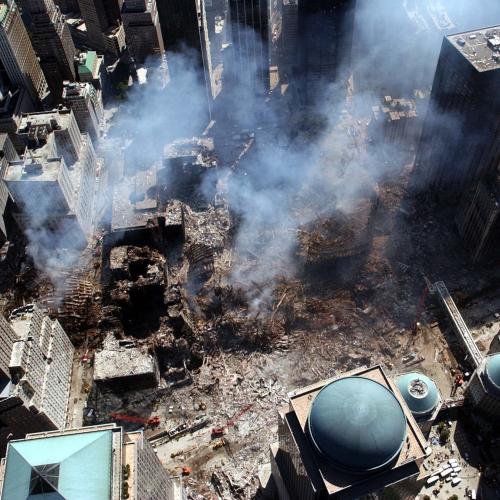
September 11, 2001 (D): Four planes are hijacked, two crash into the WTC, one into the Pentagon, and one into the Pennsylvania countryside. At least 3,000 people are killed. According to officials, the entire US is defended by only 14 fighters (two planes each in seven military bases). [Dallas Morning News, 9/16/01] And "they no longer included any bases close to two obvious terrorist targets - Washington, DC, and New York City." A defense official says: "I don't think any of us envisioned an internal air threat by big aircraft." [Newsday, 9/23/01]
Timeline for the Day of the 9/11 Attacks
Department of Defense (6/1/01) and FAA (7/12/01) procedure: In the event of a hijacking, the FAA hijack coordinator on duty at Washington headquarters requests the military to provide escort aircraft. Normally, NORAD escort aircraft take the required action. The FAA notifies the National Military Command Center by the most expeditious means. [DOD/, 6/1/01, FAA, 7/12/01, FAA 7/12/01]
"Pilots are supposed to hit each fix with pinpoint accuracy. If a plane deviates by 15 degrees, or two miles from that course, the flight controllers will hit the panic button. They'll call the plane, saying "American 11, you're deviating from course." It's considered a real emergency, like a police car screeching down a highway at 100 miles an hour. [MSNBC, 9/12/01]
If NORAD (North American Aerospace Defense Command) hears of any difficulties in the skies, they begin the work to scramble jet fighters [take off and intercept aircraft that are off course]. Between Sep 2000 and June 2001 fighters were scrambled 67 times. [AP, 8/12/02] When the Lear jet of golfer Payne Stewart didn't respond in 1999, F-16 interceptors were quickly dispatched. According to an Air Force timeline, a series of military planes provided an emergency escort to Payne's stricken Lear about 20 minutes after ground controllers lost contact with his plane. [Dallas Morning News, 10/26/99]
(6:45 A.M.) "Approximately two hours prior to the first attack", at least two workers in Israel at the instant messaging company Odigo receive messages warning of the WTC attack. This Israeli owned company has its headquarters two blocks from the WTC. [Washington Post, 9/28/01, Ha'aretz, 9/26/01]
(8:20 A.M.) Boston flight control decides that Flight 11 has probably been hijacked, but they don't notify other air traffic control centers for another five minutes, and don't notify NORAD for about another 20 minutes. ["about 8:20," Newsday, 9/23/01, "about 8:20," NY Times, 9/15/01] ABC News will later say, "There doesn't seem to have been alarm bells going off, traffic controllers getting on with law enforcement or the military. There's a gap there that will have to be investigated." [ABC, 9/14/01]
8:40 AM: NORAD is notified of hijacking. [NY Times, 10/16/01, 8:38 AM Washington Post, 9/15/01]
8:46 A.M. Flight 11 slams into the north tower, 1 World Trade Center. [approximately 26 minutes after controllers lost contact] [New York Times, 9/12/01]
8:46 A.M. At the time of the first WTC crash, three F-16's assigned to Andrews Air Force Base 10 miles from Washington are flying an air-to-ground training mission on a range in North Carolina, 207 miles away. Eventually they are recalled to Andrews and land there at some point after Flight 77 crashes into the Pentagon. [Aviation Week and Space Technology, 9/9/02] F-16's can travel a maximum speed of 1500 mph. Traveling even at 1250 mph, at least one of the F-16's could have returned to Washington within 10 minutes and started patrolling the skies well before 9:00 A.M. Why were they recalled so late, and then ordered back to base (and then to take off again) instead of being sent straight to Washington?
(8:46 A.M.) Flight 77 from Washington goes severely off course. It heads due north for a while, then flies due south and gets back on course. [see USA Today's Flight 77 flight path]
(After 8:46 A.M.) "During the hour or so that American Airlines Flight 77 was under the control of hijackers, up to the moment it struck the west side of the Pentagon, military officials in a command center on the east side of the [Pentagon] were urgently talking to law enforcement and air traffic control officials about what to do." [NY Times, 9/15/01]
8:52 A.M. Two F-15's take off from Otis ANG Base, six minutes after being ordered to go after Flight 11, which has already crashed. [8:52, NORAD, 9/18/01, 8:52, CNN, 9/17/01, 8:53, Washington Post, 9/12/01, 8:52, Washington Post, 9/15/01] They go after Flight 175 instead. According to Maj. Gen. Paul Weaver, director of the Air National Guard, "the pilots flew 'like a scalded ape,' topping 500 mph but were unable to catch up to the airliner." [Dallas Morning News, 9/15/01] F-15's can travel over 1875 mph. [Air Force News, 7/30/97] Yet according to the NORAD timeline, these planes take about 19 minutes to reach New York City - less than 600 mph. Why so slow??
(8:56 A.M.) According to the New York Times, by this time (if not earlier), it is clear Flight 77 has gone missing, yet NORAD is not notified for another 28 minutes! [NY Times, 10/16/01]
(9:01 A.M.) Bush later makes the following statement. "I was sitting outside the classroom waiting to go in, and I saw an airplane hit the tower -- the TV was obviously on, and I used to fly myself, and I said, 'There's one terrible pilot. It must have been a horrible accident.'" [CNN, 12/4/01] He has repeated the story on other occasions: "When we walked into the classroom, I had seen this plane fly into the first building." [White House, 1/5/02, CBS, 9/11/02] Given that there actually was no film footage of the first attack on TV until much later (and no footage of the plane actually hitting the tower), could this be a lie to make it seem he didn't know what was happening? By 8:38, NORAD knew that Flight 11 was hijacked [CNN, 9/17/01, Washington Post, 9/12/01], and by 8:43, they knew Flight 175 was hijacked [NORAD, 9/18/01, CNN, 9/17/01] As the New York Times points out, they also probably knew Flight 77 was hijacked a few minutes after 8:48. [NY Times, 9/15/01]
9:03 A.M. Flight 175 crashes into the south WTC tower. [23 minutes after NORAD notified, 43 minutes after air traffic control lost contact with pilots] F-15 fighter jets from Otis Air National Guard Base are still 71 miles or eight minutes away. [New York Times, 9/12/01, CNN, 9/12/01]
(After 9:03 A.M.) A few minutes after 9:03, the Secret Service calls Andrews Air Force Base, located 10 miles from Washington. They are notified to get F-16's armed and ready to fly. Missiles are still being loaded onto the F-16's when the Pentagon is hit over half an hour later. [Aviation Week and Space Technology, 9/9/02] The problem with this account is that prior to 9/11, The District of Columbia Air National Guard (located at Andrews) had a publicly stated mission "to provide combat units in the highest possible state of readiness." Shortly after 9/11 this mission statement on its website is changed, so it merely has a "vision" to "provide peacetime command and control and administrative mission oversight to support customers and DCANG units in achieving the highest levels of readiness." [DCANG Home Page (before and after the change)]
(After 9:03 A.M.) Minutes after the second WTC crash at 9:03, military base commanders from all over the US were calling NORAD and volunteering to scramble planes. For instance, the commander at Syracuse, New York said he could get a plane in the air armed with cannon in ten minutes. Yet none of these planes were put in the air until after the last hijacked plane had crashed over an hour later. [Aviation Week and Space Technology, 6/3/02]
9:09 A.M. Supposedly, NORAD orders F-16's at Langley Air Force Base, Virginia, on battle stations alert. Yet the order to scramble won't come till 9:27 or so, and they won't take off until 9:30. Around this time, the FAA command center reports 11 aircraft either not in communication with FAA facilities, or flying unexpected routes. [Aviation Week and Space Technology, 6/3/02]
9:10 AM: Major General Paul Weaver states Flight 77 came back on the (radar) scope at 9:10 in West Virginia. [Dallas Morning News, 9/15/01] Another report states the military was notified of Flight 77 several minutes after 9:03. [Washington Post, 9/15/01]
9:16 A.M.
The FAA informs NORAD that Flight
93 may have been hijacked. No fighters are scrambled in specific response,
now or later (there is the possibility some fighters sent after Flight 77
later headed towards Flight 93). [CNN,
9/17/01, NORAD,
9/18/01] Note that the crash of Flight 77 is still 25 minutes away.
F-16 fighters from Langley Air Force Base could have reached Washington
in six minutes if they traveled at 1300 mph (maximum speed for an F-16 is
1500 mph). Even if the fighters were traveling slower and it took some minutes
to get the plane off the ground, they still could easily have made it to
Washington in those 25 minutes and prevented the Flight 77 crash.
9:24 A.M. The FAA notifies NORAD that Flight 77 "may" have
been hijacked and appears to be headed towards Washington. [NORAD,
9/18/01, AP,
8/19/02] A Pentagon spokesman says, "The Pentagon was simply not
aware that this aircraft was coming our way." [Newsday, 9/23/01] Yet since
at least the Flight 11 crash, "military officials in a command center
[the National Military Command Center] on the east side of the [Pentagon]
were urgently talking to law enforcement and air traffic control officials
about what to do." [NY Times, 9/15/01]
(9:27 A.M.) Tom Burnett calls his wife Deena and says, "I'm on United Flight 93 from Newark to San Francisco. The plane has been hijacked. We are in the air. They've already knifed a guy. There is a bomb on board. Call the FBI." Deena calls 911. [The book Among the Heroes, 8/02, p. 107, ABC, 9/12/01, MSNBC, 7/30/02, Pittsburgh Post-Gazette, 10/28/01, Toronto Sun, 9/16/01] This is the first of over 30 additional phone calls by passengers inside the plane. [MSNBC, 7/30/02]
(9:27 A.M.) NORAD orders three F-16 fighters scrambled from Langley Air Force Base in Virginia to intercept Flight 77. Langley is 129 miles from Washington. Ready aircraft at Andrews Air Force Base, 15 miles away, are not scrambled. [Newsday, 9/23/01, 9:24, NORAD, 9/18/01, 9:27, CNN, 9/17/01, 9:25, Washington Post, 9/12/01, 9:35, CNN, 9/17/01, 9:35, Washington Post, 9/15/01]
9:30 A.M. The F-16's scrambled towards Flight 77 get airborne. [9:30, NORAD, 9/18/01, 9:35, Washington Post, 9/12/01] If the NORAD departure time is correct, the F-16's would have to travel slightly over 700 mph to reach Washington before Flight 77 does. The maximum speed of an F-16is 1500 mph. [AP, 6/16/00] Even at 1300 mph, these planes could have reached Washington in six minutes - well before any claim of when Flight 77 crashed. Yet they obviously don't.
(9:30 A.M.) The hijackers make an announcement to the passengers in Flight 77, telling them to phone their families as they are "all going to die." They also told the passengers that they were going to hit the White House. ["When they took over the controls," Sunday Herald, 9/16/01, "around 9:30," Cox News, 10/21/01] Given this announcement, why are there almost no phone calls from this flight?
(9:32 A.M.) Secret Service agents burst into Vice President Cheney's White House office. They carry him under his arms - nearly lifting him off the ground - and propel him down the steps into the White House basement and through a long tunnel towards an underground bunker. [9:32, Washington Post, 1/27/02, shortly after Bush's speech at 9:30, CBS, 9/11/02] Why didn't this happen to Bush? Was he meant to remain visibly out of the loop?
9:33 A.M. According to the New York Times, Flight 77 was lost at 8:56 when it turned off its transponder, and stayed lost until now. Washington air traffic control sees a fast moving blip on their radar at this time and sends a warning to Dulles Airport in Washington. [NY Times, 10/16/01] Is it conceivable that an airplane could be lost inside US air space for 37 minutes? One doesn't need a transponder signal to get a radar signal!
(9:41 A.M.) Flight 77 crashes into the Pentagon. [42 minutes or more after contact was lost, one hour after NORAD notification of first hijacking] The section of the Pentagon hit consists mainly of newly renovated, unoccupied offices. Approximately 125 determined killed or missing. Fighters are supposedly still 105 miles or 12 minutes away. [Newsday, 9/23/01, NORAD, 9/18/01, 9:37, NORAD, 9/18/01, 9:37, Washington Post, 9/12/01, 9:38, CNN, 9/17/01, 9:38, Guardian, 10/17/01, 9:38 New York Times, 10/16/01, 9:39, Washington Post, 1/27/02, 9:40, AP, 8/19/02, 9:43, CNN, 9/12/01, 9:43, MSNBC, 9/22/01, 9:43, MSNBC, 9/3/02, 9:43, New York Times, 9/12/01, 9:45, Boston Globe, 11/23/01] NORAD states the fighters took off from Langley at 9:30, 129 miles away, yet when Flight 77 crashes they are still 105 miles away. [NORAD, 9/18/01] That means they were flying at an average only about 205 mph!
9:59 A.M. The south tower of the World Trade Center collapses. It was hit by Flight 175 at 9:03. [AP, 8/19/02, New York Times, 9/12/01]
(Before 10:06 A.M.) CBS television reports at some point before the crash that two F-16 fighters are tailing Flight 93. [Independent, 8/13/02] Shortly after 9/11, a flight controller in New Hampshire ignores a ban on controllers speaking to the media, and it is reported he claims that "an F-16 fighter closely pursued Flight 93." The F-16 made 360-degree turns to remain close to the commercial jet, the employee said. "He must've seen the whole thing," the employee said of the F-16 pilot's view of Flight 93's crash. [AP, 9/13/01, Nashua Telegraph, 9/13/01]
10:10 AM: Flight 93 crashes in Pennsylvania. [42 minutes after contact was lost][CNN, 9/12/02]
10:28 A.M. The World Trade Center's north tower collapses. [CNN, 9/12/01, NY Times, 9/12/01]
5:20 PM: Building 7 of the World Trade Center collapses. [CNN, 9/12/01] Though the media claims fires brought the building down, the building's owner Larry Silverstein later recounts the story of the collapse of this 47-story skyscraper in a PBS documentary America Rebuilds, "I remember getting a call from the fire department commander...I said...maybe the smartest thing to do is to pull it. And they made that decision to pull, and then we watched the building collapse." Over 3,000 architects and engineers later claim that contrary to the U.S. government's official story, it must have been controlled demolition. [PBS Documentary, 2nd PBS Documentary, more]
September 11, 2001 (E): Did the Air Force send up planes after the hijacked aircraft? The Air Force won't say. It says they keep about 20 F-15 and F-16 fighters on duty with Air National Guards along the nation's coastline, ready to inspect unknown aircraft entering U.S. airspace. "We can scramble and be airborne in a matter of minutes," said an Air Force spokesperson. Some airline pilots are wondering whether the FAA did enough to try to prevent the crashes. [Wall Street Journal, 09/14/01]
September 11, 2001 (F): At about 9:00 A.M., a strange incident occurs aboard United Flight 23, scheduled to fly from New York to Los Angeles. After boarding, the crew tells the passengers that the flight has been canceled. Three Middle Eastern men refuse to get off the plane. They argue with a member of the flight crew. Security is called, but before they arrive, the men escape. [CBS, 9/14/01]
September 11, 2001 (G): It is later revealed that only hours after the 9/11 attacks, a US "shadow government" is formed. Executive directives on government continuity in the face of a crisis dating back to the Reagan administration are put into effect. Approximately 100 mid-level officials are moved to underground bunkers and stay there 24 hours a day. When its existence is revealed, some controversy arises because of the exclusion of any Democrats from it - in fact, top Congressional Democrats had never even heard of it until journalists broke the story. [Washington Post, 3/2/02, CBS, 3/2/02]
September 11, 2001 (H): A few hours after the 9/11 attacks, German intelligence intercepts a phone conversation between followers of bin Laden that leads the FBI to search frantically for two more teams of suicide hijackers, according to US and German officials. The Germans overhear the terrorists refer to "the 30 people traveling for the operation." The FBI scours flight manifests and any other clues for more terrorists. [New York Times, 9/29/01] Two days later, authorities claim to have identified teams that total as many as 50 infiltrators who supported or carried out the strikes. [Los Angeles Times, 9/13/01]Yet only one person, Moussaoui, has been identified and charged as an accomplice.
September 11, 2001 (I): A National Public Radio correspondent states: "I spoke with Congressman Ike Skelton who said that just recently the director of the CIA warned that there could be an imminent attack on the United States of this nature. So this is not entirely unexpected." [NPR, 9/11/01]
September 11, 2001 (J): Senator Orrin Hatch (R) tells the Associated Press that the US government was monitoring bin Laden's communications electronically, and overheard two bin Laden aides celebrating the successful terrorist attack. [AP, 9/12/01] Defense Secretary Donald Rumsfeld publicly denounces the report, not as untrue, but as an unauthorized release of classified information. [Department of Defense news briefing, 9/12/01] The head of the NSA says bin Laden (living in a cave in Afghanistan) "has better technology" than the US ($30 billion annual intelligence budget). [Sunday Herald, 9/16/01] Why has the mainstream media not explored the implications that the CIA and FBI could monitor the private communications of al-Qaeda on the days up to and including 9/11?
September 11, 2001 (K): Six air traffic controllers who dealt with two of the hijacked airliners make a tape recording describing the events, but the tape is later destroyed by a supervisor without anyone making a transcript or even listening to it. [Washington Post, 5/6/04, New York Times, 5/6/04]
September 11-16, 2001: Andrews Air Force Base is 10 miles from Washington, DC. Langley Air Force Base in 130 miles away. The official story is that there were no fighters at Andrews, so none took off from there to intercept the hijacked planes. It takes a few days for the media to come around to that point of view: 1) A few minutes after the Pentagon was hit, "fighter jets scrambled from Andrews Air Force Base..." [Denver Post, 9/11/01] 2) "Air defense around Washington is provided mainly by fighter planes from Andrews Air Force Base. But the fighters took to the skies over Washington only after the devastating attack on the Pentagon." [San Diego Union Tribune, 9/12/01] 3) "Within minutes of the attack American forces around the world were put on one of their highest states of alert - Defcon 3, just two notches short of all-out war - and F-16's from Andrews Air Force Base were in the air over Washington DC." [Telegraph, 9/16/01
September 12, 2001: The passport of hijacker Satam Al Suqami is found a few blocks from the WTC. [AP, 9/16/01, ABC News, 9/16/01] The Guardian says, "the idea that Atta's (sic) passport had escaped from that inferno unsinged [tests] the credulity of the staunchest supporter of the FBI's crackdown on terrorism." [Guardian, 3/19/02]
Sept 13-19, 2001: Members of bin Laden's family are driven or flown under FBI supervision to a secret assembly point in Texas and then to Washington, where they leave the country on a private plane when most flights were still grounded. Top White House officials personally approve these evacuations. [New York Times, 9/4/03, Boston Globe, 9/20/01, New York Times, 9/30/01, more]
September 14, 2001: The two "black boxes" for Flight 77 are found. [PBS Newshour, 9/14/01] FBI Director Mueller will later say that the voice recorder contained "nothing useful." [CBS, 2/23/02]
September 14, 2001: The Director of the Air National Guard explains why jets failed to scramble towards the hijacked aircraft for so long. He says that during the Cold War, 100 bases defended the US, but by 1997, the number had been reduced to seven, with only two fighter planes at each base defending the entire country from external threats. [Dallas Morning News, 9/16/01]
September 14, 2001: "45 minutes. That's how long American Airlines Flight 77 meandered through the air headed for the White House, its flight plan abandoned, its radar beacon silent. Who was watching in those 45 minutes? How are they able to fly around and no one go after them?''' [Miami Herald, 9/14/01]
September 15, 2001: CIA Director Tenet briefs Bush "with a briefcase stuffed with top-secret documents and plans on Osama bin Laden, the al-Qaeda network and worldwide terrorism." In his briefing, Tenet turns to a top-secret document called the "Worldwide Attack Matrix," which describes covert operations in 80 countries that are either underway or now recommended. By comparison, the military is caught relatively unprepared and defers to the CIA plans. [Washington Post, 1/31/02]
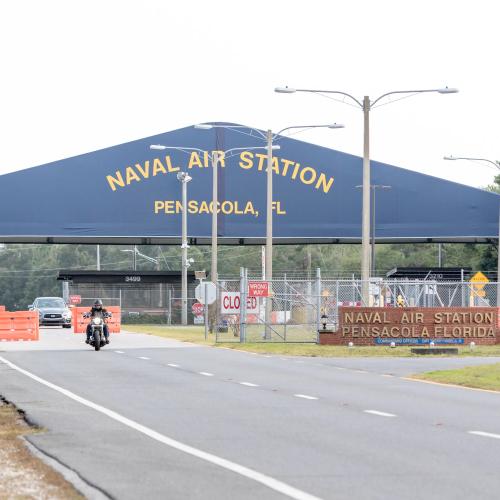
September 15-17, 2001: A series of major media articles state that several of the 9/11 hijackers may have had training in US military bases. [Los Angeles Times, 9/15/01, NY Times, 9/15/01, Newsweek, 9/15/01] Ahmad Alnami, Ahmed Alghamdi, and Saeed Alghamdi even listed the Naval Air Station in Pensacola, Florida as their permanent address on their driver's licenses. [Pensacola News Journal, 9/17/01]. Hamza Alghamdi is also connected to the Pensacola base. [Washington Post, 9/16/01] Saeed Alghamdi attended the Defense Language Institute in Monterey, California. Abdulaziz Alomari attended Brooks Air Force Base Aerospace Medical School. [Gannett News Service, 9/17/01] Atta graduated from the US International Officers School at Maxwell Air Force Base. Abdulaziz Alomari graduated from the Aerospace Medical School at Brooks Air Force Base. The media drops the story after the Air Force makes a statement, saying that while the names are similar, "we are probably not talking about the same people." [Washington Post, 9/16/01]
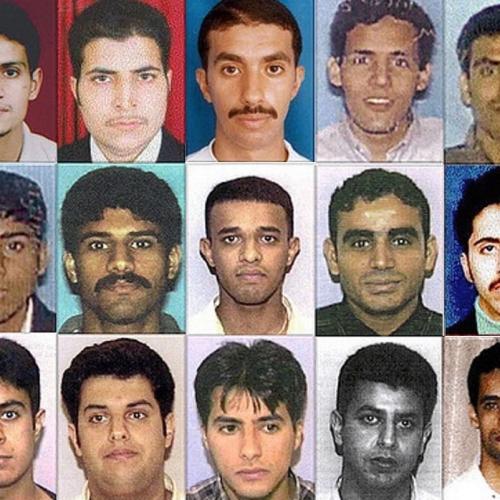
September 16-23, 2001: Reports appear in news media that some of the alleged 9/11 hijackers are still alive. [BBC, 9/23/01] The Saudi government insists that five of the Saudis mentioned are still alive. [New York Times, 9/21/01] On September 20, The Times of London reported, "Five of the alleged hijackers have emerged, alive, innocent and astonished to see their names and photographs appearing on satellite television...The hijackers were using stolen identities, and investigators are studying the possibility that the entire suicide squad consisted of impostors." [Times of London, 9/20/01] Briefly, the press took this story to heart. For instance, a story in the Observer on September 23 put the names of hijackers like Saeed Alghamdi in quotation marks. [Observer, 9/23/01] But the story died down after the initial reports, and it was hardly noticed when Mueller stated on November 2, 2001: "We at this point definitely know the 19 hijackers who were responsible,'' and claimed that they were sticking with the names and photos released in late September. [AP, 11/03/02] These same people are later listed as hijackers in the 2004 9/11 Commission Report [9/11 Commission Report - see graphic slightly over half way down the page]
September 17, 2001: Congressman Dana Rohrabacher (R), who claims to have made many secret trips into Afghanistan and even fought with the mujaheddin, describes to Congress a missed opportunity to capture bin Laden. Rohrabacher concludes "that our intelligence services knew about the location of bin Laden several times but were not permitted to attack him because of decisions made by people higher up." [Speech to the House of Representatives, 9/17/01]
September 19, 2001: The FBI claims that there may have been six hijacking teams on the morning of 9/11. [New York Times, 9/19/01, CBS, 9/14/01, Guardian, 10/13/01] Authorities have identified teams that total as many as 50 infiltrators who supported or carried out the strikes. About 40 of the men have been accounted for. [Los Angeles Times, 9/13/01] Yet only one person, Moussaoui, is later charged.
Late September 2001: Sibel Edmonds is hired as a Middle Eastern languages translator for the FBI. As she later tells CBS's 60 Minutes, she immediately encounters a pattern of deliberate failure in her translation department. Her boss says, "Let the documents pile up so we can show it and say that we need more translators and expand the department." She claims that if she wasn't slowing down enough, her supervisor would delete her work. Meanwhile, FBI agents working on the 9/11 investigation would call and ask for urgently needed translations. [CBS, 10/25/02, New York Post, 10/26/02] In January 2002, FBI officials tell government auditors that translator shortages have resulted in "the accumulation of thousands of hours of audio tapes and pages" of untranslated material. [Washington Post, 6/19/02]
October 2001-September 2002: Nine Army linguists, including six trained to speak Arabic, are dismissed from the military's Defense Language Institute in Monterey, California, because they are gay. The military claims it is facing a critical shortage of translators and interpreters for the war on terrorism. [AP, 11/15/02]
October 2, 2001: A newspaper reveals that Atta kept an e-mail list so he could send out identical e-mails to everyone on the list. [Sun and Weekly Herald, 10/2/01, NBC 2, 4/24/02] What's intriguing is that several of the 40 or so names on the list appear to have been, or still are, employees of US defense contractors. [Online Journal, 4/24/02, note this is a very partisan website]
October 2, 2001: The Patriot Act is introduced in Congress. The next day, Senate Judiciary Committee Chairman Patrick Leahy (D) accuses the Bush administration of reneging on an agreement on this anti-terrorist bill. [Washington Post, 10/4/01] Anthrax letters are sent to Leahy and Senate Majority Leader Tom Daschle (D) on October 9. [CNN, 11/18/01]
October 4, 2001: The first case of anthrax infection, in Florida, appears in the media. Letters containing anthrax continue to be received until October 19. [South Florida Sun-Sentinel, 12/01]
October 5, 2001: Contrary to popular belief, Afghanistan "has significant oil and gas deposits. During the Soviets' decade-long occupation of Afghanistan, Moscow estimated Afghanistan's proven and probable natural gas reserves at around five trillion cubic feet, and production reached 275 million cubic feet per day in the mid-1970's." [Asia Times, 10/5/01] A later article suggests the country may also have as much copper as Chile, the world's largest producer, and significant deposits of coal, emeralds, tungsten, lead, zinc, uranium ore and more. [Houston Chronicle, 12/23/01]
October 10-11,
2001: The FBI allows the
original batch of the Ames strain of anthrax to be destroyed, making tracing
the anthrax type more difficult. Suspicions that the anthrax used in
the letters was the Ames strain are confirmed on October 17. [New York Times, 11/9/01, South Florida
Sun-Sentinel, 12/01] What possible excuse can the FBI have for allowing
this destruction, especially when the Ames strain was already suspected?
October 20, 2001: The New York Times reports that although
830 people have been arrested in the 9/11 terrorism investigation, there
is no evidence that anyone now in custody was a conspirator in the 9/11
attacks. Furthermore, "none of the nearly 100 people still being sought
by the [FBI] is seen as a major suspect." Of the all the people arrested,
only four, Zacarias Moussaoui, Ayub Ali Khan and Mohammed Azmath, and Nabil
al-Marabh, a former Boston cabdriver, are likely connected to al-Qaeda.
[New York Times,
10/21/01] By mid-June 2002, only 74 people are reportedly still in custody,
and the number continues to fall. Though many were held for months, "the
vast majority were never charged with anything other than overstaying a
visa." [New
York Times, 7/11/02]
October 27, 2001: Furious government intelligence officials accuse the NSA of destroying data pertinent to the 9/11 investigation. They claim that possible leads aren't being followed because of the NSA lack of cooperation. [Boston Globe, 10/27/01]
Early November 2001: It is later reported that many locals in Afghanistan witness a remarkable escape of al-Qaeda forces from Kabul around this time. One local businessman says: "We don't understand how they weren't all killed the night before, because they came in a convoy of at least 1,000 cars and trucks. It was a very dark night, but it must have been easy for the American pilots to see the headlights. The main road was jammed from eight in the evening until three in the morning." This convoy was thought to have contained al-Qaeda's top officials. [Times of London, 7/22/02]
Nov 12, 2001–Mar 25, 2002: 13 renowned microbiologists mysteriously die over the span of less than five months. All but one or two are killed or murdered under unusual circumstances. Some are world leaders in developing weapons-grade biological plagues. Others are the best in figuring out how to stop millions from dying because of biological weapons. Still others are experts in the theory of bioterrorism. [Globe and Mail, 5/4/02, NY Times 08/11/02] Nov 12: Benito Que, 52, an expert in infectious diseases–killed in carjacking, later deemed possible stroke. [Globe and Mail, 5/4/02] Nov. 16: Don Wiley, 57, one of the world's leading researchers of deadly viruses–body found in Mississippi River. [CNN, 12/22/01] Nov 21: Dr. Vladimir Pasechnik, 64, an expert in adapting germs and viruses for military use–stroke. [NY Times, 11/23/01] Dec 10: Dr. Robert Schwartz, 57, a leading researcher on DNA sequencing analysis–slain at home. [Washington Post, 12/12/01] Dec 14: Nguyen Van Set, 44, his research organization had just come to fame for discovering a virus which can be modified to affect smallpox–dies in an airlock in his lab. [Sydney Morning Herald, 12/12/01] Jan 2002: Ivan Glebov (bandit attack) and Alexi Brushlinski (killed in Moscow), both world-renowned members of the Russian Academy of Science. [Pravda, 2/9/02] Feb 9: Victor Korshunov, 56, head of the microbiology sub-faculty at the Russian State Medical University–killed by cranial injury. [Pravda, 2/9/02] Feb 11: Ian Langford, 40, one of Europe's leading experts on environmental risk–murdered in home. [Times of London, 2/13/02] Feb 28 (2): Tanya Holzmayer, 46, helped create drugs that interfere with replication of the virus that causes AIDS, and Guyang Huang, 38, a brilliant scholar highly regarded in genetics–murder/suicide. [San Jose Mercury News, 2/28/02] Mar 24: David Wynn-Williams, 55, an astrobiologist with NASA Ames Research Center–killed while jogging. [Times of London, 3/27/02] Mar 25: Steven Mostow, 63, an expert on the threat of bioterrorism–private plane crash. [KUSA TV/NBC, 3/26/02]
November 14, 2001: A convoy of 1,000 or more al-Qaeda and Taliban fighters escape from Jalalabad and reach the fortress of Tora Bora after hours of driving and then walking. Bin Laden is believed to be with them, riding in one of "several hundred cars" in the convoy. The US bombs Jalalabad airport, but apparently not the convoy. [Knight-Ridder, 10/20/02, Christian Science Monitor, 3/4/02]
November 16, 2001: According to Newsweek, approximately 600 al-Qaeda and Taliban fighters escape Afghanistan on this day. Many senior leaders are in the group. They had walked a long trek from the Tora Bora region. There are two main routes out of the Tora Bora cave complex to Pakistan. The US bombed only one route, so the 600 escaped unattacked using the other route. Hundreds continue to use the route to escape for weeks, generally unbothered by US bombing or Pakistani border guards. [Newsweek, 8/11/02]
November 20, 2001: Five Israelis arrested on 9/11 for videotaping the WTC attack and then cheering about it [Bergen Record, 9/12/01, Ha'aretz, 9/17/01, ABC, 6/21/02] are released and return to Israel. Some of the men's names appeared in a US national intelligence database, and the FBI concluded that at least two of the men were working for the Mossad, according to ABC News. They were released as part of a deal between the US and the Israel government. [Forward, 3/15/02, ABC, 6/21/02]
November 21, 2001: The Independent runs a story with the title: "Opium Farmers Rejoice at the Defeat of the Taliban." Massive opium planting is underway all across Afghanistan. [Independent, 11/21/01] Four days later, the Observer runs a story headlined, "Victorious Warlords Set To Open the Opium Floodgates." It states that farmers are being encouraged by warlords allied with the US to plant "as much opium as possible." [Observer, 11/25/01]
November 21, 2001: The remains of all but one of the people on Flight 77, including the hijackers, are identified. [Washington Post, 11/21/01, Mercury, 1/11/02] The strange thing about this is that the official story states there was a giant fireball on impact that not only destroyed the airplane, but actually vaporized the metal. [NFPA Journal, 11/1/01] Yet remains of every passenger but one was found?
December 2001: James Hauswirth, a retired Phoenix FBI agent, writes a letter to FBI Director Mueller criticizing the priorities at the Phoenix FBI office. "[Counter-terrorism] has always been the lowest priority in the division," even though Arizona had been one of the first hubs for radical Muslim groups in the US. Hauswirth particularly criticizes that "[Ken] Williams, regarded as the best terrorism agent in the office, had to interrupt his pre-9/11 investigation of Middle Eastern flight students in order to spend six months on a arson case. He fought it. Why take your best terrorism investigator and put him on an arson case? He didn't have a choice." Williams began investigating Middle Eastern students at an Arizona flight school in early 2000, but a series of difficulties including the arson case, prevented him from continuing on that case until June 2001. A month later he wrote a now-famous memo suggesting that terrorists might be training at US flight schools. [NY Times, 6/19/02, LA Times, 5/26/02]
December 4, 2001: Convicted drug lord and opium kingpin Ayub Afridi is released from prison and recruited by the US government to help establish control in Afghanistan by unifying various Pashtun warlords. [Asia Times, 12/4/01]
December 22, 2001: Afghani Prime Minister Hamid Karzai and his transitional government takes power in Afghanistan. It was revealed a few weeks before that he had been a paid consultant for Unocal, as well as Deputy Foreign Minister for the Taliban. [Le Monde, 12/13/01, CNN, 12/22/01, Chicago Tribune, 3/18/02]
December 25, 2001: The New York Times reports that "some of the nation's leading structural engineers and fire-safety experts" believe the investigation into the collapse of the WTC is "inadequate", and "are calling for a new, independent and better-financed inquiry that could produce the kinds of conclusions vital for skyscrapers and future buildings nationwide." Experts point out that the current team of 20 or so investigators has no subpoena power, inadequate financial support, little staff support, has been prevented from interviewing witnesses, has frequently been prevented from examining the disaster site, and has even been unable to obtain basic information like detailed blueprints of the buildings that collapsed. The decision to rapidly recycle the steel columns, beams and trusses from the WTC in the days immediately after 9/11 means definitive answers may never be known. [NY Times, 12/25/01]
January 1, 2002: Zalamy Khalilzad, already a Special Assistant to the President, is appointed by Bush as a special envoy to Afghanistan. [BBC, 1/1/02] Khalilzad, a former employee of Unocal, took part in negotiations with the Taliban to build a pipeline through Afghanistan. He also wrote op-eds in the Washington Post in 1997 supporting the Taliban regime, back when Unocal was hoping to work with the Taliban. [Independent, 1/10/02] Now the US envoy is a former Unocal employee consulting with a prime minister who is a former Unocal employee in a country where Unocal might build gas and oil pipelines.
January 4, 2002: A firefighter trade magazine with ties to the NY Fire Department calls the investigation into the collapse of the WTC a "half-baked farce." The article points out that the probe has had limited access to documents and other evidence. "The destruction and removal of evidence must stop immediately." It concludes that a growing number of fire protection engineers have theorized that "the structural damage from the planes and the explosive ignition of jet fuel in themselves were not enough to bring down the towers." [NY Daily News, 1/4/02, Fire Engineering, 1/02]
January 23, 2002: Wall Street Journal reporter Daniel Pearl is kidnapped in Pakistan. [Guardian, 1/25/02, BBC, 7/5/02] "At the time of his abduction, Pearl was investigating links between Pakistani extremists and Richard C. Reid, the British man accused of trying to blow up an American airliner with explosives hidden in his sneakers. As part of that probe, Pearl may have strayed into areas involving Pakistan's secret intelligence organizations." [Washington Post, 2/23/02]
January 24, 2002: Senate Majority Leader Tom Daschle (D) later claims that on this day, Vice President Cheney calls him and urges that no 9/11 inquiry be made. Bush repeats the request on January 28, and Daschle is repeatedly pressured thereafter. [CNN, 1/29/02, Newsweek, 2/4/02]
February 6, 2002: CIA Director Tenet tells a Senate hearing that there was no 9/11 intelligence failure. When asked about the CIA on 9/11, he says, "We are proud of that record." He also states that the 9/11 plot was "in the heads of three or four people" and thus nearly impossible to prevent. [USA Today, 2/7/02]
February 14, 2002: The Israeli newspaper Ma'ariv astutely notes: "If one looks at the map of the big American bases created [in the Afghan war], one is struck by the fact that they are identical to the route of the projected oil pipeline to the Indian Ocean." [Chicago Tribune, 3/18/02]
February 18, 2002: The Financial Times reports that the estimated opium harvest in Afghanistan in June 2002 will reach a record 4500 metric tons. Afghanistan is supplying 95% of the heroin in Europe, but the US shows "little interest" in stopping the production. [Financial Times, 2/18/02]
February 21, 2002: A UN Office for Drug Control and Crime Prevention report has detected massive opium planting that had mostly stopped under the Taliban. Afghanistan is the source of 75% of the world's heroin. [Guardian, 2/21/02]
February 25, 2002: Time reports that the second highest Taliban official in US custody, Mullah Khaksar, has been waiting for months for the CIA to talk to him. Even two weeks after Time informed US officials that Khaksar wanted to talk, no one has properly interviewed him. [Time, 2/25/02]
Early March 2002: The book l'Effroyable Imposture (The Horrifying Fraud) is published in France. The book denies that an airliner crashed in the Pentagon on 9/11. It is written by the president of the Voltaire Network, a respected independent think tank whose left-leaning research projects have until now been considered models of reasonableness and objectivity. [Guardian, 4/1/02] The book is widely denounced by the media, yet sets a French publishing record for first-month sales. [Time, Europe version, 5/20/02] One of the theories is that people in the US government wanted to hit the Pentagon for its propaganda effect, but didn't want to create much damage or kill important people like Defense Secretary Rumsfeld. They note the crash hit the one section under construction, thus greatly reducing the loss of life. Furthermore, the wall at point of impact was the first and only one to be reinforced and have blast-resistant windows installed as part of an upgrade plan. [NFPA Journal, 11/1/01]
March 2, 2002: A New York Times article theorizes that a diesel fuel tank was responsible for the collapse of Building 7 near the WTC. It collapsed on 9/11 even though it was farther away than many other buildings that remained standing. It was the first time a steel-reinforced high-rise in the US had ever collapsed in a fire. [New York Times, 3/2/02, Dow Jones News, 9/10/02] What's curious, especially given all the Wall Street scandals later in the year, is that Building 7 was where the SEC was storing files related to numerous Wall Street investigations. All the files for approximately 3,000 to 4,000 SEC cases were destroyed. Some were backed up in other places, but many were not, especially those classified as confidential. [New York Law Journal, 9/17/01] Lost files include documents that could show the relationship between Citigroup and the WorldCom bankruptcy. [The Street, 8/9/02]
March 5, 2002: It is reported that many spies in the uncovered Israeli spy ring seemed to have been trailing the 9/11 hijackers. For instance, five Israeli spies are intercepted in the tiny town of Hollywood, Florida, while four 9/11 hijackers are known to have spent time in Hollywood, Florida. [Le Monde, 3/5/02, Reuters, 3/5/02, Jane's Intelligence Digest, 3/15/02] In one case, some Israeli spies lived at 4220 Sheridan Street, only a few hundred feet from where Atta was living at 3389 Sheridan Street. Israeli spies appear to have been close to at least 10 of the 19 9/11 hijackers. [Salon, 5/7/02]
March 6, 2002: A Washington Post article completely denies the existence of any Israeli spy ring. A "wide array of US officials" supposedly deny it. [Washington Post, 3/6/02] By mid-March, Jane's, the respected British intelligence and military analysis service, notes: "It is rather strange that the US media seems to be ignoring what may well be the most explosive story since the 11 September attacks - the alleged breakup of a major Israeli espionage operation in the USA." [Jane's Intelligence Digest, 3/13/02]
March 7, 2002: A series of photos surface purporting to show a plane crashing into the Pentagon on 9/11. It's not clear who released the photos, but the Pentagon says they're authentic and taken from a Pentagon security camera. The release of these pictures comes within days of the publication of the book "l'Effroyable Imposture" "Officials could not immediately explain why the date typed near the bottom of each photograph is Sept. 12 and the time is written as 5:37 p.m." [Fox News, 3/8/02
March 13, 2002: Bush says of bin Laden: "He's a person who's now been marginalized. I just don't spend that much time on him. I truly am not that concerned about him. I am deeply concerned about Iraq." [White House, 3/13/02] On April 6, Joint Chief of Staff Chairman Myers states: "the goal has never been to get bin Laden." [DOD/CNN, 4/6/02]
March 22, 2002: Translator Sibel Edmonds is fired by the FBI after raising suspicions about a co-worker and her connections to an unnamed foreign official and organization. Both Edmonds and the co-worker, Dickerson, were hired as translators in late Sept. 2001. Edmonds claims that Dickerson failed to translate sensitive information concerning the foreign official and organization, which is under investigation. When Edmonds failed to agree to spy for this organization, Dickerson told her that her refusal could put her family in danger. After her boss and others in the FBI failed to respond to her complaints, she wrote to the inspector general's office in March: "Investigations are being compromised. Incorrect or misleading translations are being sent to agents in the field." She claims she was fired for her whistleblowing, and is suing. A second FBI whistleblower, John Cole, also claims to know of security lapses in the screening and hiring of FBI translators. [Washington Post, 6/19/02, Cox News, 8/14/02] In Oct. 2002, at the request of FBI Director Mueller, Attorney General Ashcroft asks a judge to throw out Edmonds's lawsuit. He says he is protecting national security interests. [AP, 10/18/02]
April 19, 2002: FBI Director Mueller states: "In our investigation, we have not uncovered a single piece of paper–either here in the US or in Afghanistan and elsewhere–that mentioned any aspect of the 9/11 plot." He also claims that the attackers used "extraordinary secrecy" and that "investigators found no computers, laptops, hard drives or other storage media that may have been used by the hijackers." [FBI, 4/19/02, Los Angeles Times, 4/22/02] The Wall Street Journal reported, "A senior FBI official says investigators have obtained hundreds of e-mails in English and Arabic, reflecting discussions of the planned Sept. 11 hijackings." [Wall Street Journal, 10/16/01] In October 2001, USA Today reported many e-mails coordinating their plans written by the hijackers in internet cafes have been recovered by investigators, and the hijackers weren't using encryption. [USA Today, 10/1/01]
May 8, 2002: FBI Director Mueller: "there was nothing the agency could have done to anticipate and prevent the [9/11] attacks." [Senate Intelligence Committee (Witness Breitweiser), 9/18/02, more]
May 15, 2002: The Bush Administration is embarrassed when the CBS Evening News reveals that Bush had been warned about al-Qaeda domestic attacks in August 2001. Bush had repeatedly said that he had "no warning" of any kind. White House Press Secretary Ari Fleischer states unequivocally that while Bush had been warned of possible hijackings, "The president did not - not - receive information about the use of airplanes as missiles by suicide bombers." [New York Times, 5/16/02, Washington Post, 5/16/02] The Guardian will state a few days later, "the memo left little doubt that the hijacked airliners were intended for use as missiles and that intended targets were to be inside the US." [Guardian, 5/19/02]
May 17, 2002: "Members of congressional committees investigating the pre-9/11 warnings said yesterday that there is far more damaging information that has not yet been disclosed about the government's knowledge of events leading up to 9/11. 'We've just scratched the surface,' said Sen. Shelby, ranking Republican member of the Senate intelligence committee." [Washington Post, 5/17/02]
May 17, 2002: Dan Rather tells the BBC that he and other journalists haven't been properly investigating since 9/11. He says: "The fear is that you will have a flaming tire of lack of patriotism put around your neck. That fear keeps journalists from asking the toughest questions." [Guardian, 5/17/02, more]
May 21, 2002: Minnesota FBI agent Coleen Rowley, upset with what she considers lying from FBI Director Mueller and others in the FBI about the handling of the Moussaoui case, makes public a long memo she's written about the topic (see the memo here: [Time, 5/21/02]). She also applies for whistleblower protection. Time magazine calls the memo a "colossal indictment of our chief law-enforcement agency's neglect." [Time, 5/27/02] Time magazine later names Rowley one of three "Persons of the Year" for 2002. [Time, 12/22/02, Time, 12/22/02]
May 21-24, 2002: A New York Times editorial says it's time to "light a fire under the FBI in its investigation of the anthrax case. Experts in the bioterror field are already buzzing about a handful of individuals who had the ability, access and motive to send the anthrax." [New York Times, 5/24/02] Similarly, the Guardian suggests that the FBI investigation is moving deliberately slow because the federal authorities have something to hide. [Guardian, 5/21/02]
May 23, 2002: President Bush says he is opposed to establishing a special, independent commission to probe how the government dealt with terror warnings before 9/11. [CBS, 5/23/02]
May 30, 2002: FBI Agent Robert Wright announces he is suing the FBI over a publishing ban. He has written a book, but the FBI won't allow him to show it to anyone. He delivers a tearful press conference at the National Press Club describing his lawsuit against the FBI for deliberately curtailing investigations that might have prevented the 9/11 attacks. Unfortunately he has been ordered to not reveal specifics publicly. [Fox News/Reuters, 5/30/02, more] He also alleges that for years the US was training Hamas terrorists to make car bombs to use against Israel. [LA Weekly, 8/2/02]
May 31, 2002: At some point prior to this date, when asked why the August 6 memo read by Bush on al-Qaeda has not been released,Vice President Cheney calls the CIA memo just a "rehash" containing nothing new or interesting. But why Congress should not see it, Cheney says, "because it contains the most sensitive sources and methods. It's the family jewels." [Christian Science Monitor, 5/31/02
June 20, 2002: The long-awaited loya jirga, or grand council, is concluded in Afghanistan. This council was supposed to be a traditional method for the Afghan people to select their leaders, but the council is clearly rigged. [BBC, 8/1/02] Half of the delegates walk out in protest. [CNN, 6/18/02] One delegate states, "This is worse than our worst expectations. The warlords have been promoted and the professionals kicked out. Who calls this democracy?" Delegates complain, "This is interference by foreign countries", obviously meaning the US. The New York Times publishes an article pointing out that the "very forces responsible for countless brutalities" in past governments are back in power. [New York Times, 6/21/02] These are the same warlords that have controlled the drug trade for years.
July 21,
2002: In an article titled, "Anthrax:
the Noose Widens," Time magazine reports, "Despite recent
claims by some in the bioterrorism community that the investigation should
be homing in on one particular American bioweapons expert, the FBI appears
to be moving in the opposite direction. US government officials say the
investigation is still ranging far and wide and that the FBI has not ruled
out a foreign connection." [Time,
7/21/02]
July 23, 2002: The New York City government decides that the audio
and written records of the Fire Department's actions on 9/11 should never
be released to the general public. The New York Times has been trying
to get copies of the materials, which include firsthand accounts given to
Fire Department officials by scores of firefighters and chiefs. [New
York Times, 7/23/02]
Late July 2002: US Special Forces apprehend Mullah Akhter Mohammed Osmani, a top general and one of the six most-wanted Taliban, in Kandahar. He is flown to a detention center north of Kabul for interrogation, but is released a few weeks later and escapes to Pakistan. [Washington Times, 12/18/02]
August 2, 2002: The Washington Post reveals that FBI agents have questioned nearly all 37 members of the Senate and House intelligence committees about 9/11 information leaks. They have asked them to submit to lie detector tests. Congress members express "grave concern" for this historically unprecedented move. A law professor states, "Now the FBI can open dossiers on every member and staffer and develop full information on them. It creates a great chilling effect on those who would be critical of the FBI." [Washington Post, 8/2/02] The administration bitterly complains about leaks out of a committee, yet leaks abound about secret war plans for fighting a war against Saddam Hussein. There's a bit of a contradiction here, if not a double standard.'" [Washington Post, 8/3/02]
August 11, 2002: A Newsweek article suggests that some of Bush's advisors advocate not only attacking Iraq, but also Saudi Arabia, Iran, North Korea, Syria, and Burma! One senior UK official says: "Everyone wants to go to Baghdad. Real men want to go to Tehran." [Newsweek, 8/11/02]
August 11, 2002: In the past, Afghanistan mostly exported raw opium. Now many new refineries are converting the opium into heroin. The Observer was able to determine the precise location of some of these factories, but the US led forces in Afghanistan are doing nothing to stop them. [Observer, 8/11/02]
August 13, 2002: On the Donahue TV show, Kristen Breitweiser, whose husband died in the WTC, says the following about Bush's behavior on 9/11: "It was clear that we were under attack. Why didn't the Secret Service whisk [Bush] out of that school?" She further states, "I don't understand how a plane could hit our Defense Department, which is the Pentagon, an hour after the first plane hit the first tower. I don't understand how that is possible. When you look at the fact that we spend a half trillion dollars on national defense, and you're telling me that a plane is able to hit our Pentagon, our Defense Department, an hour after the first tower is hit?" [Donahue, 8/13/02] Why have mainstream journalists largely continued to ignore these issues?
August 15, 2002: Rena Golden, the executive vice-president and general manager of CNN International, claims that the press has censored itself over 9/11 and the Afghanistan war. "Anyone who claims the US media didn't censor itself is kidding you." [Press Gazette, 8/15/02]
August 23, 2002: The government starts giving out large cash compensations to the relatives of the 9/11 attack victims. However, in order to qualify, the families have to promise not to sue anyone. Only about one-fifth have agreed to compensation, the rest appear to want to sue the airlines, the Saudis, the government and others. [AP, 8/23/02]
August 29, 2002: German authorities charge a Moroccan man named Mounir El Motassadeq with complicity in the 9/11 attacks. He is only the second person in the world to be charged with any crime related to the 9/11 attacks, after Moussaoui. [AFP, 8/29/02, NY Times, 8/29/02, Telegraph, 8/30/02]
September 5, 2002: Richard Shelby of Alabama, the ranking Republican on the Senate Intelligence Committee, expresses doubts that the committee's investigation into 9/11 will be able to accomplish anything. He supports an independent investigation. He adds that there is explosive 9/11 information that has not been publicly released. "I know that there are some more bombs out there." [NY Times, 9/10/02]
September 11, 2002: On the first anniversary of the 9/11 attacks, The New York Times writes, "One year later, the public knows less about the circumstances of 2,801 deaths at the foot of Manhattan in broad daylight than people in 1912 knew within weeks about the Titanic, which sank in the middle of an ocean in the dead of night." The former police commissioner of Philadelphia, says: "You can hardly point to a cataclysmic event in our history when a blue-ribbon panel did not set out to establish the facts and, where appropriate, suggest reforms. That has not happened here." [NY Times, 9/11/02]
October 9, 2002: San Diego FBI agent Steven Butler reportedly gives "explosive" testimony to the 9/11 inquiry. Butler, recently retired, has been unable to speak to the media. [New York Times, 11/23/02] The FBI unsuccessfully tried to prevent Butler from testifying. [New York Times, 10/5/02]
October 16, 2002: The directors of the US's three most famous intelligence agencies, the CIA, FBI and NSA, testify before a Congressional inquiry on 9/11. All three say no individual at their agencies has been punished or fired for any of missteps connected to 9/11. This does not satisfy several on the inquiry, including Senator Carl Levin, who says "People have to be held accountable." [Washington Post, 10/18/02]
October 21, 2002: The General Accounting Office, the nonpartisan investigative arm of Congress, releases a report asserting that at most 6 of the 19 9/11 hijackers were interviewed by US consular officials before being granted visas to enter the US. This contradicts previous assurances from the State Department that 12 of the hijackers had been interviewed. It also found that for 15 hijackers whose applications could be found, none had filled in the documents properly. [Washington Post, 10/22/02, ABC News, 10/23/02] The State Department maintains that visa procedures were properly followed. In December 2002, two top Republican senators report that "if State Department personnel had merely followed the law and not granted nonimmigrant visas to 15 of the 19 hijackers in Saudi Arabia, 9/11 would not have happened." [AP, 12/18/02]
October 23, 2002: Visa applications for the 15 Saudi Arabian hijackers are made public. Six experts agree: "All of them should have been denied entry [into the US]." [NY Post, 10/9/02, ABC, 10/23/02]
October 27, 2002: The Los Angeles Times exposes a leaked August 16, 2002 report from Defense Secretary Rumsfeld's influential Defense Science Board 2002. The board "recommends creation of a super-Intelligence Support Activity. Among other things, this body would launch secret operations aimed at 'stimulating reactions' among terrorists and states possessing weapons of mass destruction -- that is, for instance, prodding terrorist cells into action and exposing themselves to 'quick-response' attacks by US forces." [Los Angeles Times, 10/27/02, Asia Times, 11/5/02]
October 29, 2002: MSNBC reports that of the "more than 800 people" rounded up since 9/11, "only 10 have been linked to the hijackings" and "probably will turn out to be innocent." [Newsweek, 10/29/02]
November 12, 2002: A new audio tape purportedly made by bin Laden is broadcast. [BBC, 11/13/02, BBC, 11/18/02] US officials believe the voice is "almost certainly" bin Laden, but one of the world's leading voice-recognition institutes, is 95% certain the tape is a forgery. [BBC, 11/18/02, BBC, 11/29/02, Toronto Star, 12/16/02]
November 27, 2002: President Bush names Henry Kissinger Chairman of the National Commission on Terrorist Attacks. Kissinger served as Secretary of State and National Security Advisor for Presidents Nixon and Ford. [NY Times, 11/28/02] He has a very controversial past. "Documents released by the CIA strengthen suspicions that he was actively involved in the establishment a covert plan involving six Latin American countries to assassinate thousands of political opponents." He is also famous for an "obsession with secrecy." [BBC, 4/26/02] Investigative judges in Spain, France, Chile and Argentina seek to question him in legal actions related to his involvement in war crimes, particularly in Latin America, Vietnam, Cambodia, Chile and East Timor. [BBC, 4/18/02, Village Voice, 8/15-21/01, Chicago Tribune, 12/1/02] "Indeed, it is tempting to wonder if the choice of Mr. Kissinger is not a clever maneuver by the White House to contain an investigation it long opposed." [NY Times, 11/29/02]
December 11, 2002: A Senate Committee on Intelligence investigating the performance of government agencies before the 9/11 attacks releases its final report. The committee accuses the Bush administration of refusing to declassify 9/11 information, criticizes the FBI, and says the CIA lacked an effective system for holding its officials accountable. The committee chairman says the Bush administration has given Americans an "incomplete and distorted picture" of foreign assistance the hijackers may have received." [ABC, 12/10/02] He further says "There are many more findings to be disclosed," and he and others express frustration that 9/11 information that should be released is being kept classified by the Bush administration. [St. Petersburg Times, 12/12/02] The vice chairman says that CIA Director Tenet should resign. "There have been more massive failures on his watch than any CIA director in history. Yet he's still there. It's inexplicable to me." [Reuters, 12/10/02, PBS, 12/11/02]
December 13, 2002: Henry Kissinger resigns as head of the new 9/11 investigation [AP, 12/13/02, ABC, 12/13/02] Two days earlier, the Bush Administration argued that Kissinger was not required to disclose his private business clients. [New York Times, 12/12/02] However, the Congressional Research Service insists that he does, and Kissinger resigns rather than reveal his clients. [MSNBC, 12/13/02, Seattle Times, 12/14/02] It is reported that Kissinger has been a consultant for Unocal, the oil corporation, and was involved in plans to build pipelines through Afghanistan. [Washington Post, 10/5/98, Salon, 12/3/02] Kissinger claimed he did no current work for any oil companies or Mideast clients, but several corporations with heavy investments in Saudi Arabia pay him consulting fees of $250,000 a year. [Newsweek, 12/15/02]
December 16, 2002: President Bush names former New Jersey governor Thomas Kean as the Chairman of the National Commission on Terrorist Attacks Upon the United States, after his original choice, Henry Kissinger, resigned. [Washington Post, 12/17/02] In an appearance on NBC, Kean promises an aggressive investigation. [AP, 12/17/02] However, Kean plans to remain President of Drew University and devote only one day a week to the commission. He also claims he would have no conflicts of interest, stating: "I have no clients except the university." [Washington Post, 12/17/02] However, he has a history of such conflict. Most disturbing is his Board of Director and Executive Committee positions at Amerada Hess, an oil company with extensive investments in Central Asia. [Amerada Hess, 2002] The mainstream media has barely mentioned Kean's conflict of interest with Amerada Hess. [AP, 1/20/03]
Jan 13, 2003: The worldwide turmoil caused by US government policies goes not exactly unreported, but entirely de-emphasized. Guardian writers are inundated by e-mails from Americans asking why their own papers never print what is in UK papers. If there is a Watergate scandal lurking in this administration, it is unlikely to be [Washington Post's Bob] Woodward or his colleagues who will tell us about it. If it emerges, it will probably come out on the web. "That is a devastating indictment of the state of American newspapers." [Guardian, 1/13/03]
March 26, 2003: Though the investigation into the space shuttle Columbia tragedy cost $50 million and the Ken Starr investigation of Whitewater and Monica Lewinsky ran $64 million, the White House balks at increasing funding beyond $3 million for the 9/11 Commission's investigation into the worst terror attack ever. The latest effort to curtail funding has angered victims of the 9/11 attacks. "The White House decision was another in a long line of efforts to water down or shrink the panel's role." [Time, 3/26/03, MSNBC, 9/20/06]
July 22, 2004: The 9/11 Commission Report is published. It fails to mention that a year before the 9/11 attacks a secret Pentagon project named Able Danger had identified four 9/11 hijackers, including leader Mohamed Atta. The Commission spokesperson initially states members were not informed of this, but later acknowledges they were. [New York Times, 8/11/05, more]
Nov 19, 2004: The fear that Afghanistan might degenerate into a narco-state is becoming a reality. Afghanistan has surpassed Colombia as the world's biggest gross producer of illicit narcotics, heroin being the "main engine of economic growth" and the "strongest bond" among tribes that previously fought constantly. What we have here now is a narco-economy where 40 to 50 percent of the GDP is from illicit drugs. [San Francisco Chronicle, 11/19/04] How does a country controlled by the US become the largest producer of illegal drugs? For a possible answer, click here.
Nov 17, 2005: Former FBI Director Louis Freeh: "The Able Danger intelligence, if confirmed, is undoubtedly the most relevant fact of the entire post-9/11 inquiry. Yet the 9/11 Commission inexplicably concluded that it 'was not historically significant.' This astounding conclusion—in combination with the failure to investigate Able Danger and incorporate it into its findings—raises serious challenges to the commission's credibility and, if the facts prove out, might just render the commission historically insignificant itself." [Wall Street Journal, 11/17/05]
2004 - 2005: A growing number of top government officials and public leaders express disbelief in the official story of the 9/11 attacks. Some even believe 9/11 may have been an inside job. 100 prominent leaders and forty 9/11 family members sign a statement calling for an unbiased inquiry into evidence that suggests high-level government officials may have deliberately allowed the 9/11 attacks to occur. [Various Publications]
August 9, 2006: A shocking new book by the 9/11 Commission co-chairmen Thomas Kean and Lee Hamilton says we still don't know the whole truth about 9/11. The book outlines repeated misstatements by the Pentagon and the FAA. Untrue–the military's original timeline of United Flight 93. Equally untrue, the government's timeline for American Flight 77 and details about fighter jets scrambled to intercept it. CNN News anchor Lou Dobbs: "The fact that the government would permit deception...and perpetuate the lie suggests that we need a full investigation of what is going on." [CNN, 8/9/06 , MSNBC/AP, 8/4/06, more]
2006-now: Over 50 senior government officials from the military, intelligence, Cabinet and Congress, and over 100 highly respected professors, including engineers, physicists, architects, philosophers and theologians publicly criticize The 9/11 Commission Report as flawed, and call for a new, independent investigation. Over 3,000 architects and engineers have created a website calling for a new investigation. Some even claim rogue elements of government were involved in the 9/11 attacks. [Officials, Professors, Architects and Engineers]
For a 60-page summary of the 9/11 attacks: www.WantToKnow.info/9-11timeline60pg
For a powerful, engaging video revealing lots more: www.WantToKnow.info/911video
For reliable resources
on the 9/11 attacks and what you can do: 9/11
Information Center