


































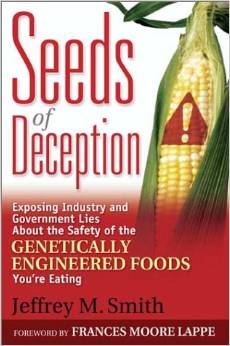
Seeds of Deception
By Jeffrey M. Smith
A 10-Page Summary
|
Exposing Industry and Government Deception
About the Safety of the Genetically Engineered Foods You're Eating |
Note: For a two-page summary of this article, click here.
Praise for the Book Seeds of Deception
"Outrageous! That's what you'll say when you read how the biotechnology companies have manipulated the government, our food, and the media, and put an entire generation at risk.
~~ Ben Cohen, Co-Founder, Ben & Jerry's
"Clear, profound, and unerringly accurate, Seeds of Deception tells what you need to know about genetically engineered food – and what Monsanto won't tell you. If you care about the safety of our food supply, if you care what corporations are doing to your food and health, this is the book to get."
~~ John Robbins, author of The Food Revolution and Diet For A New America
"This pivotal exposé leaves no doubt that politics and corporate influence, not sound science, allowed these potentially dangerous GM foods onto supermarket shelves."
~~ Joe Mendelson, Legal Director, Center for Food Safety
"I've seen first hand how Monsanto and the FDA resorted to scientific deceit of the highest order to market genetically engineered milk. With captivating style and a flair for describing science in clear, accurate language, Seeds of Deception unveils the distortions, omissions, and lies for all to see."
~~ Samuel S. Epstein, M.D., professor emeritus environmental and occupational medicine
University of Illinois at Chicago School of Public Health
Chairman, Cancer Prevention Coalition
Introduction
On May 23, 2003, President Bush proposed an Initiative to End Hunger in Africa [1] using genetically modified (GM) foods. He also blamed Europe's "unfounded, unscientific fears" of these foods for thwarting recovery efforts. Bush was convinced that GM foods held the key to greater yields, expanded U.S. exports, and a better world. His rhetoric was not new. It had been passed down from president to president, and delivered to the American people through regular news reports and industry advertisements.
The message was part of a master plan that had been crafted by corporations determined to control the world's food supply. This was made clear at a biotech industry conference in January 1999, where a representative from Arthur Anderson Consulting Group explained how his company had helped Monsanto create that plan.
First, they asked Monsanto what their ideal future looked like in fifteen to twenty years. Monsanto executives described a world with 100 percent of all commercial seeds genetically modified and patented. Anderson Consulting then worked backwards from that goal, and developed the strategy and tactics to achieve it. They presented Monsanto with the steps and procedures needed to obtain a place of industry dominance in a world in which natural seeds were virtually extinct.
Integral to the plan was Monsanto's influence in government, whose role was to promote the technology worldwide and to help get the foods into the marketplace quickly, before resistance could get in the way. A biotech consultant later said, "The hope of the industry is that over time, the market is so flooded that there's nothing you can do about it. You just sort of surrender." [2]
The anticipated pace of conquest was revealed by a conference speaker from another biotech company. He showed graphs projecting the year-by-year decrease of natural seeds, estimating that in five years, about 95 percent of all seeds would be genetically modified.
While some audience members were appalled at what they judged to be an arrogant and dangerous disrespect for nature, to the industry this was good business. Their attitude was illustrated in an excerpt from one of Monsanto's advertisements: "So you see, there really isn't much difference between foods made by Mother Nature and those made by man. What's artificial is the line drawn between them." [3]
To implement their strategy, the biotech companies needed to control the seeds–so they went on a buying spree, taking possession of about 23 percent of the world's seed companies. Monsanto did achieve the dominant position, capturing 91 percent of the GM food market. [4] But the industry has not met their projections of converting the natural seed supply. Citizens around the world, who do not share the industry's conviction that these foods are safe or better, have not "just sort of surrendered."
Widespread resistance to GM food has resulted in a global showdown. U.S. exports of genetically modified corn and soy are down, and hungry African nations won't even accept the crops as food aid. Monsanto is faltering financially and is desperate to open new markets. The U.S. government is convinced that EU resistance is the primary obstacle and is determined to change that. On May 13, 2003, the U.S. filed a lawsuit with the World Trade Organization (WTO), charging that the European Union's restrictive policy on GM food violates international agreements.
On the day the WTO suit was filed, U.S. Trade Representative Robert Zoellick declared, "Overwhelming scientific research shows that biotech foods are safe and healthy." [5] This has been industry's chant from the start. It is the key assumption at the basis of their master plan, the WTO challenge, and the president's campaign to end hunger. It is also, however, untrue.
The following chapters reveal that it was industry influence, not sound science, which allowed these foods onto the market. Moreover, if overwhelming scientific research suggests anything, it is that the foods should never have been approved.
Just as the magnitude of the industry's plan was breathtaking, so too are the distortions and cover-ups. While many of the stories in this book reveal government and corporate maneuvering worthy of an adventure novel, the impact of GM foods is personal. Most people in North America eat them at every meal. These chapters not only dismantle the U.S. position that the foods are safe, they inform you of the steps you can take to protect yourself and your family.
Chapter 1: A Lesson From Overseas
When eminent scientist Arpad Pusztai went public about his accidental discovery that genetically modified (GM) potatoes severely damage the immune system and organs of rats, he was suspended from the prestigious Scottish research institute where he had worked for thirty-five years. He was silenced with threats of a lawsuit while the Institute denied or distorted his findings.
In the ensuing war over public opinion, biotech advocates tried to spin the science in favor of GM foods, but were thwarted at each attempt by leaked documents and compelling evidence. Pusztai, who describes this chapter as "the most thorough and accurate report on the topic," was ultimately vindicated when his potato study was published in the Lancet. His remains the only independent safety assessment in a peer-reviewed journal. It contrasts sharply with the handful of published industry studies, an analysis of which reveals how they were designed to avoid finding problems.
Excerpt:
When Susan answered the door, she was startled to see several reporters standing in front of her. Several more were running from their cars in her direction and she could see more cars and TV news vans parking along the street.
"But you all know that we can't speak about what happened. We would be sued and–" [6]
"It's OK now," the reporter from Channel Four Television interrupted, waving a paper in front of her. "They've released your husband. He can talk to us."
Susan took the paper. "Arpad, come here," she called to her husband.
Arpad Pusztai (pronounced: Are-pod Poos-tie), a distinguished looking man in his late sixties, was already on his way. As his wife showed him the document, the reporters slipped past them into the house. But Arpad didn't notice; he was staring at the paper his wife had just handed him. He recognized the letterhead at once–The Rowett Institute, Aberdeen, Scotland. It was one of the world's leading nutritional institutes and his employer for the previous thirty-five years–until his sudden suspension seven months ago. And there it was, clearly spelled out. They had released their gag order. He could speak.
The document was dated that same day, February 16, 1999. In fact, less than twenty minutes before, thirty reporters had sat in the Rowett Institute press conference listening to its director, Professor Phillip James, casually mention that the restrictions on Dr. Pusztai's speaking to the press had been lifted. Before James had finished his sentence, the reporters leaped for the door. They jumped into their cars and headed straight to the Pusztai's house on Ashley Park North, an address most were familiar with, having virtually camped out there seven months earlier. Now those thirty reporters, with TV cameras and tape recorders, were piled into the Pusztai's living room.
Arpad Pusztai read the document–twice. As he looked up, the reporters started asking him questions all at once. He smiled, and breathed more easily than he had in a long time. He had all but given up hope. Now he finally had the chance to share what he knew about the dangers of genetically engineered foods.
The story of Arpad Pusztai made headlines throughout Europe for months, alerting readers to some of the serious health risks of genetically modified (GM) foods. It was barely mentioned, however, in the U.S. press; the media watchdog group Project Censored described it as one of the ten most underreported events of the year. [7] In fact, major U.S. media avoided almost any discussion of the controversy over genetically modified organisms (GMOs) until May 1999. But that was all about saving the monarch butterfly from GM corn pollen, not about human food safety.
It wasn't until the massive food recall prompted by StarLink corn that Americans were even alerted to the fact that they were eating GM foods everyday. Moreover, the American press was forced to question whether GM foods were safe. Up until then, the media had portrayed European resistance to America's GM crops as unscientific anti-Americanism. But as the story of Arpad Pusztai reveals, the European anti-GMO sentiment had been fueled, in part, by far greater health risks than the scattered allergic reactions attributed to StarLink.
Between the Chapters: The Wisdom of Animals
Mice avoid eating GM foods when they have the chance, as do rats, cows, pigs, geese, elk, squirrels, and others. What do these animals know that we don't? At the end of each chapter is a one-page story describing how farmers, students, and scientists discovered that animals refuse to eat the same GM foods that we consume everyday.
Excerpt:
The Washington Post reported that laboratory mice, usually happy to munch on tomatoes, turned their noses up at the genetically modified FlavrSavr tomato. Scientist Roger Salquist said of his tomato, "I gotta tell you, you can be Chef Boyardee and mice are still not going to like them." [8] The mice were eventually force fed the tomato through gastric tubes and stomach washes. Several developed stomach lesions; seven of forty died within two weeks. The tomato was approved without further tests.
Chapter 2: What Could Go Wrong–A Partial List
Genetic engineers continually encounter unintended side effects–plants create toxins, react to weather differently, contain too much or too little nutrients, become diseased or malfunction and die. This chapter describes the process of genetic engineering and twenty-one ways in which it can create unexpected, potentially serious problems.
Excerpt:
New DNA chip technology has recently allowed scientists to monitor changes in DNA functioning when foreign genes are inserted. In one experiment, there was a staggering 5 percent disruption of gene expression. In other words, after a single foreign gene had been added through genetic engineering, one out of every 20 genes that were creating proteins either increased or decreased their output. According to Professor David Schubert, "while these types of unpredicted changes in gene expression are very real, they have not received much attention outside the community of the DNA chip users." He adds that, "there is currently no way to predict the resultant changes in protein synthesis." [9]
Chapter 3: Spilled Milk
"The scientists' testimony before a Senate committee was like a scene from the conspiratorial television show The X-Files." [10] This was how Canada's leading paper described the story of six Canadian government scientists who tried to stand up to pressure to approve Monsanto's genetically engineered bovine growth hormone (rbGH) which they believed was unsafe. The scientists were threatened by senior government officials, files were stolen from their locked file cabinets, Monsanto allegedly offered them a bribe of $1-2 million, and one senior official suddenly quit and disappeared, avoiding an appearance before a Parliamentary Committee. [11]
What was happening to the Canadian scientists in 1998 amounted to "re-runs" of what U.S. government scientists faced in the 1980s. When FDA scientists tried to blow the whistle on what was happening, they were stripped of responsibilities or fired. The FDA eventually approved rbGH on the basis of a research summary submitted by Monsanto that had distorted and deleted data about serious health effects, including cancer.
Excerpt:
The FDA's article states, "it has also been determined that at least 90 percent of bovine growth hormone (bGH) activity is destroyed upon pasteurization of milk. Therefore, bGH residues do not present a human food safety concern." [12] Robert Cohen decided to investigate this claim. He uncovered what he considers to be blatant scientific fraud. The research had been conducted by undergraduate Paul Groenewegan. His three co-authors all had close ties with Monsanto. The paper described how they heated milk at 162 degrees F for thirty minutes.
Cohen said, "when I read that, I said, wait a second, milk is pasteurized for 15 seconds at that temperature–not 30 minutes. They intentionally tried to destroy the hormone.... That must have been their mission. Why else would they heat the milk for 30 minutes at a high temperature reserved for a 15 second treatment?" But even after thirty minutes only 19 percent of the bGH in milk from hormone-treated cows was destroyed.
According to Cohen, "They then 'spiked' the milk. This is their word, 'spike.' They added artificial bGH ... 146 times the level of naturally occurring bST in powdered form to the milk and heated it. The powdered bGH in milk was destroyed! They saved the day for Monsanto. The experiment worked. These men of science could claim that heat treatment destroys bGH." [13]
Chapter 4: Deadly Epidemic
In 1989, first dozens, then thousands fell sick. About one hundred people died, others struggled with paralysis, unbearable pain, and debilitating symptoms. [14] Authorities eventually tracked its cause: contaminants produced in one company's genetically modified variety of the food supplement L-tryptophan. [15] This chapter describes the evidence implicating genetic engineering as the cause of the epidemic and the efforts by industry and the FDA to divert the blame. Current regulations are so loose, they would allow that same type of deadly supplement onto the market today.
Chapter 5: Government By the Industry, For the Industry
Henry Miller was in charge of biotechnology issues at the FDA from 1979 to 1994. According to Miller, "U.S. government agencies have done exactly what big agribusiness has asked them to do and told them to do." [16] This chapter reveals how industry influence has dictated policy, and how the FDA ignored the recommendations by the majority of their own scientists by approving GM foods without requiring safety tests.
Excerpts:
The biotech industry's success with these government leaders became apparent on May 26, 1992 in the Indian Treaty Room of the Old Executive Building. There, Vice President Dan Quayle announced the Bush administration's new policy on genetically engineered food: "The reforms we announce today will speed up and simplify the process of bringing better agricultural products, developed through biotech, to consumers, food processors and farmers. We will ensure that biotech products will receive the same oversight as other products, instead of being hampered by unnecessary regulation." [17]
By "receive the same oversight as other products," Quayle meant that GM foods would be considered just as safe as natural, non-GM foods. And sidestepping "unnecessary regulation" meant that the government would not require any safety tests or any special labels identifying the foods as genetically engineered. The rationale for this hands-off policy was spelled out in an FDA document dated three days after Quayle's announcement. "The agency is not aware of any information showing that foods derived by these new methods differ from other foods in any meaningful or uniform way." [18] Monsanto had what it wanted: government endorsement of safety, and no regulations that would interfere with its plans for rapid worldwide sales.
Political Science at the FDA
Attorney Michael Taylor was involved in the development of FDA policy. Prior to working at the FDA, Monsanto was his personal client. Taylor had helped Monsanto draft pro-biotech regulations that the industry would lobby for. While working for the FDA, Taylor could implement those laws himself. For Monsanto, there was no better person to step into a leadership role at the FDA.
Taylor did not simply fill a vacant position at the agency. In 1991 the FDA created a new position for him: Deputy Commissioner for Policy. He instantly became the FDA official with the greatest influence on GM food regulation, overseeing the development of government policy.
According to public interest attorney Steven Druker, who has studied the FDA's internal files, "During Mr. Taylor's tenure as Deputy Commissioner, references to the unintended negative effects of bioengineering were progressively deleted from drafts of the policy statement (over the protests of agency scientists), and a final statement was issued claiming (a) that [GM] foods are no riskier than others and (b) that the agency has no information to the contrary." [19] In 1994, Taylor became the administrator at the Department of Agriculture's Food Safety and Inspection Service, where he was also involved in biotechnology issues. He later became Vice President for Public Policy at Monsanto.
When the FDA announced its policy, the public was not aware of any internal dissent. The policy boldly claimed that there was no information to indicate that GM foods were different or more risky than natural varieties. Since the American public generally trusts the FDA, people assumed that no such risks existed. But nearly a decade later, the agency's internal documents–made public for the first time through a lawsuit–told a different story.
Linda Kahl, an FDA compliance officer, protested that by "trying to force an ultimate conclusion that there is no difference between foods modified by genetic engineering and foods modified by traditional breeding practices," the agency was "trying to fit a square peg into a round hole." She insisted, "the processes of genetic engineering and traditional breeding are different, and according to the technical experts in the agency, they lead to different risks." [20]
One such expert was FDA microbiologist Louis Pribyl. "There is a profound difference between the types of unexpected effects from traditional breeding and genetic engineering," wrote Pribyl in a letter to James Maryanski, the FDA's biotech coordinator. Pribyl said that several aspects of gene splicing "may be more hazardous." [21] According to the New York Times, "Dr. Pribyl knew from studies that toxins could be unintentionally created when new genes were introduced into a plant's cells." [22] Moreover, Pribyl wrote "there is no certainty that [the breeders of GM foods] will be able to pick up effects that might not be obvious." He declared, "This is the industry's pet idea, namely that there are no unintended effects that will raise the FDA's level of concern. But time and time again, there is no data to back up their contention." [23]
Pribyl was only one of many FDA scientists asked to provide input during the formulation of the FDA's policy on genetically engineered food. According to Druker, records show that the majority of these scientists identified potential risks of GM foods. Druker was the main organizer of the lawsuit that forced the FDA documents into the public domain. His nonprofit organization, the Alliance for Bio-Integrity, was the lead plaintiff. Having sorted through tens of thousands of pages of FDA documents, he described the opinion of the agency's scientists as follows: "The predominant view was that genetic engineering entails distinct risks and that its products cannot be regarded as safe unless they have been confirmed to be so through appropriate feeding studies." Druker says several scientists "issued strong warnings." [24]
The Toxicology Group, for example, warned that genetically modified plants could "contain unexpected high concentrations of plant toxicants," and described the reasons why these might be very difficult to identify. [25] Their director wrote, "The possibility of unexpected, accidental changes in genetically engineered plants justifies a limited traditional toxicological study." [26]
The Division of Food Chemistry and Technology outlined four potential dangers:
- "Increased levels of known naturally occurring toxins"
- "Appearance of new, not previously identified" toxins
- Increased tendency to gather "toxic substances from the environment" such as "pesticides or heavy metals"
- "Undesirable alterations in the levels of nutrients"
They warned, "unless genetically engineered plants are evaluated specifically for these changes," these four "may escape breeders' attention." The division recommended testing every GM food "before it enters the marketplace." [27]
Gerald Guest, the director of FDA's Center for Veterinary Medicine (CVM) sent a letter to the FDA's Biotech Coordinator, James Maryanski, saying that he and the other CVM scientists concluded that there is "ample scientific justification" to require testing and review of each GM food before it is eaten by the public. He stated, "CVM believes that animal feeds derived from genetically modified plants present unique animal and food safety concerns." He pointed out that, "residues of plant constituents or toxicants in meat and milk products may pose human food safety concerns." [28]
In spite of repeated internal memos outlining the potential for increased health risks posed by this new technology, subsequent drafts of the FDA's policy statement, overseen by Taylor, deleted more and more of the scientist's input. In a fiery memo to Maryanski, Pribyl challenged the direction the policy statement had taken: "What has happened to the scientific elements of this document? Without a sound scientific base to rest on, this becomes a broad, general, 'What do I have to do to avoid trouble'-type document.... It will look like and probably be just a political document.... It reads very pro-industry, especially in the area of unintended effects."
But while the FDA's scientists were emphasizing caution and testing, its leaders were beholden to an altogether different lobbying effort. A March 1992 memo from FDA Commissioner David Kessler, confirmed the White House's influence in the crafting of the agency's policy. "The approach and provisions of the policy statement are consistent with the general biotechnology policy established by the Office of the President.... It also responds to White House interest in assuring the safe, speedy development of the U.S. biotechnology industry." [29]
But even the draft of the policy that Kessler praised as White House-friendly was subject to further revision as it went up the political chain of command. A memo from the Office of the Assistant Secretary for Health, at the Department of Health & Human Services, expressed reservations about the length and depth of the policy statement's concern for environmental effects of GM crops. The letter said, "The extensive twelve page discussion seems to be ... dangerously detailed and drawn-out." [30] In the end, it was the political, rather than scientific considerations that prevailed.
The agency not only ignored its scientists, it claimed their concerns never existed. For example, the State Department's Melinda Kimble, while negotiating GMO trade policy said, "I want to make very clear that it is the position of the United States government that we do not believe there is a difference between GMO commodities and non-GMO commodities." [31] Likewise, a March 2003 statement by Speaker of the House Hastert declared, "There is general consensus among the scientific community that genetically modified food is no different from conventional food." [32]
When the FDA documents eventually became public, Maryanski defended the agency's policy. On February 28, 2000, he told the OECD Conference on GM Food Safety in Edinburgh, Scotland that the FDA scientists had merely been asking questions about the various issues involved in bioengineered food. Maryanski was unpleasantly surprised when Druker, who was a member of the conference, stood up and invited the audience to read the FDA memos that were posted on his organization's website. They could see for themselves that the agency's scientists were not merely asking questions; many of their statements were quite emphatic about the unique risks of GM foods.
Maryanski, other FDA officials, and representatives throughout the U.S. government continue to claim there is overwhelming consensus among scientists that GM foods are safe. In an Oct. 1991 letter to a Canadian official, however, Maryanski himself had admitted that this was not true. He said, "there are a number of specific issues... for which a scientific consensus does not exist currently, especially the need for specific toxicology tests." Maryanski also said, "I think the question of the potential for some substances to cause allergenic reactions is particularly difficult to predict." [33]
Commenting on statements made by FDA scientists, the New York Times wrote. "The scientists were displaying precisely the concerns that Monsanto executives from the 1980's had anticipated -- and indeed had considered reasonable. But now, rather than trying to address those concerns, Monsanto, the industry and official Washington were dismissing them as the insignificant worries of the uninformed." [34]
Many scientists who understood the dangers, however, were not convinced by the FDA's assurances. Geneticist David Suzuki, for example, said, "Any politician or scientist who tells you these products are safe is either very stupid or lying. The experiments have simply not been done." [35] A January 2001 report from an expert panel of the Royal Society of Canada likewise supported the conclusions of the FDA scientists.
The Royal Society of Canada report said it was "scientifically unjustifiable" to presume that GM foods are safe. The report explains that the "default prediction" for any GM foods is that "expression of a new gene (and its products) ... will be accompanied by a range of collateral changes in expression of other genes, changes in the pattern of proteins produced and/or changes in metabolic activities." This could result in novel toxins or other harmful substances.
The report emphasized the need for safety testing, looking for short and long-term human toxicity, allergenicity, and other health effects. The panel began their comprehensive 245-page report by quoting the editors of the UK's Nature Biotechnology. "The risks in biotechnology are undeniable, and they stem from the unknowable in science and commerce. It is prudent to recognize and address those risks, not compound them by overly optimistic or foolhardy behavior." [36]
FDA veterinarian Richard Burroughs described the changes he saw at the FDA. "There seemed to be a trend in the place toward approval at any price. It went from a university-like setting where there was independent scientific review to an atmosphere of 'approve, approve, approve." He said, "the thinking is, 'How many things can we approve this year?' Somewhere along the way they abdicated their responsibility to the public welfare." [37]
A congressional aide said, "At FDA morale stinks. Hundreds of people have either retired or quit in disgust. All the best people, who believed in working on behalf of public health, have gone." Dan Glickman, former Secretary of Agriculture, describes the government's pro-biotech mind-set. "It was almost immoral to say that it wasn't good because it was going to solve the problems of the human race and feed the hungry and clothe the naked." He said, "You felt like you were almost an alien, disloyal, by trying to present an open-minded view.... So I pretty much spouted the rhetoric... It was written into my speeches." [38]
Chapter 6: Rolling the Dice With Allergies
An infant girl in England broke out in cold sores from drinking soymilk, but was tested as "not allergic" to normal soy. Was she allergic to something in GM soy instead? Perhaps it was the increased amount of the allergen–trypsin inhibitor–found in Monsanto's Roundup Ready soybeans? Could this also explain why soy allergies in the UK jumped by 50 percent after Roundup Ready soy was introduced? It's difficult to say, because although scientists have confirmed that deadly allergies can be transferred into foods via genetic engineering, there are no robust allergy tests done on GM foods. This was brought to the public's attention only after StarLink had been blamed for severe, potentially fatal allergic reactions. It took the FDA nearly a year to develop a test to see if StarLink was allergenic. The test was so poorly designed and unreliable, even the EPA rejected the results.
Excerpts:
In March 1999, the York Nutritional Laboratory, Europe's leading specialists on food sensitivity, reported that soy allergies skyrocketed over the previous year, jumping 50 percent. The increase propelled soy into the top ten list of allergens for the first time in the 17 years of testing. York scientists tested 4,500 people for allergic reactions to a wide range of foods. In previous years, soy affected 10 percent of consumers. Now, 15 percent reacted with a range of chronic illnesses, including irritable bowel syndrome, digestion problems, and skin complaints, as well as neurological problems, chronic fatigue syndrome, headaches and lethargy. Researchers confirmed the link with soy by detecting increased levels of antibodies in the blood. Furthermore, the soy tested in the study was likely to contain significant percentages of the genetically modified Roundup Ready variety.
The fact that GM soy had just entered the food supply was not lost to the researchers, who, according to the Daily Express, "said their findings provide real evidence that GM food could have a tangible, harmful impact on the human body." A spokesman said, "We believe this raises serious new questions about the safety of GM foods."
The British Medical Association had already "warned that the technology may lead to the emergence of new allergies." With the York's research in hand, now British scientists urged their government to impose an immediate ban on GM food until further testing evaluated their safety. Pathologist Michael Antoniou said that the increased allergic responses "points to the fact that far more work is needed to assess their safety. At the moment no allergy tests are carried out before GM foods are marketed." [39]
At a business lunch with co-workers, 35-year-old Grace Booth dined on three chicken enchiladas, which she later recalled were very good. Within about fifteen minutes, however, something went wrong. She felt hot, itchy. Her lips swelled; she lost her voice and developed severe diarrhea. "I felt my chest getting tight, it was hard to breathe," recalled Booth. "She didn't know but she was going into shock," reported CBS news. "I thought, oh my God, what is happening to me? I felt like I was going to die." Her co-workers called an ambulance . . . . [40]
Booth didn't know what had caused her nearly deadly allergic reaction. But this was September 2000 and within a few days she heard the news. A genetically modified corn product called StarLink, a potential allergen not approved for human consumption, was discovered in tacos, tortillas, and other corn products. More than 300 items were eventually recalled from the grocery store shelves in what was to become one of the world's biggest GM food debacles.
Chapter 7: Muscling the Media
The biotech industry uses its considerable resources to mold public opinion on genetically modified foods. In addition to promoting a one-sided image of the foods as safe and necessary, they stifle coverage about health and environmental damage. For example, a Fox TV station canceled a news series, a publisher canceled a book contract, [41] scientific journals refused papers, and a printer shredded 14,000 magazines, all due to fear of lawsuits by Monsanto. Other stories in this chapter describe how the industry manipulated news that was reported.
Excerpt:
A national TV commercial showed a montage of smiling Asian children, caring doctors, rice paddies, and a narrator who says that golden rice can 'help prevent blindness and infection in millions of children' suffering from vitamin-A deficiency." [42] Time magazine went so far as to claim on their cover, "This rice could save a million kids a year." The biotech company Syngenta claims one month of a delay in marketing Golden Rice, would cause 50,000 children to go blind. [43]
The biotech industry had found its poster child, genetically engineered rice that makes its own beta-carotene–a precursor to vitamin A. In his New York Times Magazine article, "The Great Yellow Hype," Michael Pollan says that golden rice impales Americans on the horns of a moral dilemma: "if we don't get over our queasiness about eating genetically modified food, kids in the third world will go blind."
"Yet the more one learns about biotechnology's Great Yellow Hope," Pollan continues, "the more uncertain seems its promise." [44] A closer look reveals some interesting omissions in the industry's numbers. According to a Greenpeace report, golden rice provides so little vitamin A, "a two-year-old child would need to eat seven pounds per day." [45] Likewise, an adult would need to eat nearly twenty pounds to get the daily-recommended dose.
"This whole project is actually based on what can only be characterized as intentional deception," writes Benedikt Haerlin, former international coordinator of Greenpeace's genetic engineering campaign. "We recalculated their figures again and again. We just could not believe serious scientists and companies would do this." [46]
Even the president of the Rockefeller Foundation, which funded development of golden rice, said "the public-relations uses of golden rice have gone too far" and are misleading the public and media. He adds, "We do not consider golden rice the solution to the Vitamin A deficiency problem." [47]
There are other considerations as well. No published study has confirmed that the human body could actually convert the beta-carotene in golden rice. Also other nutrients such as fat and protein, often lacking in the diets on malnourished children, are needed in order to absorb Vitamin A. And it is not clear whether the genes from the daffodil, which are used to create golden rice, will transfer known allergens from the flower. [48]
The biotech proponents also admit that to persuade people to eat yellow rice may require an educational campaign. But if they are going to spend the time to educate, Pollan asks, why not instead teach "people how to grow green vegetables [that are rich in vitamin A and other nutrients] on the margins of their rice fields, and maybe even give them the seeds to do so? Or what about handing out vitamin-A supplements to children so severely malnourished their bodies can't metabolize beta-carotene?"
Distributing supplements is precisely what the Vitamin Angel Alliance is doing. They give children who are at risk a high potency tablet, strong enough so that only two are required per year to prevent blindness. At a cost of only $.05 per tablet, only $25,000 is needed to prevent 500,000 children from going blind per year. [49] Contrast this with golden rice, which has cost more than $100 million dollars so far, and is not yet ready.
Michael Khoo of Greenpeace says golden rice "isn't about solving childhood blindness, it's about solving biotech's public relations problem." If the industry were truly dedicated to the problems of malnutrition and starvation, a tiny fraction of their advertising budget could have been diverted to make an enormous difference already. Khoo says, "It is shameful that the biotech industry is using starving children to promote a dubious product." [50]
Grains of Delusion, a research report jointly released by humanitarian organizations in Thailand, Cambodia, India, Philippines, Indonesia and Bangladesh, concluded that, "the main agenda for golden rice is not malnutrition but garnering greater support and acceptance for genetic engineering amongst the public, the scientific community and funding agencies. Given this reality, the promise of golden rice should be taken with a pinch of salt." [51]
Chapter 8: Changing Your Diet
This chapter describes all the sources of GM foods and explains how to remove them from your diet. It also provides additional motivation to make a change, describing how food can dramatically influence mood and behavior.
Chapter 9: What You Can Do
This chapter offers some practical ways to stay informed and to make a real change. One of these is to get this book into the hands of those who can make a difference.
Excerpt:
Books have power. Upton Sinclair's novel The Jungle exposed the unsanitary conditions of the meat packing industry. After Teddy Roosevelt read the book on a long train trip, he pushed a bill through congress creating meat inspection. At a press conference, President Kennedy acknowledged the importance of Rachel Carson's book Silent Spring, which exposed the dangers of pesticides. Kennedy then had his scientific advisor look into the issue. The book was eventually "credited with beginning the American environmental movement, the creation of the Environmental Protection Agency, and the 1972 ban on DDT." [52]
Officials around the world who are in charge of GM food policy need to be made aware of the foods' dangers and of how their approval was based on politics, not science. They have been subjected to relentless promotion by the biotech industry and bullying by the U.S. government to accept GM foods and crops. The revelations in this book might change that.
Epilogue
This section ties in recent events with a summary of some of the salient points from the book.
Excerpt:
There are the numerous ways in which industry researchers apparently doctored their studies to avoid finding problems with GM foods. For example, Aventis heated StarLink corn four times longer than standard before testing for intact protein; Monsanto fed mature animals diets with only one tenth of their protein derived from GM soy; researchers injected cows with one forty-seventh the amount of rbGH before testing the level of hormone in the milk and pasteurized milk 120 times longer than normal to see if the hormone was destroyed; and Monsanto used stronger acid and more than 1,250 times the amount of a digestive enzyme recommended by international standards to prove how quickly their protein degraded.
Cows that got sick were dropped from Monsanto's rbGH studies, while cows that got pregnant before treatment were counted as support that the drug didn't interfere with fertility; differences in composition between Roundup Ready soy and natural soy were omitted from a published paper; antibody reactions by rats fed rbGH were ignored by the FDA; and deaths from rats fed the FlavrSavr tomato remain unexplained.
Overturning a myth is not easy and cannot be accomplished by only a few individuals. Please join with those of us who are dedicated to getting the truth out.
Order Your Copy of Seeds of Deception Here
For other reliable resources on health cover-up issues, see Health Information Center
For an excellent website on the GMO cover-up, see www.seedsofdeception.com
For reliable information on other major cover-ups, see www.WantToKnow.info

- Inform your media and political representatives of this important information on genetically engineered foods and the GMO cover-up. To contact those close to you, click here.
- Learn more about major health cover-ups which put your health at risk and other ways to improve your health in this lesson from the free Insight Course.
- Read concise summaries of revealing major media reports on the GMO cover-up available here.
- Visit our Health Information Center at www.WantToKnow.info/healthinformation.
- Spread this news to your friends and colleagues, and bookmark this article on key news websites using the "Share" icon on this page, so that we can fill the role at which the major media is sadly failing. Together, we can make a difference.
Seeds of Deception - Genetically Modified Organisms (GMOs) in the Food You Eat
[1] See the White House press release on this available here. The comments mentioned are about two-thirds of the way down the web page.
[2] Stuart Laidlaw, "StarLink Fallout Could Cost Billions," The Toronto Star, Jan. 9, 2001. Article can be purchased in the Toronto Star archives available here, or find a free copy by clicking here.
[3] Robert Cohen, Milk, The Deadly Poison, Argus Publishing, Englewood Cliffs, New Jersey, 1998, p. 133
[6] Unless otherwise indicated, quotes from Arpad Pusztai, his wife Susan, or Philip James are based on personal communications with Arpad Pusztai.
[7] Project Censored, www.projectcensored.org/top-stories/articles/7-independent-study-points-to-dangers-of-genetically-altered-foods/
[8] Rick Weiss, "Biotech Food Crop Raises a Crop of Questions," Washington Post, August 15, 1999; p. A1
[9] David Schubert, "A different perspective on GM food," Nature Biotechnology, Vol. 20, 2002, p. 969
[10] Anne McIlroy, "Pierre Blaise thought it was his duty," Globe and Mail (Canada), Nov. 18, 1998
[11] James Baxter, The Ottawa Citizen, October 23, 1998, p. A1
[12] Judith C. Juskevich, C. Greg Guyer, "Bovine Growth Hormone: Human Food Safety Evaluation," Science, 1990, vol. 249, pp. 875-884
[13] Robert Cohen, Milk, The Deadly Poison, Argus Publishing, Englewood Cliffs, New Jersey, 1998
[14] Phillip A. Hertzman and others, The Eosinophilia-Myalgia Syndrome: The Los Alamos Conference, Journal of Rheumatology, vol. 18, no. 6, 1991, pp. 867-873
[15] William Crist, Investigative report on L-tryptophan, found at www.biointegrity.org
[16] Kurt Eichenwald, and others, "Biotechnology Food: From the Lab to a Debacle," The New York Times, January 25, 2001
[17] Ibid.
[18] "Statement of Policy: Foods Derived From New Plant Varieties," Federal Register vol. 57, No. 104 at 22991. May 29, 1992
[19] Steve Druker, www.biointegrity.org
[20] Linda Kahl to James Maryanski, about Federal Register document "Statement of Policy: Foods from Genetically Modified Plants," January 8, 1992, www.biointegrity.org
[21] Louis J. Pribyl "Biotechnology Draft Document, 2/27/92," March 6, 1992, www.biointegrity.org
[22] Kurt Eichenwald and others, "Biotechnology Food: From the Lab to a Debacle," New York Times, January 25, 2001. Read the full article on the Times website at this link.
[23] Louis J. Pribyl "Biotechnology Draft Document, 2/27/92," March 6, 1992, www.biointegrity.org
[24] Steve Druker, www.biointegrity.org
[25] Edwin J. Mathews to the Toxicology Section of the Biotechnology Working Group. "Analysis of the Major Plant Toxicants." October 28, 1991, www.biointegrity.org
[26] Samuel I. Shibko to James Maryanski, "Revision of Toxicology Section of the Statement of Policy: Foods Derived from Genetically Modified Plants," January 31, 1992, www.biointegrity.org
[27] Division of Food Chemistry and Technology and Division of Contaminants Chemistry, "Points to Consider for Safety Evaluation of Genetically Modified Foods; Supplemental Information," November 1, 1991, www.biointegrity.org
[28] Gerald B. Guest to James Maryanski, "Regulation of Transgenic Plants--FDA Draft Federal Register Notice on Food Biotechnology." February 5, 1992, www.biointegrity.org
[29] David Kessler, "FDA Proposed Statement of Policy Clarifying the Regulation of Food Derived from Genetically Modified Plants--DECISION." March 20, 1992, www.biointegrity.org
[30] Eric Katz to John Gallivan, "Food Biotechnology Policy Statement," March 27, 1992, www.biointegrity.org
[31] Bill Lambrecht, Dinner at the New Gene Café, p 322
[32] "Speaker Hastert Calls for End of European Union's 'Protectionist, Discriminatory Trade Policies," U.S. Newswire, March 26, 2003
[33] James Maryanski, to Dr. Bill Murray, Chairman of the Food Directorate, Canada, "The safety assessment of foods and food ingredients developed through new biotechnology," October 23, 1991, www.biointegrity.org
[34] Kurt Eichenwald, and others, "Biotechnology Food: From the Lab to a Debacle," The New York Times, January 25, 2001. Read the full article on the Times website at this link.
[35] Andrea Baillie, "Suzuki Warns of Frankenstein Foods," CP Wire, October 18, 1999
[36] "Expert Panel on the Future of Food Biotechnology," January, 2001, www.WantToKnow.info/health/deception_panel_food_biotechnology.pdf
[37] Craig Canine, "Hear No Evil," Eating Well, July/August 1991
[38] Bill Lambrecht, Dinner at the New Gene Café, p 139
[39] Mark Townsend, "Why soya is a hidden destroyer," Daily Express, March 12, 1999
[40] "Life-Threatening Food?" CBS News, May 17, 2001, http://www.cbsnews.com/stories/2001/05/17/eveningnews/main291992.shtml
[41] Read this unbelievable account at www.WantToKnow.info/massmedia, first story
[42] Michael Pollan, "The Great Yellow Hype," New York Times, March 4, 2001, Section 6; p 15
[43] "GE rice is fool's gold," Greenpeace, https://www.greenpeace.org/archive-new-zealand/en/press/genetically-engineered-golden/
[44] Michael Pollan, "The Great Yellow Hype," New York Times, March 4, 2001, Section 6; p 15
[45] Greenpeace demands false biotech advertising be removed from TV, Letter, Feb. 9, 2001
[46] Opinion piece about Golden Rice by Benedikt Haerlin, http://archive.greenpeace.org/~geneng/highlights/food/benny.htm
[47] Greenpeace demands false biotech advertising be removed from TV, Letter, Feb. 9, 2001
[48] "Grains of Delusion," Jointly published by BIOTHAI (Thailand), CEDAC (Cambodia), DRCSC (India), GRAIN, MASIPAG (Philippines), PAN-Indonesia and UBINIG (Bangladesh), February 2001, www.grain.org/publications/delusion-en.cfm
[49] Vitamin Angel Alliance, http://www.vitaminangelalliance.com/vitamina.html
[50] FIFRA Scientific Advisory Panel (SAP), Open Meeting, July 17, 2001
[51] "Grains of Delusion," Jointly published by BIOTHAI (Thailand), CEDAC (Cambodia), DRCSC (India), GRAIN, MASIPAG (Philippines), PAN-Indonesia and UBINIG (Bangladesh), February 2001, www.grain.org/publications/delusion-en.cfm
[52] Dorothy Mclaughlin, "Fooling with Nature, Silent Spring Revisited," PBS, http://www.pbs.org/wgbh/pages/frontline/shows/nature/disrupt/sspring.html
copyright © 2003 Jeffrey M. Smith, posted here with permission