



























































Wilbert Smith: The New Science
Astounding Exploration into How Our World and Universe Work
Editorial Note: Wilbert Smith was a Canadian official deeply involved in new energy explorations in the 1950s. He is most known for his quote from a declassified memo, which states, "Flying saucers exist. The matter is the most highly classified subject in the US Government, rating higher even than the H-bomb." He wrote the below astounding description of alternate dimensions and deep forces of the universe. At the bottom of this webpage is a link to more of Smith's intriguing writings.
The New Science by Wilbert B. Smith (1910 - 1962)
Copyright 1964 by Murl Smith
Published by Fenn-Graphic Publishing Co., Ltd (Canada)
Assembled by W. B. Smith from data obtained from beings more advanced than we are.
Section One: The New Science
Foreword
Introduction
Chapter I ~ The Basic Concept
Chapter II ~ The Quadrature Concept
Chapter III ~ The Space Fabric
Chapter IV ~ The Field Fabric
Chapter V ~ The Control Fabric
Chapter VI ~ The Percipitation Fabric
Chapter VII ~ The Basic Particle
Chapter VIII ~ Radiated Energy
Chapter IX ~ Building Blocks of Matter
Chapter X ~ Forces
Chapter XI ~ Gravity
Definition of Unusual Terms
Section Two: The Q Concept
Section Three: Principles & Technology of Other Races
Part 1: Fundamentals
1.1 ~ The Structure of Meaning
1.2 ~ The Rectilinear Concept
1.3 ~ Relativity of Measurement
1.4 ~ Basic Reality
1.5 ~ The Concept of Spin
Part 2: The Structure of Spin
2.1 ~ The Spin Mechanism
2.2 ~ The Units
2.3 ~ Distribution of Spin
2.4 ~ Spin Velocity
2.5 ~ The Tempic Field
Part 3: The Spin Fields
3.1 ~ The Significance of the Tempic Field
3.2 ~ Simultaneity
3.3 ~ The Divergence of Spin
3.4 ~ The Curl of Spin
3.5 ~ The Gradient of Spin
Part 4: Multiplicity of Spin Centers
4.1 ~ General Considerations
4.2 ~ Summation of Scalar Spin
4.3 ~ Summation of Gradient of Spin
Section One
The New Science
A first reading of this book will undoubtedly leave the reader with many questions in mind, and with few answers immediately obtainable. As a work which purports to provide a comprehensive yet simplified understanding of the universe and of reality as we observe it, it will appear most novel in its development, intricate in its ramifications, and will challenge the most vivid imagination. Yet, the implications are far-reaching in their significance and the applications innumerable. The serious reader is advised to peruse it often, and most of all, to THINK.
THE NEW SCIENCE attempts to provide a fundamental understanding of reality in general, and of our known universe in particular. It advances a unified concept governing our awareness of reality, explains the generation of this reality, and describes the factors which mold it into the numerous forms in which we find it.
To some extent it is not a "first" attempt. For centuries philosophers and scientists have, with varying degrees of success, framed hypotheses with the same considered objective. It may be said that such attempts at a unified understanding of the universe is a natural result of man's inquisitiveness and his searching need of the ultimate order. THE NEW SCIENCE is unique, however, in bringing into play not only those factors which are usually considered as physical and material, but also the more subtle yet no less important influence of the mental and spiritual.
The work was produced after many years of thought and investigation. Existing concepts were considered in all their scope and depth. It is the belief of many that numerous "clues" were obtained from civilizations much more advanced than ours. Some of the more physical aspects were confirmed by actual experiment and the less tangible considerations tested against observable data and evaluated for consistency. At this point, a few words about the author would seem appropriate.
Wilbert Brockhouse Smith was born at Lethbridge, in the Province of Alberta, Canada on the 17th of February, 1910. He exhibited early in life an eager interest in the nature of things. At the age of 15, he wrote a treatise dealing with the controversial concept of perpetual motion. He was also the author of several scientific novels. After having obtained his S. SC. And M. Sc. Degrees in Electrical Engineering from the University of Columbia in 1933 and 1934, he spent four years on the staff of radio station CJOR in Vancouver, BC, where he became chief engineer. In 1939 he joined the Department of Transport of Canada, where he continued his work in the field of broadcasting and ...
[missing text]
We find ourselves in this Universe, and we are aware of it. We strive to understand it, and to do so we use all means at our disposal. We observe and speculate; we look and sometimes we find; we ask many questions and get many answers. If the questions are proper we get proper answers, but if they are not proper questions we get indefinite answers or no answers at all.
Sometimes we cannot distinguish between cause and effect or the phenomenon and the effect of the phenomenon. Sometimes we mistake the shadow for the substance and pass by the reality while we pursue the image.
Often we are so enamoured of our own brilliance that we cannot see the little glints of Truth that line our way. Many shining nuggets of Truth lie buried at our feet and if we are not too proud to dig we will find them.
There are certain fundamental Truths in this Universe, and if we are prepared to accept them we can use them as tools for its better Understanding.
No principal can be described or satisfactorily defined except in terms of concepts which are more basic, until one basic concept is reached which in itself cannot be defined at all, but which will define all other concepts.
The Universe contains no anomalies, and the appearance of an anomaly is warning that our understanding is inadequate.
Mathematics must be the servant of Understanding and not its master. Equations, by their very nature, cannot discover; they can only yield relationships derived from the initial statements and which were inherently in them when they were stated.
Truth is not hidden; it is available to all and is the same for all. Apparent differences must be due to inadequate understanding.
Chapter I
Whatever might be the origin of this Universe, of one thing we can be reasonably sure, that it is within "nothing at all". If it "started", then it must have started from nothing at all. It always was. This "it" has nothing at all around it. Whatever there might be beyond this "nothing at all", we have no way of knowing, for we are within it and of this Universe, and have no concept beyond it.
This idea of nothing at all is a most difficult one to come to grips with, but it is an absolute necessity to an understanding of even the first ideas of cosmology. Nothing at all means exactly what it says: NOTHING AT ALL; no space, no time, no substance, no energy, no change. To approach it one must slough off all reality and proceed deliberately into the void of nothingness. It is something extremely personal which must be experienced by the individual as a basic exercise; it is something which cannot be "taught".
Most people recoil from the idea of nothing at all, feeling that it is akin to annihilation, which it is. But we must know of "nothing at all" before we can understand the basic concept upon which our Universe is built. Subsequent lessons are futile without this basic understanding.
Having become aware of nothing at all, there is only awareness and nothing at all. Awareness injects into nothing at all a concept which will render it unique. Since no concept of any kind can be defined except in terms of that which is more basic, this Concept cannot be defined. We may use it only in defining concepts which are less basic. Since this Concept is the basis of our Universe, its derivatives must be the basic parameters of it, and in itself it must remain the nameless Reality.
We do not know if this basic Reality exists independently from Awareness or whether one is the consequence of the other; or whether in the final analysis they are in fact one and the same. In any case we do know, or think that we know, that Reality does exist, and we are aware of it. But we do not know how far beyond us the Awareness extends, so we must either postpone this determination pending a better understanding, or accept the statements by other entities who are presumably more advanced than we are that Awareness is universal and extends throughout all Reality and has a particular relationship thereto which will be discussed later.
Our physical senses are very limited such that we can observe directly only certain aspects of our Universe, and these only within strictly limited ranges. However, as our understanding increases, we are able to devise ways and means for extending our senses both in range and scope, which in turn leads to better understanding.
But we must always remember in thus extending our senses to distinguish between the language of observation and its translation into the language of our senses, lest we miss the phenomenon while inspecting its effect. Also, since the information we get through extensions of our senses is essentially "second hand", we must be doubly sure that it is truly what we think it is, that it is in fact "the truth, the whole truth, and nothing but the truth."
There are two ways of learning, memorizing and understanding. No matter how good memory is, it can never do more than regurgitate that which has been assimilated, without form and undigested. A library is an excellent memory, but its understanding is nil. Understanding, however, allows one to KNOW. It is not limited to material which has already been assimilated. Further, understanding can extrapolate while memory cannot even interpolate. Therefore, in dealing with the Basic Concept of the Universe which is Nothing-At-All, mere memory is not good enough; understanding must be used, otherwise the whole exercise is meaningless and we cannot KNOW.
In striving to attain the knowledge of Nothing-At-All and the basic concept of Reality within it, words are hopelessly inadequate because by their very nature words are merely symbols in which there is some degree of common understanding. As yet we have no words for that which is basic, we must attain the understanding of it and then carry this understanding into whatever language we find convenient. But however we may approach the subject, the understanding of it is entirely personal. As one of the people from "elsewhere" once stated, "I cannot teach you; I can only help you to learn!"
Chapter II
Having understood Nothing-At-All and the basic concept of Reality within it, we must next understand the relationship of Awareness to these concepts. Whether or not Awareness and Reality are one and same is probably the Creator's secret, but to us at least they seem to be separate, and through the one, we observe the other.
Realizing that at this stage we have not yet even approached the basic or derived parameters of the Universe, we have no understood framework within which to explore the relationship of Awareness to Reality. Also, since the only basic concept we have at this stage is the nameless one injected into Nothing-At-All, it is only this which we can use to define the higher concepts. Therefore, the only possible understanding of the relationship of Awareness to reality must be determined from that which is inherent within the understanding of both.
We could define the Quadrature Concept as the relationship of Awareness to Reality. To some a definition of this nature may be adequate, but it would carry little or no understanding, and great difficulties would arise later when this concept is needed to understand the derivation and relationships between the twelve fundamental parameters. Therefore, a little time and effort spent at this stage to understand this relationship will pay large dividends later. Through the symbology of words and through analogy an attempt will be made to bracket this concept and bring it into approximate focus, and after that, only individual and personal effort can bring it into precise focus so that understanding is attained.
Our personal experience with awareness is largely confined to the operation of our senses. If we see something and can see all sides of it, we usually have a pretty good idea of what it looks like. Also, if we can feel it all over, we can conclude quite a bit about its shape, temperature, texture, etc. We get even more information from any sounds which it may make, or any smells which it may exude. We may even want to taste it. If we can get at it sufficiently to use most or all of our senses on it, we can form a pretty good idea of what it is, such that if we met it again we would probably recognize it. What then is the mechanism by which our awareness obtains this information?
If we find ourselves in a certain situation, such as being caught out in a storm, our senses respond to certain stimuli and we arrive at certain conclusions. Thereafter we have a degree of understanding of that particular situation and would have no trouble recognizing or identifying it if we ever met it again.
Emotional responses, stemming sometimes from very restricted stimulation, can be distinguished and identified, and to a certain degree passed along to others if they are coded through their own experience to receive such information. Under these circumstances, we can say that such emotions are "understood". But just what is the relationship of Awareness to them?
When we get into the area of abstracts such as mathematics, physical relationships and the like, logic and intuition extend the range and scope of our senses, but there still exists that mysterious relationship between Awareness and Reality.
In the transcendental area involving extra sensory perception, estannation, and those other capabilities of the mind which as yet are only vaguely appreciated, we also find a definite and determinable relationship between Awareness and Reality. In fact, anything about which we can think, if it in any way involves an aspect of the universe, must implicate and make use of this relationship. In the ultimate, the Quadrature Concept is the link by which Awareness observes and Understands Reality.
Mathematics is a discipline in which many people have a fair understanding, and within which one facet of the Quadrature Concept manifests most elegantly. Geometry, complex algebra, and vectors all make use of a special relationship in which one line is at right angles to another. Various properties, some of which are obvious and some which are not so obvious, have been ascribed to this quadrature relationship between lines. In fact, whole mathematical philosophies have been developed around this relationship. Their practical application has given us electrical current, radio, aeronautics, and many others.
In mathematics the Quadrature Concept manifests as two lines mutually at right angles, or to a line which has been subjected to an operation by the square root of minus one from its previous position. Successive operations yield relationships which are the cornerstones of various branches of mathematics. But the universal Quadrature Concept extends much beyond its mere mathematical application, interesting though this may be, and is in fact the Concept which links Awareness with the Concept which is fundamental.
Chapter III
Our Universe appears to us as an enormous, tremendously complicated system, with myriads of actions and reactions, functions and functional derivatives, and it is hard to realize that it is all a manifestation of a single basic concept in Nothing-At-All. We suspect, correctly, that there must be many "layers" or "levels" between the basic concept and what we observe around us. It is up these levels that we must work our way to an understanding of the universe, rather than downwards.
Anyone who is at all familiar with modern physics is, no doubt, appalled at its complexity, confused by the many correction and perturbation factors, and amazed at the many weird theories propounded in all sincerity to explain observations in terms of "established principles". Anomalies are the rule rather than the exception, and the amount of data which just won't fit is colossal. All in all it is fairly obvious that this view of the Universe is bogging down and we are in reality conjuring up a mathematical monstrosity and raising it to Deity status. It is truly the modern Golden Calf.
It is much more difficult to conceive of a universe which is basically highly complex, but breaking down into simpler units, than to conceive of a Universe in which everything is built up of different aspects and combinations of these aspects of a single basic Reality. Therefore, why not tread again the path which was trodden by the Creator when the universe was established, and start as he did with Nothing-At-All and place therein the single basic Concept of Reality and study that which may be derived from it.
We were unable to establish the point of whether or not there is any interdependence between Reality and Awareness, and we may never be able to do so, but we must take it that they both do in fact exist, otherwise the whole exercise becomes meaningless and all is illusion. Therefore, insofar as we are concerned, the Reality of the Universe exists as we are aware of it.
The first degree of awareness of the basic concept is length. This is a bold statement and although many other combinations of words could be used the MEANING is identical. Again, the understanding of this parameter is a personal matter, and the mere reiteration of a formula will never convey understanding. Hence another personal visit into Nothing-At-All and a first hand view of the basic concept is called for. The viewing should be by means of the Quadrature Concept and, if correctly carried out to the exclusion of all else, that which is viewed will be the concept of length. This is the First Parameter, or as it might fairly be put at this point, the First Dimension. [Planck's Constant, *L]
Now, if the Quadrature Concept is again applied to the basic Concept of Reality, taking into account the already established Parameter of Length, then Area will be established, which is the Second Parameter. This Area is the true Second Dimension, thus making Volume the true Third Dimension. For similar reasons another Length at right angles to the other two could not qualify.
Hence, Awareness of the basic concept of Reality, through successive applications of the Quadrature Concept has established a fabric of three Parameters, Length, Area and Volume, containing One, Two, and Three conventional Dimensions. This is the Space Fabric, and establishes a place for the Universe, which is at once simple and possible of understanding. There is no need for Warps, Foreshortenings, and all the other attachments appended to Space by conventional science to avoid facing the Universe as the Creator faced it, from the viewpoint of Nothing-At-All.
At this point it may be well to say something about Zero and Infinity. Originally these were mathematical concepts which gradually became established in our consciousness, even though to most people they never had any real meaning. Mathematically, it is possible to evolve quite satisfactory definitions for Zero and infinity, and so long as they are confined to mathematics, we can get along with them quite well. But when we try to become aware of zero or infinity as a personal experience, we find it most difficult. It is only through the Quadrature Concept that we can become aware of these two extremes at all. But if we do view them "in quadrature", we find them quite understandable; in fact, they become as real as any other numbers.
We can say that Zero is the smallest number in which our Awareness has any interest, and that Infinity is the largest number in which our Awareness has any interest. If we have the same degree of interest in Zero as we have in Infinity, we will find that Unity is exactly half way between. This is quite apart from any scale of measurement and is a most important relationship. It is because nothing in the universe is absolute except the basic concept of reality itself. Even geometrical relationships are tempered by the means by which we become aware of them.
In establishing the Space Fabric, we have understood only the concepts which result from the application of the Quadrature Concept to the basic Concept of Reality. While we immediately recognize the results of these operations as the space within which we dwell, we must avoid implying other properties to it than can be derived directly from the basic premises. In other words, we have only space, with nothing in it. Anything which we may subsequently define within Space must be derived by further applications of the Quadrature Concept if it is to have any meaning.
A further word may be said about scales of measurement. Within the space just described, there are no scales of measurement, and any positioning of awareness must of necessity be entirely arbitrary with one position being quite as good as any other. Relative positioning must of course remain relative regardless of how many positions may be established. A corollary of this is that Space is linear no matter where we investigate it, and this relationship must be accepted as fundamental.
Chapter IV
In establishing the Space Fabric, the basic Concept of Reality was operated upon successively by the Quadrature Concept, giving the concepts of Length, Area and Volume. Further operations with the Quadrature Concept will yield more relationships which, when established, may be recognized as parameters of the Universe in which Awareness finds itself.
Since the relationships established to constitute the Field Fabric do not impinge upon our awareness as directly as does Space, except in their composite forms, some sort of language is needed to facilitate Understanding. To those having a mathematical background this presents no particular problem since the relationships are merely those of established Vector Algebra. To those not having such a background, understanding must be obtained through appreciation of the meanings of the actual words used. In any case, if the basic principles already set forth have been adequately understood, there should not be too great difficulty. A visualization of what is going on, extending upwards from Nothing-At-All as the Quadrature Concept is applied successively to Reality and its derivatives, is really what is called for.
The application of the Quadrature Concept to the Third Parameter yields a further parameter which we might describe as Density or gradient. This is really an expression of how Reality is distributed in Space. Vectorially it is the scalar view by awareness of the Volumetric parameter of Reality. It is the scale against which any change in Reality must be gauged. The Fourth Parameter is therefore essentially Change, the true Fourth Dimension. There are many interesting implications which will be studied later in more detail.
If the Quadrature Concept is applied again, another partially familiar vectorial quantity results, namely Divergence, or the stable condition in which Awareness finds Reality. This is the Fifth Parameter, which also presents some interesting implications which will be studied later.
The Sixth Parameter is developed by still another application of the Quadrature Concept to Reality, which gives the vectorial quantity Curl, or Deviation of Reality, which is essentially the dynamic aspect of Reality as perceived by Awareness.
At this point it is fairly obvious that our Universe is poly-dimensional in the truest sense of the word, even though the dimensions are not quite what we fancied they ought to be. They are more correctly parameters and are aspects of Reality established by Awareness through the mechanism of the Quadrature Concept. Again, we cannot say whether or not Reality could exist without Awareness, but we believe that they are actually separate manifestations of the same thing, and one is incomplete without the other. In any case, so long as we are aware of our Universe, it must be through the Parameters which are inherent in it. And there are six more of them making twelve Parameters in all, after which the system closes on itself. These Twelve Parameters are the necessary and sufficient conditions for the existence of the Universe as we are aware of it.
Although there is a smooth relationship following in the development of the various parameters, we find that they fall naturally into four fabrics of three parameters each. Just as each parameter has its unique characteristic, so each fabric has its own unique characteristics, which include those of the individual parameters and the interrelationships between them.
It should be noted that in the development of the three parameters in the field fabric, the Quadrature Concept was applied in each case to the previously established parameter, and in its broader sense. This should not be confused with the mathematical manipulation of multiplying the previously established parameter by the square root of minus one, as this is an operation which will subsequently be employed and is similar to parallel processes which go on in the space fabric. While this distinction is fairly obvious in the space fabric, it may not be so obvious in the field fabric.
Let us next look at those aspects of the Universe which impinge upon our awareness and which may possibly be identified with the parameters of the field fabric. The Fourth Parameter, Change, reaches our awareness through our concept of Time, although we have here mistaken the shadow for the substance and vice versa.
A field is a region which has a unique characteristic. The space fabric, in displaying the characteristic of Change, has a unique characteristic, so that this characteristic which so appears can qualify as a field. But the field must be "somewhere". The space fabric fills this need, just as Area is necessary for the evolution of the concept of Volume.
Suppose we call this field of Change a Tempic Field to give it a name of its own, so that we can study its relationship to those things which impinge upon our awareness. Inspection of the Concept shows that if the Change is great, the tempic field must be great. But we associate Change with our Concept of Time, which is something against which we gauge a rate of change. Expressed mathematically, this rate can be written as dS/dt which expresses the manner in which something changes with respect to time. More explicitly this should be written as TS where T is the tempic field operator, and S is the aspect of Reality upon which it operates. A convenient, though only partially adequate description of the Tempic Field is "Frequency", since we recognize frequency as being a certain number of somethings per unit of time. It is dimensionally the reciprocal of Time.
Heretofore we have always considered Time as an immutable flow against which everything involving Change could be measured, whereas, it is really the converse which is true; Change is the basic concept and Time its derivative. Unfortunately, our mathematics are geared to the Time concept and will require considerable reworking to fit them into this more precise concept. But when this is done, there will result a most elegant simplification in all the analysis involving time. In the meantime, the transition in thinking can be made less painful if we merely regard Time as the consequence of the existence of a Tempic Field, and this is by no means fixed.
It may be interesting at this point to mention something about the velocity of light. This quantity is generally recognized to be something rather basic in our universe, being the "rate at which space changes with time". But when viewed in the light of this new field concept, it is merely the tempic field intensity, or how the tempic field is distributed in space. We have been told that light doesn't "travel"; it "is", which is an idea not at all foreign to the field concept. Of course, it follows that the velocity of light will be a constant only under conditions of constant tempic field. As this field changes, so will the velocity of light change.
Having had a superficial look at the Tempic Field and its derivation, we may now allow our Awareness to inspect the next parameter, which is Divergence, to see if it is something which can be recognized. Previously we noted that Reality had to extend to infinity from zero in order to establish Space and that unity, so far as Awareness was concerned, lay half way between. With the application of the Quadrature Concept to the parameter of Change or Tempic Field, Divergence is established, from which we derive a starting point at zero and a finish at infinity. Between these two limits and through unity there is divergence, which we can recognize as the Electric Field, but with the exception that there is no point charge at the zero. Our Awareness, however, established the "charge" at radius unity, with exactly one half of it being "inside" and the other half being "outside". The real significance of this boundary will be apparent when we study the tenth parameter.
When Divergence was established by Awareness, the Quadrature Concept was applied to the Tempic Field, so we may expect within the electric field two quantities, scalar and vector, or quantity and its manner of distribution. These attributes we recognize immediately as pertaining to the electric fields with which we have experience.
While the Tempic field is purely scalar, the application of the Quadrature Concept gave it an aspect which is vectorial in establishing the Electric Field, in that it now has "direction" as well as "quantity". In dealing with this parameter, both these aspects should always be included. Otherwise the analysis is bound to be incomplete. In other words, mere vectorial summation is not sufficient, and the scalar values must also be integrated. Also, we must get away from the idea that they are the manifestation of the fifth parameter from zero to infinity and in themselves are the reality.
When Awareness inspects Divergence through the Quadrature Concept and establishes Curl, similar appreciation results, and we see in Curl many of the characteristics of the Magnetic Field. But again, we have a boundary within which is half the reality and outside of which is the other half. We call that within (or without) this boundary the magnetic moment. But again we cannot establish a point source. Also, dealing with magnetic fields, we must always include the scalar as well as the vectorial aspects.
Just as Area has Length incorporated in it, and Volume has Area incorporated in it, so has the Electric Field the Tempic Field incorporated in it. Each of these three fields are mutually at right angles to each other. The three fields together are the manifestation of Reality in the Field Fabric as perceived by Awareness. The interrelationships between these various fields manifests to our Awareness as Matter and Energy, and the great variety of these manifestations is well known to us.
Chapter V
The complete understanding of the Control Fabric is not easy, chiefly because by their very nature, our mathematics cannot be applied to it directly, and any analysis must be indirect. However, it is hoped that with some understanding of the Fabric, suitable mathematics will be evolved to deal with it. In any case, it should be realized the Understanding comes with increasing Awareness. If the basic concepts are understood, the rest will follow.
Awareness, inspecting Reality, notices that the Tempic Field is to some extent everywhere, and except for any arbitrarily prescribed reference point is largely homogenous. The Electric Field, however, does have a reference point of its own, but other than this, it spreads out everywhere. The magnetic Field, in addition to having both the foregoing characteristics, has another one, namely orientation.
If the Quadrature Concept is applied to the Magnetic Field, it will be found that its orientation can be anything, or in other words, it is Random. The probability of finding it in any particular orientation is exactly the same as for any other orientation. And while the Field itself has a unique characteristic, its display is strictly random. While this is a rather over-simplified derivation of the Seventh Parameter, it may be sufficient to guide thinking in the direction of its appreciation. And as has been said previously, this appreciation is purely personal.
In all previous applications of the Quadrature Concept by Awareness, the matter of choice did not arise, as how the Concept was applied did not make any difference. However, with the application of the Quadrature Concept to the magnetic Field, this is no longer the case, and a condition of asymmetry has been introduced which makes it necessary to decide how the Concept shall be applied. In fact, the application of the Concept is in itself a definition of the Eighth parameter, which is that of Decision, or Free Will.
The Ninth parameter, however, again establishes symmetry, and leads to a concept of Sequence, or Order, or Specific Arrangement.
Up to the Eighth Parameter, Awareness was largely in the position of Observer, and was unable to make any difference in the scheme of things in the Understanding of what happened when the Quadrature Concept was successively applied to the Basic Concept. However, with the Eighth Parameter, Awareness became part of the Scheme in that a difference could result. It is at this level that Free Will is exercised, even though we may have many ideas to the contrary. It is through this characteristic that we are able to control at least a part of this universe. Increased understanding will of course make possible extension of control, to the extent that our Awareness actually does Understand.
There is a price tag on this control through Free Will, however, in that the next application of the Quadrature Concept establishes a pattern which persists right around the cycle, and sequences are established which are directly consequential of the application of the Eighth Parameter.
In our relationship with the Universe we see all sorts of applications of the Control Fabric, from Random, through Free Will and into Sequence, as well as all sorts of combinations of them. Again, as was the case in the lower fabrics, each Parameter includes the lower Parameters as well as extending the Concept to include a new one. Therefore, it follows that all higher Parameters than the Eighth will be subject to modification by Awareness, with proper Understanding. The modification will be the consequence of the operation on the asymmetry of the Field Fabric, and its consequences will be felt right up to the Twelfth Parameter.
Chapter VI
Once Awareness has understood through the application of the Quadrature Concept, the establishment of the first nine Parameters, the further application of this Concept yields three more Parameters which bring Matter and Energy as we know them into being. Again, as in the Third or Control Fabric, we have no tools except our own Awareness and understanding to follow through the evolvement of this Fabric. The two higher Fabrics require much more sophisticated manipulations than our mathematics are capable of to show the relationships existing between the lower Parameters and Fabrics and the higher ones. At our stage of evolvement we can reach them only through personal mental activity aided by hints and direction from others who have already passed this way.
The application of the Quadrature Concept to the Parameter of Sequence yields the Tenth Parameter, Form. It was previously mentioned that there is a unique value between zero and infinity called Unity, where exactly half the Reality is "inside" and half is "outside". While it is true for formal mathematics and may be so established, it is also universally true outside of this discipline, that no amount of manipulation can alter the value of unity and it always remains the fulcrum about which all other values pivot, regardless of scale. The Tenth Parameter attaches a special significance to this value in that it becomes the apparent boundary of Reality.
It is at once apparent that there is no prescription of any "absolute" quantity of Reality, or any scale of dimensions at all in this derivation. Therefore it follows that any and all Reality will manifest Form such that its apparent boundary will manifest half of the Reality inside and half outside. We do not know, and may never know, the total amount of Reality in the Universe, but the Form of the Universe will be such that half the Reality is inside and half outside. At the other extreme, the smallest bit of Reality that we can discern will also have this characteristic of one half being inside and the other half outside.
The next application of the Quadrature Concept yields the Parameter of Multiplicity, where more than one Form is established. Remembering that each Parameter contains within itself all lower Parameters, any and all deviations will reflect in the higher parameters. The Eleventh Parameter will allow individualization in Form as a consequence. This may not be at once obvious, but it is the mechanism by which the various bits and pieces of matter and energy came into being, actually a coagulation of substance out of the basic Reality.
When the Quadrature Concept is again applied, there results the Parameter of Aggregation, or Assembly of bits into a Purposeful Structure. In this region resides the recognizable universe, animate and inanimate. It is the degree of exercise of Free Will that distinguishes between these two realms.
Further application of the Quadrature Concept merely offsets the universe from itself, which is the same as another linear dimension or First Parameter and the system closes on itself. Therefore, within the Universe as we are aware of it, there are only these Twelve Parameters. They are the necessary and sufficient conditions for our Universe as we know it. All of which we are aware can be defined in terms of these Parameters, and it is the duty and responsibility of Science to do so.
Having established twelve Parameters through our Awareness observing the Basic Reality through the Quadrature Concept, the question naturally arises regarding the place of Awareness in the Universe. Since none of the Parameters in any way establishes Awareness, yet Awareness observes all twelve, it must occupy some unique position relative thereto. This is true, but its understanding is not aided by the Reality of the universe and again it becomes a personal matter.
The following analogy may assist in visualizing to some extent the relative structure of the universal parameters and Awareness. Consider a sphere which is completely surrounded by twelve other spheres of the same size. All the spheres are in contact, and all the outer spheres are in contact with the inner. Only three spheres and the inner sphere can have mutual contact under any one circumstance. Radius of these three spheres may be mutually at right angles and the radius of the inner sphere may be in line with any one of these. Depending on the starting point and progression, all spheres may be inspected sequentially, without any preference. A quadrature relationship is possible between any three spheres, including the central one. All these relationships are valid with respect to the relationships existing among the twelve parameters and Awareness.
Chapter VII
Establishing the Twelve Parameters of the Universe, in their four Fabrics of Three Parameters each, makes it possible to study from the point of view of the Creator the evolution of the basic building blocks out of which our Universe is constructed. Considering the evolution of one particle only, we need go no higher than the first seven parameters, actually holding the seventh constant. The higher Parameters enter the scene only when we want to do something with the particle so established.
The first three Parameters set up a framework in space within which the particle will appear. The next three will provide the wherewithal with which to make it. We can work with Length, Area and Volume, Tempic, Electric and Magnetic Fields, and all needed relationships between them. Our result will of course not be a true particle, because the higher Parameters will not have been applied; for example, it will not display Form, but will be diffuse from zero to infinity.
In the establishment of the Space Fabric, the repeated application of the Quadrature Concept stepped up the available dimensions to three, but it also made possible all sorts of quadrature relationships within this framework. Similarly, in the establishment of the Field Fabric, three field regions were established with quadrature relationships between them. Furthermore, there exists complete quadrature freedom between the field and space fabric, so that in effect we work in a Six Dimensional Continuum.
It is easy to appreciate the large number of possibilities among the many permutations and combinations of spatial dimensions and fields, but the real problem is to sort out the actuality from the possibility. This can be done only by continual cross-reference to observation of Reality; i.e., by asking Mother Nature the right questions. We can be reasonably certain, however, of one thing: there will not be any unused Parameters, and the final result of the studies will involve all six.
Since we have no senses by which we can become directly aware of the various fields, we will have to depend on the second hand data made available through our instruments. Here we must be extremely careful to distinguish between the phenomenon itself and the effects of the phenomenon on the instruments. Also, we must be particularly careful in posing our questions to nature, so that they ask exactly what we want to find out and are not ambiguous.
In developing the twelve Parameters, the Quadrature Concept was applied between Awareness and the next lower Parameter, but it may also be applied between any aspects of any Parameters, or any derivatives of them. In doing this, however, it is most necessary to realize just what is being done, and to understand the relationships which are involved. Furthermore, we must never forget that we are dealing with Reality, and even though certain aspects may become zero, the Reality never vanishes. Conversely, any aspect which extends to infinity is still reality.
Since it was established that reality does extend in all cases from zero to infinity, it follows that if there is to be particularization as made possible by the eleventh Parameter, there must be "overlap" among certain aspects. This simply means that in the field fabric it is possible to have fields that exist independently amongst themselves and independently of any "background" which may also exist. In fact, we do not know directly at present how much "unpercipitated Reality" there is in the universe, which will of course appear as a uniform background to the precipitated Reality with which we exist.
Whether or not fields stick together and add up to a single field depends entirely on the antecedents of the field. If the fields are of unit particles, they will become coherent for more than half of the reality to be held in common, when the little bits combine to form a big bit. If a field is produced by the simultaneous behavior of lots of particles or other fields, then it will be coherent, so long as more than half its reality exists in common. These are basic principles and form the subject matter of a series of interesting and enlightening experiments. When understood, they provide an elegant interpretation of much data being pondered by students of these matters.
The transition between coherent and incoherent fields results from conditions which bring more or less than half of the reality in common, and the "stability" is purely a function of how close to "half" the system actually is.
In manipulating fields and applying the Quadrature Concept between them, we must understand that what we are really doing is allowing one field to operate on another. The operation of A on b is not necessarily the same as the operation of B on A, although there can be relationships between these two operations. Successive operations will go right around the circle and back to the starting point provided certain conditions are met. These conditions will become apparent later.
There is basically no difference between particles and radiated energy, except one of structure and configuration. Both contain Reality and are made up of fields in space, and are subject to the higher Parameters. We can say that radiated energy is "extended" and that matter is "re-entrant", to describe loosely their configurations and structures.
With the foregoing in mind we can now explore what happens when the various fields are operated upon by each other. When an electric field is operated upon by a tempic field, i.e., changed, a magnetic field results. When a magnetic field is operated upon by a tempic field, i.e., changed, an electric field results. A tempic field should result when an electric field operates on a magnetic field, but the trick is to make it do so. Also, we would like to know what happens when a tempic field is operated upon by an electric field or a magnetic field.
A tempic field is largely amorphous and has direction only in relation to its own gradient in space, while both the electric and magnetic fields have vectorial aspects in addition to their scalar aspects. Therefore, we could hardly expect complete symmetry among the operations of these three fields. We can, however, work through an intermediate arrangement whereby we generate the desired field with its interaction already built into it. Whether or not there is a limit to this sort of operation we do not know, but it certainly hasn't been found yet. It is a valid approach so long as we keep the basic rules constantly in mind.
As an introductory exercise consider the operation of a tempic field on an electric field by the simple expedient of having the electric field move. A magnetic field will be produced and will have a certain specific orientation. The vectorial direction of the magnetic field will be mutually at right angles to the direction of the electric field and its motion. Now, since the magnetic field is a curl function, its divergence over the entire field must be zero. In order to bring this about the magnetic field must operate on either or both of the other fields to close the system somehow, somewhere.
One such method would be for this operation to increase the tempic field on one side and decrease it on the other, so that the motion would close into a loop. This implies the operation of the magnetic field on the electric field to produce a tempic field. If the structure of the three fields is understood, the validity of this operation is at once apparent, which establishes another principle; namely, that when a magnetic field, produced by a moving electric field, is moved longitudinally, a tempic field is produced.
More thinking about this exercise discloses the fact that if this system merely closes on itself, the divergence, which is the electric field is eliminated, so that the only way in which the system can be self-sustaining is for it to close toroidally, so that there will be components of all three fields in all directions. That this is in fact the model of the basic particle of the universe in which we exist is amply borne out by experiment, because it displays a tempic field, an electric field, and a magnetic moment. The electric polarity depends on whether the spiral is right- or left-handed.
Inspection of this model discloses the fact that the tempic field will drop off as the inverse distance from the center of the toroid, the electric field will drop off as the inverse square of this distance, and the magnetic field will drop off as the inverse cube. What fields we observe with our instrumentation in the vicinity of such a particle will be the summation of the particle fields, the fields of all other particles, and the unresolved background fields of the fabric itself.
Possibly a clearer understanding of the structure of the basic particle may be had by considering the composition, orientation, and interaction of the entire field structure, considered together as a unit.
Looking at the composite field structure shows us three fields at right angles to each other. There is the tempic with its gradient in one direction, the electric with its divergence in a direction at right angles to it and including it, and the magnetic at right angles to the other two and including both of them. For self-sustaining conditions, the operation of each upon the other, there must be one-for-one relationships between them. Therefore the real movement under stable self-sustaining conditions will be in the vectorial 1,1,1 direction, or exactly midway among the three directions of the component fields.
The skew progression of the fields results in a double closure of the system, which will have both rotation and precession. It is readily apparent that since the tempic field only must have a specified gradient, the other two fields have two possible orientations, which will result in two directions of possible rotation and two directions of possible precession. The electric polarity of the particle will be the resultant of the coherent fields arising from both the rotation and precession, and can have two values of positive and two values of negative. Because of the necessary geometrical conditions imposed by the nature of space itself, the precessional field will be smaller than the rotational field giving particles having two values of positive charge rather close together and two negative equally close together.
The significance of these differences in charges will be discussed later in the chapter on gravity, as well as some very interesting circumstances arising out of the skew condition, particularly at close range.
Chapter VIII
The basic tempic particle resulted from the operation of the tempic field on the electric field through movement. In other words, there was a permitted gradient of tempic field in space. If, however, we had insisted that the change be such that it occurred at one place, we would have had a slightly different picture. The only change possible under these conditions would have been an increase or decrease in the electric field through the operation of the tempic field. It would have had to inject its own quadrature relationship in order to exist. Therefore, the tempic field must in itself carry the quadrature concept, which simply means that it becomes a sinusoidally varying alternating field in the single space location.
Now, if the tempic field varies at any point in space, adjacent to that point there must be tempic field gradients, or "velocities". Since the electric field has a definite orientation, and consequently the magnetic field resulting from the tempic field operation will also have a definite orientation, it will in turn produce a further tempic field of definite orientation which will be coherent with the original field, increasing it in one direction and reducing it in the other direction. The whole business can therefore become self-sustaining only if it darts off in this particular direction with the velocity of light, or in the direction of the establishing tempic field gradient.
It is readily apparent that we cannot avoid space getting into the picture in some way or other. If we permit things to travel through space, they just go round and round and stay in one place. But if we try to make them stay in one place they dart off with the velocity of light! Furthermore, the difference between matter and radiated energy is very similar to that between Direct Current and Alternating Current. Otherwise, there is very little difference between the two forms of the expression of Reality.
As coherence is possible among particles if more than half the reality is common, so is coherence possible in radiated energy if more than half the reality is in common.
The extent to which the tempic field makes use of the quadrature concept in its operation will reflect in the "wave length" of the radiation, which in turn will reflect the quantity of reality involved. The maximum values of the electric and magnetic fields will be those existing in the region where the radiated energy originated, since there is no concept in this universe for Negative Reality, and the operations must be on the total coherent fields present. This same reasoning applies to the size and maximum fields of the basic particle.
It follows that where radiated energy originates in fabrics having appreciably different background fields, its wavelength will be different from that of equivalent radiated energy originating in more familiar fabric.
Within the universe which we perceive, we are reasonably satisfied that the maximum value of all the coherent fields involved in our particles and radiated energy have the same value. Planck's Constant is the numerical expression of this value. The velocity of light is the expression of the numerical value of the tempic field intensity. Whether or not other universes can and do exist having other numerical values, and what the relationships ought to be between them, is quite another matter, subject to entirely separate consideration.
In the previous consideration, the operation of the tempic field on the electric field was proposed as the starting point. If, however, the initial operation was on the magnetic field, an additional complication gets injected. The electric field so generated can have its required divergence only if the whole system is folded back on itself. This establishes a condition where the magnetic field is entirely closed on itself about a tempic field "core", with the electric field interlaced with alternating polarity.
Picturesquely, it would look like a string of magnetic doughnuts of alternating magnetic direction, stuck together with electrostatic icing of alternating polarity, and all threaded into a string of increased tempic field and placed inside a tube of decreased tempic field. A most complicated picture, but one which does exist in this universe and has some most remarkable properties. For lack of a better name it is called "tensor energy".
Tensor energy carries its tempic field with it, so it is therefore not subject to propagation, and both ends of the beam are actually simultaneous (interval zero). The beam does not dissipate and has the same numerical values at the receiving end as it has at the transmitting end. Regardless of the combination of field conditions encountered at the receiving end, the same relationships are maintained as existed at the transmitting end.
Reversing the initial polarity of the magnetic field will place decreased tempic field on the inside and increased on the outside, so that several tensor beams can be stuck together as a "cable". Since the tensor beam does not have any external field of any kind, it is immune to any and all outside field effects. The only manifestation external to the beam itself is the tempic field gradient of the outer sheath.
Chapter IX
When the basic particle was developed, it was tacitly stated that only the first six parameters would be considered. However, during the development there were many instances when the higher Parameters were invoked, particularly those of the Fourth Fabric, so that not only could the particle itself be visualized, but some idea might evolve as to how it might be related to other particles. When all the parameters have been applied, there exists a particle, having form, along with many others of its kind, and having certain definite relationships to them, and possible combinations with others to form purposeful aggregates.
Two particles will merge into a single particle if they can be so arranged that more than half the reality is in common. Since the basic particle is shaped like a toroid, stacking them is rather obviously the way to achieve this. We can put them together alternately with opposite polarities until we reach a point where this basic condition no longer holds. Remembering that the tempic field is an inverse distance field, the electric is an inverse square field, and the magnetic is an inverse cube field, the coherence of the various fields will be different, and there will be reached limits beyond which the system will not be stable with simple stacking. We can then stick the stacks together sideways, and then stick another stack on the ends of the resulting assembly, and so on.
Electrons and positrons as we know them are basic particles. Protons and neutrons are simply stacks of these with either an even or odd number in the stack. Mesons are merely fragmented stacks. There are quite a variety of other bits and pieces made up of basic particles stuck together through their field coherence, with varying degrees of stability being displayed according to how close to the half-in-half-out rule they are.
Since it is rather obvious that no pattern of stacking can ever make all the fields involved equally interpenetrating, there must be some pattern of leftover fields manifesting outside the composite particle. These are the fields which establish the characteristics of matter as we know it. Study of the relative configurations of the electric and magnetic fields establishes the electric charge and the configuration of the family of basic particles which the composite particle attracts. The electrons will drift into the electric field and then attach themselves over appropriate poles, to an extent that interpenetration can be established between electron fields and the residual fields of the composite particle. The number of poles and the number of unit charges determine the "elements" as we identify these systems.
The tempic field, being purely scalar in nature merely contributes to the manner in which changes can occur in the system. If, however, through some characteristic of configuration, the tempic field within a composite particle displays some irregularity, this will manifest as a "vibration". And if the magnitude of the vibration is such as to cause the interpenetrating fields to exceed the half-and-half point, the whole system will come apart: radioactivity.
When a system does come apart, those fields which were coherent and interpenetrating in the correct proportion will remain so and take off down the tempic field gradient and become radiated energy.
The fields which contribute to the internal "attractions" of atoms are the electric and magnetic, supplemented by secondary fields resulting from any further operations between the basic field parameters. These fields form a static pattern, which is dynamic only when tempic field irregularities occur. The difference in energy levels is the extent to which the fields are coherent in the proportions to form radiated energy, which can enter or leave the system upon appropriate arrangement of its components.
At this point it may be well to call attention to a simple but often overlooked principle. Since all Reality in this universe must conform to the parameter of Form, it must always display the characteristic of being half-in and half-out. This rule also applies to energy, either quantized or amorphous. Energy always exists in conjunction with its conjugate. In other words, in any reaction involving energy, we see only one half the energy involved; the other half is either inside or outside from our point of concern. It is most fortunate that this is so, otherwise the universe wouldn't work!
In developing our understanding of radiated energy, we made certain initial assumptions, i.e., that we did have a field upon which we could operate, that this field was sufficiently detached, and that the operation was so isolated that it could be considered quite apart from any interaction with other fields or particles. Rather obviously this does not represent a real condition. In nature we always find a close association between matter and energy somewhere in the scheme of things, usually at both ends of the system. So we should have a closer look at the interaction of matter and energy, always bearing in mind that they are both different aspects of the same Reality.
The reason that fields curl around to form material particles is because tempic fields are generated which increase the time available on one side of the system and decrease it on the other. Therefore, whenever any degree of asymmetry is introduced into a coherent field system, it will change direction. And if the conditions are right for the system to be self-sustaining, a particle will be formed. Conversely, if a discontinuity is introduced sufficient to disturb the closure of a system, the differences in the tempic field distribution will disappear and the particle will dart off as radiated energy.
When particles merge to such an extent that the interpenetration of the fields exceeds the halfway point, and an asymmetry is introduced. A tempic field gradient is established away from the system in the direction bisecting so that two bits of radiated energy take off in both directions down these gradients.
Conversely, when two approximately equal bits of radiated energy merge beyond the halfway point, a deviation in direction of the tempic field takes place which, if it can be maintained, allows the bits of radiated energy to merge into a particle.
Within a complex structure of particles there may be coherent field systems, which if disturbed may acquire a linear tempic field gradient, such that a bit of the Reality will take off down this gradient and radiation will be emitted by the structure.
With the curling in on itself of radiated energy, if the geometry is correct, the alternating field aspects flow into a uni-directional arrangement. Conversely, when a particle unwraps to form radiation, a quadrature phase is introduced in the field relationships.
With an understanding of the basic particle, the structure of radiated energy, and the transition mechanism, we do in fact have the understanding of how this universe is put together and how it operates. Using the principles already understood, we can explore all of the many and varied manifestations of matter and energy, and understand just what goes on. Here and there we can confirm our understanding by reference to experiment, in the full knowledge that we will pose our questions correctly, and that nature will give us explicit answers.
Chapter X
In the evolution of the twelve Parameters of the Universe by the Quadrature Concept on the Basic Concept in Nothing-At-All, such questions as the forces involved and the energy which became apparent did not arise. These matters come into being only when the twelve Parameters have been established, and we find that what goes on in this universe requires some understanding of these factors.
A field is a region which has a unique characteristic. The unique characteristics of fields were established by the operation of the Quadrature Concept on the Space Fabric, and then in turn on the fields as each was established. In the earlier stages of this development, before the application of the parameters higher than the Sixth, we could not discern the presence of these factors in the amorphous background of the field and space fabrics; only the Reality which had been established.
Subsequent applications of the Quadrature Concept provided Control and Percipitation, but none of the Fabrics added anything beyond what existed in Nothing-At-All as perceived by Awareness. All Reality which existed or can exist was provided by the Creator in that original state. Awareness merely established how it was arranged to establish the universe as we know it.
We generally think of a Force as something which pulls or pushes against some sort of resistance, and as such have a pretty fair, but superficial, idea of what it is. In the establishment of the Space Fabric, Force is what stretched a Point into a Line and kept it there. It is what pulled a line out sideways to make an area and held it there, and what pushed the area apart into a volume and sustained it. Force provided the means by which the density of Reality in Space was adjusted to form the Tempic Field. It also provided the means by which the Tempic Field was given a Divergence to establish the Electric Field, the means by which the Electric Field was given a Curl to establish the Magnetic Field, and the means by which these fields were sustained.
Force, in turn establishes the parameters of the Control Fabric and the Percipitation Fabric, and makes possible the establishment of Matter and Energy as we know them. In other words, each operation with the Quadrature Concept involves a Force arrangement, and the magnitude and significance of each of the Forces depends on the manipulation carried out and the Fabric in which it is being done. Conversely, forces always develop whenever Reality is modified, and always in the Fabric where the modification takes place. It takes the combined manipulation of all three Parameters in any one Fabric to extend a force into another Fabric, which, needless to say, is a rather special arrangement.
We say that Energy is the ability to do work, or the ability to establish a force which will operate against a resistance over a certain prescribed distance. But these ideas are not quite basic enough to relate Force with the basic Reality. Looking at a region of unit size in which there is a field, we note that this field came into being because of the Quadrature Concept, a Force, and is being sustained by this Force.
The Unique Characteristic which describes this field says that there is a difference between opposite sides of the unit region in the direction of the field, and therefore the field must be stressed against itself in this direction, and therefore the Reality so expressed is the product of the field intensity with itself, so that the total Reality within the total field will be the integrated value of this "Field Intensity Squared" over the entire space occupied by the field, bearing in mind the half-in-half-out relationship of Form. Or we can concern ourselves with the Reality or Energy within a limited region only and perform the integration over that region. There is a very interesting factor which enters the picture at this point called the Principle of Inversion.
If a region is selected in which there are two fields of the same kind, same magnitude and same direction, such that very nearly half the Reality of each is within the region, then the two fields are just on the edge of becoming coherent. If the fields are not coherent, the total energy in the region is the sum of the energies of the two fields, i.e., twice the square of the field intensity of each integrated over the region. If, however, the fields are coherent, the total energy is the square of twice the field intensity integrated over the region, or twice the energy of the two fields incoherent! This relationship is most significant as it represents the "packing energy" of the bits and pieces in atomic nuclei. It also points the way to the precipitation of energy out of the cosmic background.
When we take a look at the mechanics of matter we find some interesting relationships. Kinetic energy, or the energy of change, is one half the mass times the velocity squared. But the velocity is the reciprocal of the gradient of reality or the tempic field, from which it appears the energy is one half the mass times the tempic field intensity squared, integrated over the region involved in the change. If the mass is taken as the density of reality times the volume it occupies, the fact that twice as much energy appears indicates that the fields making up matter are coherent. This again is an important relationship as it pertains to the chopping up of matter.
Chapter XI
The twelve Parameters of the Universe are the necessary and sufficient conditions for the establishment of our Universe as we know it, and together with the unique position of Awareness forms our entire experience in this physical world. All of which we are or can be aware are expressable in terms of these twelve Parameters.
Gravity is a phenomenon with which we have daily experience, but about which we haven't learned very much, working backwards as we do from effect to cause. The fact that objects fall when given an opportunity to do so, experiencing an acceleration which appears to have very nearly the same value on this planet for all falls, leads us to the conclusion that it is somehow an inertial phenomenon. The added fact that ordinary manipulations appear not to affect gravity leads to the conclusion that somehow gravity is inherent in matter itself. By studying the effects of gravity and keeping close track of the numerical quantities involved, we have established some rules respecting forces, energy and interactions, all of which allow us to work with gravity as we find it, but there it stops.
Since matter and energy are manifestations of Reality entirely within the Twelve parameters, we must look for explanations of their behavior within the structure of these parameters, and regardless of any ideas to the contrary, this is where we will find it!
The field fabric sets up three, and three only, fields which are capable of exercising forces on the field structures which constitute matter and energy. So gravity must be due to the operation of one or more of these three fields. The fact that observation indicates that gravity falls off as the inverse square of the distance indicates that it is essentially an electric field, divergence. The fact that we cannot cancel it out by the application of the electric fields to which we have access is due to the fact that we cannot make the canceling field coherent. The best we can do is to integrate the effects of the fields, not the fields themselves, to produce an opposing force in a limited region.
The inertial approach involves the application of a particular tempic field gradient, carefully adjusted so that its effects are consistent with observation, but this implies certain flexibilities in the space fabric inconsistent with its established linear nature.
Another inertial concept of gravity is the all-pervading micro-particular gas, the units of which impinge on matter and, through an exchange of momentum, press the matter together. The difficulty of this concept is the necessity for explaining the inflow of energy to matter, which implies either an energy sink within matter or an obscure energy exchange phenomenon between the regions within and without matter.
When the basic particle was being considered, it was established that four kinds of particles were possible: right hand and left hand spin and right hand and left hand precession, which gave particles having positive charges with plus and minus increments, but all having the same magnetic moments and tempic fields. Within these particles, and within systems made up of them as atoms, etc., there is field coherence, so that there are specific values for these fields determined by the particles themselves, and outside of them the fields will also be quite specific.
Looking at the model of the basic particle, it is noted that the electric field is a dynamic condition resulting from the mutual interaction of the three basic fields. But since the tempic field is a gradient, it is in itself not "motional". The radial component of the electric field being divergence and having no component along either of the tempic field gradient directions also is not motional. These fields are essentially static so long as the particle itself doesn't move or change. However, the skew component of the electric field, due to the precession, does have a component along a tempic field gradient and is motional. Therefore, field coherence is possible within the static structure due to spin, but not within the dynamic structure due to precession, unless the configuration is such that the skew field can comply with the half-and-half Form condition.
It is fairly obvious from the foregoing that only matter having the same direction of precession will assemble into large aggregates, first, because of the selective action of the differences in forces resulting from the differences in electric charges, and second, because the interpenetration of particles of opposite precession will introduce an asymmetry in the system resulting in its immediate conversion into radiated energy. There are, however, a few special configurations where fairly large aggregates are involved and where the initial fields already had an asymmetry which could be offset by the asymmetry introduced by the particle with the reversed precession, so that the whole system may be stable. Consequently, in the evolution of our universe, we would expect a separation process to take place which would result in matter of essentially the same precession congregating together, and a fairly quick conversion to radiated energy of particles of opposite precession which happened to wander into such regions.
In considering the integration of basic particles to form the larger units of matter, there is a slight advantage for the particles with the larger total electric charge to so integrate, because suitable configurations will permit coherence of the skew fields. In any aggregate system such as a planet, there is bound to be a continual circulation of particles, both basic and composite, so that after many cycles of such circulation, most of the big ones congregate in the nuclei and the little ones take up outer positions. This is the condition which we find now, as we inspect the matter to which we have access.
When the aforementioned separation has taken place and most of the particles of opposite precession have been eliminated, we find that the system contains nuclei having one specific charge with electron shells having the opposite charge. The matter on planet Earth has positive charges dominant in the nucleus and negative charges in the shells, and as free particles. Elsewhere in the universe there will be an aggregate of the converse relationship.
An aggregate of matter such as we have on Earth, where the sort-out is reasonably complete, will be electrically neutral so far as the electric fields are concerned. It may or may not have a magnetic moment depending on how random the orientation of the various particles is, again determined by the summation of the effects of the fields¨ and a tempic field which will be the direct scalar summation of the many contributing tempic fields. It will also have the skew electric fields of the same polarity as the nuclei.
With the exception of the skew fields, all the other external fields of the aggregate may be considered as static because they have no component of the tempic field at right angles to them. The skew fields, on the other hand, are dynamic because they do have a quadrature tempic field component. Furthermore, the skew fields are largely incoherent simply because the normal, almost random orientation precludes their meeting the half-in requirement of Form to become coherent.
Since the skew fields do have a tempic field component at right angles, they will generate an electric field throughout the entire region of the same polarity as the static electric field to which they are additive. Such an aggregate may be considered as having two electric fields, one of which is subject to cancellation by surrounding electric particle fields, and the other not so subject. Partial cancellation is possible, and if the aggregate is left to its own devices, it will be attained by a surrounding shell of particles of the opposite polarity, so that externally to the entire system, the effects of the fields will be a minimum and electrically neutral.
However, if another aggregate of similar precession enters the vicinity, such cancellation can no longer be approximated, and the skew field induces an electric field within this aggregate which amounts to an electric field distortion or "polarization". A convenient way of discussing what happens is to consider the skew fields and the polarization in terms of electric "charges", even though this concept is not strictly correct.
If the primary aggregate is considered to have a charge which induces the polarization in the secondary aggregate, this polarization will be equivalent to a charge displacement, such that the product of the displaced charges and the distance through which they are displaced will be a statement of the amount of polarization. This will be located in the electric field of the primary aggregate and will have two forces acting which will be numerically equal; one maintaining the polarization and the other between the polarization and the primary field.
Therefore, the net force will be the product of the primary field divergence and the square of the polarization in the secondary aggregate. There are of course other ways of establishing this relationship, but they all say the same thing in other words, which is that Gravity is a dynamic field function and is the product of the gravitational field divergence and the square of the polarization induced in the attracted bit of matter, with the gravitational field being merely the skew electric field.
For the mathematician the following is offered:
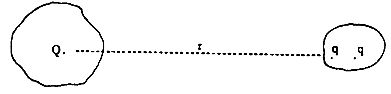
Polarization in the attracted bit is q(q dr)
Equating forces q(q dr) = Qq/r2 + Qq/(r + dr)2
Gravity F= Qq/r2 + Qq/(r + dr)2 = (q dr)2 1/r
Having established the nature of Gravity and its "formula", we may now see what can be done with it. Since it is essentially an electric field phenomenon, albeit not an electrostatic one, its distribution and behavior will be much the same as any other electric field, except for its dynamic characteristic. Altering the polarization will alter the force exerted by gravity, but because this is a square relationship, no such alteration can make the force negative (operate in the opposite direction). However, altering the divergence will alter both the magnitude and direction of the force, and the trick for controlling gravity is precisely this.
Since the gravitational field is due to the skew electric field, or stated differently, to the induction from the motional electric field, this is the logical region to explore for the mechanism by which fields may be produced to combine with the gravitational field and produce a resultant, having a divergence more to our liking.
In taking a quick look at the gravitational relationships of the basic particles alone, there are some interesting aspects. Since in an established region practically all the precessions are the same, the free particles will have a motional field of polarity the same as the particles making up the composite ones. They will therefore be "repelled" by gravity. This repulsion, however, will be quite a bit less than the electrostatic attraction, so a compromise position will be established at such a distance that everything will be in equilibrium.
In the atomic structure there are therefore the electric field forces holding the electrons onto the nucleus, the magnetic forces fixing them in position, the gravitational forces tending to push them away and resulting in a compromised location, with the tempic field contributing to the dynamic conditions within and contiguous to the structure. All these forces have been developed from the basic concepts already put forward. They are possible of confirmation by experiment if we ask nature the right questions. These same forces extend beyond the atom into molecular chemistry, crystal forms, and amorphous aggregates. These same forces exist within the atomic nuclei together with others, resulting from the interpenetration of the fields and their coherence. Matter, though magnificently complex, is elegantly simple in its basic structure when understood.
Aggregate ~ The physical assembly of particles as separate units.
Amorphous ~ Assembly of matter in which control is largely random.
Awareness ~ The relationship between a Being and all else.
Coherence ~ The condition when two or more fields of the same kind and direction combine into a single field.
Creator ~ The primary Cause for the existence of Awareness, Reality and its perception.
Crystal ~ Assembly of matter in which control is largely sequential.
Fabric ~ Grouping of three of the basic Parameters according to derivation and contiguous characteristics.
Integration ~ The summation of bits of the same kind into a whole.
Parameter ~ One of the twelve basic principles upon which all Reality perceived by Awareness is based.
Percipitation ~ Bringing Reality totally within the Perception of Awareness.
Personal ~ Pertaining to the identity of a Being.
Plasm ~ Assembly of matter in which control is largely free will.
Quadrature ~ A special operation by which a broadside (at right angles) relationship is established.
Skew ~ The geometrical configuration in which certain fields have tangential as well as radial components.
Tempic ~ The field parameter of Change
Tensor ~ Pertaining to a configuration of radiated energy which is self-contained.
Section Two
If we consider the fraction 2/3, we see that we are comparing the number 2 with the number 3. Nothing is said about the reality to which each number applies, beyond the implication that both numbers apply to the same reality. If, however, they do not apply to the same reality, then one of two things result: i.e., a conversion must be made or we agree that we cannot deal with the situation.
Suppose we are considering 2 apples and 3 pears. They are both fruit and have many features in common. The fraction 2/3 tells us that of the 5 fruit, 2 are of one kind and 3 are of another, and that we have 2/3 as many of one kind as we have of the other, and 3/2 of the converse.
If we rewrite the fraction in the following form 2/3|5 this nomenclature will tell us all of the above in one glance; namely, that we have 5 articles, having a factor in common which we are comparing, and that we have 2 of one kind and 3 of the other. Written 3/2|5 tells us precisely the same thing except that the order of comparison is reversed.
If we write i2/j3|5 we realize at once that 2 somethings lie along the x axis and 3 somethings lie along the y axis, but that we are considering their numerical values only.
If we write i2/j3|5 we realize that we are comparing two vectors in a quite normal manner. In fact, we are so familiar with vectors that the mere presence of the i and j notation tell us the whole story with respect to these two vectors. Therefore, the vertical line and what is to the right of it may properly be omitted.
Consider next the problem of zero and infinity. If we define infinity as the largest number in which we have any interest and zero as the smallest number in which we have any interest, and if we maintain exactly the same degree of interest in both, then unity must lie exactly halfway between our zero and infinity. We may tell this story in our nomenclature as follows: 0/∞|1 or ∞/0|1.
Consider next the situation with respect to differentials. The quantity dy/dx implies that there exists a relationship between y and x and that there are no aspects not included in this relationship. If, however, there are unrelated aspects, then dy/dx implies that only the related aspects are being considered. To a limited extent we get around this difficulty by "conversion factors" or scale constants, but these means do not allow us to cross the gap between one type of reality to a totally different type.
If we write sy/dx|A we are saying that A describes the relationship between y and x which we are to consider. This relationship may be ANYTHING.
The foregoing, though interesting, is not essential to the handling of ordinary concepts and their mathematics. However, there are certain transcendental concepts which do not lend themselves to a mathematical analysis unless we use such devices to orient them within the framework of the mathematics we have learned to understand.
We are all familiar (or think we are) with the term "NOW" meaning the present. We speak of the past, present and future and consider "now" as the bracket in time with which we are immediately concerned. However, no matter how precisely we define it, we cannot establish exactly what the present or now really is, except that it is vaguely a dividing point between the past and the future. Nevertheless, we know quite well instinctively that we are living in the present, and it is a perfectly real and satisfactory situation. Furthermore, we are advised that, to a disembodied entity, the present is the complete reality, and the past and future merely arrangements of events in the broadest sense.
If we write Future - Past = Now, we are saying that "Now is a very small differential between two very large items". A more proper expression is: Future - Past/Now|90° where we show that the present is actually in quadrature with the Future-Past, and hence need not be a small differential at all, but can assume the proportions which we instinctively know it to possess.
If we use the symbol Q for this quadrature concept we can write the above as:
F - P| Q
N
This tells us the whole story regarding this relationship and leaves us satisfied that it is all in the proper perspective.
We know that spin itself, the divergence of spin and the curl of spin are all mutually at right angles. Therefore, any inter-comparison between the three fields presented by these quantities should properly be written with the Q concept included:
De/dm|Q dm/dt|Q dt/de|Q
Incidentally, our observation of these three fields is always in quadrature. This is quite apparent with respect to time as set forth above, but a little consideration is necessary to appreciate that it also applies to the other two basic fields as well. This concept is even more necessary when learning to appreciate the higher dimension. Without it we cannot deal mathematically with the relationship between fields and, say, free will.
Here it should be emphasized that the Q concept extends beyond mere quadrature, or kind. It actually embraces the relationships existing among whole families of aspects of reality.
Consider the twelve dimensions of Deity, oriented in four fabrics of three each. Ordinarily one would not consider any dimensional relationship to exist, say, between the electric field and probability, but these are truly related through the Q concept. In fact, the Q concept is the only relationship which does in fact exist between the various dimensions.
Again, we have defined a field as any region which has a unique characteristic. If we extend our concept of a region to include the abstract as well as the spatial idea, then all twelve of the dimensions become fields. Admitting this, the Q concept must exist between the various dimensions incorporated in the analysis.
Let us look at an example:

This is a valid equation only if both sides, and everything on each side, refer to the same aspect of reality or a Unity relationship exists between all of the components. Note the resemblance of this equation to certain electromagnetic wave equations, which are in fact particular cases of this general case.
Employing the Q concept, this equation becomes:
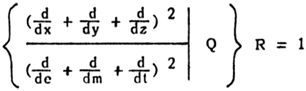
Section Three
Principles & Technology of Other Races
[Assembled from disclosures made by space people in various communications made to W. B Smith, and others with whom contact has been established. Data is arranged in logical rather than chronological order. ]
Part 1
Fundamentals
1.1 ~ The Structure of Meaning
Meaning is something which we generally take for granted. It is something with which we live day by day and which we usually have no occasion to define. In fact, a strict definition might be exceedingly difficult to evolve. To try to attach a meaning to meaning is very much like trying to pull oneself up by one's bootstraps. We could say that meaning is a way of conveying understanding, or that understanding results from the success of meaning. Understanding itself is something that begs definition.
Our knowledge of the physical world is acquired in two ways: by physical experience, and by conveyance of meaning by others. In either case it can have two results. The knowledge can simply be stored to be regurgitated on demand, or it can be understood. There is a vast difference between these two aspects. In the first case, the action is much like a phonograph or the memory box in an electronic brain. The stored data is usable only in the precise form in which it was deposited, any change whatsoever being tantamount to error. In the second case, however, since the data is understood, it can be used in any form whatsoever and in any combination with other data which is understood.
Obviously, understanding is enormously more useful than mere memory storage. Where memory bits can be used only one by one, or in combinations which have been established in memory, understanding permits use in all sorts of permutations and combinations: "The greatest wealth which can be acquired by man, is a complete understanding" (A-lan).
An example may be used to illustrate these points. If a blind person who has never enjoyed the use of his eyes were handed a lemon and told that it was yellow, he could feel its shape, texture, hardness and smell or taste it. Thereafter, if handed a similar object he would be fairly capable of telling someone else that it was a lemon and that it was yellow. However, he probably would have no understanding of yellow.
Three things are necessary to understanding, that is for data to have meaning. First, the data must actually reach the recipient accurately, and this is not nearly as easy as it looks. It must reach him either through his physical senses, or through direct mind contact, both of which are subject to distortions. Second, the recipient must be coded to receive the information. That is, each bit of information must be significant to him; it must have its own meaning in its own right. Third, the recipient must be able to process the data, which is the fitting of it together until it becomes an integrated whole, which is meaningful and self-consistent. To these three major steps may be added a fourth, which is essentially the cross-checking of meaning with others who have been exposed to the same data.
There exist many aids to understanding, such as formal logic, mathematics, computers, and methods of thinking which in themselves are close to intuition. In what follows, use will be made of any and all aids to understanding. However, it cannot be stressed too strongly that in nature there are certain fundamentals upon which all else is predicated, and an understanding of the more complex cannot be attained until the fundamentals are completely understood. This does not mean merely committing to memory certain formulas that appear to work.
When properly understood, this universe in which we find ourselves is beautifully simple. It is not at all the mathematical monstrosity with which we are accustomed to deal in our conventional science. True, the basic principles are foreign to our scholastic training, but they are strictly in accordance with what we know instinctively to be true. We are actually born with a better understanding of our universe than we boast of after a college graduation.
In formal geometry we base our reasoning on certain axioms, which we hold to be self-evident truths. The fact that we can build an integrated, meaningful, and self-consistent whole on these axioms gives us confidence in them. What would our attitude be if we found that the farther we advanced in geometry the more corrections we had to apply to make things come out right? We most certainly should question the validity of our precious axioms, or our methods, or both.
In our conventional science we have assumed certain things to be self-evident, and we have built a very complicated structure on them. We actually are finding, however, that we have to apply more and more corrections to make our philosophy work. In fact, we now apply so many corrections that we have formed the habit and consider that to do so is perfectly natural and in the orderly course of events. We are so far along this road that it is difficult even to look back, let alone to return to our axioms for a reappraisal and maybe a fresh start.
In what follows a complete new start is attempted. No apology will be made for this approach, and no explanations will be given beyond those believed to be necessary for an understanding of the subject. As a matter of fact, a useful preliminary ceremony would be a good brain washing. It should be remembered that no one can really teach; they can only help others to learn.
As a first consideration let us consider what space appears to be to us. We have no doubts about its volumetric nature, although we have no senses by which we can observe this condition. We conclude that space is volumetric by the nature of things which we find in it. What would it be like if everything were removed from space? Would we even have space?
Can we conceive of a space structure completely devoid of matter or energy in any form; real empty space? What would such space be like? If we were disembodied entities located in such a space, how could we identify our position or describe where or how we were? What sort of yardstick could we use? These and many more similar questions must be faced squarely by those seeking understanding.
When one has satisfied himself by actually doing it – that he can conceive of space with absolutely nothing in it, and is not too terrified of his creation, he is then in a position to take the next step, namely to find his way about in it.
An arbitrary decision can be made to refer all concepts to where the investigator conceives himself to be, thereby establishing a point. He can next conceive of an adjacent point, thereby establishing a line. By turning in various directions he can establish the concepts of surfaces and volumes. But no matter what he does after that, the investigator cannot add more concepts to the space itself. He therefore concludes that what he instinctively felt soon after he first conceived the empty space, that it was volumetric, and nothing more, is correct.
The foregoing is actually an exercise in mental gymnastics, but as physical exercise is necessary for body-building, so are these exercises necessary for the building of understanding. It is absolutely necessary to satisfy oneself on these points before going on to the next concept.
The next step is to conceive of a way of getting about in this empty space, and to realize that one has done so when the operation is complete. The concept of an adjacent position, or point, is a good approach, and here again the operation becomes one of mental gymnastics, and a lot of manipulation and practice is necessary to get the feel of the situation.
As one gains in understanding of the properties of space, the various geometries become evident, and it becomes increasingly obvious that a wide variety can be made to work, if certain basic parameters are admitted. However, since our concern is primarily with our space and our universe, we will want to select the geometry that best fits our experience.
Ordinary Euclidean or rectilinear geometry is quite familiar and comprehensible to us, and we can understand easily how it can be applied to space as we conceive it. We can understand a sideways, forwards-backwards, up-down concept, or expressed mathematically, and x, y and z axis. Also, we experience no great difficulty in conceiving of these three axes as converging at right angles to a single point and extending outward there from to enormous distances. We can even introduce the idea of infinity in any direction as being somewhat beyond the farthest distance in which we have any interest.
In our rectilinear concept we can conceive of such a thing as a straight line, although we might be hard put to define it, since the concept is in itself axiomatic. However, if we understand what a straight line actually is in our concept and we are sure that others with whom we communicate also have the same understanding, we can use it as a real datum point in our appreciation of our universe. This point is of particular significance in what is to follow, as it is one of the few solid anchors we have on which to fasten our understanding. Let us never lose sight of this concept of a straight line, as entirely distinct from the behavior of matter or energy.
Our rectilinear concept at once validates our Euclidean geometry. Furthermore, it removes any limitations which might be imposed on it by either great or small distances. It provides us with a clear-cut framework within which we can think our way about in space. We should satisfy ourselves that this concept actually is a necessary and sufficient condition for this purpose, although we remember that its selection was arbitrary and that other geometries probably would work just as well. However, since we have made our decision to use the rectilinear concept, we must be prepared to stick to our decision unless and until proved wrong. As a matter of fact, any geometry can be used, and will work within the limiting parameters of its definitions. It is only when extended beyond these limits that corrections become necessary. But even with the corrections, the geometry itself does not become invalid, only the things we expect it to do.
1.3 ~ Relativity of Measurement
In our concept of space, one of our first needs is for methods of measurement. We want to fix distances and directions, and we want to be sure that what we measure stays measured at the value we measure. We can agree upon some arbitrary distance between two points of which we can conceive, and make our measurements in terms of this distance as a unit, or standard, if you please. But can we be sure that the two points which form our standard stay put? And would it actually make any difference if they didn't? Is there any characteristic of our space which would tell us if our standard changed?
As a matter of fact, if there were, such a property itself would make an excellent standard. We are forced to the conclusion that, (a) absolute distances in space as determined by properties of space cannot exist, all measurements being relative to some arbitrary standard, and (b) so long as ALL the measurements in which we are interested are made relative to the same arbitrary standard, it doesn't matter if they do change, as we have no way of knowing anyway.
To get ahead of ourselves a bit, we might discuss the use of the so-called constant quantity, the velocity of light, as a standard of distance. This implies two assumptions: (a) that some quantity, time, is fixed somehow so that a measurement can be made relative to it, and (b) that we can be sure that light will behave in a ladylike manner with respect to our rectilinear geometry. At first this may seem to be an attractive way out, but a little consideration will show that it merely trades one difficult problem for two more which are inherently just as difficult. These maters will form the subject of a later section where it will be shown that the problem is even more complex than appears above. Fortunately, there is a solution which is at once simple and satisfying, but a good deal of preliminary conditioning must be endured before this concept can be understood.
Having conceived of completely empty space and satisfied ourselves regarding the geometry of it and the limitations of measurement which are inherent in it, we may quite properly ask ourselves, how real it is it? Does our space, the space which surrounds us, actually have these characteristics? We know that our space contains lots of things we consider as quite real, and we may ask of what are they made, and what is their basic reality?
To conceive of an abstract quality and assign to it concrete properties and then call it a real substance is most unsatisfactory in the face of our notions regarding everyday matter. We would much prefer to have something more tangible as a starting point. Consequently, even though reality actually is a concept just as intangible as our rectilinear concept, it might assist understanding if some primordial quantity could be introduced as a medium of expression.
The early postulation of ether and the still earlier Greek Ylm might fulfill this requirement. Both were considered to be all-pervading strictly continuous substances out of which matter was fabricated, and to have whatever properties were necessary for the formation of matter, without regard to how conflicting these properties might be. There is no fundamental objection to the use of such a medium of expression, since we will find that all references to it actually cancel out anyway. However, if it will serve as a crutch to help us in our first faltering steps, by all mean let's use it.
In our considerations of Ylm or ether we have something that is structureless, imponderable, and without boundaries, and in every sense intangible. Our concept of space provides a place in which we can conceive of the ether as being located, but by what manipulation can we convert this imponderable substance into ponderable matter?
Instinctively we know that we must make use of space as we have it, and that which we find therein, if we are to designate reality as distinct from the continuous background of ether. If we cannot designate some portion of the ether as being unique and distinguishable from all the rest, then we cannot say that we have established any degree of reality.
What is required then is for us to conceive of something which may be done, some manipulation which when completed will designate without uncertainty a certain region as being unique above all others, and therefore real. Ordinary spatial measurement we know to be inadequate since they are all relative to the arbitrary standard with which they were measured.
Obviously what is needed is something which in itself is absolute: something that will display the same value no matter where or how it is inspected, something against which a measurement may be made with assurance that when made it will not change. Furthermore, to assume the arbitrary injection of such a standard merely begs the question, since we transfer the question of reality from the substance to the yardstick that measured it, without yet establishing the reality of the yardstick. No, we must find that for which we seek in our concept of space itself.
There is one, and only one, concept that is absolute in its own right in rectilinear space, and that is the concept of spin. The word should be understood in the sense of a manipulation, or process, performed within the concept of space as we have conceived it, or performed on the ether within it. Either approach is valid.
Imagine two points in rectilinear space, with a straight line joining them. Imagine that another line which started out coincident with the first is swung around one of the points until it is again coincident with its initial position. Something has been done, once, and the concept of it having been done is established. No matter how big or small our region may become relative to some yardstick, the rotation once around remains the same. So also are absolute, multiple and factional rotations.
It is at once apparent that this concept of spin, extended through a place rotating about a line, and extending to infinity can be made to encompass our entire concept of rectilinear space. We can fill all space with a single spin, or any portion thereof, or we can fill it with many spins. Furthermore, we can conceive of the many spins being oriented in many ways, and having many manners of distribution. But the important thing to understand is that a region which is spinning is distinguishable from regions which are not, and that the actual spin is independent of any arbitrary standard of measurement.
At this point it must be noted that nothing is said about the rate of spin; only that spin takes place. Earlier we toyed with a concept of time which we held in abeyance because the concept added nothing to our concept of space and only posed more problems than it solves. We do not need to introduce time so long as we recognize the intervals of spin; that is, the relative angles of displacement at each comparative measurement. Understanding this point is vital to an understanding of spin. It will be shown later that time is a consequence of spin, and not something by which spin may be measured.
Having established the absolute nature of spin, we may next question its reality. By reality, we understand the ability to distinguish the reality from all else, to be able to say what it is and what it is not, to say where it is and where it is not, to make it interact with other reality. In other words, reality is something which we can place in a definite mental compartment with reasonable assurance that it will remain there. We want to be able to think about reality as a unit, and not have it mixed up with or overshadowed by unreality, or unresolved background.
If a concept meets these requirements reasonably well, we are reasonably happy with it and prepared to consider it as real. If we are to understand the reality of spin we must satisfy ourselves that it actually does meet these criteria. Much of what follows is developed with this end in view, and in recognition of the fact that it may be difficult to accept the status of reality for something which seems to be merely a mental manipulation.
Even though the concept of spin may not be too acceptable at first as a basic reality, when its many properties are explored and found to coincide with observed properties of matter, and when from these properties may be predicted the laws which we know matter to follow, the status of spin most certainly will be enhanced and with increased understanding will come greater confidence in the beautiful simplicity of the rectilinear concept of space within which spin manifests as the basic reality. In fact, we will find that we need no further foundations upon which to build our complete understanding of the material universe with all its glittering apparent complexity.
Part 2
The Structure of Spin
The concept of spin is fundamental in nature and is the only concept in nature which is absolute in its own right. The idea of spin has been associated integrally with the idea of units, multiples and fractions of complete revolutions, and these units are completely independent of any yardstick with which they may be measured. We can conceive of enormously large and enormously small numbers. These are applicable directly to spin and have exactly the same significance with respect to any particular spin to which they may be applied.
Within any interval of attention, spin may make many revolutions, one revolution only, or even a minute fraction of a revolution, without losing in any way its absolute nature. In fact, within any interval of attention, it need not actually turn at all, but merely display a tendency to turn, or be ready to turn. Or again, using our familiar concept of time (which incidentally we shall have to modify severely), we could say that one revolution completed in eternity would still be valid. In other words, there are no intrinsic limits imposed on spin. We can think about it exactly the same way as we can think about any pure number, for that is precisely what it is: the basic number of our material universe.
In our concept of rectilinear space we conceived of a single spin being present, centered about a point and extending out indefinitely far, perhaps to infinity. We satisfied ourselves that it could involve all of our space, and probably would unless we chose to prescribe arbitrary boundaries, which could be relative to some arbitrary yardstick at best. So now we can do two things: study the structure of a single spin, and then the interaction of a plurality of spins, because we know by our experience with this physical universe that spins do interact.
At this point it might be well to make a blatant statement and leave the derivation of it until much later, in order to facilitate understanding of what this discussion of spin is leading up to. Since spin is the only concept which we have in this universe which is absolute, it is fairly obvious that it must be the primordial building material of matter and energy, and a unit of spin must be the basic unit of these manifestations. All that we have in this material universe, whether matter or energy, is made up of spin, various units of which are fitted together in manners becoming to each and every form of matter or energy with which we are familiar, and many of which we do not even yet suspect.
Consider first a single spin alone in space. Let us inspect it closely to see what we have. If our interval of inspection is sufficiently large, we still observe it to make one complete revolution. We can assign to that interval one unit. We may subdivide the unit to any extent we please, or we may observe it for a larger interval while it makes many revolutions. We have thus defined a unit for our interval.
It is fairly obvious that since linear distances in rectilinear space are purely relative, and spin is absolute, the interval of a unit of spin, or any fraction or any multiple of it must be precisely the same regardless of the relative distance from the center of spin that the observation was made. This point is of vital importance in the understanding of the origin of time.
Furthermore, uniform subdivisions of an interval of spin must all be identical. This is almost axiomatic, since if it were not so, how could we tell anyway?
In our conceptions of space and spin, we must understand that we are not limited in any way to numbers in the vicinity of unity. We wish to establish relative values of unity to construct useable scales, but there is no necessity whatsoever to confine our thinking to the middle register of numbers. In fact, we will find that nature runs the gamut of numbers from the infinitesimally small to the enormously large, for all practical purposes from a real zero to a real infinity. Therefore we can construct our practical scales where convenient.
So far, in our conception of spin, we have considered it to be distributed uniformly throughout our rectilinear space. We have tacitly assumed that angular displacement within any interval would be constant. However, under this concept it is apparent that the farther one goes away from the center of spin, the greater will be the actual spin displacement, and the reality of the spin will obviously be located anywhere other than at the center of spin, where we would suppose it to be, and where it has to be if it is to be consistent with our experience with matter.
While we can conceive of many possible distributions of spin, only one is consistent with our universe as we find it. We cannot say whether or not other real universes can co-exist with ours having spin distribution different from that of our universe, but it is most unlikely that means would exist to detect them if they did.
Spin in our universe is almost certainly evenly distributed, in that the spin displacement is the same regardless of the relative distance from the center of spin. This concept is validated by the fact that conclusions derived from it are entirely consistent with our experience with matter and energy. If it were not so, there would exist voids in our universe into which our matter and energy could not penetrate, and we know of no such voids, although it is quite conceivable that they could exist. Certainly within the range of our observations on the behavior of matter and energy, the concept of even distribution of spin displacement appears to be valid.
It is very important to understand what is meant by uniform displacement of spin, as this peculiarity of structure is responsible for all the characteristics of matter and energy with which we are familiar. Imagine a line in space being rotated around a point and away from another line through the same point. If both lines are straight there will be an increasing angle between them, the magnitude of which will be indicative of the spin. But with uniform displacement of spin in any interval, there is just as much displacement of the line near to the point about which the turning takes place as more remote from it. This is a consequence of the relativity of linear measurements, and although related to the geometry of the spin, this must not be confused with it. The obvious conclusion is that the interval near the center contains more units than the interval farther out.
A natural question at this point is, just what is this interval about which we have been talking? It should be noted that the word time has deliberately been avoided, and for a very good reason. It is first necessary to establish the interval in terms of spin only, so that derivatives of the interval can have an absolute status. The interval itself can next be cut up into convenient and meaningful units, which are also absolute in nature. If we wish, we can call these subdivisions by the name time, but if we do we must realize that this time is not quite the same as the process which our clocks measure. It is truly the amount of spin contained in an interval of attention, and nothing more.
In the consideration of the distribution of spin and spin displacement, reference was made to an arbitrary interval of attention. The amount of spin in this interval signifies the extent of happening, or amount of reality present. But since the interval is arbitrary while the spin is absolute, the unit of interval of necessity must be defined in terms of spin.
I = Interval
i= Subdivisions of Interval
n = Number of subdivisions
S = Spin
D = Spin displacement
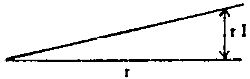
From geometry D = S / rI
rI = S / D which is constant for all values of r. But n i = I, from which r n i = constant, from which it is apparent that n must be proportional to I / r if the values of i are to be all the same. By suitable choice of units, which is permissible since our interval is quite arbitrary, we can have n = I / r whence D = S / i.
The quantity D, which is spin per unit of interval, is spin velocity as referred to a unit of time, if we wish to think of the subdivisions of the interval as time. This quantity, spin velocity or spin displacement, is a fundamental concept in nature, and although we may use many and varied units for n and i, the quantity remains fixed when once defined.
Spin velocity will be shown later to bear a close resemblance to the universal constant c, or the velocity of light, but it would be erroneous at this stage to say that this is the derivation of c, since there are other factors that also enter into its derivation. The real fundamental constant is of course spin velocity, and this is constant for matter and energy as we know them.
A field is a region that has a unique characteristic. This definition is purposefully broad and includes all kinds of fields. It even includes fields of grain and battlefields. A broad definition is necessary since so far, all we have defined in the universe is a three dimensional space (region) and spin (characteristic). But we know that our space contains an enormous variety of things, all made of spin, and somehow we must explain them all. We will have to study all the characteristics of spin in our region of interest in order to do this. Therefore, we will tackle the job piecemeal and study each field separately, that is each spin characteristic manifesting in the region.
In the consideration of the distribution of spin and in the derivation of the spin velocity, it was pointed out that units of subdivision of an interval could be defined in terms of spin, and that the number of such units was always proportional to the amount or quantity of spin present at that point. Consider a region about a center of spin, extending as far as we please in all directions. The distribution of spin is such that more lies close to the center than farther away. Also, the units within the interval of attention follow the same distribution. This is then a unique characteristic in our region of interest qualifying it as a field, and in view of the fact that we may associate units of interval subdivision with our ideas of time, it would be proper to give this field a name having some kind of time significance. We will call it the tempic field.
The intensity of the tempic field is obviously the number of units of interval subdivision associated with the spin that is present at that point. The distribution of the field of course follows exactly the distribution of the spin that defines it. The more intense the tempic field, the larger number of units necessary to express it.
Because of its very nature, and being located as it is in a rectilinear space, spin must be both scalar and vector. That is, there will be a quantity of reality that does not involve direction, and various characteristics that involve direction as well as magnitude. By definition of the units by which spin is measured these units must always be positive; therefore it is apparent that they cannot have direction, and must be completely scalar in nature, but always additive. However, because of the geometry of space and the distribution of spin, many of its characteristics will be vectorial.
The tempic field actually is the direct manifestation of spin, and like the reality of the spin quantity itself, is a scalar quantity. Its distribution throughout the space can, however, have directional properties and hence be vectorial. We could say that the tempic field is synonymous with the quantity of spin, although it would not be quite correct to say that the tempic field and spin were the same thing.
It would be well to remember that the entire concept of interval, subdivisions of interval, and tempic field, is necessary to enable us to conceive of spin as a real quantity and to make it possible for something to happen in our concept of rectilinear space. Our universe being what it is, a basic rectilinear or three-dimensional matrix, with the only absolute quantity of spin with which to populate it, means that regardless of what we might choose to call the various manifestations of spin, they are none the less real and are the building blocks of our matter and energy.
In order to determine just where reality lies we might perform an interesting mathematical operation. Consider a system of spherical coordinates centered on our spin center, with q as the vertical angle and ø as the horizontal angle. Let r equal the radius and dv the element of volume.
dv = r cos q d ø r d q dr
But since the tempic field intensity is proportional to I / r, the quantity of spin in the element dv is
dq = k dv / r3
dq = k cos q d q d ø dr / r
Integrating q = 4pi k loge r2 / r1
For unit radius k = 1 / 4pi , also note log 1 = 0
Hence for unit radius, one half the total spin lies inside a sphere of radius1, and half lies outside. Also, the total quantity is 4pi times the quantity per unit volume. These figures will be seen to have significance later when the various other spin fields are considered.
Part 3
The Spin Fields
3.1 ~ The Significance of the Tempic Field
We have just satisfied ourselves that spin may be described or measured in terms of subdivisions of an interval, and that these units may properly be considered as a field. We have called this field tempic field, rather than a time field, because time for us has a connotation that is not strictly in accord with the characteristics of this field. As a matter of fact, our clocks do not measure either time or tempic field; they measure entropy changes. If it were not for the fact that so much of the matter in our universe is behaving in a most ladylike manner, our clocks would indeed be quite erratic. It will be shown later that time may be altered through natural processes or manipulated by intelligent control.
Suppose again that we were disembodied entities, but this time located in space near where a certain quantity of spin existed. If our psychological time sense were reasonably good and we set about to explore the region, we would find that it took us longer to explore a given relative distance near to the spin center than a distance farther away. Also, we would probably notice that if we moved at right angles to the line joining our position with the spin center, it would take us just as long to develop a given angle regardless of how far from the spin center we might be. This is the true concept of time, reduced to its most basic form.
As disembodied entities, we are able to prowl around the spin center and investigate its many aspects without disturbing it. In order to understand it, we must appreciate it as it is, not through a third or fourth hand effect as may be shown on some crude indicating instrument. When we understand the structure of matter, we may devise confirmatory experiments using whatever instrumentation we please, but until that understanding is attained, the proper tool is the uninhibited mind.
In our explorations of the region surrounding the spin center, we would always find some spin. It would always be present. It would never become negative or zero, although it might be quite small. But we would find that the tempic field intensity is such that it could easily fool us in regard to the amount of space which we had explored, particularly if we had used an arbitrary yardstick to measure it.
Again, if we used an arbitrary yardstick to measure the space, we would find that the spin density would be inversely proportional to the distance from the spin center, provided that our arbitrary yardstick didn't change. We would, however, find that the time taken to explore an equal volume close to the center was more than that taken to explore the same volume farther away. We might jump to the conclusion that time was fixed, and that the space was stretched or warped close to the spin center. This is precisely what happened when the Theory of Relativity was formulated. This theory is quite valid, provided it is used only in a region where the tempic field bears a simple relation to the relative linear scale; otherwise it can become frightfully complicated as all who have struggled through it can testify.
The Theory of Relativity, therefore, is really a special case where Time is held constant and everything else is allowed to vary if need be. Is it not ever so much simpler to recognize the field nature of time and have a rectilinear space which is straight forward and easy to understand, than to insist on a constant time with its attendant necessity for continually introducing and trying to justify such weird concepts as space warps, contractions, etc? The fact remains furthermore, that whether we like it or not, the tempic field exists and no amount of skepticism will make it go away.
In developing the properties of spin, the term "interval" was used extensively. It was not defined except by implication. In fact, it would be most difficult to define it except in terms of spin itself. We could say, with respect to a single spin center, that an interval was a multiple or fraction (or unity) of a complete revolution, but this definition would not be valid when more than one spin center was under consideration, except in special circumstances. It is suggested that understanding is more readily attained if the term is always considered in this subjective sense, as "interval of attention", and merely brackets the extent of our consideration for the matter. This may seem to be laboring a point, but a full appreciation of the term is essential for an understanding of simultaneity.
Since the tempic field and therefore time at any point is the result of the spin condition manifesting at that point, the concept of simultaneity in its usual sense becomes somewhat ambiguous and requires redefining. There is no great difficulty when a single spin center is considered, or within a region where the tempic field is constant, but the matter is not quite so simple in other cases.
Consider first the case of a single spin center. Here simultaneity would be established by one or more straight lines converging on the spin center. In the practical case, some means of direct observation or communication along such lines is implied. If this is not possible, then it is at once apparent that simultaneity cannot be established directly and may only be deduced. Subjectively, however, we can visualize the spin angle swept out within any given interval of attention and declare that simultaneity existed throughout that particular spin during that interval. It must be carefully noted that this simultaneity is quite separate from the amount of time that might have been included in the interval in the various parts of the spin, although measurable by any of the times.
Consider next a region that is relatively small enough that the tempic field is uniform throughout. Here it is fairly obvious that simultaneity exists throughout the region. Also, that within any interval of attention the amount of time existing is the same for the entire region. The surface of the earth very closely approximates this condition.
In anticipation of cases to be discussed at greater length later, let us turn our attention to something of a general case, where the tempic field is neither uniform nor follows a simple pattern of distribution. Subjectively we can declare that simultaneity exists throughout the region within any given interval of attention, but how are we to establish this fact? Obviously, throughout the region different parts will have different amounts of time within the interval, but unless we are able to observe all points separately, or have means of communication between these points, we will not know when to start counting the time at the start of the interval, nor when to stop counting it at the end.
Although simultaneity is a concept which in itself is not difficult, because of the characteristics of spin that make up our universe, simultaneity cannot be established unless the interval of attention starts with everything in which we are interested located at a single point in space and finishes at another single point in space. This is probably the most fundamental concept in connection with the tempic field, and merely states that with respect to time one cannot have a cake and eat it too.
Suppose two observers started out from a point where the tempic field was t1 and one went immediately to a region where the field was t2 and the other went to a region where the field was t3. Suppose that there were three clocks that responded proportionately to the tempic fields, one carried out by each of the observers and the third remaining at the starting point. Suppose that, after a certain interval, both observers returned to the starting point and compared notes.
They would find that the elapsed time as measured by the clocks was closely proportional to the fields within which they had been operating, any discrepancies being due to the transition periods between the various regions. Probably the two observers would disagree violently with each other and with the home clock as to how long they had been away, but with simultaneity established by common points of start and finish of the interval, they would be forced to admit that the time change was real. Otherwise, the time would appear to be absolute and simultaneity would be sacrificed.
It was shown previously that the only reality that we have in our universe is spin. This reality is of course both scalar and vector. The total quantity of spin is scalar and represents the total quantity of reality. The distribution of this reality gives rise to another scalar quantity, namely spin density, and also to several vector quantities, including gradient, divergence and curl. There are also other tensor quantities as well. Spin density was shown to have the characteristics of a field, the properties of which were identified with a time aspect and the field seen to be that which gives rise to our phenomena of time, and therefore was called a tempic field.
It may readily be appreciated that since spin is centered about a point and has a distribution other than uniform, it must have a divergence. This divergence is identical with the result of the mathematical operation of the scalar product of the differential operator del, or unit differential vector with the spin unit itself. The mathematical development will be dealt with later when we come to the integration of these basic concepts with conventional science. With this subsequent analysis it will be shown why the electric field has the properties that it displays, and how they got there. Because the divergence of spin is the electric field. Here again we have a fundamental principle derived and stated.
Having seen that the divergence of spin results from the mathematical operation of the scalar product of del and spin, we may next look at the vector product of these two quantities. This produces the curl of spin. Again the detailed mathematical developments will be deferred until we study the properties of the magnetic field, because the curl of spin is the magnetic field. This may come as something of a shock, particularly in the light of certain of our preconceived ideas regarding the structure of magnetic fields. However, skepticism has never yet made a fact go away, and the magnetic field is still the curl of a spin.
Incidentally, at this point we may inject a comment that was directed at our science and in particular of our knowledge of magnetism: "Scientists of Earth know an amazing number of things about magnetism which are not so!". In the light of the understanding of the true nature of magnetism, this statement is most appropriate. The two things that are possibly closest to our daily lives of the entire physical science are magnetism and gravitation, and these are the things about which we have the wildest misconceptions. One of our queer ideas about magnetic fields is that they are made up of lines of force that loop around and close on themselves. Undoubtedly we got this idea from playing with iron filings and a magnet. What we didn't see, however, was what happened inside the magnet. In fact, the field does not close on itself and inside the magnet it has exactly the same sense of direction as outside. These and many more features of the magnetic field will be demonstrated later.
Having considered the mathematical operation of the unit vector del on the vector aspect of spin to obtain the divergence and curl, and having seen the significance of these operations, let us next look at the effect or consequence of the operation of del on the scalar aspect of spin. It is at once apparent that this will yield a gradient of spin, and to this we must attach meaning.
We have seen the scalar aspect of spin to be the parent quantity from which our time is derived. The gradient of this quantity is therefore the rate of change over time over the incremental distance considered and in the direction decreed by the unit vector del. In writing this out we have
G = dt / dx + dt / dy + dt / dx = dt / ds
where t is the tempic field and s the distance in the direction of del. Inverting this equation, we have
1 / G = ds / dt
which we recognize immediately to be a velocity.
Of course we will at once ask the question, if this gradient is the reciprocal of a velocity, what is going where? The answer is that one spin center in the universe would be unstable and at once expand to infinity, but within the structure of our matter, the arrangement is such that these gradients precisely cancel each other out and stable matter results. This property then gives us the clue for the manner in which our matter is built up, and in effect is responsible for the ponderable nature of matter.
It is interesting to note the relationship defining momentum, mass times velocity, which is, of course, mass divided by the spin gradient. Or, we can define mass as the product of the ponderability of matter and the spin gradient that produced it. Much more will be said about these and other relationships later.
Part 4
Multiplicity of Spin Centers
We have had a superficial look at the behaviors of a single spin center and a peek at a multiplicity of spin centers. We know that our matter is made up of enormous numbers of spin centers, some of which are quite close together, so let us now see what happens when there are a great many to consider.
In the first place, all the spin centers could be lined up; that is, their spin vectors could all be pointing in the same direction. In this case we would say that such matter is "polarized", and we would expect different properties than from unpolarized matter in which the spin vectors were randomly oriented.
It may be readily appreciated that at any point the effect of the summation of each of the fields due to each individual spin will depend on (a) the relative distance from the reference point to each spin center, and (b) the relative orientation of the spin centers with respect to one another. This consideration is apart from any "background" field that may be present.
Since spin is both scalar and vector, it follows that the scalar components will simply add up, while the laws of vector addition will be followed by the vector components, with one important additional consideration. The scalar addition must be performed before the mathematical operations with del are performed to yield the field conditions. This consideration is merely stated at this stage as being important. Its significance will be apparent later, but it has to do with the fact that spin, which is what is being operated upon, is in itself the only absolute quantity with respect to which the operation may be performed.
Another important consideration is to realize that spin centers are exactly what their name implies; they are centers about which the units of reality function. They are not particles. Therefore, the standard equations of vector analysis such as LaPlace's and Poisson's equations may not always be valid. These equations are derived on the assumption that the entire virtue of a particle is contained within the point center, and its only influence is apparent outside of the point. This is of course not the case, as the entire virtue of a spin center actually lies completely outside the point center, and may correctly be said to be everywhere except within the point.
4.2 ~ Summation of Scalar Spin
Consider first an aggregate or cluster of a large [?] by a finite number of spin centers. At any point the total spin will be the scalar sum of all the individual spins at that point. The total resultant spin density will give the tempic field intensity at that point. If the reference is very far from the cluster, then the resultant tempic field intensity will appear to originate (approximately) from a single large spin center coincident with the geometry of the cluster. It will be found to vary intensely as the distance from this virtual center.
As the cluster is approached by the reference point, the tempic field intensity increases according to the inverse distance law until quite near, when it levels off to become nearly constant as the cluster is penetrated. The significant point here is that the presence of additional spin centers modifies the simple inverse distance law of spin distribution around a single spin center.
The exact description in any particular case can of course be worked out mathematically, but at this stage there is little point in doing so, as it is only part of the story and does not necessarily represent any actual condition of spin distribution. In practical cases, there is always a "background" of tempic field to be considered along with the purely local consideration. In addition, there may be tempic fields due to "dynamic" relationships between the other fields present in the region.
4.3 ~ Summation of Gradient of Spin
We have seen that the gradient of spin has the characteristic of one over a velocity; also that the ponderability of matter multiplied by the spin gradient gives mass. It is not too difficult to conceive of configurations of spin centers that will produce extensive regions of reduced spin gradient.
In these regions the apparent spin velocities become high, but since the physical distances involved remain unchanged, and spin velocity is constant, the effect is a decrease in the tempic field. In other words, holes are formed in the background of the tempic field, i.e., there is to all intents and purposes negative spin introduced. Surrounding these holes there will be represented all the characteristics of new, but negative, spin centers with their attendant fields superimposed on the fields of the original spin centers that produced the holes.
In a matrix of a large number of spin centers all oriented in the same direction, it is easy to see that there will be very nearly the same number of holes formed in the spaces between them. In the microscopic sense, the gradients balance and the entire mass is stable. In the case of a large number of randomly oriented spin centers, only a few will produce real holes, with the remainder producing "virtual" holes. These virtual holes are none the less real, even though they lie in effect "outside" the spin centers responsible for their existence.
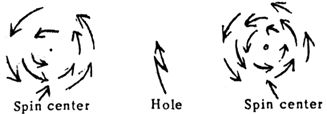
If we look at a pair of spin centers that are oriented in the same direction, we find a hole developing between them, and a "shell" of increased spin developing around them. On the other hand, if they are oriented in the opposite direction, a region of increased spin develops between them and a shell of reduced spin develops around them.
Here we must be careful to maintain a clear concept of what is going on. The scalar aspect of spin is its absolute reality and is either present or absent. It has no fixed direction or polarity. It adds up arithmetically to produce the total amount of reality present. The distribution of spin, however, is a function of relative position and its derivative, the gradient of spin, also has direction in that it is a scalar quantity measured in a certain direction. In the foregoing, the basic spin units remain unaltered by the presence or absence of other spin units, but the field structure associated with them is altered by the presence of other spin centers.
Where holes develop, there is no change in the absolute quantity of spin present, only a redistribution; a conversion of some spin from positive to negative, super-imposed on the background of positive spin.
We may ask what the difference is between a real and a virtual hole. A real hole develops in "polarized" matter where the gradient of spin is reduced in the space between the spin centers and increased in the region surrounding the spin centers. Consequently, since the ponderability of matter is proportional to the reciprocal of the spin gradient, such polarized matter loses ponderability while still retaining reality (mass) with respect to all outside consideration. A virtual hole develops in unpolarized matter and may have almost any distribution from a real hole to a completely virtual hole as in the case of opposite spin orientation. The one feature in common is that of increasing the ponderability of matter with respect to outside considerations.
Where there are available large numbers of randomly oriented spin centers, patterns of real and virtual holes can develop, which when taken together with patterns resulting from other field considerations give rise to the structure of matter as we know it.
Part 5
[ This part was not written ]
5.1 ~ Definition of Force
5.2 ~ Changing Reality
5.3 ~ Work & Energy
Notes: Summary of the 12 Parameters/Dimensions/Degrees of Awareness
- Length
- Area
- Volume
- Change/density/gradient (tempic field [time], how Reality is distributed in space)
- Divergence (electric field, the stable condition in which Awareness finds Reality)
- Curl/deviation (magnetic field, the dynamic aspect of Reality as perceived by Awareness)
- Orientation (random)
- Decision/free will
- Sequence/order/specific arrangement (re-establishes symmetry)
- Form (boundary of Reality)
- Multiplicity (allows individualization in form, a coagulation of substance out of basic Reality.)
- Aggregation (assembly of bits into a purposeful structure)
The first three constitute the Space Fabric.
The second three constitute the Field Fabric.
The third three constitute the Control Fabric.
The final three constitute the Percipitation Fabric.
Note: For other essays and memos by Wilbert Smith, click here and here.