


























Tsunami Bomb Weapon Reported in
New Zealand's Top Newspaper
"Top-secret wartime experiments were conducted off the coast of Auckland to perfect a tidal wave bomb, declassified files reveal. An Auckland University professor seconded to the Army set off a series of underwater explosions triggering mini-tidal waves at Whangaparaoa in 1944 and 1945. Details of the tsunami bomb, known as Project Seal, are contained in 53-year-old documents released by the Ministry of Foreign Affairs and Trade."
-- From article in the New Zealand Herald (New Zealand's leading newspaper), 9/25/1999
Dear friends,

A declassified government report (96 MB file) featured in the newspaper article below shows that a tsunami bomb was created as a potential weapon during WWII in a program code-named Project Seal. There is little doubt that this tsunami weapon was further developed and refined over the ensuing decades, though all documents related to current developments of the project are almost certainly still classified.
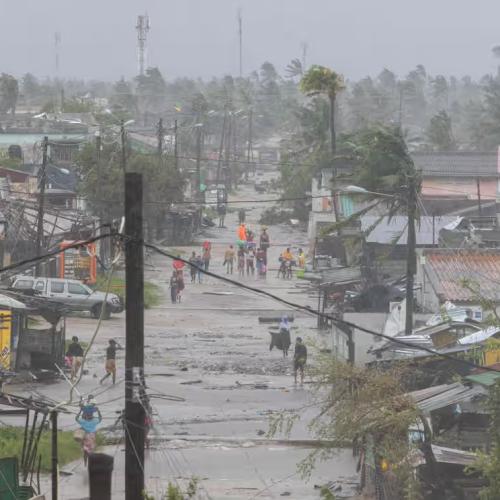
Though it may seem far-fetched to imagine military involvement, these documents and reports raise serious questions about the 2011 tsunami in Japan and the 2004 tsunami in Indonesia.
The many layers of intense secrecy both in the government and military result in very few people being aware of the gruesome capabilities for death and destruction that have been developed over the years. Were it not for the below article in New Zealand's leading newspaper, the public would never have known that a tsunami bomb had been created many decades ago. No one denies that highly destructive weapons are being developed in secret by the militaries of the world. What the public doesn't know is what these weapons are, and what they are being used for. All of this is generally classified for reasons of "national security."
Sadly, the rubric of "national security" has all too often been used for secret political and economic gains which clearly do not benefit the public. Operation Northwoods, uncovered by ABC News in the year 2000, showed that the top Pentagon generals were willing to foment terrorism and sacrifice innocent civilians in order to provoke a war with Cuba in the early 1960s. Credible researchers into the government's HAARP program are convinced that this technology which manipulates our ionosphere is being used for military means and can even play a role in natural disasters like earthquakes. Because of this, we have to ask the hard questions.
It is unprecedented in recorded history for two major tidal waves to occur less than seven years apart. See brief descriptions of the 10 most destructive tsunamis in recorded history at this link. For four intriguing theories on what might have caused the Japanese earthquake (including one which predicted the date), click here. Theory two seems ridiculous, but the other three are worth considering. The fourth theory is based on HAARP and has some good information about that possibility.
Few people are aware of the secret societies composed of some of the world's wealthiest and most powerful people. Read the major media reports on this key topic at this link. Many serious researchers, including myself, suspect that factions of the power elite want to keep us in fear and even to promote an armageddon scenario for their own benefit. For more on this, click here. In order to avoid further unnecessary wars and destruction, let us all educate ourselves on these important matters and work towards greater transparency and cooperation between all good people who share our world.
With best wishes,
Fred Burks for PEERS and WantToKnow.info
Former language interpreter for Presidents Bush and Clinton
Note: See the excellent "What you can do" box below this article for how you can make a difference. If each of us does our part to transform the part of life within our reach, we can build a better world for all of us.
Tsunami
bomb - NZ's devastating war secret
September 25, 1999
By Eugene Bingham
[Original article available on New Zealand Herald website at this link]
Top-secret wartime experiments were conducted off the coast of Auckland to perfect a tidal wave bomb, declassified files reveal.
An Auckland University professor seconded to the Army set off a series of underwater explosions triggering mini-tidal waves at Whangaparaoa in 1944 and 1945.
Professor Thomas Leech's work was considered so significant that United States defence chiefs said that if the project had been completed before the end of the war it could have played a role as effective as that of the atom bomb.
Details of the tsunami bomb, known as Project Seal, are contained in 53-year-old documents released by the Ministry of Foreign Affairs and Trade.
Papers stamped "top secret" show the US and British military were eager for Seal to be developed in the post-war years too. They even considered sending Professor Leech to Bikini Atoll to view the US nuclear tests and see if they had any application to his work.
He did not make the visit, although a member of the US board of assessors of atomic tests, Dr Karl Compton, was sent to New Zealand.
"Dr Compton is impressed with Professor Leech's deductions on the Seal project and is prepared to recommend to the Joint Chiefs of Staff that all technical data from the test relevant to the Seal project should be made available to the New Zealand Government for further study by Professor Leech," said a July 1946 letter from Washington to Wellington.
Professor Leech, who died in his native Australia in 1973, was the university's dean of engineering from 1940 to 1950.
News of his being awarded a CBE ["Commander of the Order of the British Empire", a grade in the Order of the British Empire] in 1947 for research on a weapon led to speculation in newspapers around the world about what was being developed.
Though high-ranking New Zealand and US officers spoke out in support of the research, no details of it were released because the work was on-going.
A former colleague of Professor Leech, Neil Kirton, told the Weekend Herald that the experiments involved laying a pattern of explosives underwater to create a tsunami.
Small-scale explosions were carried out in the Pacific and off Whangaparaoa, which at the time was controlled by the Army.
It is unclear what happened to Project Seal once the final report was forwarded to Wellington Defence Headquarters late in the 1940s.
The bomb was never tested on a full scale, and Mr Kirton doubts that Aucklanders would have noticed the trials.
"Whether it could ever be resurrected ... Under some circumstances I think it could be devastating."
- Read other powerful, reliable major media articles on secret military weapons at this link.
- Inform your media and political representatives of this critical information on top secret lethal weapons. To contact those close to you, click here. Urge them bring this information to light and allow public dialog on the topic of weather control and electromagnetic weapons.
- To read excellent, well researched articles by top researchers in the field of HAARP, electromagnetic warfare and secret weapons, click here, here, here, here, and here.
- Learn about the intriguing history and development of controversial behavior modification programs in this excellent two-page summary. Footnotes and links to reliable sources are provided for verification purposes.
- Explore inspiring ideas on how we can build a brighter future in this short essay.
- Spread this news to your friends and colleagues, and bookmark this article on key news websites using the "Share" icon on this page, so that we can fill the role at which the major media is sadly failing. Together, we can make a difference.
- We need your support. Please help our work to grow and thrive by donating at this link.

Finding Balance: WantToKnow.info Inspiration Center
WantToKnow.info believes it is important to balance disturbing cover-up information with inspirational writings which call us to be all that we can be and to work together for positive change. For an abundance of uplifting material, please visit our Inspiration Center.
See our exceptional archive of revealing news articles.
www.momentoflove.org - Every person in the world has a heart
www.personalgrowthcourses.net - Dynamic online courses powerfully expand your horizons
www.WantToKnow.info - Reliable, verifiable information on major cover-ups
www.weboflove.org - Strengthening the Web of Love that interconnects us all
Subscribe here to the WantToKnow.info email list (two messages a week)




