





































Big Brother News Articles
Below are key excerpts of revealing news articles on Big Brother from reliable news media sources. If any link fails to function, a paywall blocks full access, or the article is no longer available, try these digital tools.

Some countries have been trying to construct something like an Ebola Virus, and that would be a very dangerous phenomenon, to say the least. Alvin Toeffler has written about this in terms of some scientists in their laboratories trying to devise certain types of pathogens that would be ethnic specific so that they could just eliminate certain ethnic groups and races; and others are designing some sort of engineering, some sort of insects that can destroy specific crops. Others are engaging even in an eco- type of terrorism whereby they can alter the climate, set off earthquakes, volcanoes remotely through the use of electromagnetic waves. So there are plenty of ingenious minds out there that are at work finding ways in which they can wreak terror upon other nations. It's real, and that's the reason why we have to intensify our efforts.
If terrorist organizations have the capability to set off earthquakes and other major natural disasters, do you think huge military research laboratories with vast budgets might have some of the same capabilities? For more, click here and here.
One of the most astounding facts about our American life is that the wealth and property of the country and the control of the machinery of government are in the hands of less than 2 per cent of the inhabitants. A small group of excessively wealthy individuals, members of the Republican and Democratic Parties alike, have, through the exercise of powerful, sinister and, too often, unlawful influence, usurped the government and seized public property on such a wholesale scale that they have become ... virtual dictators. A small group of international bankers and money lenders, public utility exploiters and tariff beneficiaries have actually dictated nominations for offices up to the Presidency. They have placed the slickest, cleverest, and most cunning manipulators in official positions, even in the minor posts, where they could be of service when called upon by the invisible power which, utterly devoid of all humanity, seeks but to wallow in riches. So absolute is the power of America's secret dynastic rulers that they have, without hindrance, written the very platforms and pledges of political parties, and because of substantial contributions to campaign chests they have arrogated to themselves the right to dictate the governmental policies of the administration elected to office regardless of party. Woe to the public officials who dare to resent their dictatorship! If there be such public officials who will not submit to their imperious dictation, then the flood-gates of lying press propaganda are released, sweeping the unhappy public servant to an earthly as well as political grave, or compelling him to compromise with his conscience and become their subservient tool to the end of his term.
Note: John F. Hylan was Mayor of New York City from 1918 to 1925. New York has long been the US banking and financial headquarters, with the mayor's office about a half-mile from the New York Stock Exchange. The rest of this important article can be accessed at this link as well as the one above. It is interesting to note that this article was published not long after the Federal Reserve was created, turning over huge amounts of control of the U.S. economy to the most powerful bankers in the country. For more on this, click here.
The tools European security agencies now have at their disposal ... would make any American or Canadian intelligence officer drool. Britain has literally created a surveillance state. The British Security Industry Authority estimated three years ago the government has installed about six million closed-circuit TV cameras in the public square; one for every 10 citizens. The French, too, have vastly expanded public video surveillance in recent years. And it's all been done with overwhelming support from the general public, which feels safer for the presence of the surveillance, never mind the lack of objective proof that they are more protected against outrages, which keep on occurring. Both England and France are former colonial powers that ... long ago subordinated individual rights to collective security. Canada and America more dearly cherish individual rights. Still, a surveillance state is growing here, too. David Lyon, a professor of surveillance studies at Queen's University, has identified several public surveillance trends, all of which he says are "increasing at an accelerating rate." Canada is not about to become Western Europe, he says, but "it is incumbent upon us as a society to think about the ethical consequences" of mass surveillance. [Some] would argue that the cameras are desperately needed tools, and that anyone who isn't doing anything wrong has nothing to worry about. That of course is the police state justification. They hate us because we are free, we are told. The fact that we've responded by giving up ever more freedom doesn't seem to matter.
Note: Many of the politicians publicly defending the surveillance state receive huge sums of money from private security companies. For more along these lines, see concise summaries of deeply revealing news articles about government corruption and the disappearance of privacy.
[Google engineers] are making it far more difficult and far more expensive for the National Security Agency and the intelligence arms of other governments around the world to pierce their systems. As fast as it can, Google is sealing up cracks in its systems that Edward J. Snowden revealed the N.S.A. had brilliantly exploited. It is encrypting more data as it moves among its servers and helping customers encode their own emails. Facebook, Microsoft and Yahoo are taking similar steps. After years of cooperating with the government, the immediate goal now is to thwart Washington as well as Beijing and Moscow. The strategy is also intended to preserve business overseas in places like Brazil and Germany that have threatened to entrust data only to local providers. A year after Mr. Snowdens revelations, the era of quiet cooperation is over. Telecommunications companies say they are denying requests to volunteer data not covered by existing law. A.T.&T., Verizon and others say that compared with a year ago, they are far more reluctant to cooperate with the United States government in gray areas where there is no explicit requirement for a legal warrant. But governments are fighting back, harder than ever. The cellphone giant Vodafone reported ... that a small number of governments around the world have demanded the ability to tap directly into its communication networks [and] noted that some countries did not issue warrants to obtain phone, email or web-searching traffic, because the relevant agencies and authorities already have permanent access to customer communications via their own direct link.
Note: For more on this, see concise summaries of deeply revealing government surveillance news articles from reliable major media sources.
Just before Edward Snowden became a household name, the ACLU argued before the supreme court that the FISA Amendments Act one of the two main laws used by the NSA to conduct mass surveillance was unconstitutional. In a sharply divided opinion, the Supreme Court ruled, 5-4, that the case should be dismissed because the plaintiffs didn't have "standing". The court relied on two claims by the Justice Department to support their ruling: 1) that the NSA would only get the content of Americans' communications without a warrant when they are targeting a foreigner abroad for surveillance, and 2) that the Justice Department would notify criminal defendants who have been spied on under the Fisa Amendments Act, so there exists some way to challenge the law in court. It turns out that neither of those statements were true. One of the most explosive Snowden revelations exposed a then-secret technique known as "about" surveillance. As the New York Times first reported, the NSA "is searching the contents of vast amounts of Americans' e-mail and text communications into and out of the country, hunting for people who mention information about foreigners under surveillance." In other words, the NSA doesn't just target a contact overseas it sweeps up everyone's international communications into a dragnet and searches them for keywords. The Snowden leaks also pushed the Justice Department to admit ... that the government hadn't been notifying any defendants they were being charged based on NSA surveillance.
Note: For more on the realities of intelligence agency operations, see the deeply revealing reports from reliable major media sources available here.
From 10,000 feet up, tracking an entire city at one glance: Ohio-based Persistent Surveillance Systems is trying to convince cities across the country that its surveillance technology can help reduce crime. Its new generation of camera technology is far more powerful than the police cameras to which America has grown accustomed. But these newer cameras have sparked some privacy concerns. A new, far more powerful generation is being quietly deployed [from small aircraft] that can track every vehicle and person across an area the size of a small city, for several hours at a time. Although these cameras cant read license plates or see faces, they provide such a wealth of data that police, businesses and even private individuals can use them to help identify people and track their movements. Already, the cameras have been flown above major public events such as the Ohio political rally where Sen. John McCain named Sarah Palin as his running mate in 2008. Theyve been flown above Baltimore; Philadelphia; Compton, Calif.; and Dayton [OH] in demonstrations for police. Theyve also been used for traffic impact studies, [and] for security at NASCAR races. Defense contractors are developing similar technology for the military, but its potential for civilian use is raising novel civil liberties concerns. In Dayton, where Persistent Surveillance Systems is based, city officials balked last year when police considered paying for 200 hours of flights, in part because of privacy complaints. The Supreme Court generally has given wide latitude to police using aerial surveillance as long as the photography captures images visible to the naked eye.
Note: For more on surveillance by government agencies and corporations, see the deeply revealing reports from reliable major media sources available here.
Taken together, the [Edward Snowden] revelations have brought to light a global surveillance system that cast off many of its historical restraints after the attacks of Sept. 11, 2001. Secret legal authorities empowered the NSA to sweep in the telephone, Internet and location records of whole populations. Six months after the first revelations ... Snowden agreed to reflect at length on the roots and repercussions of his choice. He was relaxed and animated over two days of nearly unbroken conversation. Snowden offered vignettes from his intelligence career and from his recent life as an indoor cat in Russia. But he consistently steered the conversation back to surveillance, democracy and the meaning of the documents he exposed. For me, in terms of personal satisfaction, the missions already accomplished, he said. I already won. As soon as the journalists were able to work, everything that I had been trying to do was validated. Because, remember, I didnt want to change society. I wanted to give society a chance to determine if it should change itself. All I wanted was for the public to be able to have a say in how they are governed, he said. Snowden ... had come to believe that a dangerous machine of mass surveillance was growing unchecked. Closed-door oversight by Congress and the Foreign Intelligence Surveillance Court was a graveyard of judgment, he said, manipulated by the agency it was supposed to keep in check. The NSAs business is information dominance, the use of other peoples secrets to shape events. At 29, Snowden upended the agency on its own turf.
Note: For more on the realities of intelligence agency activities, see the deeply revealing reports from reliable major media sources available here.
Long before Edward Snowden walked out of the NSA with his trove of documents, whistleblowers there had been trying for years to bring attention to the massive turn toward domestic spying that the agency was making. Last year in my Wired cover story on the enormous new NSA data center in Utah, Bill Binney, the man who largely designed the agencys worldwide eavesdropping system, warned of the secret, nationwide surveillance. He told how the NSA had gained access to billions of billing records not only from AT&T but also from Verizon. I also wrote about Adrienne J. Kinne, an NSA intercept operator who attempted to blow the whistle on the NSAs illegal eavesdropping on Americans following the 9/11 attacks. She [attempted and failed] to end the illegal activity with appeals all the way up the chain of command to Major General Keith Alexander. The deception by General Alexander is especially troubling. In my new cover story for Wireds July issue ...I show how he has become the most powerful intelligence chief in the nations history. Never before has anyone in Americas intelligence sphere come close to his degree of power, the number of people under his command, the expanse of his rule, the length of his reign, or the depth of his secrecy. A four-star Army general, his authority extends across three domains: He is director of the worlds largest intelligence service, the National Security Agency; chief of the Central Security Service; and commander of the U.S. Cyber Command. As such, he has his own secret military, presiding over the Navys 10th Fleet, the 24th Air Force, and the Second Army.
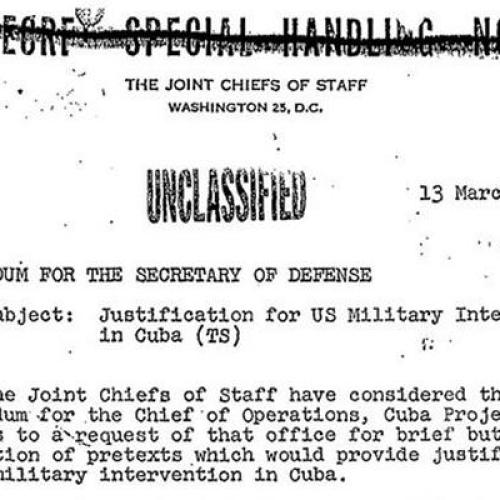
Note: James Bamford, the author of this article, was the ABC producer responsible for breaking the story on Operation Northwoods, which proved a level of deception almost beyond belief at the very highest levels of the Pentagon. For more on this, click here. For deeply revealing reports from reliable major media sources on the realities of intelligence agency activity, click here.
Federal law enforcement and national security officials are preparing to seek sweeping new regulations for the Internet, arguing that their ability to wiretap criminal and terrorism suspects is going dark as people increasingly communicate online instead of by telephone. Essentially, officials want Congress to require all services that enable communications including encrypted e-mail transmitters like BlackBerry, social networking Web sites like Facebook and software that allows direct peer to peer messaging like Skype to be technically capable of complying if served with a wiretap order. The mandate would include being able to intercept and unscramble encrypted messages. James X. Dempsey, vice president of the Center for Democracy and Technology, an Internet policy group, said the proposal had huge implications and challenged fundamental elements of the Internet revolution including its decentralized design. They are really asking for the authority to redesign services that take advantage of the unique, and now pervasive, architecture of the Internet, he said. They basically want to turn back the clock and make Internet services function the way that the telephone system used to function.
Note: For an analysis of this new government move to spy on US citizens, click here. For lots more from reliable sources on disturbing government threats to privacy and civil liberties, click here and here.
[An] IMF paper [that] first came out in April, 2010, [a]uthored by Reza Moghadam, director of the IMFs strategy, policy and review department, ... discusses how the IMF sees the International Monetary System evolving after the financial crisis. In the eyes of the IMF ... the best way to ensure the stability of the international monetary system (post crisis) is actually by launching a global currency. And that, the IMF says, is largely because [sovereign nations] cannot be trusted to redistribute surplus reserves, or battle their deficits, themselves. The ongoing buildup of such imbalances, meanwhile, only makes the system increasingly vulnerable to shocks. Its also a process thats ultimately unsustainable for all, says the IMF. All in all, the IMF believes there has simply been too much reserve hoarding going on. A global currency makes the most sense, the paper concludes especially since the SDR [Special Drawing Rights] is currently just an accounting tool that draws on the freely usable currencies of member states, not an actual currency itself.
Note: For key news articles on the global financial crisis to which this IMF report is responding, click here.
With no warning one weekday morning, investigators entered an organic grocery with a search warrant and ordered the hemp-clad workers to put down their buckets of mashed coconut cream and to step away from the nuts. Then, guns drawn, four officers fanned out across Rawesome Foods in Venice. Skirting past the arugula and peering under crates of zucchini, they found the raid's target inside a walk-in refrigerator: unmarked jugs of raw milk. Cartons of raw goat and cow milk and blocks of unpasteurized goat cheese were among the groceries seized in the June 30 raid by federal, state and local authorities the latest salvo in the heated food fight over what people can put in their mouths. On one side are government regulators, who say they are enforcing rules designed to protect consumers from unsafe foods and to provide a level playing field for producers. On the other side are " healthy food" consumers [who] seek food in its most pure form. "This is about control and profit, not our health," said Aajonus Vonderplanitz, co-founder of Rawesome Foods. "How can we not have the freedom to choose what we eat?" Demand for all manner of raw foods including honey, nuts and meat has been growing, spurred by heightened interest in the way food is produced. But raw milk in particular has drawn a lot of regulatory scrutiny, largely because the politically powerful dairy industry has pressed the government to act.
Note: For lots more on government corruption from reliable sources, click here.
The federal government is launching an expansive program dubbed "Perfect Citizen" to detect cyber assaults on private companies and government agencies running such critical infrastructure as the electricity grid and nuclear-power plants. The surveillance by the National Security Agency, the government's chief eavesdropping agency, would rely on a set of sensors deployed in computer networks for critical infrastructure that would be triggered by unusual activity suggesting an impending cyber attack. Defense contractor Raytheon Corp. recently won a classified contract for the initial phase of the surveillance effort valued at up to $100 million. Some industry and government officials familiar with the program see Perfect Citizen as an intrusion by the NSA into domestic affairs. One internal Raytheon email, the text of which was seen by The Wall Street Journal [said,] "Perfect Citizen is Big Brother." Raytheon declined to comment on this email. The information gathered by Perfect Citizen could also have applications beyond the critical infrastructure sector, officials said, serving as a data bank that would also help companies and agencies who call upon NSA for help with investigations of cyber attacks, as Google did when it sustained a major attack late last year.
Note: For key reports of government and corporate surveillance from reliable sources, click here.
President Bush signed into law ... legislation that broadly [expands] the governments authority to eavesdrop on the international telephone calls and e-mail messages of American citizens without warrants. The law [goes] far beyond the small fixes that administration officials had said were needed to gather information about foreign terrorists [and will] sharply alter the legal limits on the governments ability to monitor millions of phone calls and e-mail messages going in and out of the United States. The new law for the first time [provides] a legal framework for much of the surveillance without warrants that was being conducted in secret by the National Security Agency and outside the Foreign Intelligence Surveillance Act, the 1978 law that is supposed to regulate the way the government can listen to the private communications of American citizens. This more or less legalizes the N.S.A. program, said Kate Martin, director of the Center for National Security Studies in Washington. Previously, the government needed search warrants approved by a special intelligence court to eavesdrop on ... electronic communications between individuals inside the United States and people overseas. The new law gives the attorney general and the director of national intelligence the power to approve the international surveillance, rather than the special intelligence court. The law also gave the administration greater power to force telecommunications companies to cooperate with such spying operations. The companies can now be compelled to cooperate by orders from the attorney general and the director of national intelligence.
Long-secret documents released Tuesday provide new details about how the Central Intelligence Agency illegally spied on Americans decades ago. Known inside the agency as the family jewels, the 702 pages of documents released Tuesday catalog domestic wiretapping operations, failed assassination plots, mind-control experiments and spying on journalists from the early years of the C.I.A. The papers provide evidence of paranoia and occasional incompetence as the agency began a string of illegal spying operations in the 1960s and 1970s, often to hunt links between Communist governments and the domestic protests that roiled the nation in that period. Yet the long-awaited documents leave out a great deal. Large sections are censored, showing that the C.I.A. still cannot bring itself to expose all the skeletons in its closet. And many activities about overseas operations disclosed years ago by journalists, Congressional investigators and a presidential commission which led to reforms of the nations intelligence agencies are not detailed in the papers. The 60-year-old agency has been under fire ... by critics [of] the secret prisons and harsh interrogation practices it has adopted since the Sept. 11 attacks. Some intelligence experts suggested ... that the release of the documents was intended to distract from the current controversies. And they and historians expressed disappointment that the documents were so heavily censored. Tom Blanton of the National Security Archive, the research group that filed the Freedom of Information request in 1992 that led to the documents becoming public, said he was initially underwhelmed by them because they contained little about the agencys foreign operations. But Mr. Blanton said what was striking was the scope of the C.I.As domestic spying efforts.
Note: The entire body of the CIA's "Family Jewels" documents have been posted online by the National Security Archives, and can be read by clicking here.
The Bush administration is writing a new plan to maintain governmental control in the wake of an apocalyptic terrorist attack or overwhelming natural disaster, moving such doomsday planning for the first time from the Federal Emergency Management Agency to officials inside the White House. Discussion among legal specialists, homeland security experts and Internet commentators [includes] concerns that the policy may [make] it too easy to invoke emergency presidential powers such as martial law. The ... new "National Continuity Policy" contains few details about how surviving officials would invoke emergency powers, or when emergency powers should be deemed to be no longer necessary. The unanswered questions have provoked anxiety across ideological lines. The conservative commentator Jerome Corsi [wrote] that the directive looked like a recipe for allowing the office of the presidency to seize "dictatorial powers" because the policy does not discuss consulting Congress about when to invoke emergency powers -- or when to turn them off. Some specialists say that the White House should be more specific about its worst-case scenario plans, pointing out two unanswered questions: what circumstances would trigger implementation of the plan and what legal limits the White House recognizes on its own emergency powers. The policy ... does not contain a direct reference to statutes in which Congress has imposed checks and balances on the president's power to impose martial law or other extraordinary measures, [nor does it] explicitly acknowledge the National Emergencies Act, [a] law that gives Congress the right to override the president's determination that a national emergency still exists.
A secret FBI intelligence unit helped detain a group of war protesters in a downtown Washington parking garage in April 2002 and interrogated some of them on videotape about their political and religious beliefs. [Washington] D.C. police said authorities only recently found the logs of police responses to that day's events. That discovery came after three years of police assurances in federal court that no such records or logs existed showing the FBI's role. The FBI and D.C. police said they had no records of such an incident. And police told a federal court that no FBI agents were present when officers arrested more than 20 protesters that afternoon for trespassing; police viewed them as suspicious for milling around the parking garage entrance. Similar intelligence-gathering operations have been reported in New York, where a local police intelligence unit tried to infiltrate groups planning to protest at the Republican National Convention in 2004, and in Colorado, where records surfaced showing that the FBI collected names and license plates of people protesting timber industry practices at a 2002 industry convention.
Gov. Rick Perry on Thursday angrily defended his relationship with Merck & Co. and his executive order requiring that schoolgirls receive the drugmaker's vaccine against the sexually transmitted cervical-cancer virus. The Associated Press reported Wednesday that Perry's chief of staff had met with key aides about the vaccine on Oct. 16, the same day Merck's political action committee donated $5,000 to the governor's campaign. In issuing the order, the governor made Texas the first state to require the vaccine Gardasil for all schoolgirls. But many lawmakers have complained about his bypassing the Legislature altogether. The executive order has inflamed conservatives, who said it contradicts Texas' abstinence-only sexual education policies and intrudes into families' lives. Critics have previously questioned Perry's ties to Merck. Mike Toomey, Perry's former chief of staff, now lobbies for the drug company. And the governor accepted a total of $6,000 from Merck during his re-election campaign. Merck has waged a behind-the-scenes lobbying campaign to get state legislatures to require girls to get the three-dose vaccine to enroll in school. But on Tuesday the pharmaceutical company announced it was suspending the effort because of pressure from parents and medical groups. The Kentucky House on Thurday passed a bill that would require the vaccination for middle school girls unless their parents sign a form opposing it. Virginia lawmakers have also passed legislation requiring the vaccine, but the governor has not decided if he will sign it.
Note: The drug company lobby is the most powerful in the U.S., as reported by the former editor-in-chief of one of the most respected medical journals in the U.S. Click here for more.
A judge Friday indicted 26 Americans and five Italians in the abduction of an Egyptian terror suspect on a Milan street in what would be the first criminal trial stemming from the CIAs extraordinary rendition program. Prosecutors allege that five Italian intelligence officials worked with the Americans to seize Muslim cleric Osama Moustafa Hassan Nasr on Feb. 17, 2003. Nasr was allegedly transferred by vehicle to the Aviano Air Force base near Venice, then by air to the Ramstein Air Base in Germany, and on to Egypt, where his lawyer says he was tortured. Nasr was freed earlier this week by an Egyptian court that found his four years of detention in Egypt unfounded. All but one of the Americans have been identified as CIA agents, including the former Milan station chief Robert Seldon Lady and former Rome station chief Jeffrey Castelli. Among the Italians indicted by Judge Caterina Interlandi was the former chief of military intelligence, Nicolo Pollari, and his former deputy, Marco Mancini. The CIA has refused to comment on the case, which has put an uncomfortable spotlight on its operations. Prosecutors are pressing the Italian government to seek the extradition of the Americans. In Italy, defendants can be tried in absentia. Prosecutors elsewhere in Europe are moving ahead with cases aimed at the CIA program. A Munich prosecutor recently issued arrest warrants for 13 people in another alleged CIA-orchestrated kidnapping, that of a German citizen who says he was seized in December 2003 at the Serbian-Macedonia border and flown to Afghanistan.
Note: At long last, the CIA is beginning to be held accountable for flagrantly breaking laws resulting in torture.
The CIAs former No. 3 official and a defense contractor were charged Tuesday with fraud and other offenses in the corruption investigation that sent former Rep. Randy Duke Cunningham to prison. Federal indictments named Kyle Dusty Foggo, executive director of the CIA until he resigned in May, and his close friend, San Diego defense contractor Brent Wilkes, both 52, according to two government officials who spoke on condition of anonymity. One of the officials said the grand jury heard claims that Foggo joined Wilkes on trips to Hawaii and Scotland, and was introduced to Wilkes employees as early as 2003 as a future executive of Wilkes company, Wilkes Corp., which allegedly received $12 million in illicit contracts from various government agencies. Cunningham, an eight-term Republican, served on the House Intelligence Committee and on the defense subcommittee of the Appropriations Committee assignments that made him a key figure in the awarding of Pentagon contracts. Cunningham pleaded guilty in November 2005 to taking $2.4 million in bribes from defense contractors and others, including mortgage payments and a yacht he named Duke-Stir. The indictments paint a stunning picture of corruption in Washington. The alleged crimes by Cunningham and defense contractors is, according to the U.S. Attorney in San Diego, "breathtaking in scope." Foggo was named executive director of the CIA in 2004, responsible for running the agencys day-to-day operations. He retired in May while under investigation by the FBI, the Internal Revenue Service, the Pentagon, the CIA and the U.S. attorneys office in San Diego.
Note: This is very encouraging news as the once "untouchable" CIA is finally being subject to some of the same laws and justice as the rest of us.
Lyndon Johnson relished summoning underlings in to confer with him while he sat on the toilet. Richard Nixon authorized illegal wiretaps on perceived enemies because, as he later told an interviewer, "when the president does it, it's not illegal." Bill Clinton wantonly had sex with intern Monica Lewinsky. Why is it said that power corrupts, and absolute power corrupts absolutely? In the past few years...research has zeroed in on what an intoxicating elixir power can be. And one thing has become clear: The phrase "drunk with power" is often a dead-on description. These new studies show that power acts to lower inhibitions, much the same as alcohol does. It explains why powerful people act with great daring and sometimes behave rather like gorillas. "Disinhibition is the very root of power," said Stanford Professor Deborah Gruenfeld, a social psychologist who focuses on the study of power. "For most people, what we think of as 'power plays' aren't calculated and Machiavellian -- they happen at the subconscious level. When people feel powerful, they stop trying to 'control themselves.'" People with power...tend to be more oblivious to what others think, more likely to pursue the satisfaction of their own appetites, poorer judges of other people's reactions, more likely to hold stereotypes, overly optimistic and more likely to take risks. People who are naturally selfish grow even more selfish if they attain power, while people who are naturally selfless and giving become more so with power. Henry Kissinger discerned that power is "the ultimate aphrodisiac." "Nearly all men can stand adversity," said Abraham Lincoln, "but if you want to test a man's character, give him power."
Note: This most excellent article graphically describes the problems that can occur when a hierarchical political systems places certain individuals in positions of great authority. For more on this fascinating topic, click here.
Important Note: Explore our full index to revealing excerpts of key major media news articles on several dozen engaging topics. And don't miss amazing excerpts from 20 of the most revealing news articles ever published.