




















Civil Liberties News Articles
Below are key excerpts of revealing news articles on the erosion of our civil liberties from reliable news media sources. If any link fails to function, a paywall blocks full access, or the article is no longer available, try these digital tools.

A newly declassified document gives a fascinating glimpse into the US military's plans for "information operations". The declassified document is called "Information Operations Roadmap". It was obtained by the National Security Archive at George Washington University using the Freedom of Information Act. Officials in the Pentagon wrote it in 2003. The Secretary of Defense, Donald Rumsfeld, signed it. The operations described in the document include a surprising range of military activities: public affairs officers who brief journalists, psychological operations troops who try to manipulate the thoughts and beliefs of an enemy, computer network attack specialists who seek to destroy enemy networks. The military's psychological operations, or Psyops, is finding its way onto the computer and television screens of ordinary Americans. "Psyops messages will often be replayed by the news media for much larger audiences, including the American public. Strategy should be based on the premise that the Department [of Defense] will 'fight the net' as it would an enemy weapons system," it reads. The document recommends that the United States should seek the ability to "provide maximum control of the entire electromagnetic spectrum". US forces should be able to "disrupt or destroy the full spectrum of globally emerging communications systems, sensors, and weapons systems dependent on the electromagnetic spectrum". The fact that the "Information Operations Roadmap" is approved by the Secretary of Defense suggests that these plans are taken very seriously indeed in the Pentagon.
Note: For other revealing news articles on military corruption, click here. For other revealing news articles on government corruption, click here.
Woody Norris aims the silvery plate ... demonstrating something called HyperSonic Sound (HSS). I pace out a hundred yards. Norris pelts me with the Handel. The sound is inside my head. Imagine, he says, walking by a soda machine (say, one of the five million in Japan that will soon employ HSS) ... then hearing what you alone hear -- the plink of ice cubes and the invocation, ''Wouldn't a Coke taste great right about now?'' An HSS transmission can travel 450 feet - at practically the same volume all along its path. In past months, Norris and his staff have made a further, key improvement to HSS -- instead of sending out a column of sound, they can now project a single sphere of it, self-contained, like a bubble. [And] there are Defense Department applications. Norris [has] been busy honing something called High Intensity Directed Acoustics (HIDA). Although [it] has been routinely referred to as a "nonlethal weapon," ... in reality, HIDA is both warning and weapon. If used from a battleship, it can ward off stray crafts at 500 yards with a pinpointed verbal warning. Should the offending vessel continue ... the stern warnings are replaced by 120-decibel sounds that are as physically disabling as shrapnel. Certain noises, projected at the right pitch, can incapacitate even a stone-deaf terrorist; the bones in your head are brutalized by a tone's full effect whether you're clutching the sides of your skull in agony or not. "HIDA can instantaneously cause loss of equilibrium, vomiting, migraines - really, we can pretty much pick our ailment," he says brightly. Last month, [Norris' company] A.T.C. cut a five-year, multimillion-dollar licensing agreement with General Dynamics, one of the giants of the military-industrial complex.
Note: This entire article is well worth reading if you want to understand just how advanced these dangerous weapons are. And there is little doubt that this weapon can cause death. Remember the article was written in 2003. Sound weapons developed for war are now routinely used against civilian populations. Explore an excellent, well researched article going into more detail on these weapons. For more along these lines, see concise summaries of deeply revealing non-lethal weapons news articles from reliable major media sources.
Over the past three years, more than 60 institutions, including several of the world's most prestigious research centers, have been criticized by the U.S. government for failing to protect human subjects adequately. As recently as 1974 individual scientists and their financial backers could decide for themselves what constituted ethical research. Most of the time their judgment was sound, but there were plenty of appalling exceptions. In the 1950s Army doctors gave LSD to soldiers without telling them what it was. In 1963 researchers injected prisoners and terminally ill patients with live cancer cells to test their immune responses; they were told only that it was a "skin test." In the 1950s mentally retarded children at Willowbrook, a state institution in New York, were deliberately infected with hepatitis so that scientists could work on an experimental vaccine. And in perhaps the most infamous case on record, doctors at Georgia's Tuskegee Institute, starting in the 1930s, deliberately withheld treatment from syphilis-infected African-American men for 40 years to monitor the course of the disease. Financial conflicts of interest can extend not only to the institutions but also to the researchers themselves. Jesse Gelsinger's death in the University of Pennsylvania's gene-therapy trial in 1999 seemed especially scandalous [because] James Wilson, the principal investigator in the study, held a 30% equity stake in Genovo, which owned the rights to license the drug Wilson was studying; the university owned 3.2% of the company. When Targeted Genetics Corp. acquired Genovo, Wilson reportedly earned $13.5 million and Penn $1.4 million.
Note: For a powerful, reliable list of astounding incidents in which government and medical professionals used humans as guinea pigs over the past hundred years and continuing to the present, click here. Links are provided to reliable sources for verification. For key facts on government mind control programs, click here.
Dr. Jose M. R. Delgado of [Yale University] is one of the leading pioneers in ... E.S.B.: electrical stimulation of the brain. He is also the impassioned prophet of a new “psychocivilized” society whose members would influence and alter their own mental functions to create a “happier, less destructive and better balanced man.” [Delgado said,] “We know that [E.S.B.] can delay a heartbeat, move a finger, bring a word to memory, evoke a sensation.” [His] animals performed like electrical toys. One monkey, Ludy, each time she was stimulated [would] stand up on two feet and circle to the right; climb a pole and then descend again. This “automatism” was repeated [by Ludy] through 20,000 stimulations! The tickling of a few electric volts can send a monkey into a deep sleep, or snap him awake. Similarly, human beings are unable to resist motor responses elicited by E.S.B. Large-scale studies of rats with electrodes in [a] “pleasureful area” found that they preferred E.S.B. above all else—including water, sex and food. Sometimes ravenously hungry rats, ignoring nearby food, would stimulate themselves up to 5,000 times an hour—persisting with manic singleness of purpose for more than a day running, until they keeled over on the floor in a faint! “In humans also ... states of arousal and pleasure have been evoked" ... Delgado added. One patient of ours was a rather reserved 30-year-old woman. E.S.B. at one cerebral point made her suddenly confess her passionate regard for the therapist—whom she'd never seen before." According to one psychoanalyst, “The danger of this being abused is ... tremendous.”
Note: Though quite long, this entire intriguing article is well worth reading. If behavior manipulation was this advanced in 1970, what are they capable of now, and why is it being kept quiet? For more along these lines, see concise summaries of deeply revealing news articles on mind control from reliable major media sources. Then explore the excellent, reliable resources provided in our Mind Control Information Center.
Western intelligence agencies are attempting to manipulate and control online discourse with extreme tactics of deception and reputation-destruction. Today, [The Intercept is] publishing [a document from GCHQ's previously secret unit, JTRIG, the Joint Threat Research Intelligence Group], entitled "The Art of Deception: Training for Online Covert Operations." Among the core self-identified purposes of JTRIG are two tactics: (1) to inject all sorts of false material onto the internet in order to destroy the reputation of its targets; and (2) to use social sciences and other techniques to manipulate online discourse and activism to generate outcomes it considers desirable. To see how extremist these programs are, just consider the tactics they boast of using to achieve those ends: "false flag operations" (posting material to the internet and falsely attributing it to someone else), fake victim blog posts (pretending to be a victim of the individual whose reputation they want to destroy), and posting "negative information" on various forums. Government plans to monitor and influence internet communications, and covertly infiltrate online communities in order to sow dissension and disseminate false information, have long been the source of speculation. Harvard Law Professor Cass Sunstein, a close Obama adviser and the White House's former head of the Office of Information and Regulatory Affairs, wrote a controversial paper in 2008 proposing that the US government employ teams of covert agents and pseudo-"independent" advocates to "cognitively infiltrate" online groups and websites, as well as other activist groups. Sunstein also proposed sending covert agents into "chat rooms, online social networks, or even real-space groups" which spread what he views as false and damaging "conspiracy theories" about the government.
Note: To see a guidebook developed by intelligence agencies full of charts and information on how to infiltrate and deceive the public, click here. The Intercept is a media source being funded by Pierre Omidyar and featuring Glenn Greenwald and other top reporters known for their independence. Note that Greenwald fails to mention that Sunstein's almost exclusive focus was on "conspiracy theories" advocated by the 9/11 truth movement. For more on his call for what amounts to a new COINTELPRO, see David Ray Griffin's book Cognitive Infiltration.
Imagine a global spying network that can eavesdrop on every single phone call, fax or e-mail, anywhere on the planet. It sounds like science fiction, but it's true. Two of the chief protagonists - Britain and America - officially deny its existence. But the BBC has confirmation from the Australian Government that such a network really does exist. The base is linked directly to the headquarters of the US National Security Agency (NSA) at Fort Mead in Maryland, and it is also linked to a series of other listening posts scattered across the world, like Britain's own GCHQ. The power of the network, codenamed Echelon, is astounding. Every international telephone call, fax, e-mail, or radio transmission can be listened to by powerful computers capable of voice recognition. They home in on a long list of key words, or patterns of messages. The network is so secret that the British and American Governments refuse to admit that Echelon even exists. But another ally, Australia, has decided not to be so coy. The man who oversees Australia's security services, Inspector General of Intelligence and Security Bill Blick, has confirmed to the BBC that their Defence Signals Directorate (DSD) does form part of the network. Asked if they are then passed on to countries like Britain and America, he said: "They might be in certain circumstances." They are looking for evidence of international crime, like terrorism. But the system is so widespread all sorts of private communications, often of a sensitive commercial nature, are hoovered up and analysed.
Note that this is a 1999 article, long before the revelations of Edward Snowden. The capability to monitor all communications has existed for a long time. For a powerful, well documented 20-page paper in the Federal Communications Law Journal providing strong evidence that this program is unconstitutional, click here.
The Biden administration likely infringed upon the First Amendment when it leaned on social media companies to remove false or misleading COVID-19 content, a federal court of appeals ruled Friday — narrowing a bombshell district court order that barred several officials and agencies from communicating with the platforms. The White House, surgeon general, Centers for Disease Control and Prevention and the FBI “likely coerced or significantly encouraged social-media platforms to moderate content” and in doing so, “likely violated the First Amendment,” the New Orleans-based Fifth US Circuit Court of Appeals determined. The three-judge panel, however, adjusted the scope of US District Judge Terry Doughty’s July 4 order ... removing officials from the National Institute of Allergy and Infectious Disease, the Cybersecurity and Infrastructure Security Agency and the State Department from the injunction. The Fifth Circuit vacated nine of the 10 provisions in Doughty’s order that prevented Biden administration officials from “urging, encouraging, pressuring” or “inducing” social media companies from removing content. Similarly, the appeals court determined that “following up with social-media companies” about content moderation, “requesting content reports from social-media companies” or asking platforms to “Be on The Lookout” for certain types of material does not violate individuals’ First Amendment rights.
Note: Many posts that were censored contained factual information on COVID-related issues. For more along these lines, see concise summaries of deeply revealing news articles on the coronavirus and media manipulation from reliable sources.
In the five decades since Martin Luther King Jr. was shot dead by an assassin at age 39, his children have worked tirelessly to preserve his legacy. They are unanimous on one key point: James Earl Ray did not kill Martin Luther King. For the King family and others in the civil rights movement, the FBIs obsession with King in the years leading up to his slaying in Memphis on April 4, 1968 - pervasive surveillance, a malicious disinformation campaign and open denunciations by FBI director J. Edgar Hoover - laid the groundwork for their belief that he was the target of a plot. Until her own death in 2006, Coretta Scott King, who endured the FBIs campaign to discredit her husband, was open in her belief that a conspiracy led to the assassination. Her family filed a civil suit in 1999 ... and a Memphis jury ruled that the local, state and federal governments were liable for Kings death. There is abundant evidence, Coretta King said after the verdict, of a major, high-level conspiracy in the assassination of my husband. The jury found the mafia and various government agencies were deeply involved in the assassination. Mr. Ray was set up to take the blame. But nothing changed afterward. William Pepper, a New York lawyer and civil rights activist who knew and worked with King ... became convinced of Rays innocence and continued to investigate the case even after Ray died. Pepper wrote three books outlining the conspiracy, most recently The Plot to Kill King in 2016, which were largely ignored by the media.
Note: Watch an excellent, six-minute clip from Canada's PBS giving powerful evidence based on the excellent work of William Pepper that King was assassinated by factions in government that wanted his movement stopped. For more along these lines, see concise summaries of deeply revealing civil liberties news articles from reliable major media sources.
The [FDA] amassed a stockpile of pistols, shotguns, and semiautomatic rifles, along with ample supplies of ammunition, liquid explosives, gun scopes, and suppressors. Between 2006 and 2014, [the Animal and Plant Health Inspection Service, an agency of the USDA] spent nearly $4.8 million to arm itself. And far from being an outlier, it is one of dozens of federal agencies that spends lavishly on guns, ammunition, and military-style equipment. A report issued this month by American Transparency ... chronicles the explosive - and expensive - trend toward militarizing federal agencies, most of which have no military responsibilities. Between 2006 and 2014, the report shows, 67 federal bureaus, departments, offices, and services spent at least $1.48 billion on ammunition and material one might expect to find in the hands of SWAT teams, Special Forces soldiers - or terrorists. The Internal Revenue Service, for example, now spends more than $1 million annually on firearms, ammunition, and military gear. Since 2006, the Department of Veterans Affairs ... has poured nearly $11.7 million into guns and ammo. Even the Smithsonian Institution and the Social Security Administration have each devoted hundreds of thousands of dollars to weaponry. There are now fewer US Marines than there are officers at federal administrative agencies with the authority to carry weapons and make arrests.
Note: The Washington Post in 2009 reported that military influence over US civilian authorities was quietly increasing, and the militarization of US police has been well-documented. For more along these lines, see concise summaries of deeply revealing news articles about government corruption and the erosion of civil liberties.
The Justice Department and FBI have formally acknowledged that nearly every examiner in an elite FBI forensic unit gave flawed testimony in almost all trials in which they offered evidence against criminal defendants over more than a two-decade period before 2000. Of 28 examiners with the FBI Laboratorys microscopic hair comparison unit, 26 overstated forensic matches in ways that favored prosecutors in more than 95 percent of the 268 trials reviewed so far, according to the National Association of Criminal Defense Lawyers (NACDL) and the Innocence Project, which are assisting the government with the countrys largest post-conviction review of questioned forensic evidence. The cases include those of 32 defendants sentenced to death. Of those, 14 have been executed or died in prison, the groups said under an agreement with the government to release results after the review of the first 200 convictions. The admissions mark a watershed in one of the countrys largest forensic scandals, highlighting the failure of the nations courts for decades to keep bogus scientific information from juries, legal analysts said. The question now, they said, is how state authorities and the courts will respond to findings that confirm long-suspected problems with subjective, pattern-based forensic techniques like hair and bite-mark comparisons that have contributed to wrongful convictions in more than one-quarter of 329 DNA-exoneration cases since 1989.
Note: For more along these lines, see concise summaries of deeply revealing news articles on the threats to civil liberties posed by government corruption from reliable major media sources.
Nearly all of the highest-profile domestic terrorism plots in the United States since 9/11 featured the "direct involvement" of government agents or informants, a new report says. Some of the controversial "sting" operations "were proposed or led by informants", bordering on entrapment by law enforcement. Yet the courtroom obstacles to proving entrapment are significant, one of the reasons the stings persist. The lengthy report, released on [July 21] by Human Rights Watch, raises questions about the US criminal justice system's [respect for] civil rights and due process in post-9/11 terrorism cases. [The report] portrays a system that features not just the sting operations but secret evidence, anonymous juries, extensive pretrial detentions and convictions significantly removed from actual plots. "In some cases the FBI may have created terrorists out of law-abiding individuals by suggesting the idea of taking terrorist action or encouraging the target to act," the report alleges. Out of the 494 cases related to terrorism the US has tried since 9/11, the plurality of convictions ... are not for thwarted plots but for "material support" charges, a broad category expanded further by the 2001 Patriot Act that permits prosecutors to pursue charges with tenuous connections to a terrorist act or group. Several cases featured years-long solitary confinement for accused terrorists before their trials. Some defendants displayed signs of mental incapacity. Jurors for the 2007 plot to attack the Fort Dix army base, itself influenced by government informants, were anonymous, limiting defense counsel's ability to screen out bias.
Note: Why was this important news not picked up by any major US media? For more on this, see concise summaries of deeply revealing intelligence agency operations news articles from reliable major media sources.
In March I received a call from the White House counsels office regarding a speech I had prepared for my boss at the State Department. The speech was about the impact ... of National Security Agency surveillance practices. The draft stated that if U.S. citizens disagree with congressional and executive branch determinations about the proper scope of signals intelligence activities, they have the opportunity to change the policy through our democratic process. But the White House counsels office told me that no, that wasnt true. I was instructed to amend the line. Some intelligence practices remain so secret, even from members of Congress, that there is no opportunity for our democracy to change them. Public debate about the bulk collection of U.S. citizens data by the NSA has focused largely on Section 215 of the Patriot Act. Based in part on classified facts that I am prohibited by law from publishing, I believe that Americans should be even more concerned about the collection and storage of their communications under Executive Order 12333 than under Section 215. Unlike Section 215, the executive order authorizes collection of the content of communications, not just metadata, even for U.S. persons. It does not require that the affected U.S. persons be suspected of wrongdoing and places no limits on the volume of communications by U.S. persons that may be collected and retained. None of the reforms that Obama announced earlier this year will affect such collection.
Note: The above was written by John Napier Tye, former section chief for Internet freedom in the State Departments Bureau of Democracy, Human Rights and Labor. A 2014 Washington Post investigation sheds more light on the NSA's legally dubious domestic mass surveillance program. For more along these lines, see concise summaries of deeply revealing news articles about intelligence agency corruption and the disappearance of privacy.
Whistle-blower AT&T technician Mark Klein says his effort to reveal alleged government surveillance of domestic Internet traffic was blocked not only by U.S. intelligence officials but also by the top editors of the Los Angeles Times. Klein describes how he stumbled across "secret NSA rooms" being installed at an AT&T switching center in San Francisco and later heard of similar rooms in at least six other cities. Eventually, Klein says he decided to take his documents to the Los Angeles Times, to blow the whistle on what he calls "an illegal and Orwellian project." But after working for two months with LA Times reporter Joe Menn, Klein says he was told the story had been killed at the request of then-Director of National Intelligence John Negroponte and then-director of the NSA Gen. Michael Hayden. Klein says he then took his AT&T documents to The New York Times, which published its exclusive account last April [later removed from NY Times website]. In the court case against AT&T, Negroponte formally invoked the "state secrets privilege," claiming the lawsuit and the information from Klein and others could "cause exceptionally grave damage to the national security of the United States." The Los Angeles Times' decision was made by the paper's editor at the time, Dean Baquet, now the Washington bureau chief of The New York Times. As the new Washington bureau chief of The New York Times, Baquet now oversees the reporters who have broken most of the major stories involving the government surveillance program, often over objections from the government.
Note: This webpage was removed from the ABC website, but is still available through archive.org on thise webpage. So after the NY Times has the guts to report this important story, the man who was responsible for the censorship at the LA Times is transferred to the very position in the NY Times where he can now block future stories there. For why this case of blatant media censorship isn't making headlines, click here.
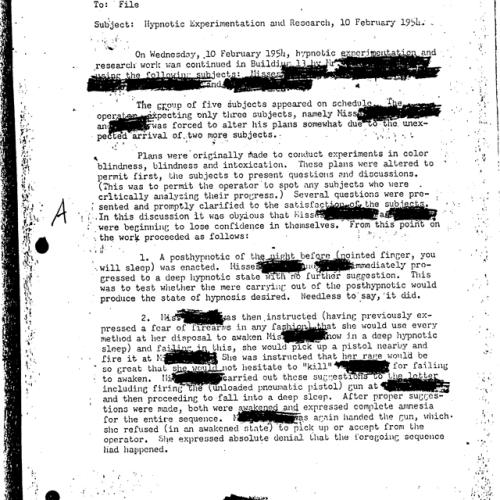
In December 1974, the New York Times reported that the CIA had conducted illegal domestic activities, including experiments on U.S. citizens during the 1960s. That report prompted investigations by both Congress (in the form of the Church Committee) and a presidential commission (known as the Rockefeller Commission) into the domestic activities of the CIA, the FBI, and intelligence-related agencies of the military. Congressional hearings and the Rockefeller Commission report revealed to the public for the first time that the CIA and the DOD had conducted experiments on both cognizant and unwitting human subjects as part of an extensive program to influence and control human behavior through the use of psychoactive drugs (such as LSD and mescaline) and other chemical, biological, and psychological means. They also revealed that at least one subject had died after administration of LSD. Frank Olson, an Army scientist, was given LSD without his knowledge or consent in 1953 as part of a CIA experiment and apparently committed suicide a week later. Subsequent reports would show that another person ... died as a result of a secret Army experiment involving mescaline. The CIA program, known principally by the codename MKULTRA, began in 1950 and was motivated largely in response to alleged Soviet, Chinese, and North Korean uses of mind-control techniques on U.S. prisoners of war in Korea. Most of the MKULTRA records were deliberately destroyed in 1973 by order of then-Director of Central Intelligence Richard Helms.
Note: This highly revealing article on a U.S. government website shows that the CIA was actively involved in mind control projects. Explore also an excellent summary based on thousands of pages of declassified CIA documents showing the secret creation of unknowing assassins or "Manchurian Candidates."
A federal court in Texas issued a ruling on Thursday afternoon preliminarily enjoining enforcement of Texas law banning contractors from boycotting Israel. The court ruled that the law plainly violates the free speech guarantee of the First Amendment. Following similar decisions by federal courts in Kansas and Arizona, the ruling becomes the third judicial finding out of three who have evaluated the constitutionality of such laws to conclude that they are unconstitutional attacks on the free speech rights of Americans. The case was brought by Bahia Amawi, a longtime elementary school speech pathologist in Austin, Texas, whose contract renewal was denied due to her refusal to sign an oath certifying that she does not participate in any boycotts of Israel. Amawi, a U.S. citizen and mother of four U.S.-born children, was required to sign the pro-Israel oath due to a new law enacted with almost no dissent by the Texas State Legislature in May 2017, and signed into law two days later by GOP Gov. Greg Abbott. When signing the bill, Gov. Abbott proclaimed: Any anti-Israel policy is an anti-Texas policy. But this was precisely the mentality, along with the virtually unanimous pro-Israel sentiment in the Texas State Legislature, that the Texas federal judge identified when explaining why the pro-Israel oath so blatantly violates the free speech guarantees of the U.S. Constitutions First Amendment.
Note: Watch a video documenting Amawi's story. For more along these lines, see concise summaries of deeply revealing government corruption news articles from reliable major media sources.
Our personal data and the ways private companies harvest and monetize it plays an increasingly powerful role in modern life. One unifying thread to this pervasive system is the collection of personal information from marginalized communities, and the subsequent discriminatory use by corporations and government agencies–exacerbating existing structural inequalities across society. Data surveillance is a civil rights problem, and legislation to protect data privacy can help protect civil rights. Where mobile apps are used disparately by specific groups, the collection and sharing of personal data can aggravate civil rights problems. For example, a Muslim prayer app (Muslim Pro) sold geolocation data about its users to a company called X-Mode, which in turn provided access to this data to the U.S. military through defense contractors. In 2016, Twitter, Facebook, Instagram, and nine other social media platforms were found to have provided software company Geofeedia with social media information and location data from their users. This data was subsequently used by police departments across the U.S. to track down and identify individuals attending Black Lives Matter protests. Moreover, lower-income people are often less able to avoid corporate harvesting of their data. For example, some lower-priced technologies collect more data than other technologies, such as inexpensive smartphones that come with preinstalled apps that leak data and can't be deleted.
Note: Read how Clearview AI gave law enforcement access to 30 billion images from social media sites. For more along these lines, see concise summaries of deeply revealing news articles on government corruption and the erosion of civil liberties from reliable major media sources.
The number of recommended vaccines was only 23 doses of seven vaccines in 1983. By 2017, the CDCs recommended number skyrocketed to 69 doses of 16 vaccines – 50 doses given before age 6. Vaccination is not appropriate for every individual due to ones genetic disposition, autoimmune deficiency, allergy or other circumstance. Medical professionals would never claim that because a certain drug or therapy was approved for most people, everyone should be subject to it – but with vaccine injury, the clinical evidence does not seem to apply. Despite ... specific warnings on each vaccine insert, there is an unwillingness to acknowledge the risk for some individuals. While some claim vaccine injuries are rare, the CDC-funded Harvard Pilgrim Projects [found] that less than 1 percent are ever reported to VAERS, the Vaccine Adverse Events Reporting System. Taxpayers not liability-free pharmaceutical companies have paid patients $4 billion for their injuries or death through the Vaccine Injury Compensation Program since 1988. Most families that have experiences with vaccine reactions were never notified beforehand of [this] program. Certain ingredients in vaccinations, including chemicals, human, animal, and insect DNA and RNA, are abhorrent to some for religious or ethical reasons. Mandated vaccination should not force someone to compromise their beliefs. The American Medical Associations code of ethics affirms the right to both religious and philosophical exceptions for physicians themselves to not be vaccinated. The same standard should apply to their patients.
Note: See the highly revealing 6-page report on the US government's "Health Information Technology" website that states, "Adverse events from drugs and vaccines are common, but underreported. ... Fewer than 1% of vaccine adverse events are reported." A concise summary of this report can be found here. More valuable information is available here. For even more along these lines, see concise summaries of deeply revealing news articles on vaccines from reliable major media sources. Explore also the best website calling for responsibility in vaccination.
Covering protests in Minneapolis on Saturday, photojournalist Ed Ou could feel his hands and face were wet. For a long time, he didnt know if it was teargas, pepper spray, or blood in the end, it turned out to be a combination of all three. He has documented civil unrest in the Middle East, Ukraine and Iraq, where he learned a few things. So when the curfew hit and police fired teargas into the crowd of protesters, Ou stood steady, out of the way, documenting. And then the unexpected happened. They literally started throwing concussive grenades in our direction, in the middle of the journalists, he says. What ensued was a prolonged attack that involved being hit at with batons, being teargassed, dodging concussive grenades and begging for help. As of 9pm Thursday, the US press freedom tracker has received 192 reports of journalists being attacked by police forces while covering the protests across the US. Among them, some have sustained serious injuries. Linda Tirado, a photojournalist, was hit in the face with a tracer round, resulting in loss of sight in one eye. The Chicago Tribunes Ryan Fairclough was left with stitches after being shot through the window of his moving car. In Detroit, Nicole Hester was hit by pellets fired by Detroit police, leaving welts on her body. Others have been beaten up, arrested, their equipment damaged and they have been threatened for taking photos and filming on public streets. These are not one-off incidents: this is a picture of widespread attacks on the profession.
Note: For more along these lines, see concise summaries of deeply revealing news articles on police corruption and the erosion of civil liberties from reliable major media sources.
Bill Gates ... just called for a complete and utter shutdown and quarantining of the entire American nation. Despite urging from public health experts, Gates wrote in a Washington Post opinion piece, some states and counties havent shut down completely. This is a recipe for disaster. Because people can travel freely across state lines, so can the virus. The countrys leaders need to be clear: Shutdown anywhere means shutdown everywhere. Until the case numbers start to go down ... no one can continue business as usual or relax the shutdown. He then added that the impacts of the new coronavirus could linger another 18 months or so, until a vaccine was developed. For the peons of America, work isnt an option. Its food. Its survival. The fate of a hard-earned dream shouldnt rest with a globalist billionaire whos warning of dire coronavirus consequences to come all the while making hands-over-fist coronavirus money. Its a conflict of interest. WHO didnt announce the coronavirus as a pandemic until the very day after Gates ... made a very large donation to a cause that benefits WHO. In a 2017 piece titled, Meet the worlds most powerful doctor: Bill Gates, Politico wrote: Some billionaires are satisfied with buying themselves an island. Bill Gates got a United Nations health agency. Over the past decade, the worlds richest man has become the World Health Organizations second-biggest donor, second only to the United States. This largesse gives him outsized influence over its agenda. The result, say his critics, is that Gates priorities have become the WHOs.
Very Important Note: To understand how the coronavirus is being used to exert more control over humanity, don't miss this incredibly important video focused on how Bill Gates is using fear around the coronavirus to push through his agenda to vaccinate everyone on the planet and then require a "digital certificate" to ensure they've been vaccinated. For other reliable, verifiable informing demonstrating how Gates' vaccine agenda has already harmed hundreds of thousands of children read this excellent article by Robert F. Kennedy, Jr.
A disturbing trend of undercover federal agents engaging minors online to plan acts related to terrorism abroad, then arresting them shortly after they turn 18, ought to raise eyebrows as well as outrage, given that many of these targets are teens who have significant cognitive and intellectual disabilities. The most recent case in Colorado involves Humzah Mashkoor, an 18-year-old from Westminster charged with “attempting to provide material support to a designated foreign terrorist organization,” according to a U.S. Department of Justice December 2023 press release. Months earlier, in July last year, FBI agents arrested Davin Daniel Meyer, 18, of Castle Rock, charged with the same crime, which can carry a stiff penalty of decades in prison. And in June, 18-year-old Mateo Ventura of Massachusetts was charged with a similar crime of intention after being in contact not with terrorists but with undercover FBI agents. A fourth case occurred last year in Philadelphia. When you look at the striking similarities of these cases, it’s not unreasonable to conclude that federal agents are failing morally and ethically by seemingly coaxing and cajoling minors – including two Colorado children with limited intellectual capacity and no history of harming anyone — to cross a line. The FBI agents then “get their man” – even before these individuals are in fact men. Enough time has gone by to show the human element to this story, but no reporters seem to be interested.
Note: Read more about the FBI's manufacture of terrorist plots. For more along these lines, see concise summaries of deeply revealing news articles on law enforcement corruption and terrorism from reliable major media sources.
Important Note: Explore our full index to revealing excerpts of key major media news articles on several dozen engaging topics. And don't miss amazing excerpts from 20 of the most revealing news articles ever published.