











Secrecy News Articles
Below are key excerpts of revealing news articles on secrecy from reliable news media sources. If any link fails to function, a paywall blocks full access, or the article is no longer available, try these digital tools.

It was July 1974. William Simon, newly appointed U.S. Treasury secretary, and his deputy, Gerry Parsky, stepped onto an 8 a.m. flight. [Simon's] mission, kept in strict confidence within President Richard Nixon's inner circle, would take place during a four-day layover in the coastal city of Jeddah, Saudi Arabia. The goal: persuade a hostile kingdom to finance America's widening deficit with its newfound petrodollar wealth. The United States would buy oil from Saudi Arabia and provide the kingdom military aid and equipment. In return, the Saudis would plow billions of their petrodollar revenue back into Treasuries and finance America's spending. At the end of months of negotiations, there remained one small, yet crucial, catch: King Faisal bin Abdulaziz Al Saud demanded the country's Treasury purchases stay "strictly secret." With a handful of Treasury and Federal Reserve officials, the secret was kept for more than four decades. In response to a Freedom-of-Information-Act request submitted by Bloomberg News, the Treasury broke out Saudi Arabia's holdings for the first time this month. The $117 billion trove makes the kingdom one of America's largest foreign creditors. A former Treasury official ... says the official figure vastly understates Saudi Arabia's investments in U.S. government debt, which may be double or more. In April, Saudi Arabia warned it would start selling as much as $750 billion in Treasuries and other assets if Congress passes a bill allowing the kingdom to be held liable in U.S. courts for the Sept. 11 terrorist attacks.
Note: In May, the Senate approved a bill that allows victims of 9/11 and their families to pursue lawsuits against Saudi Arabia for its role in the Sept. 11 attacks. Several prominent figures are currently pushing for the declassification of hidden 9/11 report pages which reportedly shed further light on Saudi support for terrorism. For more along these lines, see concise summaries of deeply revealing government secrecy news articles from reliable major media sources.
America's only top-secret airline may be hiring again. Janet Airlines, which flies from from Las Vegas to a number of government sites, is reportedly looking for a pilot for its Boeing 737 aircraft. Janet - an acronym which some claim stands for "Just Another Non-Existent Terminal" - is a shuttle service that is operated by defense contractor AECOM and the U.S. Air Force, making daily flights from a private, unmarked (and heavily guarded) terminal at McCarran International Airport to military bases including the restricted Tonopah Test Range, aircraft manufacturing site Plant 42 and a site at Groom Lake, Nevada which ... is more commonly known as Area 51. The Tactical Air Network discovered a job posting on AECOM's website for a First Officer, and the contractor is currently accepting applications from candidates with a ... Single Scope Background Investigation (SSBI) in order to qualify for Top Secret security clearance. Janet's fleet currently includes white 737-600 aircraft, which are remarkable for how completely unremarkable they are, with no logos and no markings other than a red stripe and a registration number. The Janet jets are the narrow visible bandwidth of a much broader spectrum of 'black world' places and projects. At its core, Janet Airlines is the heart of an entire clandestine defense ecosystem that is spread across the deserts of the American southwest, pumping talent and brain power to some of the most advanced technologies mankind has ever developed.
Note: For more on this secret airline, see this webpage. For more along these lines, see concise summaries of deeply revealing secrecy news articles from reliable major media sources.
The United States has slipped so far with respect to transparency that some open-government groups now rank it behind Yemen, Kyrgyzstan and Liberia. Today, the Freedom of Information Act our countrys signature right-to-information law is alarmingly dysfunctional. It is impeding the ability of the press to do its job. Sharyl Attkisson, a journalist with five Emmy Awards ... asked the Centers for Disease Control and Prevention last October for records related to a virus that had possibly killed 14 children and paralyzed another 115. The CDC still hasnt turned over a single document in response. This isnt the first such experience for Attkisson. She recently told a congressional committee that it took the Department of Defense 10 years to respond to a request she made in 2003. It is a sad turn of events that FOIA has become so unhelpful to journalists. Like many other citizens who make requests under FOIA which allows any person to request federal agency records for any reason journalists face backlogs, excuses for withholding, and delays. Non-responsiveness is the norm, Karen Kaiser, general counsel of The Associated Press, told a Senate panel in May. Agencies could do a far better job of enforcing FOIA as it is written. Notably, agencies need to faithfully adhere to a provision of FOIA that allows journalists requests to go to the front of the queue when there is an urgency to inform the public. As it stands, agencies reject these so-called expedited processing requests the vast majority of the time.
Note: Along with having her FOIA requests stalled, Sharyl Attkisson has sometimes been spied on and computer-hacked by U.S intelligence agencies for her investigative journalism. The number of FOIA requests denied by government agencies has been rapidly increasing in recent years.
[One spy unit is] responsible for some of the United Kingdom's most controversial tactics of surveillance, online propaganda and deceit. Documents ... demonstrate how the Joint Threat Research Intelligence Group (JTRIG), a unit of the signals intelligence agency Government Communications Headquarters (GCHQ), is involved in efforts against political groups it considers "extremist". Though its existence was secret until last year, JTRIG quickly developed a distinctive profile [after] Edward Snowden revealed that the unit had engaged in "dirty tricks" like deploying sexual "honey traps" designed to discredit targets, launching denial-of-service attacks to shut down Internet chat rooms, pushing veiled propaganda onto social networks and generally warping discourse online. Particularly revealing is a fascinating 42-page document from 2011 detailing JTRIG's activities. The document lays out the tactics the agency uses to manipulate public opinion, its scientific and psychological research into how human thinking and behavior can be influenced. Many GCHQ documents describing the "missions" of the "customers" for which it works make clear that the agency has a wide mandate far beyond national security, including providing help on intelligence to the Bank of England, ... to various departments on agriculture and whaling activities, to government financial divisions to enable good investment decisions. Beyond JTRIG's targeting of Anonymous, other parts of GCHQ targeted political activists deemed to be "radical," even monitoring the visits of people to the WikiLeaks website. [The document] includes detailed discussions of how to foster "obedience" and "conformity".
Note: Read amazing excerpts of this report at the link above showing how JTRIG plays an active role on the Internet in directly manipulating many political discussions and websites. For more along these lines, see concise summaries of deeply revealing news articles on corruption in intelligence agencies from reliable major media sources.
Todays conspiracy theory is tomorrows news headlines. The truth is not only out there, but its more outlandish than anything we could have made up. So, what are some of our biggest conspiracies? The Iraq War. America is attacked by terrorists and so, declares war on a country that had nothing whatsoever to do with the attacks, while ignoring an oil rich ally which had everything to do with them. The result is a disaster. And yet, we cant really bring ourselves to hold anyone accountable. Fifa [is] the conspiracy du jour. We always knew Fifa was shonky and bribey, but ... it now looks like every World Cup in the last three decades ... could have been fixed. For those who say "its only a stupid sport", well, recently weve heard accusations of arms deals for votes involving ... Saudi Arabia. The banking crisis [is a] nice financial counterpoint to Iraq. Virtually destroy the western financial system. Get bailed out by the taxpayers who youve been ripping off. Oh, and while were at it, the banks played a part in the Fifa scandal. Paedophiles. At first it was just a few rubbish light entertainers. Then we had people muttering about the political establishment and others counter-muttering dont be ridiculous, thats a conspiracy theory. But it wasnt. Now, its a slow-motion train crash and an endless series of glacial government inquiries.
Note: For more along these lines, see concise summaries of deeply revealing news articles on corruption in government and in the corporate world.
The trade rules of the proposed Trans-Pacific Partnership ... would cover nearly 40 percent of the world economy. Access to the text of the proposed deal is highly restricted. At last months World Economic Forum in Switzerland, U.S. Trade Representative Michael Froman defended the ... refusal to release the full text of the proposed trade pact. It is incomprehensible to me that leaders of major corporate interests who stand to gain enormous financial benefits from this agreement are actively involved in the writing of the TPP, while at the same time, the elected officials of this country, representing the American people, have little or no knowledge of whats in it, wrote Sen. Bernie Sanders, independent-Vt., in a letter to Froman last month. Congressional lawmakers are permitted to view the text of the agreement only in the U.S. trade representatives office, without their own staff members or experts present. They are not allowed to take copies of the agreement back to Capitol Hill for deeper, independent evaluation. Despite those restrictions, specific details of the agreements text have surfaced from unauthorized leaks. One of the leaks showed the U.S. proposing to empower corporations to attempt to overturn domestic regulations, while ... another leaked provision would help the pharmaceutical industry inflate the price of medicines.
Note: For more, watch an excellent, two-minute video by former U.S. Secretary of Labor Robert Reich on the TPP titled "The Worst Trade Deal You've Never Heard of," or read leaked draft texts of the Trans-Pacific Partnership for yourself.
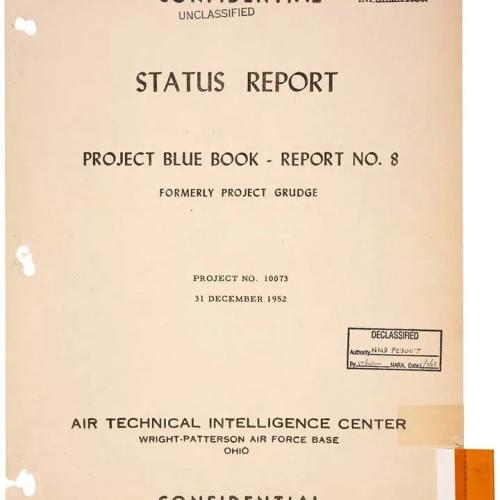
Nearly 130,000 pages of declassified Air Force files on UFO investigations and sightings are now available in one place online. Declassified government records about UFOs have long existed on microfilm in the National Archives in Washington, DC. Many of them also live on websites devoted to the topic. But UFO enthusiast John Greenewald says his database, Project Blue Book Collection, is the first to compile every single declassified document from the Blue Book project -- headquartered at Wright-Patterson Air Force Base in Ohio from 1947 to 1969 -- in one place for anyone to search or download for free. The collection consists of files from Project Blue Book, Project Sign and Project Grudge, the names given to official investigations into unidentified flying objects by the United States military. Greenewald's ... says he's just driven by curiosity. "I'm a history buff. I think this stuff should be accessible," he said. "It defied explanation," he said, "and 5,000 FOIAs later my curiosity hasn't gone away." The collection contains 10,000 PDFs, each representing a different case. The files include the details of some of the most famous UFO cases, including the Exeter incident, the Kenneth Arnold sighting and the Mantell crash. Still, Greenewald believes the contents are "just the tip of the iceberg." "It's all a puzzle," he said. "Just when you think you've got all the pieces to make a picture, you realize it's only a piece of a bigger puzzle."
Note: Explore Greenewald's revealing searchable archive of Air Force UFO files. For more along these lines, see the excellent, reliable resources provided in our comprehensive UFO Information Center.
Entrepreneurs and established companies alike depend on the U.S. Patent and Trademark Office. Newly released documents reveal that the office, tasked with evaluating and protecting the rights to intellectual property, has a covert system for delaying controversial or inconvenient patents. Its a system that ... could function as a way to limit or stomp out emerging companies. Before today, the program named the Sensitive Application Warning System (SAWS) has been mentioned only anecdotally by examiners who work in or with the office, and in a government memo that was leaked in March 2006. However, a new 50-page document obtained by a law firms Freedom of Information Act request shows the sweeping scope and conflicting interests of this particular set of rules. The law firm behind the request, Kilpatrick Townsend & Stockton LLP, frequently represents major tech companies, including Apple, Google, Twitter, and Oracle. For Thomas Franklin, a partner at Kilpatrick Townsend, applications that he prosecutes typically issue as patents 22 months after filing. Any application that is categorized in SAWS, however ... can be delayed for years. There is no official channel to notify an applicant once her patent is placed in the system. Franklin told Yahoo Tech., Thats what piqued my interest as a constitutional issue. Theres a secret program that theyre not supposed to talk about.
Note: When the government has a "property interest" in any patent application, it may be rejected, stolen, or classified according to secret criteria. Among new energy technology researchers, it is well known that the patent office can block patents of amazing inventions that could cost oil and energy companies billions of dollars. Read this excellent summary for more on this.
In 2003, caravans of trucks began to arrive at Andrews Air Force Base outside Washington on a regular basis, unloading an unusual cargo pallets of shrink-wrapped $100 bills. The cash, withdrawn from Iraqi government accounts held in the United States, was loaded onto Air Force C-17 transport planes bound for Baghdad. Exactly what happened to that money after it arrived? Finding the answer became first the job and then the obsession of Stuart W Bowen Jr. His investigators finally had a breakthrough, discovering that $1.2 billion to $1.6 billion had been stolen and moved to a bunker in rural Lebanon. Bowen kept the discovery and his investigation of the cash-filled bunker ... secret. He has never publicly discussed it until now. Billions of dollars have been taken out of Iraq over the last ten years illegally, he said. The money ... came from the Development Fund of Iraq, which was created by a United Nations resolution in May 2003 to hold Iraqi oil revenue. An advantage of using the cash from the Development Fund instead of money appropriated by Congress for Iraq was that there were not a lot of rules governing its use, and no federal regulations or congressional oversight of what happened to it. The CIA expressed little interest in pursuing the matter, and the FBI said it lacked jurisdiction, Bowen recalled. An informant told [Bowen] about the bunker, which in addition to the cash, was believed to also have held approximately $200 million in gold belonging to the Iraqi government.
Note: For more along these lines, see concise summaries of deeply revealing news articles about wartime deceptions and government secrecy from reliable major media sources.
Nearly 13 years after the 9/11 terrorist attacks, the extent of Saudi involvement in the deaths of almost 3,000 people remains unclear but according to members of Congress and the families of victims, information about this has been suppressed ever since the publication of a 2002 congressional investigation into the plot. Prior to the release of the final report of the Joint Inquiry into Intelligence Community Activities Before and After the Terrorist Attacks of September 11, 2001, the Bush administration classified a 28-page section in the name of national security. The 28 pages make up part four of the report, a section titled Finding, Discussion and Narrative Regarding Certain Sensitive National Security Matters. They are widely believed to implicate Saudi officials or describe support from Saudi intelligence for the hijackers, 15 of whom were Saudi citizens. Former Senator Bob Graham of Florida, who co-chaired the joint Senate-House investigation, dispensed with the equivocation and told VICE News that the redactions are a cover up. Ive said this since the first classification of the 28 pages, he remarked. Its become more and more inexplicable as to why two administrations have denied the American people information that would help them better understand what happened on 9/11. Graham said that the 28 pages describe the financing of the attacks. Follow the money, he said. That will illuminate other significant aspects of 9/11. The Saudi kingdom has always denied any complicity in the attacks.
Note: Watch a video of Congressman Massie telling how shocked he was to read these 28 pages. Why aren't the major media reporting this important news? For more on this, see concise summaries of deeply revealing 9/11 news articles from reliable major media sources.
A sweeping [gag] order issued in Australia to block reporting of any bribery allegations involving several international political leaders in the region has been exposed by WikiLeaks. The prohibition emerged from a criminal case in the Australian courts and applies throughout the country. It was issued by the criminal division of the supreme court of Victoria in Melbourne. The Australia-wide [gag] order is a superinjunction, which means it also contains a clause insisting that the terms of the order itself should remain secret. [It] states: "Subject to further order, there [shall] be no disclosure, by publication or otherwise, of any information derived from or prepared for the purposes of these proceedings including the terms of these orders." In a statement published with the leak, Julian Assange, the founder of WikiLeaks, said the gagging order relates to a case that "concerns the subsidiaries of the Australian central bank". He said it was the first blanket suppression order of this nature in Australia since 1995. "With this order, the worst in living memory, the Australian government is not just gagging the Australian press, it is blindfolding the Australian public," said Assange, who is himself Australian. "This is not simply a question of the Australian government failing to give this international corruption case the public scrutiny it is due. Foreign minister Julie Bishop must explain why she is threatening every Australian with imprisonment in an attempt to cover up an embarrassing corruption scandal involving the Australian government".
Note: Very few media were even willing to report on the reasons for this gag order, which were clearly to cover up corruption at the highest levels. See the CNN article for how no mention is even made of what was revealed. It seems that the higher up the corruption goes, the more vehemently courts rule to keep the investigations secret. Could there be a double standard here? For more on this, see concise summaries of deeply revealing government corruption news articles from reliable major media sources.
Robert David Steele, former Marine, CIA case officer, and US co-founder of the US Marine Corps intelligence activity, is ... widely recognised as the leader of the Open Source Intelligence (OSINT) paradigm. In 1992, despite opposition from the CIA, he obtained Marine Corps permission to organise a landmark international conference on open source intelligence the paradigm of deriving information to support policy decisions not through secret activities, but from open public sources available to all. The conference was such a success it brought in over 620 attendees from the intelligence world. But the CIA ... ensured that Steele was prohibited from running a second conference, [prompting] him to resign from his position as second-ranking civilian in Marine Corps intelligence. Last month, Steele presented a startling paper at the Libtech conference in New York. Drawing on principles set out in his latest book, The Open-Source Everything Manifesto ... he told the audience that all the major preconditions for revolution set out in his 1976 graduate thesis were now present in the United States and Britain. Steele's book ... connects up the increasing corruption, inefficiency and unaccountability of the intelligence system and its political and financial masters with escalating inequalities and environmental crises. But he also offers a comprehensive vision of hope. "Sharing, not secrecy, is the means by which we ... can create a nonzero win-win Earth that works for one hundred percent of humanity."
Note: Watch an excellent video showing Mr. Steele believes that most terrorist attacks are false flag operations.
The Obama administration has been quietly advising local police not to disclose details about surveillance technology they are using to sweep up basic cellphone data from entire neighborhoods. Citing security reasons, the U.S. has intervened in routine state public records cases and criminal trials regarding use of the technology. This has resulted in police departments withholding materials or heavily censoring documents in rare instances when they disclose any [information] about the purchase and use of such powerful surveillance equipment. One well-known type of this surveillance equipment is known as a Stingray. The equipment tricks cellphones into identifying some of their owners' account information, like a unique subscriber number, and transmitting data to police as if it were a phone company's tower. That allows police to obtain cellphone information without having to ask for help from service providers ... and can locate a phone without the user even making a call or sending a text message. The Obama administration is asking agencies to withhold common information about the equipment, such as how the technology is used and how to turn it on. "These extreme secrecy efforts are in relation to very controversial, local government surveillance practices using highly invasive technology," said Nathan Freed Wessler, a staff attorney with the American Civil Liberties Union, which has fought for the release of these types of records. "People should have the facts about what the government is doing to them."
Note: For more on this, see concise summaries of deeply revealing government surveillance news articles from reliable major media sources.
Reports from an oil rig worker who saw a fire in the sky on the night Malaysia Airlines flight 370 disappeared are being taken seriously, police sources have confirmed. But New Zealander Mike McKay, 55, has lost his job in the circus that developed after his report to authorities was leaked. Mr McKay had been working on the Songa Mercur oil rig in the South China Sea when he saw an orange light on an especially clear night. The object was still in one piece and close to where MH370 first dropped off radar between Malaysia and Vietnam on March 8 with 239 people on board. He emailed his employer and Vietnamese authorities about his sighting, but his statement was leaked, which included his full name, email, passport number, and full details of the company operating the rig. In the ensuing media storm, Mr McKay said the Japanese-based petroleum company, Idemitsu, was flooded with emails and he was taken off the rig. He is now unemployed and disappointed his efforts at reporting potentially vital information turned into such a circus. I was only trying to privately help, he told Fairfax Media during a series of interviews. If it was the aeroplane I saw, then it must have been an external fire. How far would an aeroplane stay in the air after such a fire?
Note: So much strangeness here. Why was this man fired for reporting simply what he saw? And why isn't this getting more media attention? For possible answers, see our essay on media corruption.
Reports that nearly 800 dead babies were discovered in the septic tank of a home run by nuns [have] sparked calls for accountability from government and Catholic Church officials. Some 796 children were secretly buried in the sewage tank of the home in Tuam, County Galway, where unmarried pregnant women were sent to give birth in an attempt to preserve the country's devout Catholic image. The home was run by nuns from the Bon Secours Sisters congregation between 1925 and 1961. People who lived near the home said they have known about the unmarked mass grave for decades, but a fresh investigation was sparked this week after research by local historian Catherine Corless ... showed that of the hundreds of children who died at the home, only one was buried at a cemetery. She also said that health board records from the 1940s said conditions at the home were dire, with children suffering malnutrition and neglect and dying at a rate four times higher than in the rest of Ireland. The claims came to light after Corless obtained death records for the home and cross checked them with local cemetery records. According to Eoin O'Sullivan, associate professor at Trinity College Dublin, "Tuam was a former workhouse and conditions were pretty bleak," said O'Sullivan, co-author of the 2001 book Suffer the Little Children: The inside Story of Ireland's Industrial Schools. "Ireland's first mother and baby home, at Bessborough, in Cork, had an even worse infant mortality rate of around 82 percent: In the year ending March 31, 1944, 124 children were born or admitted there, and 102 died."
Note: For more on institutional abuse of children, see the deeply revealing reports from reliable major media sources available here.
The federal governments spy-satellite agency failed to alert authorities after some of its employees and contractors admitted during polygraph tests to crimes including child molestation and lying on security-clearance questionnaires, according to a watchdog. The intelligence communitys inspector general released two reports ... saying the National Reconnaissance Office did not refer some of the cases because of confusion about reporting expectations and requirements. According to one of the reports, an Air Force lieutenant colonel admitted during a 2010 lie-detector test to touching a child in a sexual way and downloading child pornography on his work computer. The NRO only reported that case to the Air Force division that oversees security clearances instead of the Justice Department or the Air Forces special-investigations office, the inspector general said. The NRO is not legally required to report certain state crimes such as child molestation. Thirty individuals who took NRO lie-detector tests from 2009 through 2012 admitted to child abuse or using child pornography, according to the report. The NRO failed to report three of those cases. Sen. Chuck Grassley (R-Iowa), who requested the review after a McClatchy news investigation raised concerns about the matter in 2012, said the NRO showed a complete lack of common sense in failing to require reporting of serious state crimes of this sort.
Note: The NRO is the agency that was running a drill on the morning of 9/11 of an airplane crashing into one of its Washington, DC buildings, as reported in this USA Today article. It has also allegedly been involved in the UFO cover-up, as reported in this testimony.
Malaysia's prime minister says the disappearance of Malaysia Airlines Flight 370 appears to be "deliberate." The latest evidence suggests the plane didn't experience a catastrophic incident over the South China Sea as was initially suspected. Prime Minister Najib Razak said the investigation has refocused onto the crew and passengers aboard the missing plane. He added that ... all possibilities are still being investigated. A Malaysian government official who is involved in the investigation said investigators have concluded that one of the pilots or someone else with flying experience hijacked the missing Malaysia Airlines jet. The official said that hijacking was no longer a theory. "It is conclusive." A Malaysian official, who also declined to be identified because he is not authorized to brief the media, said only a skilled aviator could navigate the plane the way it was flown after its last confirmed location over the South China Sea. The official said it had been established with a "more than 50 percent" degree of certainty that military radar had picked up the missing plane after it dropped off civilian radar. Malaysian officials have said radar data suggest it may have turned back and crossed back over the Malaysian peninsula westward, after setting out toward the Chinese capital. The flight altered its course more than once after it lost contact with ground control and that it made significant changes in altitude. Investigators say there's further evidence suggesting the jet did not crash immediately after being lost on radar; a transmitter on the plane tried for another four hours to ping satellites.
Note: Why is the military radar 50% certain? How could a transmitter on the plane ping for four hours, yet no one on the plane made a phone call? Remember that after Flight 93 was hijacked on 9/11, many phone calls were made by passengers on the plane. There is an abundance of high strangeness to this airplane's disappearance. For valuable speculation on the missing flight not well covered in the major media, click here. For some very unusual radar evidence of its disappearance, click here.
In the tense days after a powerful earthquake and tsunami crippled the Fukushima Daiichi power plant in Japan on March 11, 2011, staff at the U.S. Nuclear Regulatory Commission made a concerted effort to play down the risk of earthquakes and tsunamis to Americas aging nuclear plants, according to thousands of internal emails reviewed by NBC News. The emails, obtained via the Freedom of Information Act, show that the campaign to reassure the public about Americas nuclear industry came as the agencys own experts were questioning U.S. safety standards and scrambling to determine whether new rules were needed to ensure that the meltdown occurring at the Japanese plant could not occur here. At the end of that long first weekend of the crisis three years ago, NRC Public Affairs Director Eliot Brenner thanked his staff for sticking to the talking points that the team had been distributing to senior officials and the public. "While we know more than these say," Brenner wrote, "we're sticking to this story for now." There are numerous examples in the emails of apparent misdirection or concealment in the initial weeks after the Japanese plant was devastated: When asked to help reporters explain what would happen during the worst-case scenario -- a nuclear meltdown -- the agency declined to address the questions. The emails pull back the curtain on the agencys efforts to protect the industry it is supposed to regulate. The NRC officials didn't lie, but they didn't always tell the whole truth either. When someone asked about a topic that might reflect negatively on the industry, they changed the subject.
Note: For more on corruption in the nuclear power industry, see the deeply revealing reports from reliable major media sources available here.
The list of those caught up in the global surveillance net cast by the National Security Agency and its overseas partners, from social media users to foreign heads of state, now includes another entry: US lawyers. A top-secret document, obtained by former NSA contractor Edward J. Snowden, shows that a US law firm was monitored while representing a foreign government in trade disputes with the United States. The disclosure offers a rare glimpse of a specific instance of Americans ensnared by the eavesdroppers and is of particular interest because US lawyers with clients overseas have expressed growing concern that their confidential communications could be compromised by such surveillance. The government of Indonesia had retained the law firm for help in trade talks, according to the February 2013 document. The NSAs Australian counterpart, the Australian Signals Directorate, notified the agency that it was conducting surveillance of the talks, including communications between Indonesian officials and the US law firm, and offered to share information. The NSA is banned from targeting Americans, including businesses, law firms, and other organizations based in the United States, for surveillance without warrants, and intelligence officials have repeatedly said the NSA does not use spy services of its partners in the so-called Five Eyes alliance Australia, Britain, Canada, and New Zealand to skirt the law. The Australians told officials at an NSA liaison office in Canberra, that information covered by attorney-client privilege may be included in the intelligence gathering. Most attorney-client conversations do not get special protections under US law from NSA eavesdropping.
Note: For more on intense deception perpetrated by the intelligence community, see the deeply revealing reports from reliable major media sources available here.
In an extraordinary feat of subterfuge, Israel managed to assemble an entire underground nuclear arsenal now estimated at 80 warheads, on a par with India and Pakistan and even tested a bomb nearly half a century ago, with a minimum of international outcry or even much public awareness of what it was doing. Despite the fact that the Israel's nuclear programme has been an open secret since a disgruntled technician, Mordechai Vanunu, blew the whistle on it in 1986, the official Israeli position is still never to confirm or deny its existence. When the former speaker of the Knesset, Avraham Burg, broke the taboo last month, declaring Israeli possession of both nuclear and chemical weapons and describing the official non-disclosure policy as "outdated and childish" a rightwing group formally called for a police investigation for treason. Meanwhile, western governments have played along with the policy of "opacity" by avoiding all mention of the issue. Israel ... almost certainly broke a treaty banning nuclear tests, as well as countless national and international laws restricting the traffic in nuclear materials and technology. The list of nations that secretly sold Israel the material and expertise to make nuclear warheads, or who turned a blind eye to its theft, include today's staunchest campaigners against proliferation: the US, France, Germany, Britain and even Norway. Israeli agents charged with buying fissile material and state-of-the-art technology found their way into some of the most sensitive industrial establishments in the world.
Note: For more on government secrecy, see the deeply revealing reports from reliable major media sources available here.
Important Note: Explore our full index to revealing excerpts of key major media news articles on several dozen engaging topics. And don't miss amazing excerpts from 20 of the most revealing news articles ever published.