














Secrecy News Articles
Below are key excerpts of revealing news articles on secrecy from reliable news media sources. If any link fails to function, a paywall blocks full access, or the article is no longer available, try these digital tools.

The secret overseas "black sites" where the CIA conducted the interrogations are empty now, if not already dismantled. They were never examined by a congressional committee, nor inspected by the international Red Cross. The black sites not only imprisoned men but reduced them to a near helpless state. The aim, as outlined in one document, was to teach every detainee "to perceive and value his personal welfare, comfort and immediate needs more than the information he is protecting." The prisoners' arrival -- almost always in diapers -- was engineered to achieve that end. After being shaved, stripped and photographed nude, detainees were examined by CIA medical and psychological personnel. Then came a preliminary interrogation that would determine the prisoners' fate. Only those considered extremely cooperative would avoid a trio of techniques designed to produce a "baseline, dependent" state: the deprivation of clothes, solid food and sleep. Follow-up sessions would start with the prisoner standing with his back against a wall and a towel or collar to prevent whiplash wrapped around his neck. He could be thrown against the wall just once "to make a point, or 20 to 30 times consecutively." Prisoners so abhorred the repeated slamming that they would remain in so-called stress positions, such as painful kneeling postures, for hours to avoid a return to the wall, according to one Dec. 30, 2004, memo that amounts to a CIA blueprint for breaking a detainee's will. Earlier this year, the Obama administration released a series of Justice Department memos laying out legal rationales for the array of coercive interrogation methods the CIA employed.
Note: For further revelations from major media sources on the illegal methods used by the US government in its wars around the world, click here.
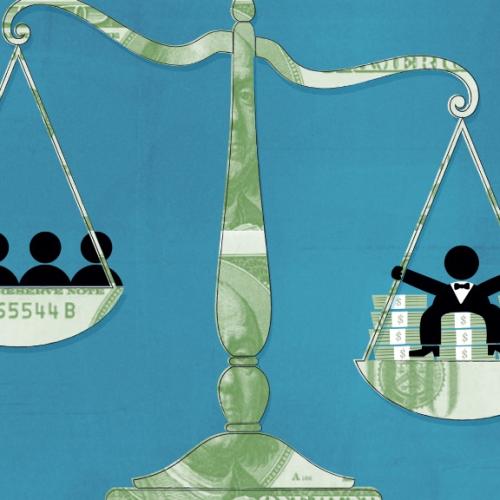
PAUL SOLMAN, NewsHour economics correspondent: As the Federal Reserve moved rapidly and radically last year to prevent what it feared was an economic meltdown, it bailed out some institutions, but not others, forced mergers, [and] created hundreds of billions of dollars. The net result: increased suspicion of the Fed itself. That's nothing new. The 1913 act of Congress that established America's central bank was ... a compromise between government ... and private banking interests, which owned the 12 regional Fed branches. [All along,] some Americans have been suspicious of the Fed for operating above politics, too close to bankers, and behind closed doors. Simply Google "Federal Reserve." You encounter everything from skepticism to fear of conspiracy. NARRATOR: With the power to regulate the money supply is also the power to bring entire economies and societies to its knees. DONALD KOHN, Federal Reserve vice chairman: We bring information to bear from the private sector, from foreign governments and foreign central banks that they tell us in confidence about what's going on in their businesses. WILLIAM GREIDER, author, "Secrets of the Temple": You could say, "We have to have our meetings in secret because things will be said that are national security secrets, but we'll vet the transcript and release it four weeks later." Why not do that? SOLMAN: A House bill ... would give the Government Accountability Office the right to audit the Fed's interest rate decisions. Chairman Bernanke opposes it as compromising the Fed's independence.
Note: If you look at the top of any U.S. currency, you will see the words "Federal Reserve Note." U.S. dollars are issued and controlled by the Federal Reserve, which is privately owned, though subject to minimal federal oversight. To see just how much control the Federal Reserve has over the issuance of U.S. currency, see their webpage at this link. For lots more on hidden manipulations of the Federal Reserve, click here.
Photographs of alleged prisoner abuse which Barack Obama is attempting to censor include images of apparent rape and sexual abuse, it has emerged. At least one picture shows an American soldier apparently raping a female prisoner while another is said to show a male translator raping a male detainee. Further photographs are said to depict sexual assaults on prisoners with objects including a truncheon, wire and a phosphorescent tube. Another apparently shows a female prisoner having her clothing forcibly removed to expose her breasts. Detail of the content emerged from Major General Antonio Taguba, the former army officer who conducted an inquiry into the Abu Ghraib jail in Iraq. Allegations of rape and abuse were included in his 2004 report but the fact there were photographs was never revealed. He has now confirmed their existence in an interview with the Daily Telegraph. The graphic nature of some of the images may explain the US Presidents attempts to block the release of an estimated 2,000 photographs from prisons in Iraq and Afghanistan despite an earlier promise to allow them to be published. Maj Gen Taguba, who retired in January 2007, said he supported the Presidents decision, adding: These pictures show torture, abuse, rape and every indecency. I am not sure what purpose their release would serve other than a legal one and the consequence would be to imperil our troops, the only protectors of our foreign policy, when we most need them. The mere description of these pictures is horrendous enough, take my word for it.
Charlie Black, senior adviser to John McCain, caused a fluff by saying that a terrorist attack on U.S. soil would be a "big advantage" to his candidate. No one mentioned that eight years ago, the Project for a New American Century called for "a new Pearl Harbor" that could move the American people to accept the neoconservative vision of militarized global domination. Then 9/11 happened, lifting George W. Bush from the shadows of a disputed election to the heights of a "war presidency." Bush has taken on unprecedented powers since the events of 9/11. On that day, the president issued his "Declaration of Emergency by Reason of Certain Terrorist Attacks" under the authority of the National Emergencies Act. This declaration, which can be rescinded by joint resolution of Congress, has instead been extended six times. In 2007, the declaration was quietly strengthened with the issuance of National Security Presidential Directive 51, which gave the president the authority to do whatever he deems necessary in a vaguely defined "catastrophic emergency," including everything from canceling elections to suspending the Constitution to launching a nuclear attack. Not a single congressional hearing was held on this directive. Will Congress act decisively to remove the president's emergency powers, challenge the directive and defend the Constitution?
The Justice Department concluded in October 2001 that military operations combating terrorism inside the United States are not limited by Fourth Amendment protections against unreasonable searches and seizures, in one of several secret memos containing new and controversial assertions of presidential power. The memo, sent on Oct. 23, 2001, to the Defense Department and the White House by the Office of Legal Counsel, focused on the rules governing any deployment of U.S. forces inside the country "in the event of further large-scale terrorist activities." Administration officials declined to detail what domestic military operations were being contemplated at the time. The memo has not been formally withdrawn. The Fourth Amendment assertion is one of several far-reaching legal arguments revealed by the disclosure Tuesday of a 2003 Justice Department memo that authorized harsh military interrogations. In its footnotes, asides and central text, that 81-page memo asserted nearly unlimited presidential powers during a time of war. The document disclosed, for example, that the administration's top lawyers had declared that the president has unfettered power to seize oceangoing ships as commander in chief; that Congress has no ability to pass legislation governing the interrogations of enemy combatants; and that federal laws prohibiting assault and other crimes did not apply to military interrogators. One section discussed to what extent the president might be allowed to legally maim a prisoner, such as through the use of a "scalding, corrosive, or caustic substance." A footnote argued that Fifth Amendment guarantees of due-process rights "do not address actions the Executive takes in conducting a military campaign against the Nation's enemies."
Note: For further disturbing reports on threats to civil liberties, click here.
Most Americans have never heard of Sibel Edmonds, and if the U.S. government has its way, they never will. The former FBI translator turned whistle-blower tells a chilling story of corruption at Washington's highest levels sale of nuclear secrets, shielding of terrorist suspects, illegal arms transfers, narcotics trafficking, money laundering, espionage. Ms. Edmonds' account is full of dates, places and names. And if she is to be believed, a treasonous plot to embed moles in American military and nuclear installations and pass sensitive intelligence to Israeli, Pakistani and Turkish sources was facilitated by figures in the upper echelons of the State and Defense Departments. Her charges could be easily confirmed or dismissed if classified government documents were made available to investigators. But Congress has refused to act, and the Justice Department has shrouded Ms. Edmonds' case in the state-secrets privilege, a rarely used measure so sweeping that it precludes even a closed hearing attended only by officials with top-secret security clearances. Ms. Edmonds' revelations have attracted corroboration in the form of anonymous letters apparently written by FBI employees. There have been frequent reports of FBI field agents being frustrated by the premature closure of cases dealing with foreign spying, particularly when those cases involve Israel, and the State Department has frequently intervened to shut down investigations based on "sensitive foreign diplomatic relations." Curiously, the state-secrets gag order binding Ms. Edmonds, while put in place by DOJ in 2002, was not requested by the FBI but by the State Department and Pentagon which employed individuals she identified as being involved in criminal activities. If her allegations are frivolous, that order would scarcely seem necessary.
Note: The author of this article, Philip Giraldi, is a retired career CIA officer. For further powerful details of Sibel Edmonds' revelations, click here.
More than five years ago, Congress and President Bush created the 9/11 commission. Soon after its creation, the presidents chief of staff directed all executive branch agencies to cooperate with the commission. The commissions mandate was sweeping and it explicitly included the intelligence agencies. But the recent revelations that the C.I.A. destroyed videotaped interrogations of Qaeda operatives leads us to conclude that the agency failed to respond to our lawful requests for information about the 9/11 plot. Those who knew about those videotapes and did not tell us about them obstructed our investigation. No one in the administration ever told the commission of the existence of videotapes of detainee interrogations. We did ask, repeatedly, for the kind of information that would have been contained in such videotapes. Beginning in June 2003, we requested all reports of intelligence information ... that had been gleaned from the interrogations of 118 named individuals, including both Abu Zubaydah and Abd al Rahim al-Nashiri, two senior Qaeda operatives, portions of whose interrogations were apparently recorded and then destroyed. The C.I.A. gave us many reports summarizing information gained in the interrogations. But the reports raised almost as many questions as they answered. So, in October 2003, we sent another wave of questions to the C.I.A.s general counsel. The general counsel responded in writing with non-specific replies. The agency did not disclose that any interrogations had ever been recorded or that it had held any further relevant information, in any form. Government officials decided not to inform a lawfully constituted body, created by Congress and the president, to investigate one the greatest tragedies to confront this country. We call that obstruction.
Note: The authors of this op-ed, Thomas H. Kean and Lee H. Hamilton, served as chairman and vice chairman, respectively, of the 9/11 Commission.
When the Justice Department publicly declared torture abhorrent in a legal opinion in December 2004, the Bush administration appeared to have abandoned its assertion of nearly unlimited presidential authority to order brutal interrogations. But soon after Alberto R. Gonzaless arrival as attorney general in February 2005, the Justice Department issued another opinion, this one in secret. It was a very different document; according to officials briefed on it, [it was] an expansive endorsement of the harshest interrogation techniques ever used by the Central Intelligence Agency. The new opinion ... for the first time provided explicit authorization to barrage terror suspects with a combination of painful physical and psychological tactics, including head-slapping, simulated drowning and frigid temperatures. Later that year, as Congress moved toward outlawing cruel, inhuman and degrading treatment, the Justice Department issued another secret opinion. The Justice Department document declared that none of the C.I.A. interrogation methods violated that standard. The classified opinions, never previously disclosed, are a hidden legacy of President Bushs second term and Mr. Gonzaless tenure at the Justice Department. Congress and the Supreme Court have intervened repeatedly in the last two years to impose limits on interrogations, and the administration has responded as a policy matter by dropping the most extreme techniques. But the 2005 Justice Department opinions remain in effect, and their legal conclusions have been confirmed by several more recent memorandums, officials said. They show how the White House has succeeded in preserving the broadest possible legal latitude for harsh tactics.
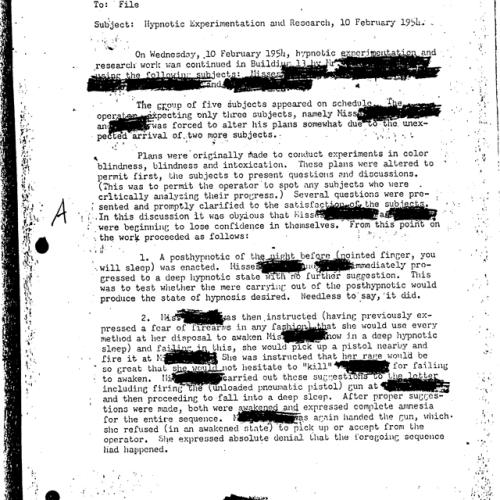
Easily lost, on page 425, in the mass of the CIA's notorious "Family Jewels" files is a short paragraph outlining "potentially embarrassing Agency activities". "Experiments in influencing human behaviour through the administration of mind- or personality-altering drugs to unwitting subjects." Of all the heinous acts committed by the CIA in the name of national security, these experiments, done on the agency's behalf by prominent psychiatrists on innocent victims - including children as young as four - may be the darkest. "We have no answer to the moral issue," former director Richard Helms infamously said when asked about the nature of the projects. The release of the Family Jewels documents revealed the CIA handsomely funded these real-life Dr Strangeloves and engaged pharmaceutical companies to help its experiments. The agency appealed to Big Pharma to pass on any drugs that could not be marketed because of "unfavourable side effects" to be tested on mice and monkeys. Any drugs that passed muster would then be used ... on volunteer US soldiers. The Family Jewels files do not provide further detail into the numerous mind-control programs, such as MKULTRA, covertly propped up by the agency. In 1953, MKULTRA was given 6 per cent of the total CIA budget without any oversight. The nature of the experiments, gathered from government documents and testimony in numerous lawsuits brought against the CIA, is shocking, from testing LSD on children to implanting electrodes in victims' brains to deliberately poisoning people with uranium. "The CIA bought my services from my grandfather in 1952 starting at the tender age of four," wrote Carol Rutz of her experiences.
Note: The entire body of the CIA's "Family Jewels" documents have been posted online by the National Security Archives, and can be read by clicking here. And for a 10-page summary of Carol Rutz's riveting book on her experiences as a government-created Manchurian candidate, click here.
Part One: 'A Different Understanding With the President': In less than an hour ... Cheney's proposal had become a military order from the commander in chief. Foreign terrorism suspects held by the United States were stripped of access to any court -- civilian or military, domestic or foreign. They could be confined indefinitely without charges and would be tried, if at all, in closed "military commissions." "What the hell just happened?" Secretary of State Colin L. Powell demanded ... when CNN announced the order that evening, Nov. 13, 2001. National security adviser Condoleezza Rice, incensed, sent an aide to find out. Even witnesses to the Oval Office signing said they did not know the vice president had played any part. "Angler," as the Secret Service code-named him, has approached the levers of power obliquely, skirting orderly lines of debate he once enforced as chief of staff to President Gerald R. Ford. He has battled a bureaucracy he saw as hostile, using intimate knowledge of its terrain. He has empowered aides to fight above their rank, taking on roles reserved in other times for a White House counsel or national security adviser. And he has found a ready patron in George W. Bush for edge-of-the-envelope views on executive supremacy that previous presidents did not assert. Over the past six years, Cheney has shaped his times as no vice president has before. [The] relationship [between Bush and Cheney] is opaque, a vital unknown in assessing Cheney's impact on events. Officials who see them together often, not all of them admirers of the vice president, detect a strong sense of mutual confidence that Cheney is serving Bush's aims.
Note: This is an important, in-depth investigation of the Cheney vice-presidency. It is highly revealing and well worth reading it its entirety.
David Talbot, founder of Salon.com ... believes that new evidence, including his own research encompassing more than 150 interviews, further undermines the conclusions of the Warren Commission Report. [His new book] "Brothers" ... stresses the extent to which the Kennedy administration faced political pressure from the extreme right, including elements of the CIA leadership, the national security apparatus [and] anti-Castro Cubans. JFK incurred the wrath of his enemies and incubated a desire for revenge in many of them. The author will convince many ... that the likelihood of a conspiracy to assassinate JFK (and maybe RFK) is significant. Talbot's highly readable, at times gripping book makes the case for releasing the classified documents pertaining to the JFK assassination. Declassified JFK files reveal that in 1963, [CIA agent George] Joannides was the agent in charge of one of the most powerful Cuban anti-Castro organizations in Miami, the Revolutionary Students Directorate, or DRE. A few months before JFK's assassination, the DRE had significant contact with Lee Harvey Oswald. In the course of four intensive investigations of the JFK assassination, however, the CIA failed to divulge information about this connection, or even that Joannides was the CIA officer assigned to manage the DRE, and refused to release important parts of Joannides' personnel file. In September, on grounds of national security, the CIA successfully thwarted a request for such information. Until it is released, many ... will reasonably speculate that crucial information about the JFK assassination is being concealed.
Note: For more reliable information on the Kennedy assassination and more, click here. The History Channel also has an excellent documentary showing beyond doubt there was more than one gunman. To order this highly revealing documentary, click here.
New charges have been filed alleging that a former top CIA official pushed a proposed $100 million government contract for his best friend in return for lavish vacations, private jet flights and a lucrative job offer. The indictment [brings] charges ... against Kyle Dusty Foggo, who resigned from the spy agency a year ago, and ... defense contractor Brent Wilkes. The charges grew from the bribery scandal that landed former U.S. Rep. Randy Duke Cunningham in prison. The pair now face 30 wide-ranging counts of fraud, conspiracy and money laundering [including that] Foggo provided Wilkes with sensitive, internal information related to ... national security, including classified information, to help him prepare proposals for providing undercover flights for the CIA under the guise of a civil aviation company and armored vehicles for agency operations. Then, he pushed his CIA colleagues to hire Wilkes companies without disclosing their friendship, prosecutors allege. In a June 2005 e-mail to the head of CIA air operations quoted in the indictment, Foggo offered to use some EXDIR grease on Wilkes behalf. Foggo was the agencys executive director at the time. In return, Wilkes offered to hire Foggo after he retired from government service. [An] initial indictment in February charged the pair with 11 counts of the same charges in connection with a $1.7 million water-supply contract Foggo allegedly helped win for one of Wilkes companies while he was working as a logistics coordinator at a CIA supply hub overseas. Foggo, the former No. 3 official at the CIA, resigned from the spy agency after his house and office were raided by federal agents.
Note: Until just a few years ago, there was a virtual blackout in the media on any negative coverage of the CIA. The prosecution of the #3 man in the CIA is an external manifestation of huge shake-ups going on behind the scenes. Buzzy Krongard, the previous #3 at the CIA has been linked to the millions of dollars in suspicious stock option trades made just prior to 9/11 that were never claimed, though this received little media coverage.
A disturbing recent phenomenon in Washington is that laws that strike to the heart of American democracy have been passed in the dead of night. So it was with a provision quietly tucked into the enormous defense budget bill at the Bush administrations behest that makes it easier for a president to override local control of law enforcement and declare martial law. The provision, signed into law in October, weakens two obscure but important bulwarks of liberty. One is the doctrine that bars military forces, including a federalized National Guard, from engaging in law enforcement. The other is the Insurrection Act of 1807, which ... essentially limits a presidents use of the military in law enforcement to putting down lawlessness, insurrection and rebellion, where a state is violating federal law or depriving people of constitutional rights. The newly enacted provisions upset this careful balance. The president may now use military troops as a domestic police force in response to a natural disaster, a disease outbreak, terrorist attack or to any other condition. Changes of this magnitude should be made only after a thorough public airing. But these new presidential powers were slipped into the law without hearings or public debate. The president made no mention of the changes when he signed the measure, and neither the White House nor Congress consulted in advance with the nations governors.
[Book Review of] Medical Apartheid: The Dark History of Medical Experimentation on Black Americans From Colonial Times to the Present. Harriet Washington opens the door on the torture room in "Medical Apartheid". Experimental operations on the skulls of slave children, Washington writes, were a favorite pursuit of a particularly sadistic South Carolinian doctor named J. Marion Sims, widely revered today as the "father of gynecology." For years, Sims experimented on a group of slave women, to whom he refused anesthesia. The most notorious post-slavery racial crime of American medicine [was] the Tuskegee Syphilis Study, conducted by the U.S. Public Health Service between 1932 and 1972. More than 100 black subjects ... were denied treatment, even and especially after the discovery of penicillin in 1943. The research required that they suffer and die, the more slowly the better. Tuskegee was hardly unique. The Rockefeller Institute ... conducted a study in 1910 that saw 470 black syphilitics injected with a deadly strain of malaria. Black Americans were also disproportionately used ... as subjects in government inquiries into the effects of radiation. Washington's chilling history ends with contemporary case studies. At the Incarnation Children's Center in New York, Columbia University doctors continue to administer experimental AIDS drugs to minority orphans, even after many develop painful and debilitating reactions. As for current clinical trials in Africa, Washington describes the continent as the new "laboratory for the West," where unsuspecting patients regularly receive experimental therapies that might never receive state sanction in the United States or Europe.
Note: For more reliable, verifiable information on major corruption in the health industry, click here. It's also interesting to not that no other major media chose to review this important book.
Stock sales by America's corporate leaders exceeded purchases last month by the widest ratio in nearly 20 years. Executives sold $63.18 of shares for every $1 they bought in November, the largest ratio since at least January 1987. U.S. securities laws require company executives and directors to disclose stock purchases or sales within two business days. Insiders sold $8.4 billion in shares last month, according to data compiled from SEC filings. Buying was ... $133 million. The overall insider-selling amount was the fifth-highest since 1987. Selling peaked at $13.9 billion in March 2000. The data have "value for investors," said Wayne Reisner at Carret Asset Management in New York. "It's people who are very familiar with their company and their stock." Insiders executed 6.34 sales transactions for each purchase transaction in the eight weeks ended Dec. 1. That's up from 2.45 in the period ended Aug. 4 and above the ratio of 2.25 he considers neutral for the market. Microsoft ranked first among U.S. companies, with $594.2 million in sales by insiders in November. Seagate Technology and DreamWorks Animation SKG Inc. ranked second and third, at $311.8 million and $224.2 million, respectively. Google Inc. was fourth, at $182.1 million.
Note: Isn't it interesting that the NASDAQ stock index reached it's all-time high in March 2000, the exact month executive stock selling hit its record, and just prior to the huge NASDAQ crash. Is it possible that corporate executives knew something the rest of us didn't?
The Pentagon ... has resisted entreaties from U.S. anti-narcotics officials to play an aggressive role in the faltering campaign to curb the country's opium trade. Military units in Afghanistan largely overlook drug bazaars, rebuff some requests to take U.S. drug agents on raids and do little to counter the organized crime syndicates shipping the drug to Europe, Asia and, increasingly, the United States. Poppy cultivation has exploded, increasing by more than half this year. Afghanistan supplies about 92% of the world's opium. "It is surprising to me that we have allowed things to get to the point that they have," said ... a former top State Department counter-narcotics official. Outgoing Defense Secretary Donald H. Rumsfeld has said that Afghanistan's flourishing opium trade is a law enforcement problem, not a military one. The opium trade is one-third of the country's economy. Several dozen kingpins ... have become more brazen, richer and powerful. [They] openly run huge opium bazaars and labs that turn opium into heroin. [The] head of the United Nations Office on Drugs and Crime said ... that the location of major drug operations were "well-known to us and to the authorities." The Pentagon has balked at drug interdiction efforts even when it had the resources, said a former senior U.S. anti-drug official. "There were [drug] convoys where military people looked the other way," the former official said. "DEA would identify a lab to go hit or a storage facility and [the Pentagon] would find a reason to ground the helicopters." A recent congressional report said the DEA asked the Pentagon for airlifts on 26 occasions in 2005, and the requests were denied in all but three cases.
Note: Some observers and insiders believe the reason Afghanistan was attacked is because the Taliban had virtually stopped the opium trade in 2001. For reliable evidence supporting these allegations, click here.
After six years of technological research, more than $4 billion spent by Washington on new machinery and a widespread overhaul of the nations voting system, this months midterm election revealed that the country is still far from able to ensure that every vote counts. Tens of thousands of voters, scattered across more than 25 states, encountered serious problems at the polls. The difficulties led to shortages of substitute paper ballots and long lines that caused many voters to leave without casting ballots. Voting experts say it is impossible to say how many votes were not counted that should have been. In Florida alone, the discrepancies ... amount to more than 60,000 votes. In Colorado, as many as 20,000 people gave up trying to vote ... as new online systems for verifying voter registrations crashed repeatedly. In Arkansas, election officials tallied votes three times in one county, and each time the number of ballots cast changed by more than 30,000. Election experts say that with electronic voting machines, the potential consequences of misdeeds or errors are of a [great] magnitude. A single software error can affect thousands of votes, especially with machines that keep no paper record. In Ohio, thousands of voters were turned away or forced to file provisional ballots by poll workers puzzled by voter-identification rules. In Pennsylvania, the machines crashed or refused to start, producing many reports of vote-flipping [where] voters press the button for one candidate but a different candidates name appears on the screen. In Ohio, even a congressman, Steve Chabot, a Republican, was turned away from his polling place because the address listed on his drivers license was different than his home address.
In a nation that preaches the virtues of democracy, the United States government has consistently eroded the media's ability to report. U.S. press freedom has been slipping away since Sept. 11, 2001. Many other countries are now ranked freer than the United States. In the most recent survey by Freedom House [the U.S.] tied for 17th place. International free-press advocates Reporters Without Borders ranked us 53rd, tied with Botswana, Croatia and Tonga. Now that we are in a seemingly permanent "war" on terrorism, the government claims wartime powers that result in restricting press freedom. The Bush administration has multiplied exponentially the number of documents it classifies as secret. The office of Vice President Dick Cheney claims to be exempt from reporting even the numbers of records it brands with the "classified" stamp. Within weeks after 9/11, President Bush issued Executive Order 13233, allowing him to veto public release not only of his own presidential papers but those of former [presidents]. One of former Attorney General John Ashcroft's first post-Sept. 11 acts was to issue a directive to federal agencies restricting access to government records under the Freedom of Information Act. Cheney [refused] to disclose even the identity of the corporate executives he met with to determine the administration's energy policy. The U.S. Supreme Court held ... that there is no such thing as a First Amendment right of access to government information or facilities. The Bush administration did not advance press freedom by producing ... favorable "news" stories with fake reporters. It is hard to stomach the hypocrisy of claiming to spread democracy abroad while restricting at home the very freedoms that make democracy possible.
There were many problems with voting in this election. In at least one Congressional race, the evidence strongly suggests that paperless voting machines failed to count thousands of votes, and that the disappearance of these votes delivered the race to the wrong candidate. [In] Floridas 13th Congressional District .. according to the official vote count, the Republicans [won] narrowly. The problem is that the official vote count isnt credible. In much of the 13th District, the voting pattern looks normal. But in Sarasota County, which used touch-screen voting machines ... almost 18,000 voters nearly 15 percent of those who cast ballots using the machines supposedly failed to vote for either candidate in the hotly contested Congressional race. That compares with undervote rates ranging from 2.2 to 5.3 percent in neighboring counties. The Herald-Tribune of Sarasota ... interviewed hundreds of voters. About a third of those interviewed by the paper reported that they couldnt even find the Congressional race on the screen. Moreover, more than 60 percent of those interviewed ... reported that they did cast a vote in the Congressional race but that this vote didnt show up on the ballot summary page. An Orlando Sentinel examination of other votes cast by those who supposedly failed to cast a vote ... shows that they strongly favored Democrats, and Mr. Buchanan won the official count by only 369 votes. For the nation as a whole, the important thing isnt who gets seated to represent Floridas 13th District. Its whether the voting disaster there leads to legislation requiring voter verification and a paper trail. I’ve been shocked at how little national attention the mess in Sarasota has received.
"The Under Secretary of the Navy (UNSECNAV) is the Approval Authority for research involving: (a) Severe or unusual intrusions, either physical or psychological, on human subjects (such as consciousness-altering drugs or mind-control techniques). (b) Prisoners. (c) Potentially or inherently controversial topics (such as those likely to attract significant media coverage or that might invite challenge by interest groups). The UNSECNAV forwards to the Director, Defense Research and Engineering (DDR&E) for final determination: (a) All proposed research involving exposure of human subjects to the effects of nuclear, biological or chemical warfare agents or weapons, as required by reference (a)."
Note: This 2006 US Department of the Navy document shows that the US military continues to develop mind control techniques, use mind-altering drugs, and expose individuals to lethal nuclear, biological, and chemical agents while keeping it all out of the media's eye. For lots more showing blatant disregard for human rights on this topic, click here and here.
Important Note: Explore our full index to revealing excerpts of key major media news articles on several dozen engaging topics. And don't miss amazing excerpts from 20 of the most revealing news articles ever published.