






































War News Articles
Below are key excerpts of revealing news articles on war from reliable news media sources. If any link fails to function, a paywall blocks full access, or the article is no longer available, try these digital tools.
For further exploration, delve into our comprehensive Military-Intelligence Corruption Information Center.

President Bush and his top aides publicly made 935 false statements about the security risk posed by Iraq in the two years following September 11, 2001, according to a study released ... by two nonprofit journalism groups. "In short, the Bush administration led the nation to war on the basis of erroneous information that it methodically propagated and that culminated in military action against Iraq on March 19, 2003," reads an overview of the examination, conducted by the Center for Public Integrity and its affiliated group, the Fund for Independence in Journalism. According to the study, Bush and seven top officials -- including Vice President Dick Cheney, former Secretary of State Colin Powell and then-National Security Adviser Condoleezza Rice -- made 935 false statements about Iraq during those two years. The study says Bush made 232 false statements about Iraq and former leader Saddam Hussein's possessing weapons of mass destruction, and 28 false statements about Iraq's links to al Qaeda. The study, released Tuesday, says Powell had the second-highest number of false statements, with 244 about weapons and 10 about Iraq and al Qaeda. Former Secretary of Defense Donald Rumsfeld and Press Secretary Ari Fleischer each made 109 false statements. "It is now beyond dispute that Iraq did not possess any weapons of mass destruction or have meaningful ties to al Qaeda," the report reads. The overview of the study also calls the media to task, saying most media outlets didn't do enough to investigate the claims. "Some journalists -- indeed, even some entire news organizations -- have since acknowledged that their coverage during those prewar months was far too deferential and uncritical," the report reads.
Note: These lies led to the deaths of thousands of American soldiers and hundreds of thousands of Iraqi civilians. Why is no action being taken on this matter? For other powerful revelations of war corruption and profiteering, click here.
David Frost: Does anyone know exactly who was responsible for this assassination attempt? There is one report that said that you arranged to send President Musharraf a letter ... in the event of your death by assassination, urging him to investigate certain individuals in his government. Is that true? Benazir Bhutto: Yes it is true that I wrote to General Musharraf. I feel these are the forces that really want to stop not just me, but the democratic process and the will of the people [from] triumphing. David Frost: In terms of these three people you mentioned where they members of or associated with the government? Benazir Bhutto: One of them is a very key figure in security. He is a former military officer. He is someone who has had dealings with Jaish-e-Mohammad, one of the band [of] groups of Maulana Masood Azhar, who was in an Indian jail for decapitating three British tourists and three American tourists. And he also had dealings with Omar Shiekh, who murdered Osama bin Laden.
Note: The key statement on bin Laden's murder happens at minute five in the video at the above link. If the link fails, click here. For a Jan. 9, 2010 BBC article also suggesting bin Laden may already have been dead years earlier and that his death had been covered up, click here. Bhutto was assassinated not long after this interview on Dec. 27, 2007.
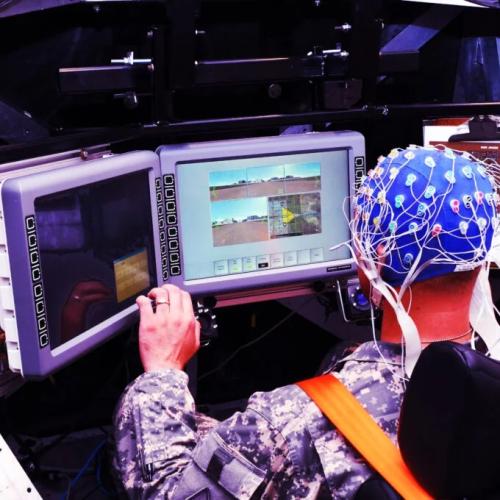
Imagine a day when the U.S. government implants microchips inside the brains of U.S. soldiers. Well you don't have to think too far into the future. The defense department is studying the idea now. The chip would be the size of a grain of rice. How far is too far when it comes to privacy? The department of defense recently awarded $1.6 million to Clemson University to develop an implantable biochip. It would go into the brain using a new gel that prevents the human body from rejecting it. The overall idea is to improve the quality and speed of care for fallen soldiers. "It's just crazy. To me, it's like a bad sci-fi movie," says Yelena Slattery [from] the website www.WeThePeopleWillNotBeChipped.com. Slattery says, "Soldiers can't choose not to get certain things done because they become government property once they sign up. When does it end? When does it become an infringement on a person's privacy?" Once the chip is in, she says, could those soldiers be put on surveillance, even when they're off-duty? A spokesman for veterans of foreign wars also urged caution. Joe Davis said, "If you have a chip that's holding a gigabyte, or 10 gigs, like an iPod, what kind of information is going to be on there? How could this be used against you if you were taken captive?"
Note: For a treasure trove of recent and reliable information on the increasing penetration of microchips into our lives, click here.
Four years ago on May 1, President Bush landed on the aircraft carrier USS Lincoln wearing a flight suit ... in front of a giant "Mission Accomplished" banner. He was hailed by media stars as a "breathtaking" example of presidential leadership in toppling Saddam Hussein. Despite profound questions over the failure to locate weapons of mass destruction and the increasing violence in Baghdad, many in the press confirmed the White House's claim that the war was won. How did the mainstream press get it so wrong? How did the evidence disputing the existence of weapons of mass destruction and the link between Saddam Hussein to 9-11 continue to go largely unreported? In the run-up to war, skepticism was a rarity among journalists inside the Beltway. The [PBS "Buying the War"] program analyzes the stream of unchecked information from administration sources and Iraqi defectors to the mainstream print and broadcast press. While almost all the claims would eventually prove to be false, the drumbeat of misinformation about WMDs went virtually unchallenged by the media. "Buying the War" examines the press coverage in the lead-up to the war as evidence of a paradigm shift in the role of journalists in democracy and asks, four years after the invasion, what's changed? "More and more the media become ... common carriers of administration statements," says the Washington Post's Walter Pincus. "We've sort of given up being independent on our own."
Note: You can view the highly revealing documentary "Buying the War" or read the transcript at the link above.
The "war on terror" has created a culture of fear in America. The Bush administration's elevation of these three words into a national mantra since the horrific events of 9/11 has had a pernicious impact on American democracy. Constant reference to a "war on terror" did accomplish one major objective: It stimulated the emergence of a culture of fear. Fear obscures reason, intensifies emotions and makes it easier for demagogic politicians to mobilize the public on behalf of the policies they want to pursue. America today is not the self-confident and determined nation that responded to Pearl Harbor; nor is it the America that heard from its leader, at another moment of crisis, the powerful words "the only thing we have to fear is fear itself." Fear-mongering, reinforced by security entrepreneurs, the mass media and the entertainment industry, generates its own momentum. The terror entrepreneurs ... are necessarily engaged in competition to justify their existence. Hence their task is to convince the public that it faces new threats. "Security" procedures have become routine, wasting hundreds of millions of dollars and further contributing to a siege mentality. Government at every level has stimulated the paranoia. The record is even more troubling in the general area of civil rights. The culture of fear has bred intolerance, suspicion of foreigners and the adoption of legal procedures that undermine fundamental notions of justice. Innocent until proven guilty has been diluted if not undone, with some -- even U.S. citizens -- incarcerated for lengthy periods of time without ... due process. There is no known, hard evidence that such excess has prevented significant acts of terrorism.
Note: This is an amazingly deep and powerful analysis of the use of fear by politicians, big business, and the media to promote their own agendas. Amazingly, the article was written by Zbigniew Brzezinski, national security adviser to President Carter. This is the same man who wrote in his book The Grand Chessboard, that U.S. global primacy is not likely to be achieved "except in the circumstance of a truly massive and widely perceived direct external threat." Strange, but the article is well worth reading in its entirety. For more, click here.
The largest government contractor youve never heard of [is] a company known simply by the nondescript initials SAIC (for Science Applications International Corporation). It is larger than the departments of Labor, Energy, and Housing and Urban Development combined. No contractor seems to exploit conflicts of interest in Washington with more zeal. And no contractor cloaks its operations in greater secrecy. SAIC has displayed an uncanny ability to thrive in every conceivable political climate. It is the invisible hand behind a huge portion of the national-security statethe one sector of the government whose funds are limitless. SAIC represents, in other words, a private business that has become a form of permanent government. Civilians at SAIC used to joke that the company had so many admirals and generals in its ranks it could start its own war. Some might argue that, in the case of Iraq, it did. 9/11 ... was very, very good for SAIC. In the aftermath of the attacks ... SAIC was ready. SAIC executives have been involved at every stage of the life cycle of the war in Iraq. SAIC personnel were instrumental in pressing the case that weapons of mass destruction existed in Iraq ... and that war was the only way to get rid of them. Then ... SAIC secured contracts for a broad range of operations in soon-to-be-occupied Iraq. When no weapons of mass destruction were found, SAIC personnel staffed the commission that was set up to investigate how American intelligence could have been so disastrously wrong.
Note: SAIC changed its name to Leidos in 2013. Lockheed Martin, which already ran a breathtakingly big part of the United States, and was reported in 2015 to be engaged in deep and systemic corruption" including paying off a Congresswoman, merged with Leidos in 2016. The hidden war machine is consolidating. For more along these lines, see concise summaries of deeply revealing news articles about corruption in government and in the corporate world.
Robert Gates will face ... the enormous task of cleaning up the Pentagon's tangled finances, which outside auditors lambaste as so chaotic that no one knows how much money is being spent on defense at any given time. The White House's Office of Management and Budget believes the Pentagon's financial management systems are in such a mess "that independent auditors still cannot certify the accuracy of the financial statements." David Walker, the U.S. Comptroller General, issued a devastating assessment of the Pentagon's finances, which include an annual budget of over $500 billion. The Pentagon's financial problems "are pervasive, complex, long-standing and deeply rooted in virtually all business operations throughout the department," Walker told the Senate Armed Services Committee. Financial problems like the Pentagon's "would put any civilian company out of business," said Kwai Chan, a former GAO auditor ... and author of a report entitled "Financial Management in the Department of Defense: No One is Accountable." Winslow Wheeler, a former national security expert for the Senate Budget Committee, called the Defense Department "the worst-managed agency in the federal government, (that) can't account for the half-trillion dollars it spends each year, and seeks to produce weapons that are irrelevant or ineffective, or both."
Note: For major media articles showing that more than $1 trillion of taxpayers money have gone missing at the Pentagon, click here. For the deeper reasons behind this, a top U.S. general's explanation is available here.
While the Bush administration, the media and nearly all the Democrats still refuse to explain the war in Iraq in terms of oil, the ever-pragmatic members of the Iraq Study Group share no such reticence. Page 1, Chapter 1 ... lays out Iraq's importance: "It has the world's second-largest known oil reserves." The report makes visible to everyone the elephant in the room: that we are fighting, killing and dying in a war for oil. Recommendation No. 63 ... calls on the U.S. to "assist Iraqi leaders to reorganize the national oil industry as a commercial enterprise." This is an echo of calls made [by] the U.S. State Department's Oil and Energy Working Group, meeting between December 2002 and April 2003. Iraq "should be opened to international oil companies as quickly as possible after the war." Its preferred method of privatization was a form of oil contract called a production-sharing agreement. These agreements are ... rejected by all the top oil producers in the Middle East because they grant greater control and more profits to the companies than the governments. For any degree of oil privatization to take place ... Iraq has to amend its constitution. Recommendation No. 26 of the Iraq Study Group calls for a review of the constitution to be "pursued on an urgent basis." Petroleum Economist magazine later reported that U.S. oil companies considered passage of the new oil law more important than increased security. Further, the Iraq Study Group would commit U.S. troops to Iraq for several more years to ... provide security for Iraq's oil infrastructure. We can thank the Iraq Study Group for making its case publicly. It is now our turn to decide if we wish to spill more blood for oil.
Note: For more on corporate complicity in fomenting war exposed by a top U.S. general, click here.
Despite a huge and costly effort by the media, the public still has an incomplete picture of what really happened during the [war in Afghanistan] and of how Osama bin Laden survived it. Gary Berntsen's Jawbreaker provides a valuable new account by a major participant that fills in many blanks. Berntsen was a top CIA field commander in the most critical sector of a new kind of war; at various times, the CIA veteran had elements of the Delta Force, Army Rangers, Navy SEALs and tactical air units reporting to him. Crown Publishers has chosen unnecessarily to position it as a diatribe that the CIA tried to suppress. In fact, while the CIA dragged its feet in reviewing the manuscript for classified material and redacted plenty of specifics, the book is hardly an attack on the CIA. In fact, the overall picture of the CIA here is far more flattering than that in The 9/11 Commission Report. Still, to portray Jawbreaker as "the book the CIA doesn't want you to read" (as the cover puts it), the publisher has displayed the redactions throughout the book as large black lines. Contradicting Bush administration denials, Berntsen writes that his teams discovered bin Laden and the remnants of his entourage in the now famous Tora Bora Mountains along the lawless, rugged Afghan-Pakistani border. Berntsen recounts very credibly how he and others pleaded with Gen. Tommy Franks and the Pentagon brass to put in blocking forces so that bin Laden and the remnants of al Qaeda's leadership could not flee into Pakistan. But for reasons that remain unclear to Berntsen ... the Bush administration or Franks decided to depend instead on local Afghan warlords rather than put U.S. forces on the ground to block bin Laden's escape.
Note: To read a concise summary of reliable news reports that raise serious questions about what really happened on 9/11, click here.
A federal appeals court yesterday backed the president's power to indefinitely detain a U.S. citizen captured on U.S. soil without any criminal charges, holding that such authority is vital during wartime to protect the nation from terrorist attacks. The ruling, by the U.S. Court of Appeals for the 4th Circuit, came in the case of Jose Padilla, a former gang member and U.S. citizen arrested in Chicago in 2002 and a month later designated an "enemy combatant" by President Bush. Padilla has been held without trial in a U.S. naval brig for more than three years, and his case has ignited a fierce battle over the balance between civil liberties and the government's power to fight terrorism since the Sept. 11, 2001, attacks. A host of civil liberties groups and former attorney general Janet Reno weighed in on Padilla's behalf, calling his detention illegal and arguing that the president does not have unchecked power to lock up U.S. citizens indefinitely. In its ruling yesterday, the three-judge panel overturned a lower court. Avidan Cover, a senior associate at Human Rights First, said the ruling "really flies in the face of our understanding of what rights American citizens are entitled to." Opponents have warned that if not constrained by the courts, Padilla's detention could lead to the military being allowed to hold anyone who, for example, checks out what the government considers the wrong kind of reading materials from the library.
Note: For many disturbing reports from major media sources on government threats to civil liberties, click here.
During the 2004 presidential campaign, George W. Bush and John Kerry battled about whether Osama bin Laden had escaped from Tora Bora in the final days of the war in Afghanistan. Bush asserted that U.S. commanders on the ground did not know if bin Laden was at the mountain hideaway along the Afghan border. But in a forthcoming book, the CIA field commander for the agency's Jawbreaker team at Tora Bora, Gary Berntsen, says he and other U.S. commanders did know that ... bin Laden was holed up at Tora Bora ... and could have been caught. Asked to comment on Berntsen's remarks, National Security Council spokesman Frederick Jones passed on 2004 statements from former CENTCOM commander Gen. Tommy Franks. "We don't know to this day whether Mr. bin Laden was at Tora Bora in December 2001," Franks wrote in an Oct. 19 New York Times op-ed. [CIA Commander] Berntsen says Franks is "a great American. But he was not on the ground out there. I was." In his booktitled "Jawbreaker"the decorated career CIA officer criticizes Donald Rumsfeld's Defense Department for not providing enough support to the CIA and the Pentagon's own Special Forces teams in the final hours of Tora Bora. Berntsen ... has sued the agency over what he calls unacceptable delays in approving his book. "They're just holding the book," which is scheduled for October release, he says. "CIA officers, Special Forces and U.S. air power drove the Taliban out in 70 days. The CIA has taken roughly 80 days to clear my book."
Note: For a concise summary of reliable, verifiable information questioning the official account of 9/11, click here.
Serratia is a bacterium that some doctors and residents of the [San Francisco] Bay Area have been familiar with for many years. In 1950, government officials believed that serratia did not cause disease. That belief was later used as a justification for a secret post-World War II Army experiment that became a notorious disaster tale about the microbe. The Army used serratia to test whether enemy agents could launch a biological warfare attack on a port city such as San Francisco from a location miles offshore. For six days in late September 1950, a small military vessel near San Francisco sprayed a huge cloud of serratia particles into the air while the weather favored dispersal. Army tests showed that the bacterial cloud had exposed hundreds of thousands of people in a broad swath of Bay Area communities. Soon after the spraying, 11 people came down with hard-to-treat infections at the old Stanford University Hospital in San Francisco. By November, one man had died. The outbreak was so unusual that the Stanford doctors wrote it up for a medical journal. But the medics and [the dead man's] relatives didn't find out about the Army experiment for nearly 26 years, when a series of secret military experiments came to light. Some people now speculate that descendants of the Army germs are still causing infections here today. The secret bio-warfare test might have permanently changed the microbial ecology of the region.
Note: The military regularly used humans as guinea pigs in experiments in the decades before and after WWII. For a list of these sometimes lethal experiments, click here. For reliable information on government mind control experiments which also used unsuspecting civilians, click here.
Outside the convention hall, New York City police plan to control protesters using a device that directs sound for up to 1,500 feet in a spotlight-like beam. Meanwhile, a display of former Republican presidents inside the hall will feature campaign speeches that are funneled to listeners through highly focused audio beams. Both technologies feature unprecedented manipulation of sound, but for very different purposes. And while both technologies have unique, "gee-whiz" factors, some remain uneasy with the idea of using sound to control crowds. When in weapon mode, LRAD blasts a tightly controlled stream of caustic sound that can be turned up to high enough levels to trigger nausea or possibly fainting. LRAD ... has been used by the U.S. military in Iraq and at sea as a non-lethal force. In these settings, operators can use the device not only to convey orders, but also as a weapon. In tests, police have shown how they can convey orders in a normal voice to someone as far as four blocks away. The sound beam is even equipped with a viewfinder so the operator can precisely target the audio by finding a person in cross hairs. Rather than using pure volume to throw sound far, the LRAD reaches distant ears by focusing the audio beam. Wherever the beam makes contact with air, the air molecules interact in a way that isolates the original audible sound. So if you're standing in front of the ultrasonic sound wave, you can hear the sound. If you're a few inches away, you hear nothing. Already, some Coca-Cola machines in Japan are equipped with the technology so passers-by hear the enticing sound of soda being poured into a glass of ice.
Note: For more reliable information on these "non-lethal weapons," click here.
Your commission ... has now issued its "9/11 Commission Report". After [9/11] we, the translators at the FBI's largest and most important translation unit, were told to slow down, even stop, translation of critical information related to terrorist activities. This issue has been confirmed by the Senate Judiciary Committee. Melek Can Dickerson, with the assistance of her direct supervisor, forged signatures on top-secret documents related to certain 9/11 detainees. Not only does the supervisor facilitating these criminal conducts remain in a supervisory position, he has been promoted. In April 2001, a long-term FBI informant/asset ... received information that: 1) Osama Bin Laden was planning a major terrorist attack in the United States targeting 4-5 major cities, 2) the attack was going to involve airplanes [and] the attack was going to be carried out soon. No action was taken. After 9/11, the agents and the translators were told to 'keep quiet' regarding this issue. The translator who was present ... reported this incident to Director Mueller in writing. Why did your report choose to exclude the information ... despite the public confirmation by the FBI, witnesses provided to your investigators, and briefings you received directly? As you are fully aware, these issues and incidents were found confirmed by a Senior Republican Senator, Charles Grassley, and a Senior Democrat Senator, Patrick Leahy. Even FBI officials 'confirmed all my allegations and denied none' during their unclassified meetings with the Senate Judiciary staff. However, neither your commission's hearings, nor your commission's five hundred sixty seven-page report ... include these serious issues, major incidents, and systemic problems.
Note: If the above link fails, click here. Sibel Edmonds is one of the great heroes of our day. She has been gagged directly by the U.S. Attorney General from telling what she knows. The above letter was not published in any major U.S. media, though widely reported in alternative new sources. To understand how such vital information is hidden from the public, click here. For lots more on Ms. Edmonds, click here.
Twice each week, a top-secret report with distinctive red stripes lands on the desks of select policymakers in Washington. Called the "Red Cell," it is the work of a CIA unit by the same name, set up after the 9/11 attacks. "Some of it is really wacky, even scary," says an insider. "Like bombing Iran." The "Red Cell," in a very real sense, is emblematic of the trouble the U.S. intelligence community finds itself in today. Created in 1947, the U.S. intelligence community has grown enormously in terms of bodies and dollars but also in the number and complexity of its responsibilities. It has also, for many reasons, grown into a mess. After 9/11, Americans had good reason to assume the nation's intelligence capabilities were being improved. But then came the Iraq war and the subsequent revelations that the CIA's "slam dunk" intelligence on Saddam Hussein's stockpiles of banned weapons was a complete air ball, a casualty of badly forged documents, eager exiles with outlandish stories, and analysis that, in the most charitable sense, could be described as flawed. The Senate Intelligence Committee's 511-page Iraq report documents how on the country's weightiest issue – whether to launch a pre-emptive war – the U.S. intelligence community ended up wrong on virtually every critical point. "In short," laments Sen. Jay Rockefeller, the intelligence panel's ranking Democrat, "we went to war in Iraq based on false claims." When Harry Truman signed into law the National Security Act of 1947, creating the CIA, he wanted precisely what the name implied: a central agency for intelligence. "The CIA was set up by me for the sole purpose of getting all the available information to the president," Truman wrote. "It was not intended to operate as an international agency engaged in strange activities." Within months, of course, Truman himself was ordering the CIA to engage in "strange activities," such as staving off a Communist takeover in Italy.
Note: For more on the realities of intelligence agency operations, see the deeply revealing reports from reliable major media sources available here.
The Department of Defense, already infamous for spending $640 for a toilet seat...couldn't account for more than a trillion dollars in financial transactions, not to mention dozens of tanks, missiles and planes. The nonpartisan General Accounting Office has raised the volume of its perennial complaints about the financial woes at Defense, which recently failed its seventh audit in as many years. "Overhauling DOD's financial management operations represent a challenge that goes far beyond financial accounting," GAO chief David Walker told lawmakers. Recent government reports suggest the Pentagon's money management woes have reached astronomical proportions. A GAO report found Defense inventory systems so lax that the U.S. Army lost track of 56 airplanes, 32 tanks, and 36 Javelin missile command launch-units. When military leaders were scrambling to find enough chemical and biological warfare suits to protect U.S. troops, the department was caught selling these suits as surplus on the Internet "for pennies on the dollar," a GAO official said. "We are overhauling our financial management system," said Dov Zakheim, the Pentagon's chief financial officer. "The Pentagon has failed to address financial problems that dwarf those of Enron," said Rep. Henry Waxman, D-Los Angeles. Gregory Kutz, director of GAO's financial management division [said] "I've been to Wal-Mart. They were able to tell me how many tubes of toothpaste were in Fairfax, Va. And DOD can't find its chem-bio suits." Opposition to defense spending is portrayed as unpatriotic. Legislators are often more concerned about winning Pentagon pork than controlling defense waste.
Note: You can read the GAO Report (Page 17 on missing planes). Page two states, "To date, no major part of DOD has yet been able to pass the test of an independent audit." For an intriguing Online Journal article exposing the deep role of the Pentagon's former CFO (Chief Financial Officer) Zakheim in this corruption, click here. Why wasn't and isn't this front page headlines? Why are newspaper editors keeping this most vital information from the public?
The Defense Department is dramatically expanding its 'black world' of covert operations. The Bush administration has turned to what the Pentagon calls the "black world" to press the war on terrorism and weapons of mass destruction. The increasingly dominant role of the military ... reflects the desire of Secretary of Defense Donald Rumsfeld to gain greater overall control of the war on terror. "Our task is to find and destroy the enemy before they strike us." Though covert action can bring quick results, because it is isolated from the normal review processes it can just as quickly bring mistakes and larger problems. The epicenter of the Pentagon's covert operations remains the North Carolina-based Joint Special Operations Command, often referred to as Delta Force. The super-secret command is still not officially acknowledged to exist. Rumsfeld's influential Defense Science Board ... recommends creation of a super-Intelligence Support Activity, an organization it dubs the Proactive, Preemptive Operations Group, (P2OG), to bring together CIA and military covert action, information warfare, intelligence, and cover and deception. This body would launch secret operations aimed at "stimulating reactions" among terrorists and states possessing weapons of mass destruction -- that is, for instance, prodding terrorist cells into action and exposing themselves to "quick-response" attacks by U.S. forces. The Air Force is designing its own Global Response Task Force ... capable of delivering a "worldwide attack within an hour."
Note: For an amazing expos by a highly decorated U.S. general on the hidden reasons behind war, click here.
Startling new evidence revealed in a BBC documentary shows that President Lyndon Johnson had no doubts that the Israeli attack on American spy ship USS Liberty, which left 34 American servicemen dead and 171 wounded, had been a deliberate attack. The incident happened ... during the Arab-Israeli Six Day War. Unmarked Israeli planes attacked and nearly sank the USS Liberty. Israel has always claimed that the affair was a tragic accident. The government of President Lyndon Johnson publicly accepted this explanation. In fact ... those at the very top never believed the Israeli version. The picture that emerges is of a daring ploy by Israel to fake an Egyptian attack on the American spy ship, and thereby provide America with a reason to officially enter the war against Egypt. Intercepts recorded during the incident reveal how America was convinced the attack was intentional, and the minutes of a White House meeting clearly suggest that President Johnson believed the attack had been deliberate. The Liberty survivors have continued to argue that the attack was intentional and that the US government colluded in a cover-up. Today, the veterans are still calling for a full investigation by Congress. It remains the only case of an attack on a US ship without a full Congressional enquiry. [The documentary] offers evidence of a secret collaboration between America and Israel before and during the war - a covert alliance of intelligence agencies that has always been denied by both sides.
Note: The complete BBC documentary can be viewed here. For more along these lines, see concise summaries of deeply revealing news articles on corruption in government and in the intelligence community.
Osama bin Laden underwent treatment in July at the American Hospital in Dubai where he met a US Central Intelligence Agency official, French daily Le Figaro and Radio France International reported today. Quoting "a witness, a professional partner of the administrative management of the hospital," they said the man suspected by the United States of being behind the September 11 terrorist attacks had arrived in Dubai on July 4 by air from Quetta, Pakistan. He was immediately taken to the hospital for kidney treatment. He left the establishment on July 14, Le Figaro said. During his stay, the daily said, the local CIA representative was seen going into bin Laden's room and "a few days later, the CIA man boasted to some friends of having visited the Saudi-born millionaire." Quoting "an authoritative source," Le Figaro and the radio station said the CIA representative had been recalled to Washington on July 15. Bin Laden ... was admitted to the urology department of Dr Terry Callaway, who specialises in kidney stones and male infertility. Telephoned several times, the doctor declined to answer questions. Several sources had reported that bin Laden had a serious kidney infection. He had a mobile dialysis machine sent to his Kandahar hideout in Afghanistan in the first half of 2000, according to "authoritative sources" quoted by Le Figaro and RFI.
Note: This article has disappeared from the Herald website. To read the full original as we copied it, click here. For excerpts from many major media articles suggesting a 9/11 cover-up, click here.
For [many] years, sci-fi writers have imagined weapons that might use energy waves or pulses to knock out, knock down, or otherwise disable enemies--without necessarily killing them. And for a good 40 years the U.S. military has quietly been pursuing weapons of this sort. Much of this work is still secret. But now ... the search for weapons that could incapacitate people without inflicting lethal injuries has intensified. Police, too, are keenly interested. Scores of new contracts have been let, and scientists, aided by government research on the "bioeffects" of beamed energy, are searching the electromagnetic and sonic spectrums for wavelengths that can affect human behavior. Recent advancements in miniaturized electronics, power generation, and beam aiming may finally have put such pulse and beam weapons on the cusp of practicality. Scientists say they are natural successors to projects already underway--beams that disable the electronic systems of aircraft, computers, or missiles, for instance. "Once you are into these antimateriel weapons, it is a short jump to antipersonnel weapons," says Louis Slesin, editor of the trade journal Microwave News. That's because the human body is essentially an electrochemical system, and devices that disrupt the electrical impulses of the nervous system can affect behavior and body functions. But these programs--particularly those involving antipersonnel research--are so well guarded that details are scarce. "People [in the military] go silent on this issue," says Slesin, "more than any other issue. People just do not want to talk about this."
Note: For key reports from reliable sources on so-called "non-lethal weapons, click here.
Important Note: Explore our full index to revealing excerpts of key major media news articles on several dozen engaging topics. And don't miss amazing excerpts from 20 of the most revealing news articles ever published.