
















Big Brother News Articles
Below are key excerpts of revealing news articles on Big Brother from reliable news media sources. If any link fails to function, a paywall blocks full access, or the article is no longer available, try these digital tools.

Stock sales by America's corporate leaders exceeded purchases last month by the widest ratio in nearly 20 years. Executives sold $63.18 of shares for every $1 they bought in November, the largest ratio since at least January 1987. U.S. securities laws require company executives and directors to disclose stock purchases or sales within two business days. Insiders sold $8.4 billion in shares last month, according to data compiled from SEC filings. Buying was ... $133 million. The overall insider-selling amount was the fifth-highest since 1987. Selling peaked at $13.9 billion in March 2000. The data have "value for investors," said Wayne Reisner at Carret Asset Management in New York. "It's people who are very familiar with their company and their stock." Insiders executed 6.34 sales transactions for each purchase transaction in the eight weeks ended Dec. 1. That's up from 2.45 in the period ended Aug. 4 and above the ratio of 2.25 he considers neutral for the market. Microsoft ranked first among U.S. companies, with $594.2 million in sales by insiders in November. Seagate Technology and DreamWorks Animation SKG Inc. ranked second and third, at $311.8 million and $224.2 million, respectively. Google Inc. was fourth, at $182.1 million.
Note: Isn't it interesting that the NASDAQ stock index reached it's all-time high in March 2000, the exact month executive stock selling hit its record, and just prior to the huge NASDAQ crash. Is it possible that corporate executives knew something the rest of us didn't?
The Pentagon ... has resisted entreaties from U.S. anti-narcotics officials to play an aggressive role in the faltering campaign to curb the country's opium trade. Military units in Afghanistan largely overlook drug bazaars, rebuff some requests to take U.S. drug agents on raids and do little to counter the organized crime syndicates shipping the drug to Europe, Asia and, increasingly, the United States. Poppy cultivation has exploded, increasing by more than half this year. Afghanistan supplies about 92% of the world's opium. "It is surprising to me that we have allowed things to get to the point that they have," said ... a former top State Department counter-narcotics official. Outgoing Defense Secretary Donald H. Rumsfeld has said that Afghanistan's flourishing opium trade is a law enforcement problem, not a military one. The opium trade is one-third of the country's economy. Several dozen kingpins ... have become more brazen, richer and powerful. [They] openly run huge opium bazaars and labs that turn opium into heroin. [The] head of the United Nations Office on Drugs and Crime said ... that the location of major drug operations were "well-known to us and to the authorities." The Pentagon has balked at drug interdiction efforts even when it had the resources, said a former senior U.S. anti-drug official. "There were [drug] convoys where military people looked the other way," the former official said. "DEA would identify a lab to go hit or a storage facility and [the Pentagon] would find a reason to ground the helicopters." A recent congressional report said the DEA asked the Pentagon for airlifts on 26 occasions in 2005, and the requests were denied in all but three cases.
Note: Some observers and insiders believe the reason Afghanistan was attacked is because the Taliban had virtually stopped the opium trade in 2001. For reliable evidence supporting these allegations, click here.
Nearly all members of the House of Representatives opted out of a chance to read this year's classified intelligence bill, and then voted on secret provisions they knew almost nothing about. The bill, which passed by 327 to 96 in April, authorized the Bush administration's plans for fighting the war on terrorism. Many members say they faced an untenable choice: Either consent to a review process so secretive that they could never mention anything about it in House debates, under the threat of prosecution, or vote on classified provisions they knew nothing about. Most chose to know nothing. A Globe survey sent to all members of the House, [revealed] the vast majority of the respondents ... said they typically don't read the classified parts of intelligence bills. The failure to read the bill, however, calls into question the vows of many House members to provide greater oversight of intelligence. The rules make open debate on intelligence policy and funding nearly impossible, lawmakers say. Revealing classified secrets has long been a crime, punishable by expulsion from the House and criminal prosecution. Operating largely in secret, the intelligence panels have a limited staff because of the security clearances involved. Further, committee members can't go to outside experts to vet policies or give advice, leaving members with no way to fact-check the administration's assertions. Democratic and Republican leaders are no longer briefed together, raising questions about whether the two leaders are being told the same things.
Note: If above link fails, click here. If you want to understand how U.S. Congressional representatives are kept in the dark and easily manipulated when it comes to intelligence matters, this article is a must read.
Hundreds of protesters gathered outside an exclusive California retreat for government and business leaders Saturday to challenge the right of a "ruling elite" to make policy decisions without public scrutiny. The annual Bohemian Grove retreat has attracted powerful men such as Ronald Reagan, George Bush, former Secretary of State Henry Kissinger, philanthropist David Rockefeller, former West German Chancellor Helmut Schmidt and former House Speaker Newt Gingrich. It's also become a magnet for all types of activists who increasingly use the event to network and organize their campaigns. The men who attend the Bohemian Grove retreat spend two weeks performing plays, eating gourmet camp grub, listening to speakers and power-bonding at the 2,700-acre compound near the Russian River in Sonoma County. The retreat is organized by the exclusive San Francisco-based Bohemian Club. The club and event are shrouded in mystery, much like Yale University's most-famous secret society, Skull and Bones, whose members include President George W. Bush and his presidential rival Sen. John Kerry.
Note: This article strangely has been removed from the San Francisco Chronicle website. To see it in the Internet Archive, click here. For an informative five-minute ABC news clip on the power elite gathering Bohemian Grove reported in 1981, click here. And for reliable information on the most secretive meeting of the world's elite reported by the major media, see our Bilderberg Group compilation available here.
"Conspiracy of Silence" is a powerful, disturbing documentary revealing a nationwide child abuse and pedophilia ring that leads to the highest levels of government. Featuring intrepid investigator John DeCamp, a highly decorated Vietnam war veteran and 16-year Nebraska state senator, "Conspiracy of Silence" reveals how rogue elements at all levels of government have been involved in systematic child abuse and pedophilia to feed the base desires of key politicians. Based on DeCamp's riveting book, The Franklin Cover-up, "Conspiracy of Silence" begins with the shut-down of Nebraska's Franklin Community Federal Credit Union after a raid by federal agencies in November 1988 revealed that $40 million was missing. When the Nebraska legislature launched a probe into the affair, what initially looked like a financial swindle soon exploded into a startling tale of drugs, money laundering, and a nationwide child abuse ring. Nineteen months later, the legislative committee's chief investigator died suddenly and violently, like more than a dozen other people linked to the Franklin case.
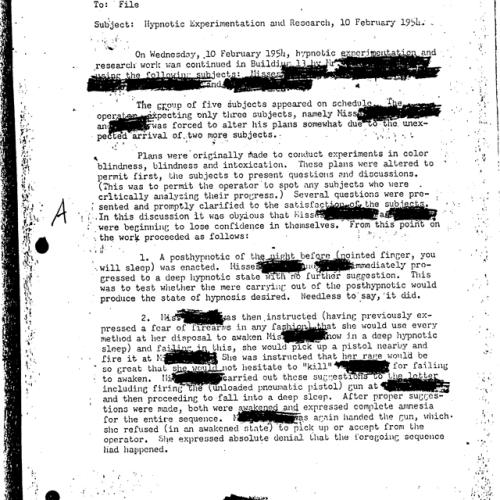
John K. Vance [was] a member of the Central Intelligence Agency inspector general's staff in the early 1960s who discovered that the agency was running a research project that included administering LSD and other drugs to unwitting human subjects. Code-named MKULTRA (and pronounced m-k-ultra), the project Mr. Vance uncovered was the brainchild of CIA Director Allen Dulles, who was intrigued by reports of mind-control techniques allegedly conducted by Soviet, Chinese and North Korean agents on U.S. prisoners of war during the Korean War. The CIA wanted to use similar techniques on its own POWs and perhaps use LSD or other mind-bending substances on foreign leaders, including Cuba's Fidel Castro a few years after the project got underway in 1953. Heading MKULTRA was a CIA chemist named Sidney Gottlieb. In congressional testimony, Gottlieb, who died in 1999, acknowledged that the agency had administered LSD to as many as 40 unwitting subjects, including prison inmates and patrons of brothels set up and run by the agency. At least one participant died when he jumped out of a 10th-floor window in a hotel; others claimed to have suffered serious psychological damage. Mr. Vance learned about MKULTRA in the spring of 1963 during a wide-ranging inspector general survey of the agency's technical services division. The inspector general's report said: "The concepts involved in manipulating human behavior are found by many people both within and outside the agency to be distasteful and unethical." MKULTRA came to public light in 1977 as a result of hearings conducted by a Senate committee on intelligence chaired by Sen. Frank Church (D-Idaho).
Note: If the above link fails, click here. For an excellent two-page summary of reliable verifiable information on CIA mind control programs which clearly violated ethical and moral standards, click here.
The U.S. Air Force is quietly spending millions of dollars investigating ways to use a radical power source -- antimatter, the eerie "mirror" of ordinary matter -- in future weapons. The most powerful potential energy source presently thought to be available to humanity, antimatter is a term normally heard in science-fiction films. But antimatter itself isn't fiction. During the Cold War, the Air Force funded numerous scientific studies of the basic physics of antimatter. Following an initial inquiry from The Chronicle this summer, the Air Force forbade its employees from publicly discussing the antimatter research program. Still, details on the program appear in numerous Air Force documents distributed over the Internet prior to the ban. It almost defies belief, the amount of explosive force available in a speck of antimatter. One millionth of a gram of positrons contain as much energy as 37.8 kilograms (83 pounds) of TNT. A simple calculation, then, shows that about 50-millionths of a gram could generate a blast equal to the explosion ... in Oklahoma City in 1995. Officials at Eglin Air Force Base initially agreed enthusiastically to try to arrange an interview with ... Kenneth Edwards, director of the "revolutionary munitions" team at the Munitions Directorate at Eglin. "We're all very excited about this technology," spokesman Rex Swenson [said] in late July. But Swenson backed out in August after he was overruled by higher officials in the Air Force and Pentagon. Reached by phone in late September, Edwards repeatedly declined to be interviewed. His superiors gave him "strict instructions not to give any interviews personally. "I'm sorry about that -- this (antimatter) project is sort of my grandchild."
As opposite as George Bush and John Kerry may seem to be, they do share a common secret - one they've shared for decades. The secret: details of their membership in Skull and Bones, the elite Yale University society whose members include some of the most powerful men of the 20th century. Bonesmen, as they're called, are forbidden to reveal what goes on in their inner sanctum. Bones has included presidents, cabinet officers, spies, Supreme Court justices, [and] captains of industry. They'd responded to questions with utter silence until an enterprising Yale graduate, Alexandra Robbins, managed to penetrate the wall of silence in her book, Secrets of the Tomb. "I spoke with about 100 members of Skull and Bones. They were members who were tired of the secrecy,” says Robbins. “But probably twice that number hung up on me, harassed me, or threatened me.” Skull and Bones, with all its ritual and macabre relics, was founded in 1832. Since then, it has chosen or "tapped" only 15 senior students a year who become ... lifetime members of the ultimate old boys' club. A lot of Bonesmen have gone on to positions of great power. President Bush ... tapped five fellow Bonesmen to join his administration. Bonesmen have [included] William Howard Taft, the 27th President; Henry Luce, the founder of Time Magazine; and W. Averell Harriman, the diplomat and confidant of U.S. presidents. Mr. Bush, like his father and grandfather before him, has refused to talk openly about Skull and Bones. But as a Bonesman, he was required to reveal his innermost secrets to his fellow Bones initiates. They're supposed to recount their entire sexual histories in ... a dimly-lit cozy room.
Note: For a highly revealing, four-minute CNN News clip on Skull and Bones, click here. For other major media news clips reporting on this powerful secret society, click here. And for lots more reliable information from major media sources on powerful, secret groups like this, click here.
The FBI used murderers as informants in Boston for three decades, even allowing innocent men to be sentenced to death to protect the secret operation, a government report has found. The FBI's policy "must be considered one of the greatest failures in the history of federal law enforcement" and had "disastrous consequences", the report by the House Committee on Government Reform said. More than 20 people were murdered by FBI informants in Boston from 1965, often with the help of FBI agents, it said. But no FBI agent or official has ever been disciplined. The FBI's policy of using murderers grew out of a belated effort by a former director, J. Edgar Hoover, to go after the Mafia, which Hoover had earlier denied even existed. In the early 1960s, the bureau began recruiting underworld informers in its new campaign. The report focuses heavily on one episode, the 1965 murder of Edward Deegan, a small-time hoodlum who was killed by Jimmy Flemmi and Joseph Barboza, who had just been recruited by an FBI agent in Boston. The FBI knew the two men were the killers because it had been using an unauthorised wire tap and had heard Flemmi ask the Mafia boss, Raymond Patriarca, for permission to kill Deegan. A few days later, Deegan was shot dead. Four men who had nothing to do with the killing were tried and convicted, with two sentenced to death and two to life in prison. Two of the men died in prison and two had their sentences commuted and were freed after serving 30 years behind bars. Hoover was kept fully informed about this murder and the wrongful convictions, the report said.
Hitler and his henchmen victimized an entire continent and exterminated millions in his quest for a so-called Master Race. But the concept of a white, blond-haired, blue-eyed master Nordic race didn't originate with Hitler. The idea was created in the United States, and cultivated in California, decades before Hitler came to power. Eugenics would have been so much bizarre parlor talk had it not been for extensive financing by corporate philanthropies, specifically the Carnegie Institution, the Rockefeller Foundation and the Harriman railroad fortune. They were all in league with some of America's most respected scientists from such prestigious universities as Stanford, Yale, Harvard and Princeton. These academicians espoused race theory and race science, and then faked and twisted data to serve eugenics' racist aims. Stanford President David Starr Jordan originated the notion of "race and blood" in his 1902 racial epistle "Blood of a Nation," in which the university scholar declared that human qualities and conditions such as talent and poverty were passed through the blood. The Rockefeller Foundation helped found the German eugenics program and even funded the program that Josef Mengele worked in before he went to Auschwitz.
Note: Josef Mengele's US-funded eugenics research laid the foundation for his experimentation on human subjects before and during World War II. He went on to participate in CIA-funded mind-control experimentation after that war. For more on Mengele, click here.
A former Navy attorney who helped lead the military investigation of the 1967 Israeli attack on the USS Liberty that killed 34 American servicemen says former President Lyndon Johnson and his defense secretary, Robert McNamara, ordered that the inquiry conclude the incident was an accident. Retired Capt. Ward Boston said Johnson and McNamara told those heading the Navy's inquiry to "conclude that the attack was a case of 'mistaken identity' despite overwhelming evidence to the contrary." Boston was senior legal counsel to the Navy's original 1967 review of the attack. He said in the sworn statement that he stayed silent for years because ... "when orders come ... I follow them." The USS Liberty was an electronic intelligence-gathering ship that was cruising international waters off the Egyptian coast on June 8, 1967. Israeli planes and torpedo boats opened fire on the Liberty. It was "one of the classic all-American cover-ups," said Ret. Adm. Thomas Moorer, a former Joint Chiefs of Staff chairman who spent a year investigating the attack as part of an independent panel he formed with other former military officials. The panel also included a former U.S. ambassador to Saudi Arabia, James Akins. David Lewis of Lemington, Vt., was on the Liberty when it was attacked. In an interview, he said Israel had to know it was targeting an American ship. He said a U.S. flag was flying that day and Israel shot it full of holes. The sailors on the ship, he said, quickly hoisted another American flag, a much bigger one, to show Israel it was a U.S. vessel.
Note: For lots more on this major cover-up by a U.S. president and top military officers, click here. ABC producer James Bamford, who exposed the Operation Northwoods cover-up, also has an excellent chapter on this event in his highly revealing book, Body of Secrets, about the National Security Agency.
At least 11 countries provided advance warning to the US of the 9/11 attacks. Two senior Mossad experts were sent to Washington in August 2001 to alert the CIA and FBI to a cell of 200 terrorists said to be preparing a big operation. The list they provided included the names of four of the 9/11 hijackers, none of whom was arrested. In November 2001 the US airforce complained it had had al-Qaida and Taliban leaders in its sights as many as 10 times over the previous six weeks, but had been unable to attack because they did not receive permission quickly enough. The BBC reported [that] a former Pakistan foreign secretary was told by senior American officials at a meeting in Berlin in mid-July 2001 that "military action against Afghanistan would go ahead by the middle of October". Zacarias Moussaoui ... was arrested in August 2001. One agent wrote, a month before 9/11, that Moussaoui might be planning to crash into the Twin Towers. US agents ... sought a warrant to search his computer. They were turned down by the FBI. [A] PNAC blueprint supports an earlier document ... which said the US must "discourage advanced industrial nations from challenging our leadership". The document also calls for the creation of "US space forces" to dominate space, and the total control of cyberspace to prevent "enemies" using the internet. It also hints that the US may consider developing biological weapons "that can target specific genotypes [and] may transform biological warfare from the realm of terror to a politically useful tool". The conclusion of all this analysis must surely be that the "global war on terrorism" has the hallmarks of a political myth propagated to pave the way for a wholly different agenda - the US goal of world hegemony, built around securing by force command over the oil supplies required to drive the whole project.
Note: This is one of the very few articles recommended as a must read. Michael Meacher was the U.K. Minister of Environment from May 1997 to June 2003. Mr. Meacher lays out a wealth of highly revealing information backed by reliable sources. To confirm most of his statements on our 9/11 timeline, click here. Mr. Meacher's cliams were reported on BBC News, as well, though the BBC mentioned amazingly little on his claims of U.S. involvement in 9/11. To see the BBC article click here.
For a quarter of a century, [Eric Olson] has believed that the Central Intelligence Agency murdered his father, a United States government scientist. On Nov. 28, 1953, around 2 a.m. [the] night manager at the Statler Hotel ... in New York rushed out the front door ... to find a middle-aged man lying on the sidewalk. The man had fallen from the 10th floor -- apparently after crashing through a closed window. [In late July, 1975] the C.I.A.'s director, William Colby [provided Olson's] family ... declassified documents relating to Frank Olson's death. Olson had not been a civilian employee of the Department of the Army. He had been a C.I.A. employee working at Fort Detrick. Olson's specialty, it turned out, had been the development of aerosols for the delivery of anthrax. The Colby documents were ... full of unexplained terms like the ''Artichoke'' and ''Bluebird'' projects. These turned out to be the precursors of what became known as MK-ULTRA, a C.I.A. project, beginning in the Korean War, to explore the use of drugs like LSD as truth serums, as well as botulism and anthrax, for use in covert assassination. The documents claimed that during a meeting between the C.I.A. and Fort Detrick scientists ... on Nov. 19,1953, Sidney Gottlieb of the C.I.A. slipped LSD into Olson's glass of Cointreau. Olson, a scientist by training, would have known that he was working for a government that had put Nazi scientists on trial at Nuremberg for immoral experiments on human beings. Now, in the late summer of 1953, [Olson] faced up to the possibility that his own government was doing the same thing. Slipping LSD into Olson's Cointreau was ... designed to get him to talk ... to assess what kind of risk he posed and then eliminate him if necessary.
Note: For those interested in this vital, yet disturbing topic, the entire Times article is well worth reading. For further verifiable information on the CIA mind control programs mentioned in this article, click here.
A handful of military personnel from the 4th Psychological Operations Group, based at Fort Bragg, NC, have until recently been working in CNN's headquarters in Atlanta. [A] Dutch journalist named Abe de Vries came up with this important story ... and remains properly astounded that no mainstream news medium in the US has evinced any interest in it. De Vries ... originally [came] upon the story [following] a military symposium in Arlington, VA that discussed the use of the press in military operations. De Vries saw a good story, picked up the phone, and finally reached Maj. Thomas Collins of the US Army Information Service, who duly confirmed the presence of these Army psy-ops experts at CNN. "Psy-ops personnel, soldiers, and officers," De Vries quoted Collins as telling him, "have been working in CNN's headquarters ... through our program, training with industry. They helped in the production of news." Eason Jordan, who identified himself as CNN's president of news-gathering and international networks, [confirmed] that CNN had hosted a total of five interns from US Army psy-ops. Jordan said the program began ... just before the end of the war against Serbia and only recently terminated. Executives at CNN now describe the Army psy-ops intern tours at CNN as having been insignificant. The commanding officer of the psy-ops group certainly thought them of sufficient significance to mention at that high-level Pentagon powwow in Arlington about propaganda and psychological warfare.
Note: This article strangely has been removed from the Los Angeles Times archives. The link above shows a scanned image of the actual newspaper. The article was first published in the San Jose Mercury News on March 23, 2000, though the article is also strangely not available in their archives. U.S. Congressional testimony in the 1970s revealed that the CIA paid employees of major media networks to influence public opinion. The CIA's Operation Mockingbird revealed blatant efforts by the CIA to manipulate public opinion in the U.S., thus violating its charter.
When Kevin Warwick enters his office building on the campus of Reading University, strange things happen. As Warwick heads down the main hall, lights turn on. When he turns to the right, an office door unbolts and opens. Each step is clocked and recorded. The building knows who he is, where he is, and what he expects to happen. The building [even] says, Hello Professor Warwick. The structure knows Warwick because of the electrical fuse-sized smart card implanted in his left arm. In Britain, hes been dubbed The Cyborg Man, the first person known to have a microchip implanted in his body for communication with outside machines. Warwick predicts chip implants will one day replace time cards, criminal tracking devices, even credit cards. Capable of carrying huge amounts of data, they may, he says, one day be used to identify individuals by Social Security numbers, blood type, even their banking information. No one knows yet how the body will respond to this type of invasion. Warwick is not blind to the ethical questions of this technology. Implants ostensibly designed to clock workers in and out might be misused to monitor where people are at all times and who they are meeting. Governments could move to use implants instead of I.D. cards and passports, but what would stop them from using this new science to invade privacy? I feel mentally different. When I am in the building I feel much more closely connected with the computer.
Note: Those who would like to control the public named these implants "smart cards" to encourage us to accept them. For more reliable information on important topic, click here and here.
For decades in art circles it was either a rumour or a joke, but now it is confirmed as a fact. The Central Intelligence Agency used American modern art - including the works of such artists as Jackson Pollock, Robert Motherwell, Willem de Kooning and Mark Rothko - as a weapon in the Cold War. The CIA fostered and promoted American Abstract Expressionist painting around the world for more than 20 years. This was a period, in the 1950s and 1960s, when the great majority of Americans disliked or even despised modern art. Why did the CIA support them? Because in the propaganda war with the Soviet Union, this new artistic movement could be held up as proof of the creativity, the intellectual freedom, and the cultural power of the US. Russian art, strapped into the communist ideological straitjacket, could not compete. The existence of this policy, rumoured and disputed for many years, has now been confirmed for the first time by former CIA officials. The decision to include culture and art in the US Cold War arsenal was taken as soon as the CIA was founded in 1947. Dismayed at the appeal communism still had for many intellectuals and artists in the West, the new agency set up a division, the Propaganda Assets Inventory, which at its peak could influence more than 800 newspapers, magazines and public information organisations. They joked that it was like a Wurlitzer jukebox: when the CIA pushed a button it could hear whatever tune it wanted playing across the world. Unknown to the artists, the new American art was secretly promoted under a policy known as the "long leash." [This] centrepiece of the CIA campaign ... a vast jamboree of intellectuals, writers, historians, poets, and artists ... was set up with CIA funds in 1950 and run by a CIA agent. At its height, it had offices in 35 countries and published more than two dozen magazines.
Note: Read the entire article at the link above to learn how the CIA secretly funnels money through cooperative millionaires. To this day, the CIA has agents in key press positions to stop stories they don't want or to promote their own pieces widely in the media. For more along these lines, see concise summaries of deeply revealing media corruption news articles and intelligence agency news articles, all from reliable major media sources.
REPRESENTATIVE JACK BROOKS, Democrat of Texas. Colonel North, in your work at the N.S.C., were you not assigned, at one time, to work on plans for the continuity of government in the event of a major disaster? SENATOR DANIEL K. INOUYE, Democrat of Hawaii. I believe that question touches upon a highly sensitive and classified area so may I request that you not touch upon that. MR. BROOKS. I was particularly concerned, Mr. Chairman, because I read in Miami papers, and several others, that there had been a plan developed, by that same agency, a contingency plan in the event of emergency, that would suspend the American Constitution. And I was deeply concerned about it and wondered if that was the area in which he had worked. I believe that it was, and I wanted to get his confirmation. MR. INOUYE. May I most respectfully request that that matter not be touched upon, at this stage. If we wish to get into this, I'm certain arrangements can be made for an executive session.
Note: Why was the chairman not allowing a discussion of the fact that plans were being made in the event of an emergency for the suspension of the U.S. Constitution? To watch a two-minute video which includes this testimony, click here.
Some of President Reagans top advisers have operated a virtual parallel government outside the traditional Cabinet departments and agencies almost from the day Reagan took office, congressional investigators and administration officials have concluded. Investigators believe that the advisers activities extended well beyond the secret arms sales to Iran and aid to the contras now under investigation. Lt. Col. Oliver North, for example, helped draw up a controversial plan to suspend the Constitution in the event of a national crisis, such as nuclear war, violent and widespread internal dissent or national opposition to a U.S. military invasion abroad. The advisers conducted their activities through secret contacts throughout the government with persons who acted at their direction but did not officially report to them. The activities of those contacts were coordinated by the National Security Council, the officials and investigators said. There appears to have been no formal directive for the advisers activities, which knowledgeable sources described as a parallel government. In a secret assessment of the activities, the lead counsel for the Senate Iran-contra committee called it a secret government-within-a-government. The arrangement permitted Reagan administration officials to claim that they were not involved in controversial or illegal activities, the officials said. It was the ultimate plausible deniability, said a well-briefed official who has served the Reagan administration since 1982 and who often collaborated on covert assistance to the Nicaraguan contras.
Note: See a downloaded copy of this article and the amazing full text. A recent Boston Globe article suggests that US national security policy continues to be made by concealed, unaccountable institutions within a corrupt government.
A demand for an investigation of charges printed in the Congressional Record by Representative Oscar Callaway of Texas, a pacifist Democrat, that the J.P. Morgan interests, the steel shipbuilding, and powder interests had purchased control of twenty-five great newspapers to further the preparedness campaign, was made in the House today by Representative J. Hampton Moore, a Pennsylvania Republican. Mr. Callaways speech, as inserted in The Record charged: In March, 1915, the J.P. Morgan interests, the steel, shipbuilding and powder interests, and their subsidiary organizations got together twelve men high up in the newspaper world and employed them to select from the most influential papers in the United States in sufficient numbers of them to control generally the policy of the daily press of the United States. They found it was only necessary to purchase the control of twenty-five of the greatest newspapers. [An] editor was furnished for each paper to properly supervise and edit information regarding the questions of preparedness, militarism, financial policies and other things of national and international nature considered vital to the interests of the purchasers. The policy also included the suppression of everything in opposition to the wishes of the interests served."
Note: For more showing how the media is controlled by carefully selected people placed by big money and the power elite, click here and here. For a short video of Congressional testimony from the 1970s proving CIA media manipulation, click here. The full text of this revealing article is available free at this link.
Amazon has apparently started removing anti-vaccine documentaries from its Amazon Prime Video streaming service. The move came days after a CNN Business report highlighted the anti-vaccine comment available on the site, and hours after Rep. Adam Schiff wrote an open letter to Amazon CEO Jeff Bezos, saying he is concerned "that Amazon is surfacing and recommending" anti-vaccination books and movies. Anti-vaccine movies that were previously available free for Prime subscribers, like "We Don't Vaccinate!," "Shoot 'Em Up: The Truth About Vaccines," and "Vaxxed: From Cover-Up to Catastrophe," are now "currently unavailable." While some anti-vaccine videos are gone from the Prime streaming service, a number of anti-vaccine books were still available for purchase on Amazon.com ... and some were still being offered for free to Kindle Unlimited subscribers. A sponsored post for the book "Vaccines On Trial: Truth and Consequences of Mandatory Shots" also remained live. Amongst the titles taken down are "VAXXED: From Cover-Up to Catastrophe," the notorious anti-vaccine documentary that was banned from the Tribeca Film Festival in 2016, and whose director, Andrew Wakefield, is one of the central figures in the anti-vaccine movements. Schiff had previously written letters to the heads of Facebook and Google, which owns YouTube, about anti-vaccine content on their platforms. Both companies publicly vowed to make changes to how anti-vaccine content is made available.
Note: This New York Times article reports that facebook is also removing key vaccine content. Our freedom to access information on all sides of various debates is gradually being eroded by giants like amazon and facebook. The documentary "Vaxxed" presents solid, verifiable evidence of a major cover-up around vaccine safety. You can find it on this webpage. For more along these lines, see concise summaries of deeply revealing news articles on vaccine risks from reliable major media sources. Then explore the excellent, reliable resources provided in our Health Information Center.
Important Note: Explore our full index to revealing excerpts of key major media news articles on several dozen engaging topics. And don't miss amazing excerpts from 20 of the most revealing news articles ever published.