






















Elections News Articles
Below are key excerpts of revealing news articles on elections from reliable news media sources. If any link fails to function, a paywall blocks full access, or the article is no longer available, try these digital tools.
For further exploration, delve into our comprehensive Elections Information Center.

Many critical election systems in the United States are poorly secured and protected against malicious attacks. In the 15 years since electronic voting machines were first adopted by many states, numerous reports by computer scientists have shown nearly every make and model to be vulnerable to hacking. The systems were not initially designed with robust security in mind, and even where security features were included, experts have found them to be poorly implemented with glaring holes. But for as long as experts have warned about security problems, voting machine makers and election officials have denied that the machines can be remotely hacked. Election officials also assert that routine procedures they perform would detect if someone altered transmitted votes or machine software. Experts, however, say ... that vendor claims about security cant be trusted. "Vendors have absolutely fumbled every single attempt in security," says Jacob D. Stauffer, vice president of operations for Coherent Cyber, who has conducted voting-machine security assessments for Californias secretary of state for a decade. Stauffer and colleagues ... found the voting machines and election-management systems to be rife with security problems. Attackers could theoretically intercept unofficial results as theyre transmitted on election night or, worse, use the modem connections to reach back into election machines at either end and install malware or alter election software and official results.
Note: For more along these lines, see concise summaries of deeply revealing elections corruption news articles from reliable major media sources. Then explore the excellent, reliable resources provided in our Elections Information Center.
The private companies that make voting equipment and build and maintain voter registration databases lack any meaningful federal oversight despite the crucial role they play in U.S. elections, leaving the nation's electoral process vulnerable to attack, according to a new report. The Brennan Center for Justice on Tuesday issued the report, which calls on Congress to establish a framework for federal certification of election vendors. The authors say this could be established as a voluntary program similar to how voting machines are certified, with incentives for state and local election officials to use vendors that have completed the process. It would include the establishment of federal standards and the ability for federal officials to monitor compliance and address any violations. The report's co-author Lawrence Norden acknowledged it was too late for any of this to happen in time for the 2020 presidential election. Although Congress sent $380 million to states last year for election security, Norden said it was a "drop in the bucket" of what is needed as state and local election officials look to fund the replacement of outdated and insecure voting systems, increase cybersecurity personnel and add security upgrades. Just three companies provide more than 80% of voting systems in the U.S.. Other systems like voter registration databases and electronic pollbooks are also supplied and, in some case, maintained by vendors.
Note: Why is it that the U.S. government is not allowed to have oversight over the companies that build and maintain voting machines and databases? What if one or more of them is bought off by a foreign or even domestic interest? Isn't this crazy? For more along these lines, see concise summaries of deeply revealing news articles on elections corruption from reliable major media sources.
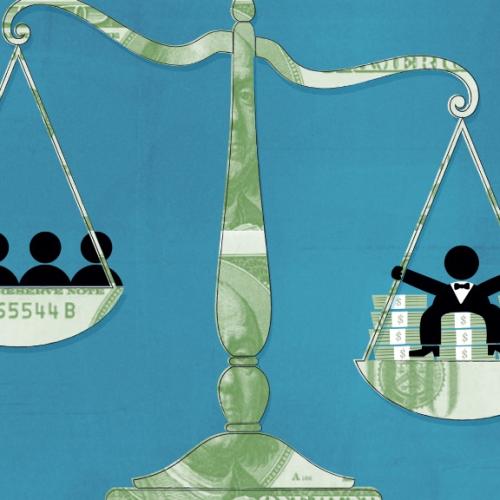
Half of all the money contributed so far to Democratic and Republican presidential candidates - $176 million - has come from just 158 families, along with the companies they own or control. Who are these people? According to the report, most of these big contributors live in exclusive neighborhoods where they have private security guards instead of public police officers, private health facilities rather than public parks and pools. Most send their kids and grand kids to elite private schools rather than public schools. They fly in private jets and get driven in private limousines rather than rely on public transportation. They don't have to worry about whether Social Security or Medicare will be there for them in their retirement because they've put away huge fortunes. It's doubtful that most of these 158 are contributing to these campaigns out of the goodness of their hearts. They're largely making investments, just the way they make other investments. And the success of these investments depends on whether their candidates get elected, and will lower their taxes even further, expand tax loopholes, shred health and safety and environmental regulations so their companies can make even more money, and cut Social Security and Medicare and programs for the poor - and thereby allow these 158 and others like them to secede even more from the rest of our society. These people are, after all, are living in their own separate society. They want to elect people who will represent them, not the rest of us.
Note: As the Democrats and Republicans duke it out, the ultra-rich laugh all the way to the bank. What if instead of fighting each other, we worked together to expose the manipulations of the ultra-rich? This essay was written by former US Secretary of Labor Robert Reich. For more along these lines, see concise summaries of deeply revealing income inequality news articles from reliable major media sources.
Researchers from the Argonne National Laboratory in Illinois have developed a hack that, for about $26 and an 8th-grade science education, can remotely manipulate the electronic voting machines used by millions of voters all across the U.S. The researchers ... performed their proof-of-concept hack on a Diebold Accuvote TS electronic voting machine, a type of touchscreen Direct Recording Electronic (DRE) voting system that is widely used for government elections. Diebold's voting-machine business is now owned by the Denver-based Dominion Voting Systems, whose e-voting machines are used in about 22 states. Roger Johnston and Jon Warner from Argonne National Laboratory's Vulnerability Assessment Team demonstrate three different ways an attacker could tamper with, and remotely take full control, of the e-voting machine simply by attaching what they call a piece of "alien electronics" into the machine's circuit board. The electronic hacking tool consists of a $1.29 microprocessor and a circuit board that costs about $8. Together with the $15 remote control, which enabled the researchers to modify votes from up to a half-mile away, the whole hack runs about $26.
Note: Why isn't this making news headlines? For more on this critical development, click here. For many other news articles on serious problems with elections, click here.
As the 2018 elections approach, the American intelligence community is issuing increasingly dire warnings about potential interference from Russia and other countries. D.H.S. has now conducted remote-scanning and on-site assessments of state and county election systems. These [measures] don't address core vulnerabilities in voting machines or the systems used to program them. And they ignore the fact that many voting machines that elections officials insist are disconnected from the internet – and therefore beyond the reach of hackers – are in fact accessible by way of the modems they use to transmit vote totals on election night. Add to this the fact that states don't conduct robust postelection audits ... and there's a good chance we simply won't know if someone has altered the digital votes in the next election. How did our election system get so vulnerable, and why haven't officials tried harder to fix it? The answer, ultimately, comes down to politics and money: The voting machines are made by well-connected private companies that wield immense control over their proprietary software, often fighting vigorously in court to prevent anyone from examining it when things go awry. The stakes are high. But the focus on Russia, or any would-be election manipulators, ignores the underlying issue – the myriad vulnerabilities that riddle the system and the ill-considered decisions that got us here.
Note: Why is it that the U.S. government is not allowed to have oversight over the companies that build and maintain voting machines and databases? What if one or more of them is bought off by a foreign or event domestic interest? Isn't this crazy? The major media have severely neglected reporting on elections manipulations that have been going on for many decades. For undeniable evidence of this, see our Elections Information Center.
The CIA has accused Russia of interfering in the 2016 presidential election. But critics might point out the U.S. has done similar things. The U.S. has a long history of attempting to influence presidential elections in other countries it's done so as many as 81 times between 1946 and 2000, according to a database amassed by political scientist Dov Levin of Carnegie Mellon University. That number doesn't include military coups and regime change efforts following the election of candidates the U.S. didn't like, notably those in Iran, Guatemala and Chile. Levin defines intervention as "a costly act which is designed to determine the election results [in favor of] one of the two sides." These acts, carried out in secret two-thirds of the time, include funding the election campaigns of specific parties, disseminating misinformation or propaganda, training locals of only one side in various campaigning or get-out-the-vote techniques, helping one side design their campaign materials, making public pronouncements or threats in favor of or against a candidate, and providing or withdrawing foreign aid. The U.S. hasn't been the only one trying to interfere in other countries' elections. Russia attempted to sway 36 foreign elections from the end of World War II to the turn of the century meaning that, in total, at least one of the two great powers of the 20th century intervened in about 1 of every 9 competitive, national-level executive elections in that time period.
Note: For more along these lines, see concise summaries of deeply revealing elections corruption news articles from reliable major media sources.
It's a perfect storm. I'm talking about the dangers facing our democracy. First, income in America is now more concentrated in fewer hands than it has been in 80 years. Almost a quarter of total income generated in the United States is going to the top 1 percent of Americans. The top one-tenth of 1 percent of Americans now earn as much as the bottom 120 million of us. Who are these people? They're top executives of big corporations and Wall Street, hedge-fund managers and private equity managers. Hundreds of millions of dollars are pouring into advertisements for and against candidates - without a trace of where the dollars are coming from. They're laundered through a handful of groups. Most Americans are in trouble. Their jobs, incomes, savings and even homes are on the line. They need a government that's working for them, not for the privileged and the powerful. Yet their state and local taxes are rising. And their services are being cut. There's no jobs bill to speak of. Washington says nothing can be done. There's no money left. No money? The marginal income tax rate on the very rich is the lowest it has been in more than 80 years. Under President Dwight Eisenhower ... it was 91 percent. Now it's 36 percent. We're losing our democracy to a different system. It's called plutocracy.
Note: As the Democrats and Republicans duke it out, the ultra-rich laugh all the way to the bank. What if instead of fighting each other, we worked together to expose the manipulations of the ultra-rich? Whether you are on the left or right of the political spectrum, this incisive article by former US Sect. of Labor Robert Reich is well worth reading in its entirety. For more in income inequality, click here.
Charlie Matulka, who lost to Senator Chuck Hagel of Nebraska [in 2002], does not trust the results in his election. Most of the votes were cast on paper ballots that were scanned into computerized vote-counting machines, which happen to have been manufactured by a company Mr. Hagel used to run. Mr. Matulka, suspicious of Senator Hagel's ties to the voting machine company, demanded a hand recount of the paper ballots. Nebraska law did not allow it, he was informed. In his primary race in 1996, Mr. Hagel, who had lived in Virginia for 20 years, beat the state attorney general by nearly two to one. In the general election, he defeated the governor, who had been elected two years earlier in a landslide. In 2002, against Mr. Matulka, he won more than 80 percent of the vote. What gets conspiracy theorists excited is not just Mr. Hagel's prodigious wins, but his job before jumping into the 1996 race: heading American Information Systems, the manufacturer of the machines that count 85 percent of Nebraska's votes. Rob Behler ... who helped prepare Georgia's machines for the 2002 election, says secret computer codes were installed late in the process. Votes ''could have been manipulated,'' he says, and the election thrown. Among the growing ranks of electronic-voting skeptics ... Mr. Hagel's wins in 1996 and 2002 have taken on mythic status. The problem is, there is no way to prove the right man was elected. A healthy democracy must avoid even the appearance of corruption. [The] Nebraska elections fail this test.
Note: For more clear evidence Hagel was directly involved in voting machine manipulation which lead to an illegal victory for him, click here and here.
For the third straight year, elite hackers from around the world who spent a long weekend hacking into voting equipment have released a report detailing vulnerabilities in machines still in use across the country. Each of the more than 100 machines the researchers looked at were vulnerable to at least some kind of attack, said Georgetown professor Matt Blaze, one of the Def Con Voting Village's organizers. As in previous years, the Voting Village collected versions of voting equipment used around the country, much of it ordered from eBay, and invited all of the more than 35,000 attendees of the Def Con hacker conference, which took place in Las Vegas in August, to see what kind of holes they could find. Some of machines were found to be vulnerable to remote attack and one electronic pollbook had a hidden ethernet cable to connect it to the internet. The issue is less that skilled hackers can break into election equipment, Blaze told CNN, and more that elections systems as a whole need to both minimize risk and double-check election results with paper ballots ... and risk-limiting audits. Following accusations that he'd been blocking election security legislation, Senate Majority Leader Mitch McConnell last week backed an amendment to give states an additional $250 million to distribute for election security. But experts have questioned whether that's enough money to get the US to an acceptable level of election security.
Note: For more along these lines, see concise summaries of deeply revealing news articles on elections corruption from reliable major media sources. Then explore the excellent, reliable resources provided in our Elections Information Center.
As Sen. Ron Wyden (D-Ore.) toured the Voting Village on Friday at Def Con, the worlds hacker conference extraordinaire, a roomful of hackers applied their skills to voting equipment. By laying siege to electronic poll books and ballot printers, the friendly hackers aimed to expose weaknesses that could be exploited by less friendly hands looking to interfere in elections. Almost all of the machines in the room were still used in elections across the United States, despite having well-known vulnerabilities that have been more or less ignored by the companies that sell them. In the three years since its inception, Def Cons Voting Village ... has become a destination not only for hackers but also for lawmakers and members of the intelligence community trying to understand the flaws in the election system that allowed Russian hackers to intervene in the 2016 election and that could be exploited again in 2020. Congregants spoke often of the need for thorough auditing of election results, increased funding and improved transparency from vendors. The call for paper ballots was a common refrain. At the time of the 2018 midterm elections, Delaware, Georgia, Louisiana, New Jersey and South Carolina had no auditable paper trails. Election officials across the country as we speak are buying election systems that will be out of date the moment they open the box, Wyden said. Its the election security equivalent of putting our military out there to go up against superpowers with a peashooter.
Note: For more along these lines, see concise summaries of deeply revealing news articles on elections corruption from reliable major media sources. Then explore the excellent, reliable resources provided in our Elections Information Center.
Hackers were able to successfully breach the software of U.S. voting machines in less than two hours at a competition in Las Vegas. The event exposed glaring deficiencies in the security of U.S. voting infrastructure. According to the Register, the hackers at the DEF CON conference Friday were given voting machines, and competed to access them by physically breaking them open and hacking them remotely. Some devices had remote ports, which could be used to insert devices with malicious software, others insecure WiFi connections, or outdated software such as Windows XP, rendering them exposed to hacking attacks. The machines, manufactured by companies including Diebold, Sequoia and Winvote equipment, were purchased over eBay or at government auctions. In June, the Intercept published leaked NSA documents showing that Russian agents hacked a U.S. voting systems manufacturer in the weeks leading to last year’s presidential election. NSA contractor Reality Leigh Winner, 25, was subsequently charged with removing classified material from a government facility and mailing it to a news outlet. “Without question, our voting systems are weak and susceptible. Thanks to the contributions of the hacker community today, we've uncovered even more about exactly how,” said Jake Braun, the Chief Executive Officer of Cambridge Global Advisors and Managing Director of Cambridge Global Capital, who designed the hacking competition.
Note: Many who follow elections closely have known and spread the word for years about serious vulnerabilities in US electronic voting. Read an enlightening analysis of elections hacking in the US which raises many serious questions. And don't miss the critically important information provided in our Elections Information Center.
An 11-year-old has been able to hack into a replica of Floridas election system in 10 minutes during a test ahead of upcoming US midterm elections this November. The boy was the fastest of 35 children who were able to hack into replicas of the websites of six swing states during the three-day Def Con security convention. The results of those efforts to test the strength of US election infrastructure will be passed onto the states, and the National Association of Secretaries of State - the officials responsible for tallying and confirming vote totals - said that they welcome the efforts. The results highlight potential security lapses amid heightened concern that American voter rolls will be tampered with in the upcoming midterm elections, and after President Donald Trumps national security team warned that Russia had launched pervasive efforts to interfere in Americas 2018 elections. The convention indicated that the hackers were able to change party names in the systems, and added as many as 12 billion votes to candidates. Candidates names were changed to Bob Da Builder and Richard Nixons head, the convention said in a tweet. The winning hacker was identified as Emmett Brewer, a boy whose Twitter account says he lives in Austin, Texas.
Note: For more along these lines, see concise summaries of deeply revealing elections corruption news articles from reliable major media sources. Then explore the excellent, reliable resources provided in our Elections Information Center.
Ex-CIA Director James Woolsey said it himself. Yes, the U.S. meddles in other countries elections. But when we do it, its for the right reasons. Only for a very good cause, he says, because our government is ensuring foreign elections result in democracy. But doesnt democracy demand that people decide for themselves? And how well has U.S. meddling actually worked out? According to Carnegie Mellon University researcher Dov Levin, the United States has attempted to sway elections in other countries more than 80 times worldwide between 1946 and 2000. But those 80+ instances of the U.S. interfering with other nations elections does not include regime change efforts. In the 1970s in Chile, the CIA conducted a botched kidnapping of General Ren Schneider, the Chilean Armys commander-in-chief, that resulted in Schneiders death. The plot was an effort to undermine the presidency of Salvador Allende, which may have fueled the violent coup that led to Allendes overthrow. In 1974, Henry Kissinger was quoted in Newsweek, saying about Chile: I dont see why we have to let a country go communist due to the irresponsibility of its own people. Levins tally also does not include covert coup detats where our government overthrows a foreign leader like the the U.S. did in Iran in 1953 or in Guatemala in 1954. In fact, Salon magazine documents 35 nations in which the United States has overthrown legitimate governments and or supported fascists, drug lords or terrorists. U.S. intervention is rarely about democracy.
Note: Truth in Media is one of the few media outlets speaking truth from a balanced place with reliable facts can be verified. Don't miss the excellent video at the webpage above. For more along these lines, see concise summaries of deeply revealing elections corruption news articles from reliable major media sources.
I Googled mainstream media is And there it was. Googles autocomplete suggestions: mainstream media is dead, dying, fake news, fake, finished. Googles first suggested link ... leads to a website called CNSnews.com and an article: The Mainstream media are dead. How had it, an obscure site Id never heard of, dominated Googles search algorithm on the topic? In the About us tab, I learn CNSnews is owned by the Media Research Center. It receives a large bulk of its funding more than $10m in the past decade from a single source, the hedge fund billionaire Robert Mercer. Robert Mercer is the money behind an awful lot of things. He was Trumps single biggest donor. Since 2010, Mercer has donated $45m to different political campaigns all Republican and another $50m to non-profits all rightwing, ultra-conservative. This is a billionaire who is ... trying to reshape the world according to his personal beliefs. He is reported to have a $10m stake in the [Cambridge Analytica], which was spun out of a bigger British company called SCL Group. It specialises in election management strategies and messaging and information operations, refined over 25 years. In military circles this is known as psyops psychological operations. Cambridge Analytica makes the astonishing boast that it has psychological profiles based on 5,000 separate pieces of data on 220 million American voters. With this, a computer ... can predict and potentially control human behaviour. Its incredibly dangerous.
Note: The above article provides a detailed look at how mass media is being combined with Big Data to produce powerful new forms of mind control.
Carnegie Mellon University researcher Dov Levin [has compiled a] historical database that tracks U.S. involvement in meddling with foreign elections over the years. The U.S. has ... tried to influence the outcome of another country's election ... more than 80 times worldwide between 1946 and 2000. One example of that was our intervention in Serbia, Yugoslavia in the 2000 election there. Slobodan Milosevic was running for re-election, and we didn't want him to stay in power there. So we intervened in various ways for the opposition candidate, Vojislav Kostunica. And we gave funding to the opposition, and we gave them training and campaigning aide. That assistance was crucial in enabling the opposition to win. About one-third of [election interventions] are public, and two-third of them are covert. In other words, they're not known to the voters in the target before the election. Covert coup d'etats like the United States did in Iran in 1953 or in Guatemala in 1954 [were not counted, only times] when the United States [tried] directly to influence an election for one of the sides. The United States is the most common user of this technique. Russia or the Soviet Union since 1945 has used it half as much. My estimate has been 36 cases between 1946 to 2000. We know also that the Chinese have used this technique and the Venezuelans when the late Hugo Chavez was still in power in Venezuela and other countries.
Note: For more along these lines, see concise summaries of deeply revealing elections corruption news articles from reliable major media sources.
Could an American elections outcome be altered by a malicious actor on a computer keyboard? I have had three jobs that, together, taught me at least one thing: If its a computer, it can be hacked. I served as the White House senior cybersecurity policy adviser. I served on [President Obama's] five-person postEdward Snowden investigative group on the National Security Agency, intelligence and technology. And for over a decade I have advised American corporations on cybersecurity. Those experiences confirm my belief that if sophisticated hackers want to get into any computer or electronic device, even one that is not connected to the internet, they can do so. Now consider that a majority of states use some kind of combination of electronic voting and a type of paper trail, but there is no standard nationwide. In most states the data that are used to determine who won an election are processed by networked, computerized devices. There are almost no locations that exclusively use paper ballots. Some states ... employ electronic voting machines that produce no paper trail, therefore there is nothing to count or recount and no way to ensure that what a voter intended is what was recorded and transmitted. If someone makes the charge after this election that the results were altered by hackers, our country has almost no way of credibly refuting that claim. Thus American voters will have no way to know if they can trust the results of the election.
Note: For more along these lines, see concise summaries of deeply revealing elections corruption news articles from reliable major media sources. Then explore the excellent, reliable resources provided in our Elections Information Center.
Princeton professor Andrew Appel decided to hack into a voting machine. He bought one online. Appel parted with $82 and became the owner of ...the Sequoia AVC Advantage, one of the oldest and vulnerable, electronic voting machines in the United States. He summoned a graduate student named Alex Halderman, who could pick the machines lock in seven seconds. Clutching a screwdriver, [Appel then] deftly wedged out the four ROM chips - they werent soldered into the circuit board, as sense might dictate - making it simple to replace them with one of his own: A version of modified firmware that could throw off the machines results, subtly altering the tally of votes, never to betray a hint to the voter. The attack was concluded in minutes. Elections could be vulnerable at myriad strike points, among them the software that aggregates the precinct vote totals, and the voter registration rolls that are increasingly digitized. But the threat, the cyber experts say, starts with the machines that tally the votes and crucially keep a record of them - or, in some cases, don't. Its not just the voting machines themselves - its the desktop and laptop computers that election officials use. And the computers that aggregate the results together from all of the optical scans. If any of those get hacked, it could could significantly disrupt the election. Hackers this year have [already] targeted voter registration rolls in Illinois and possibly Arizona, another attack highlighted by the Princeton alums.
Note: For the text of the video at the above link and more, see this webpage. For more along these lines, see concise summaries of deeply revealing elections corruption news articles from reliable major media sources. Then explore the excellent, reliable resources provided in our Elections Information Center.
Russia was behind the hacks into the Democratic National Committees computer network that led to the release of thousands of internal emails just before the partys convention began, U.S. intelligence agencies have reportedly concluded. The FBI is investigating. WikiLeaks promises there is more data to come. The political nature of this cyberattack means that Democrats and Republicans are trying to spin this as much as possible. Even so, we have to accept that someone is attacking our nations computer systems in an apparent attempt to influence a presidential election. This kind of cyberattack targets the very core of our democratic process. And it points to the possibility of an even worse problem in November. Over the years, more and more states have moved to electronic voting machines and have flirted with Internet voting. These systems are insecure and vulnerable to attack. But while computer security experts ... have sounded the alarm for many years, states have largely ignored the threat, and the machine manufacturers have thrown up enough obfuscating babble that election officials are largely mollified. Government interference with foreign elections isnt new, and in fact, thats something the United States itself has repeatedly done in recent history. But what is new is a foreign government interfering with a U.S. national election on a large scale. Our democracy cannot tolerate it, and we as citizens cannot accept it.
Note: For more along these lines, see concise summaries of deeply revealing elections corruption news articles from reliable major media sources. Then explore the excellent, reliable resources provided in our Elections Information Center.
At around 11:25 pm EST on election night, Karl Rove knew something had gone terribly wrong. Minutes earlier, Fox News called the key battleground state of Ohio for President Obama, sealing his re-election. But as the network took live shots of jubilant Obama supporters camped outside the Obama re-election headquarters in Chicago celebrating their victory, Karl Rove began building a case against the call his employer network had just made. Rove explained that when Fox called Ohio, only 74% of the vote was in, showing President Obama with a lead of roughly 30,000 votes. But, as Rove contended, with 77% reporting according to the Ohio Secretary of State office, the President’s lead had been slashed to just 991 votes. “We gotta be careful about calling the thing,” Rove said. Rove was supremely confident that the numbers coming in from Ohio throughout the night that favored President Obama weren’t indicative of who would win Ohio when all the votes were ultimately tabulated by the state's computers. With a quarter of the vote still out there, Rove was anticipating a shift to the Right just after 11 pm, which, coincidentally, is exactly what happened in 2004. So the question is: on election night this year, when Karl Rove was protesting the call his network had just made in Ohio, was Rove anticipating a wave of unpredicted vote totals to swing the election back to Mitt Romney after a statewide server crash, just as had happened in 2004? Just two days after Election Day ... Anonymous released a press statement claiming it did indeed prevent an attempt by Rove to steal the election for Mitt Romney.
Note: We don't normally use Truthout as a source, but as no major media sources covered this most important news, we've included it here. We have independent, reliable sources confirming that it is very likely that Rove tried to swing this election, as he did in 2004, but was stymied by an anonymous group. For another inspiring article describing how Karl Rove may have been stopped from manipulating the US elections, click here. And for a well researched articled suggesting that it was not Anonymous who stopped Karl Rove, but another group called "the protectors," click here.
Five Clay County [Kentucky] officials, including the circuit court judge, the county clerk, and election officers were arrested Thursday after they were indicted on federal charges accusing them of using corrupt tactics to obtain political power and personal gain. The 10-count indictment, unsealed Thursday, accused the defendants of a conspiracy from March 2002 until November 2006 that violated the Racketeering Influenced and Corrupt Organizations Act (RICO). The defendants were also indicted for extortion, mail fraud, obstruction of justice, conspiracy to injure voters' rights and conspiracy to commit voter fraud. According to the indictment, these alleged criminal actions affected the outcome of federal, local, and state primary and general elections in 2002, 2004, and 2006. Clay County Circuit Court Judge Russell Cletus Maricle, 65, and school superintendent Douglas C. Adams, 57, allegedly used their status in the county to influence the appointment of corrupt members to the Clay County Board of Election Officials. [They also] caused election officers to commit acts of extortion, mail fraud, and bribery. Clay County Clerk, Freddy Thompson, 45, allegedly provided money to election officers to be distributed by the officers to buy votes. He also instructed officers how to change votes at the voting machine. Paul E. Bishop, 60, ... hosted alleged meetings at his home where money was pooled together by candidates and distributed to election officers, including himself. He was also accused of instructing the officers how to change votes at the voting machine. The investigation preceding the indictment was conducted by the FBI, Kentucky State Police, and Appalachia
Note: For some strange reason, the article is no longer available at the link above. To read it on an MSNBC affiliate website, click here. The media have almost always proclaimed that voting machine tampering has never been proven to affect election outcome. This article demonstrates that not only does it happen, but it may be much more prevalent than most would think. For more on this indictment, click here. For more reliable information on widespread election fraud, click here.
Important Note: Explore our full index to revealing excerpts of key major media news articles on several dozen engaging topics. And don't miss amazing excerpts from 20 of the most revealing news articles ever published.



