















































Inspirational News Articles
Below are key excerpts of some of the most inspiring news articles from reliable news media sources. If any link fails to function, a paywall blocks full access, or the article is no longer available, try these digital tools.
For further exploration, delve into our Inspiration Center.

August 9, 2014, was one of the most memorable days of my life. On that day I entered a maximum-security prison in Lancaster, Calif. to witness an extraordinary event connecting the lives of some of its inmates with a pack of rescued shelter dogs. Five lucky dogs ... were pulled from a high-kill shelter in Los Angeles and entered this Level 4 prison for a chance at a better life. Earlier this year, Karma Rescue, a nonprofit that saves at-risk dogs from high-kill shelters across Southern California, partnered with the California State Prison Los Angeles County in Lancaster to create "Paws for Life," a program that matches rescued dogs with inmates who train them to boost their odds of adoption. Fourteen inmates were ... selected to train five shelter dogs who stayed at the prison this summer for a 12-week program. From the very beginning, the program struck a chord with everyone involved. Karma Rescue's founder Rande Levine wrote, "Men who had not seen an animal in decades were openly emotional at the sight of the beautiful creatures before them. Just petting our dogs brought many to happy tears. It was a day I will never, ever forget." Several times a week, professional dog trainer Mark Tipton and several dedicated Karma Rescue volunteers drove out to the prison to instruct the inmates on how to train their assigned dogs for 'Canine Good Citizen' certification, a designation that increases the chance that a dog will be successfully adopted.
Note: Don't miss the moving pictures of this inspiring program at the link above. Explore a treasure trove of concise summaries of incredibly inspiring news articles which will inspire you to make a difference.
My research team and I were following a school of bottlenose dolphins near shore ... off Los Angeles, California. The dolphins were still feeding in circle near shore, when suddenly, one individual changed direction heading out toward deeper water. A minute later, the rest of the school turned to follow. Seeing them abruptly leave a foraging ground and change direction came as a surprise to the research team. I decided to follow them. The dolphins increased their speed. Somewhere near three miles offshore the dolphin group stopped, forming a sort of ring around a dark object in the water. “Someone’s in the water!” yelled my assistant, standing up and pointing at the seemingly lifeless body of a girl. As the boat neared, she feebly turned her head toward us, half-raising her hand as a weak sign for help. If we didn’t act immediately, the girl would die. We [pulled] the frail and hypothermic body on board. “She is cyanotic,” said one of my researchers, also a lifeguard, after a cursory examination. “She has severe hypothermia. We need to get her warm!” We managed to get some of her wet garments off and wrap her in a blanket. We took turns keeping her warm by huddling with her under the blanket. A couple of hours later, we were all waiting outside the emergency room at the Marina del Rey hospital. The ER doctor came out to talk with us. The girl, it seems, would pull through, and he thanked us for our quick action. He tells us the girl was vacationing in L.A. from Germany and, as the letter found in her plastic bag explained, she was attempting suicide. If we hadn’t found her, if the dolphins hadn’t led us offshore when they did, to that specific place, she would have died.
Note: This article has been adapted from the book Dolphin Confidential: Confessions of a Field Biologist. For more on the amazing capacities of dolphins and other marine mammals, as well as the threats they face from human activities, click here. For a treasure trove of great news articles which will inspire you to make a difference, click here.
This is your moment of zen today. Two adventurers set out in a canoe and happened upon a [flock of] starlings (collectively known as a murmuration) doing their amazing collective dance in the sky. Watch the video. Just take it in. The starlings' coordinated movements do not seem possible, but then, there they are, doing it. Scientists have been similarly fascinated by starling movement. Those synchronized dips and waves seem to hold secrets about perception and group dynamics. Last year, Italian theoretical physicist Giorgio Parisi took on the challenge of explaining the [phenomenon]. What he found ... is that the math equations that best describe starling movement are borrowed "from the literature of 'criticality,' of crystal formation and avalanches -- systems poised on the brink, capable of near-instantaneous transformation." They call it "scale-free correlation," and it means that no matter how big the flock, "If any one bird turned and changed speed, so would all the others." It's a beautiful phenomenon to behold. And neither biologists nor anyone else can yet explain how starlings seem to process information and act on it so quickly. It's precisely the lack of lag between the birds' movements that make the flocks so astonishing.
Note: Don't miss the hauntingly beautiful video at the link above. For more, click here. For a treasure trove of great news articles which will inspire you to make a difference, click here.
Art graduate Victoria Khunapramot, 26, has brought [remarkable] paintings from Thailand, [including] "self-portraits" by Paya, who is said to be the only elephant to have mastered his own likeness. Paya is one of six elephants whose keepers have taught them how to hold a paintbrush in their trunks. They drop the brush when they want a new colour. Mrs Khunapramot, from Newington, said: "Many people cannot believe that an elephant is capable of producing any kind of artwork, never mind a self-portrait. But they are very intelligent animals and create the entire paintings with great gusto and concentration within just five or 10 minutes - the only thing they cannot do on their own is pick up a paintbrush, so it gets handed to them. They are trained by artists who fine-tune their skills, and they paint in front of an audience in their conservation village, leaving no one in any doubt that they are authentic elephant creations." Mrs Khunapramot, who set up the Thai Fine Art company after studying the history of art in St Andrews and business management at Edinburgh's Napier University, said it took about a month to train the animals to paint.
Note: For an amazing video clip of one of these elephants at work, click here. For more on this fascinating topic, click here and here.
Although it happened more than 60 years ago, Antonio Salazar-Hobson remembers every detail of his kidnapping. After being snatched from his back yard, he is taken into a nightmarish landscape of sex trafficking, violence and exploitation. Rather than being broken by what he experienced, he instead rose from the ashes of his stolen childhood to accomplish extraordinary academic feats and become one of the US’s most successful labour rights attorneys, representing vulnerable and powerless communities, and dedicating his life to justice and compassion. “I chose not to be obliterated by the abuse and trauma I was forced to endure,” he says. “Instead of being swallowed by the darkness, I survived by walking towards the light.” He has taken on multibillion-dollar corporations, represented First Nation people and LGBTQ+ farm worker communities, and won every case. “I’m used to people underestimating me, this poor Chicano boy going up against rooms full of corporate lawyers in suits, but I always prevail,” he says. He now plans to dedicate the rest of his life to the anti-trafficking movement. “It is my hope that somehow my story can be of service to the community of survivors of sexual assault and trafficking; what happened to me can show other kids that they don’t have to be ashamed, that they can rise up to become whoever they want to be. I want to show them that I refused to be broken and, in the end, I ... made it home.”
Note: Explore more positive stories about ending human trafficking.
From a Tampa performing arts conservatory comes the story of a blind jazz saxophonist who uses his disability as a teaching tool. He encourages his students to act on instinct; to feel the music through their instruments, and not let the waking world deceive them. “Welcome to every day of my life,” says Matthew Weihmuller in his jazz improvisation class after turning the lights off. “Then we have a big laugh,” he adds. When Weihmuller started playing, he needed braille sheet music, and pieces would take months; even years to learn. As if that weren’t difficult enough, few people in the country were capable of providing braille music, so he started “brailling” his own, with the help of his mom. “They can’t look at their instrument. Now, they have to feel their instrument with their fingers and hands, right?” Weihmuller told Fox 13. “Now, we’ve got to listen to the music. We can’t read it. It forces the students to use their other senses.” During improvisational sessions, a musician has to be ready for sudden changes in time signature or key. This is nearly impossible to express through sheet music. At least in this regard, the children are learning in the best way for this unorthodox, yet traditional form of jazz music. As an educator with blindness, Weihmuller stresses turning any disadvantage into an advantage, a teaching philosophy that has led some students to tell the man that he has changed the way they look at life.
Note: Read more inspiring news articles on the power of art. For more, explore our uplifting Inspiration Center, which focuses on solutions and the best of humanity and life.
On the outskirts of Austin, Texas, what began as a fringe experiment has quickly become central to the city’s efforts to reduce homelessness. To Justin Tyler Jr., it is home. Mr. Tyler, 41, lives in Community First! Village, which aims to be a model of permanent affordable housing for people who are chronically homeless. In the fall of 2022, he joined nearly 400 residents of the village, moving into one of its typical digs: a 200-square-foot, one-room tiny house furnished with a kitchenette, a bed and a recliner. Eclectic tiny homes are clustered around shared outdoor kitchens, and neat rows of recreational vehicles and manufactured homes line looping cul-de-sacs. There are chicken coops, two vegetable gardens, a convenience store ... art and jewelry studios, a medical clinic and a chapel. In the next few years, Community First is poised to grow to nearly 2,000 homes across three locations, which would make it by far the nation’s largest project of this kind, big enough to permanently house about half of Austin’s chronically homeless population. Many residents have jobs in the village, created to offer residents flexible opportunities to earn some income. Last year, they earned a combined $1.5 million working as gardeners, landscapers, custodians, artists, jewelry makers and more. Ute Dittemer, 66, faced a daily struggle for survival during a decade on the streets before moving into Community First five years ago with her husband. Now she supports herself by painting and molding figures out of clay at the village art house. A few years ago, a clay chess set she made sold for $10,000 at an auction. She used the money to buy her first car.
Note: Explore more positive stories like this in our comprehensive inspiring news articles archive focused on solutions and bridging divides.
Direct cash programs are growing across America, offering a path out of poverty through economic mobility. During a two-week period in 2022, nearly a quarter of a million people in the Chicago area applied for the Cook County Promise Guaranteed Income Pilot, the nation's largest direct cash pilot, and ultimately 3,250 families were randomly selected to get $500 a month for two years. Similar direct cash initiatives have changed the physical, emotional, and economic lives of families that participate. Children are better cared for, and they excel in school. Adults experience improved health and stronger familial relationships. And crucially, when recipients have economic stability, they can plan and invest in their futures—many, for the first time in their lives. The Stockton SEED project, which gave $500 a month for two years to 130 people, saw results that mirrored prior direct cash research. The study ... found that the expansion of finances and the predictable, stable source of income brought by the program created "self-determination and capacity for risk-taking not present prior," meaning that when participants could predictably afford child care, transportation, and training programs they had the financial freedom to invest in their own futures. People have big ambitions, no matter the size of their bank account. For most Americans facing economic struggles, their chief problem is a lack of cash, and not a lack of character.
Note: Explore more positive stories like this in our comprehensive inspiring news articles archive focused on solutions and bridging divides.
It all started in 2019, when Bjartmar Leósson started to see a rise in bike theft in Reykjavík. The bus driver and self-confessed “bike nerd” decided to start tracking them down and returning them to their rightful owners. Four years and, he estimates, hundreds of salvaged bikes later, the 44-year-old has developed a reputation in the Icelandic capital among cyclists and potential bike thieves. Known as the Reykjavík “bike whisperer”, people across his home city turn to him for help to find their missing bicycles, tools and even cars. Often, he says, bike thieves hand over bikes without being asked and some former bike thieves have started to help him. Now when somebody loses their bike it can take as little as 48 hours to track it down on his Facebook page, Hjóladót ofl. tapað fundið eða stolið (Bicycle stuff etc lost, found or stolen), updated every few hours with missing and found items and which has more than 14,500 members. “It’s not only me,” he says. “Many times someone sees a bike hidden in a bush, takes a picture and then someone else comments ‘hey that’s my bike’. So everyone’s looking out.” Now when people’s bikes get stolen, he says, the police direct them to his Facebook page. When there is a finder’s fee he gives it to people living in [a homeless] shelter. He he says he now sees the bike theft problem is often driven by addiction, aided by long rehab waiting lists and closures during the summer.
Note: Explore more positive stories like this in our comprehensive inspiring news articles archive focused on solutions and bridging divides.
In most of Europe, fitting a heat pump is one of the most powerful actions a person can take to reduce their carbon footprint. But in Norway, where clean-yet-inefficient electrical resistance heaters have long been common, upgrading to a heat pump is often a purely financial decision. Two-thirds of households in this Nordic country of 5 million people have a heat pump, more than anywhere else in the world. For many years, Norwegians and their neighbours heated their homes with fossil fuels. But during the 1973 oil crisis, when prices shot up, the country’s political leaders made a conscious choice to promote alternatives. “Norway ensured early on that fossil-fuel heating was the most expensive option, making heat pumps cost competitive,” said Dr Jan Rosenow from the Regulatory Assistance Project, a thinktank that works to decarbonise buildings. “They did this by taxing carbon emissions from fossil heating fuels. That’s been the key to incentivise heat pump adoption.” Norway also trained up a workforce to install them. Heat pumps’ efficiency has been increased over decades, partly because of the early adopters in Nordic countries who tinkered away to the point where a modern version can deliver three to five units of heat for every unit of electricity used to power it. An efficient gas boiler, on the other hand, can only produce as much heat as the energy contained in the fuel being burned. A heat pump will have a smaller carbon footprint than a gas boiler even when plugged into an electricity grid.
Note: Explore more positive stories like this in our comprehensive inspiring news articles archive focused on solutions and bridging divides.
The influential idea that in the past men were hunters and women were not isn’t supported by the available evidence. Women are physiologically better suited than men to endurance efforts such as running marathons. This advantage bears on questions about hunting because a prominent hypothesis contends that early humans are thought to have pursued prey on foot over long distances until the animals were exhausted. Furthermore, the fossil and archaeological records, as well as ethnographic studies of modern-day hunter-gatherers, indicate that women have a long history of hunting game. Females are ... dominating ultraendurance events such as the more than 260-mile Montane Spine foot race through England and Scotland, the 21-mile swim across the English Channel and the 4,300-mile Trans Am cycling race. In 2018 English runner Sophie Power ran the 105-mile Ultra-Trail du Mont-Blanc race in the Alps while still breastfeeding her three-month-old at rest stations. Observations of recent and contemporary foraging societies provide direct evidence of women participating in hunting. The most cited examples come from the Agta people of the Philippines. Agta women hunt while menstruating, pregnant and breastfeeding, and they have the same hunting success as Agta men. They are hardly alone. A recent study of ethnographic data spanning the past 100 years ... found that women from a wide range of cultures hunt animals for food.
Note: Explore more positive stories like this in our comprehensive inspiring news articles archive focused on solutions and bridging divides.
California has become the first U.S. state to outlaw the use of four potentially harmful food and drink additives that have been linked to an array of diseases, including cancer, and are already banned in dozens of countries. The California Food Safety Act prohibits the manufacturing, distribution and sale of food and beverages that contain brominated vegetable oil, potassium bromate, propylparaben and red dye 3 — which can be found in candy, fruit juices, cookies and more. The Food and Drug Administration banned the use of red dye 3 in cosmetics in 1990 after evidence showed it caused cancer in lab animals. But the government hasn't prohibited its use in food, and it's an ingredient in candies. Brominated vegetable oil and potassium bromate have also been associated with harmful effects on the respiratory and nervous systems, while propylparaben may negatively impact reproductive health. The proposal has been the target of a false claim that California is attempting to ban Skittles. In fact, Assemblymember Jesse Gabriel, a Democrat who sponsored the bill, has said that Skittles are sold with alternative ingredients in the European Union, where the four additives are already banned. "It's unacceptable that the U.S. is so far behind the rest of the world when it comes to food safety," Gabriel said in a statement. In addition to the EU, countries that have banned the four additives in food include the United Kingdom, Canada, Australia, New Zealand, China and Japan.
Note: Explore more positive stories like this in our comprehensive inspiring news articles archive focused on solutions and bridging divides.
Ray, a man in his 50s, used to live in an emergency homeless shelter in Vancouver, Canada. Then he participated in a study that changed his life. The newly published, peer reviewed PNAS study, conducted by the charity Foundations for Social Change in partnership with the University of British Columbia, was fairly simple. It identified 50 people in the Vancouver area who had become homeless in the past two years. In spring 2018, it gave them each one lump sum of $7,500 (in Canadian dollars). And it told them to do whatever they wanted with the cash. Over the next year, the study followed up with the recipients periodically, asking how they were spending the money and what was happening in their lives. The recipients of the cash transfers did not increase spending on drugs, tobacco, and alcohol, but did increase spending on food, clothes, and rent. What’s more, they moved into stable housing faster and saved enough money to maintain financial security over the year of follow-up. “Counter to really harmful stereotypes, we saw that people made wise financial choices,” Claire Williams, the CEO of Foundations for Social Change, [said]. What’s more ... giving out the cash transfers in the Vancouver area actually saved the broader society money. Enabling 50 people to move into housing faster saved the shelter system $8,277 per person over the year, for a total savings of $413,850. That’s more than the value of the cash transfers, which means the transfers pay for themselves.
Note: Explore more positive stories like this in our comprehensive inspiring news articles archive focused on solutions and bridging divides.
Michael Tubbs had just been elected the youngest and first Black mayor of Stockton, California, when he announced his intention to launch what would be the country’s first universal basic income program in decades. The year was 2017, and the plan was to pay some residents $500 a month, no strings attached. In the years since his announcement ... the 125 participants of the Stockton program showed that they used that extra $500 a month not for luxuries or frivolities, but to pay off debt, obtain full-time jobs and get medical treatment like dental work that they had put off for years because they could not afford it. Now, more than 100 cities and jurisdictions around the country have launched their own guaranteed income programs. The basis of guaranteed income is simple: poverty, a problem at the crux of so many societal woes, can be solved with money and it is the government’s job to solve it. It’s a guaranteed monthly income without the requirements that come with a welfare program – requirements that often keep recipients in poverty when the program benefits outweigh any job or income advancement they could make. “We’re talking about like life-changing impacts for a very small amount of dollars, in the grand scheme of things,” Tubbs said. The Stockton program was originally funded by a grant from the Economic Security Project, but some programs today are drawing directly from their governmental budgets.
Note: A documentary about the Stockton program titled "It's Basic" was recently featured at the Tribeca Film Festival. Explore more positive stories like this in our comprehensive inspiring news articles archive focused on solutions and bridging divides.
In 1983, I was out playing at the Silver Dollar Lounge. I had just finished playing the first song when someone put an arm around my shoulder. It was a white guy. He said it was his first time sitting with a Black guy, and I asked why. The man looked at me and said, "I'm a member of the Ku Klux Klan." I thought he was joking. But he pulled out his wallet and handed me his KKK membership card. It only dawned on me a couple years later that I blew my chance to ask them the question that had been plaguing me since I was 10 years old: How can you hate me when you don't know me? Who better to ask that of than someone who went out of their way to join an organization that has, for over 100 years, practiced hating people who don't look like them? I spent the next several years traveling across the country, interviewing the man from that night, Klan leaders, and Klan members, and eventually writing a book about it. I did not convert anybody. Over 200 Klan members have converted themselves. The more we conversed, the more people would change. One time, someone said we should put Black people down. But I sat there calmly, and they'd be curious about why I didn't fight back. Now their ears are open. Now we can nourish those seeds, water them, and, in most cases, they bloom. Of course, some people go to their graves with hatred in their hearts. But what gives me hope, despite the current state of this country, is the fact that I've seen it work. I've seen people change.
Note: Daryl Davis has successfully persuaded more than 200 KKK members and other white supremacists to disavow their allegiances. Read more about the power of calling people in with love, rather than criticism and judgment. Explore more positive stories like this in our comprehensive inspiring news articles archive focused on solutions and bridging divides.
Why do we care about rhythm? It connects us to the world. It plays a role in listening, in language, in understanding speech in noisy places, in walking, and even in our feelings toward one another. Rhythm is much more than a component of music. We experience the rhythmic changes of the seasons. Some of us have menstrual cycles. We have circadian rhythms – daily cycles of mental and physical peaks and troughs. Tides, 17-year cicadas, lunar phases, perigees, and apogees are other naturally occurring rhythms. Human-made rhythms include the built world – street grids, traffic lights, crop fields, mowed designs in baseball diamond outfields, the backsplash behind the kitchen counter, spatial patterns in geometric visual artforms. Rhythms in the brain have been called out as a basis for consciousness itself. Even in very young children, being (literally) "in sync" with another person engenders positive feelings toward them. Music in general, and rhythm in particular, does an uncommonly good job fostering a sense of community. Indeed, music being played at negotiation sessions helps to smooth the conversations and leads to breakthroughs and compromises. Musicians Without Borders is used to form relationships in troubled regions around the world, to bring hope, comfort, and healing to diverse populations. The Resonance Project and the Jerusalem Youth Chorus, which are forming bonds between Israeli and Palestinian children, are other examples of using musical rhythm to overcome differences.
Note: Explore more positive stories like this in our comprehensive inspiring news articles archive focused on solutions and bridging divides.
Memorial Day used to be Israel’s most sacred secular holiday because it honored those who died in wars or terrorist attacks. I attended one memorial service in Tel Aviv that rose above these tensions and penetrated to the heart of the issues troubling the country: a meeting of Israeli and Palestinian families who had lost relatives to the conflict and gathered together to share their grief. What was most astonishing about the event was to see the Palestinians fall into the arms of their Israeli hosts and hold on tightly. Why astonishing? Because these days, Palestinians and Israelis almost never come into contact, except at Israeli military checkpoints on the West Bank, or when violent Israeli settlers attack their fields — or when Palestinian workers come to Israel to work in construction or in agriculture. It was moving in the extreme to see Palestinians and Israelis who had experienced heartbreak at the hands of the other side embrace each other tightly and talk about family. It was also moving to watch thousands of Israelis file into the fenced-off area of the ceremony and fill endless rows of plastic chairs (the organizers say that 300,000 watched online). They listened in total silence as Israeli Jews and Palestinian Muslims told their personal stories on the stage. Yuval Sapir, whose sister Tamar was murdered in Tel Aviv in 1994 by a Palestinian suicide bomber ... choked out these words: “It is easy and natural to hate ... I chose to try to break the chain of revenge and hatred.”
Note: Explore more positive stories like this in our comprehensive inspiring news articles archive focused on solutions and bridging divides.
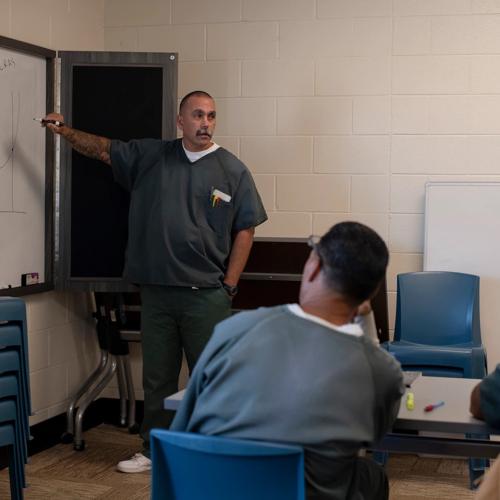
There are over 4,100 private companies in the U.S. profiting off of mass incarceration, which is a multi-billion-dollar business. With an incarcerated population of 2.2 million, the U.S. does not have a system premised on reform or creating model citizens. Most return to public life worse than when they began their prison sentences, only to be overshadowed by a national recidivism rate that’s staggering — as high as 70 percent within the first five years out and 80 percent for prisoners with juvenile records. In the restorative justice theory of change, prisoners self-identify with new, positive identities, replacing old negative self-identities. As a result, they develop healthy social support that reinforces these new identities. The concept: If you think you are scum, you will act like scum. However, if you think you are gifted, with talents, abilities and a positive identity, that’s how you will more likely act on a regular basis. Restorative justice views crime not simply as the breaking of a law, but as damage to individuals, property, relationships and the community. It represents a holistic approach to addressing criminal behavior. And it becomes a great tool toward healing the communities harmed. When we build relationships, we humanize each other and rather than simply being faceless people, we become friends, family members, students and mentors. It then becomes easier for participants to understand the harm they caused and to take responsibility. It’s a chance for the offenders to examine themselves, and understand why they made the choices they did, how they harmed the victim, family and community, and what they can do differently in the future.
Note: We've summarized many articles about the power of restorative justice. Explore more positive stories like this in our comprehensive inspiring news articles archive focused on solutions and bridging divides.
Natural disasters like earthquakes and hurricanes can level entire towns, and for the search and rescue teams trying to find survivors, it’s a painstaking task. But an unlikely savior is being trained up to help out: rats. The project, conceived of by Belgian non-profit APOPO, is kitting out rodents with tiny, high-tech backpacks to help first responders search for survivors among rubble in disaster zones. “Rats are typically quite curious and like to explore – and that is key for search and rescue,” says Donna Kean, a behavioral research scientist and leader of the project. In addition to their adventurous spirit, their small size and excellent sense of smell make rats perfect for locating things in tight spaces, says Kean. The rats are currently being trained to find survivors in a simulated disaster zone. They must first locate the target person in an empty room, pull a switch on their vest that triggers a beeper, and then return to base, where they are rewarded with a treat. While the rodents are still in the early stages of training, APOPO is collaborating with the Eindhoven University of Technology to develop a backpack, which is equipped with a video camera, two-way microphone, and location transmitter to help first responders communicate with survivors. APOPO has been training dogs and rats at its base in Tanzania in the scent detection of landmines and tuberculosis for over a decade. Its programs use African Giant Pouched Rats, which have a longer lifespan in captivity of around eight years.
Note: Don't miss the images of these adorable and heroic rats at the link above. Explore a treasure trove of concise summaries of incredibly inspiring news articles which will inspire you to make a difference.
For the past couple of years, I’ve been working with researchers in northern Greece who are farming metal. They are experimenting with a trio of shrubs known to scientists as “hyperaccumulators”: plants which have evolved the capacity to thrive in naturally metal-rich soils that are toxic to most other kinds of life. They do this by drawing the metal out of the ground and storing it in their leaves and stems, where it can be harvested like any other crop. As well as providing a source for rare metals – in this case nickel, although hyperaccumulators have been found for zinc, aluminium, cadmium and many other metals, including gold – these plants actively benefit the earth by remediating the soil, making it suitable for growing other crops, and by sequestering carbon in their roots. Hyperaccumulators are far from being the only non-humans that we might learn from. Physarum polycephalum, a particularly lively slime mould, can solve the “travelling salesman” problem – a test for finding the shortest route between multiple cities – faster and more efficiently than any supercomputer humans have devised. Spiders store information in their webs, using them as a kind of extended cognition: a mind outside the body entirely. A new conception of intelligence is emerging from scientific research: rather than human intelligence being unique or the peak of some graduated curve, there appear to be many different kinds of intelligence with their own strengths, competencies and suitabilities.
Note: This was written by James Bridle, an artist and technologist who was able to paralyze a self-driving car using salt and road markers. For more on his work, check out his fascinating perspective on how artificial intelligence technologies could be designed based on cooperation and relationships naturally reflected in living systems, as opposed to competition and domination.
Important Note: Explore our full index to revealing excerpts of key major media news articles on several dozen engaging topics. And don't miss amazing excerpts from 20 of the most revealing news articles ever published.



