


















Elections News Stories
Below are key excerpts of revealing news articles on elections from reliable news media sources. If any link fails to function, a paywall blocks full access, or the article is no longer available, try these digital tools.
For further exploration, delve into our comprehensive Elections Information Center.

In your Monday editorial, Russias roulette, you mentioned the alarming evidence of my governments alleged involvement in the U.S. presidential elections. I do believe that its just nonsense, but if you insist that its true, then it would be interesting and necessary to see the evidence. I am sure that your respected newspaper meticulously worked through all the proofs before publishing the above-mentioned editorial. Unfortunately, nobody, including my government, despite numerous official requests, has never been presented with the onus probandi. The latter will not come from just repeating the unsubstantiated accusations over and over again or referring to unknown independent researchers. As far as I know, (National Security Agency Director) Adm. Michael Rogers in his recent interview with Wall Street Journal has never mentioned RUSSIA, while the official statement of Oct. 7 that has been repeatedly referred to, has never INDICTED Russia (believing and even being confident is something very different). Without evidence, in every state of law, with the United States being one of them, the principle of the presumption of innocence prevails. And accusations remain pure speculation. In this case, ill-intentioned.
Note: The above was written by Maxim Goncharov, a press attach with the Russian Consulate in San Francisco. For more along these lines, see concise summaries of deeply revealing elections news articles from reliable major media sources. Then explore the excellent, reliable resources provided in our Elections Information Center.
Hackers set the tone for the final 100 days of the election, starting with the pilfered emails of the Democratic National Committee that were released by Wikileaks in late July. The leak established a precedent for reporting on stolen digital information in the election. U.S. officials fingered Russia as the likely backer behind the hacks. Up to 20 percent of Americans ... cast votes on digital systems without a paper trail during this election. There are enough weak spots peppered around the country to distill doubt if multiple incidents occur, said James Scott, senior fellow at the Institute for Critical Infrastructure Technology. With the kind of stealth and sophistication thats already out there, why wouldnt a nation-state, cyber-criminal gang or activist group go into election systems that are completely vulnerable? Scott said. The biggest cyber breaches to influence Tuesdays events may have occurred months ago and involved voter registration data. While identity theft is a concern ... the primary way hackers might exploit these stolen records is via a misinformation campaign ... Scott said, citing a Colombian hacker who used such tactics to manipulate elections in nine countries across Latin America. An unnamed Department of Homeland Security official told Politico in late September that at least 20 state elections systems had been probed by hackers. If a fraction of the electronic votes filed at Tuesdays polls or during early voting come into question, then it opens the door for challenges by political candidates.
Note: Read this article for more serious evidence the US elections results were manipulated. Explore also an excellent essay by two of the best elections researchers showing how gross manipulations of the recent US election may have had a major impact on the results. For more along these lines, see concise summaries of deeply revealing elections news articles from reliable major media sources. Then explore the excellent, reliable resources provided in our Elections Information Center.
There is one story this week that deserves top priority: Russian interference in the 2016 presidential election. On Tuesday, the director of the National Security Agency, Admiral Michael Rogers, was asked about the WikiLeaks release of hacked information during the campaign, and he said, "This was a conscious effort by a nation-state to attempt to achieve a specific effect." This was a stunning statement that has echoed other remarks from senior US officials. He was saying that Russia directly intervened in the US election to obtain a desired end: presumably to undermine confidence in US elections or to elect Donald Trump - or both. If the FBI, CIA, and other intelligence agencies are digging into the Russian effort to affect US politics, there is no guarantee that what they uncover will be shared with the public. The investigative activities of these agencies are not designed for public enlightenment or assurance. That's the job of Congress. When traumatic events and scandals that threaten the nation or its government have occurred ... Congress has conducted investigations and held hearings. The goal has been to unearth what went wrong and to allow the government and the public to evaluate their leaders and consider safeguards to prevent future calamities and misconduct. That is what is required now. So far, the only Capitol Hill legislator who has publicly called for [a congressional inquiry that includes open hearings and ends with a public report] is Sen. Lindsey Graham (R-S.C.).
Note: Read this article for more serious evidence the US elections results were manipulated. Explore also an excellent essay by two of the best elections researchers showing how gross manipulations of the recent US election may have had a major impact on the results. For more along these lines, see concise summaries of deeply revealing elections news articles from reliable major media sources. Then explore the excellent, reliable resources provided in our Elections Information Center.
Hillary Clinton's campaign intends to back the statewide election recount effort in the battleground state of Wisconsin spearheaded by third-party candidate Jill Stein. The Clinton team had been quiet about Stein's crusade, but campaign lawyer Marc Elias said that because a recount was set into motion Friday and could begin as soon as next week they want to see a "fair" process for all involved. President-elect Donald Trump slammed the effort as a "scam by the Green Party for an election that has already been conceded." The Wisconsin Election Commission staff announced Saturday that it has already pulled together a timeline it expects the commission to approve. Stein's campaign is trying to raise as much as $7 million for the effort online and it had garnered more than $5.9 million as of Saturday evening. Stein, the Green Party's presidential nominee, also has plans to file recount efforts in Michigan, where NBC News has yet to officially call a winner, and Pennsylvania. Trump still holds narrow leads in all three states, and his victories in Pennsylvania and Wisconsin provided him with the Electoral College advantage he needed to win the presidency. Over the last few weeks, lawyers and data scientists have urged the campaign to consider a recount, according to Elias' post. He also said a deciding factor was Russia's reported interference in the U.S. election process.
Note: Read a much more detailed account in this essay as to why they are calling for a recount. For more along these lines, see concise summaries of deeply revealing elections news articles from reliable major media sources. Then explore the excellent, reliable resources provided in our Elections Information Center.
Federal investigators believe Russian hackers were behind cyberattacks on a contractor for Florida's election system that may have exposed the personal data of Florida voters. The [cyberattack] comes on the heels of hacks in Illinois, in which personal data of tens of thousands of voters may have been stolen, and one in Arizona, in which investigators now believe the data of voters was likely exposed. Several states have reported attempted scans of their computer systems, which often is a precursor to a breach. The vendor hack in Florida prompted the FBI last week to coordinate an emergency call with county election supervisors who operate the election system in the perennial battleground state. FBI investigators believe the the hacks and attempted intrusions of state election sites were carried out by hackers working for Russian intelligence. The cyberattacks on election registration sites are focused on parts of the US election system that wouldn't affect the votes cast or the vote counts, according to US officials. Instead, the intruders are targeting registration systems. In a statement last Friday, the Director of National Intelligence and the Homeland Security Department formally [blamed] Russia for hacking political organizations, including the Democratic National Committee, and orchestrating the release of private emails in an attempt to meddle in the US elections.
Note: Common sense alone would tell us that there are hackers capable of manipulating elections results, especially since many of the voting machines are privately owned. For more along these lines, see concise summaries of deeply revealing elections news articles from reliable major media sources. Then explore the excellent, reliable resources provided in our Elections Information Center.
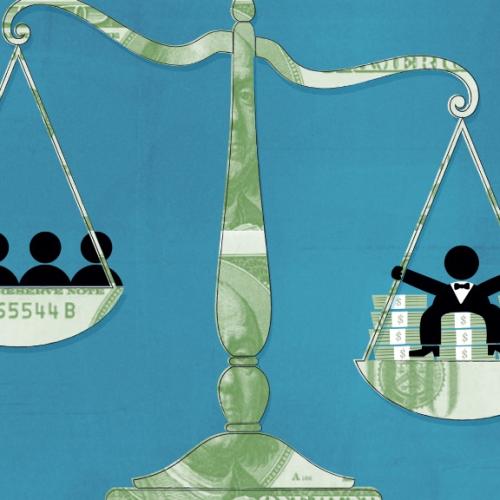
Here is what we need to understand: a hell of a lot of people are in pain. Under neoliberal policies of deregulation, privatisation, austerity and corporate trade, their living standards have declined precipitously. They have lost jobs. They have lost pensions. They have lost much of the safety net that used to make these losses less frightening. They see a future for their kids even worse than their precarious present. At the same time, they have witnessed the rise of the Davos class, a hyper-connected network of banking and tech billionaires, elected leaders who are awfully cosy with those interests, and Hollywood celebrities who make the whole thing seem unbearably glamorous. They know in their hearts that this rising wealth and power is somehow directly connected to their growing debts and powerlessness. For the people who saw security and status as their birthright ... these losses are unbearable. Donald Trump speaks directly to that pain. The Brexit campaign spoke to that pain. So do all of the rising far-right parties in Europe. They answer it with nostalgic nationalism and anger at remote economic bureaucracies. And of course, they answer it by bashing immigrants and people of colour, vilifying Muslims, and degrading women. Elite neoliberalism has nothing to offer that pain, because neoliberalism unleashed the Davos class.
Note: Learn more about the highly secretive Davos class in these summaries of major media articles on secret societies. For more along these lines, see concise summaries of deeply revealing news articles on government corruption and income inequality.
Election judges in Clinton Township, Butler County confirmed there were issues with two of their eight automated voting machines. Most of the issues came when people tried to vote straight party ticket. However, others said they specifically wanted to vote for Republican Donald Trump only to see their vote switched before their eyes to Democrat Hillary Clinton. I went back, pressed Trump again. Three times I did this, so then I called one of the women that were working the polls over. And she said you must be doing it wrong. She did it three times and it defaulted to Hillary every time, Bobbie Lee Hawranko said. Pennsylvania State Rep. Daryl Metcalfe went to Clinton Township to check on the reports for himself. In Allegheny County, officials said they heard reports about machines not recording vote choices, so they sent experts to examine those machines: In each of those cases, there has been no evidence that the machines are working incorrectly. In every election there are machines that need to be re-calibrated following transport. So far today, we have reset three machines. This is in line with what we see in each election. Pennsylvania Secretary of State Pedro Cortes says the GOP reported problems with about 25 out of nearly 24,000 machines statewide.
Note: How is it possible for this to happen? And how many other machines are malfunctioning? For more along these lines, see concise summaries of deeply revealing elections news articles from reliable major media sources. Then explore the excellent, reliable resources provided in our Elections Information Center.
The Maine Clean Elections Act, originally passed in 1996 and strengthened in 2015, gives candidates the option to finance campaigns with taxpayer dollars. Candidates who choose to run a publicly financed campaign dont need to spend time courting wealthy donors - in fact, theyre prohibited from raising private money. Instead, constituents show their support through $5 contributions to the Maine Clean Elections Fund made on behalf of a candidate. But that money doesnt go to the candidate - instead, it shows support and helps fund the public-financing program. Once candidates have raised the required number of donations, they receive a flat fee from the state, which can vary depending on the office being sought. During [State representative Joyce] McCreights first campaign, in 2014, the state gave her nearly $5,000 once shed collected 60 contributions. She won, and by the end of her first term, shed helped to write a bill that makes it easy for low-income people without insurance to get reproductive health [services]. The bill passed, and McCreight expects it to save the state $2.5 million a year. McCreights story ... was made possible by a network of activists who came together in 1995 to draft and support the Maine Clean Elections Act. The Clean Elections system has given Maine the most economically diverse legislature in the nation. About 14 percent of Maine legislators are working class: waitresses, cashiers, machinists. Only 2 percent of the U.S. Congress comes from similar backgrounds.
Note: Why is the major media not reporting this important and inspiring news? Explore a treasure trove of concise summaries of incredibly inspiring news articles which will inspire you to make a difference.
California voters faced a tough time at the polls [on June 7th], with many voters saying they have encountered broken machines, polling sites that opened late and incomplete voter rolls, particularly in Los Angeles County. Many California voters were handed the dreaded pink provisional ballot - which takes longer to fill out, longer for election officials to verify and which tends to leave voters wondering whether their votes will be counted. Its difficult to get a sense for how widespread the problems are. Tuesdays voting problems seems to be a confluence of factors - old voting machines, a competitive election that has drawn new voters, plus complex state voting laws that can be hard for poll volunteers and voters to follow. Albert Grey showed up at his polling site Tuesday morning to find that the vote-counting machine seemed to be jammed, and there didnt seem to be a supervisor on site. So he left without voting. Many California voters reported showing up to their polling sites only to find that their names were not listed on the voting rolls, leaving them to cast a provisional ballot. Sanders supporter Jonathan Daniel Brown accused Democrats of purging votes when he discovered he was not on the voting rolls at his polling station despite being registered. Brown ... refused to take a provisional ballot, and his complaints drew the attention of Los Angeles County Registrar-County Clerk Dean Logan, who intervened. Eventually, Brown said he was allowed to cast a regular ballot - though not before Brown said a poll worker called the police on him.
Note: For more along these lines, see concise summaries of deeply revealing elections corruption news articles from reliable major media sources. Then explore the excellent, reliable resources provided in our Elections Information Center.
Hillary Clinton took nearly every precaution to ensure voters would never know what she told investment bankers, lobbyists and corporate executives in dozens of closed-door paid speeches before running for president. Turns out, the Democratic presidential nominee had good reason to do so. She is ... happy to cut backroom deals with corporate interests and curry favor with Wall Street for campaign dollars. The WikiLeaks organization on Friday posted ... emails obtained in a hack of the Clinton campaign chairmans personal email account. Among the documents posted online was an internal review of the speeches conducted by campaign aides to survey the political damage her remarks could cause if they ever became public. In what aides calculated were the most damaging passages, she reflects on the necessity of unsavory political dealing. To investment bankers from Goldman Sachs and BlackRock, Clinton admits that shes kind of far removed from the middle-class upbringing that she frequently touts on the campaign trail. And in speeches to some of the countrys biggest banks, she highlighted her long ties to Wall Street ... saying that she views the financial industry as a partner in government regulation. In an effort to keep those speeches private, strongly worded contracts prohibited unauthorized recordings, reporters were banned and, in some cases, blog posts about her remarks pulled off websites.
Note: BBC has an article listing 11 intriguing revelations from the recent Wikileaks release. The emails also showed discussion of the Clinton campaign's interest in "elevating" Trump and other 'extreme' Republican candidates to make the party's eventual nominee 'unpalatable'. In 2013 alone, Clinton received $2.3 million for delivering these speeches. For more along these lines, see concise summaries of deeply revealing news articles on corruption in government and in the financial industry.
As the 1973 Yom Kippur war between Israel and neighboring Arab states intensified, I was in an underground missile launch center in Montana with a crewmate when we received an emergency message to prepare for nuclear war with the Soviet Union. We trusted the president to defuse the crisis and avert a nuclear war. Dwight D. Eisenhower recoiled at the concept of nuclear overkill, where far more people are killed than necessary to defeat an enemy. Richard M. Nixon (president during the 1973 Arab-Israeli war) ... worried about the way war plans lightly tossed about millions of deaths. Ronald Reagan, for all his thunder about the Soviet Union being an evil empire and joking that we begin bombing in five minutes, was privately averse to nuclear weapons. Donald J. Trump is of a radically different ilk and temperament from past presidents. In 1973, as it turned out, President Nixon was not in charge when the order came down to prepare for nuclear conflict. Under stress from the Watergate scandal, he had retired for the evening, drunk. His unelected advisers, led by the national security adviser, Henry A. Kissinger, and Defense Secretary James R. Schlesinger, ran the show that night. Our trust in the president was misplaced. He was not even awake when my crewmate and I saddled up for nuclear war. The president had lost personal control of the situation. But upon reflection, it would have been far scarier if a cocksure Mr. Trump, consulting no one but himself, had been there calling the shots.
Note: For more along these lines, see concise summaries of deeply revealing news articles on government corruption and war.
Super PACs seeking to influence the 2016 elections have collected more than $1 billion, a record haul driven by jumbo-sized contributions from rich donors on both sides of the aisle. Just 10 mega-donor individuals and couples contributed nearly 20 percent of the $1.1 billion raised by super PACs by the end of August. The total exceeds the $853 million that super PACs collected in the entire 2012 cycle. The top givers were split roughly equally along party lines, with five Republicans, four Democrats and one independent. Together, super PACs seeking to sway the White House and congressional races have pumped more than $674 million into TV ads and other outreach through September, filings show. By the end of the 2012 elections, such groups had spent $608 million. The figures illustrate how American campaigns have been reordered by the ability to give unlimited sums to political committees. In the six years since the Supreme Courts Citizens United v. Federal Election Commission decision created new paths for massive contributions to flow into elections, a tiny sliver of donors with immense financial capacity have rushed to participate. Along with the $1.1 billion raised by super PACs, hundreds of millions more has been directed into politically active nonprofits on both sides of the aisle that can keep the names of their contributors secret. The huge sums washing through campaigns are contributing to a growing estrangement between voters and the political system.
Note: Read more about how ghost corporations are funding the 2016 elections. For more along these lines, see concise summaries of deeply revealing elections corruption news articles from reliable major media sources. Then explore the excellent, reliable resources provided in our Elections Information Center.
In January, Oregon became the first state in the country to begin automatically registering eligible citizens to vote when they obtain or renew their drivers licenses or state IDs, completely shifting the burden of voter registration from the individual to the government. Four other states have passed similar laws and more than half have considered doing so this year - more than two decades after the National Voter Registration Act of 1993 directed states to make it easier for citizens to register to vote at offices that provide public assistance, including motor vehicle agencies. In Oregon, DMV customers ... who show up in the departments computer system as eligible but unregistered, are added by default to voter rolls without party affiliation; they later select a political party or opt out using a form sent to them in the mail. That subtle difference - requiring people to take an extra step to opt out if they dont want to be registered - is producing results. So far, its working, said Jonathan Brater, of the Brennan Center of Justice at the New York University School of Law, an advocate for the modernization of voter registration. Just two years ago, barely a handful of states were considering this form of voter registration. But technology has made it easier to seamlessly transfer data between agencies, and states increasingly are taking advantage of it. Legislatures in three other states have passed automatic voter registration laws: West Virginia, Vermont, and California.
Note: Explore a treasure trove of concise summaries of incredibly inspiring news articles which will inspire you to make a difference.
The pervasive influence of corporate cash in the democratic process, and the extraordinary lengths to which politicians, lobbyists and even judges go to solicit money, are laid bare in sealed court documents leaked to the Guardian. The John Doe files amount to 1,500 pages of largely unseen material gathered in evidence by prosecutors investigating alleged irregularities in political fundraising. Last year the Wisconsin supreme court ordered that all the documents should be destroyed, though a set survived that has now been obtained by the news organisation. The files open a window on a world that is very rarely glimpsed by the public, in which millions of dollars are secretly donated by major corporations and super-wealthy individuals to third-party groups in an attempt to sway elections. Five Wisconsin prosecutors carried out a deep investigation into what they suspected were criminal campaign-finance violations by the campaign committee of Scott Walker, Wisconsin governor. In 2015, Justice Prosser refused to recuse himself from a case in which the state supreme court sat in judgment over the John Doe investigation, despite the fact that the investigation focused on precisely the same network of lobbying groups and donors that had helped him hang onto his seat. The judge joined a majority of four conservative justices who voted to terminate the investigation and destroy all the documents now leaked to the Guardian.
Note: For more along these lines, see concise summaries of deeply revealing news articles about corruption in elections and in the judicial system.
If there is anything positive to say about the 2016 elections, it's that they have finally forced an end to the official denial of computerized election rigging. In the past month, the fact that our voting technology is a hacker's paradise has been validated by no less than all the major TV news networks. Of course, the corporate media and political parties are now professing "shock" at the very prospect that US elections can be manipulated, and yes, even stolen. Yet it has long been an open secret that game-changing races have been decided not by voters, but by insiders; from the presidential race of 1960, appropriated for John Kennedy by Democratic muscle in Chicago, to the two victories secured for George W. Bush by GOP fixers in Florida and hackers in Ohio. Among other suspect elections in recent years are key Congressional races hijacked by combinations of voter suppression, gerrymandering, dark money and the ugly little secret of American elections: rigged voting machines. How is this possible? Because over many decades, our public elections have been privatized and outsourced to a handful of corporations and dozens of private service vendors. Some have even been convicted of crimes, including bribery, bid rigging, kickback schemes, lying to voting officials and computer fraud. In turn, these shady corporations have sold us billions in "proprietary" computerized voting systems, [while] election laws have slowly been altered to facilitate this quiet transition to more "expedient" private control.
Note: For more along these lines, see concise summaries of deeply revealing elections corruption news articles from reliable major media sources. Then explore the excellent, reliable resources provided in our Elections Information Center.
Could an American elections outcome be altered by a malicious actor on a computer keyboard? I have had three jobs that, together, taught me at least one thing: If its a computer, it can be hacked. I served as the White House senior cybersecurity policy adviser. I served on [President Obama's] five-person postEdward Snowden investigative group on the National Security Agency, intelligence and technology. And for over a decade I have advised American corporations on cybersecurity. Those experiences confirm my belief that if sophisticated hackers want to get into any computer or electronic device, even one that is not connected to the internet, they can do so. Now consider that a majority of states use some kind of combination of electronic voting and a type of paper trail, but there is no standard nationwide. In most states the data that are used to determine who won an election are processed by networked, computerized devices. There are almost no locations that exclusively use paper ballots. Some states ... employ electronic voting machines that produce no paper trail, therefore there is nothing to count or recount and no way to ensure that what a voter intended is what was recorded and transmitted. If someone makes the charge after this election that the results were altered by hackers, our country has almost no way of credibly refuting that claim. Thus American voters will have no way to know if they can trust the results of the election.
Note: For more along these lines, see concise summaries of deeply revealing elections corruption news articles from reliable major media sources. Then explore the excellent, reliable resources provided in our Elections Information Center.
The FBI has uncovered evidence that foreign hackers penetrated two state election databases in recent weeks, prompting the bureau to warn election officials across the country to take new steps to enhance the security of their computer systems. The FBI warning [was] titled Targeting Activity Against State Board of Election Systems. The alert, labeled as restricted for NEED TO KNOW recipients, disclosed that the bureau was investigating cyberintrusions against two state election websites this summer, including one that resulted in the exfiltration, or theft, of voter registration data. The bulletin does not identify the states in question, but sources familiar with the document say it refers to the targeting by suspected foreign hackers of voter registration databases in Arizona and Illinois. In the Illinois case, officials were forced to shut down the states voter registration system for 10 days in late July, after the hackers managed to download personal data on up to 200,000 state voters, Ken Menzel, the general counsel of the Illinois Board of Elections, said in an interview. FBI agents confirmed to [Menzel] that the perpetrators were believed to be foreign hackers, although they were not identified by country. Agents told him they had reached no conclusions, and other experts say the hackers could also have been common cybercriminals hoping to steal personal data on state voters for fraudulent purposes, such as obtaining bogus tax refunds.
Note: Wikileaks recently published thousands of documents, reportedly obtained by an email hack, which exposed significant elections corruption in the US.
Recent attempts at campaign-directed cyber-attacks have raised red flags about just how vulnerable the upcoming U.S. election is to hackers. The most vulnerable aspect of the voting process is the individual ballot. But in a digital world, far more is susceptible to tampering than the ballot itself. With digital tools integrated throughout the electoral process ... potential weak spots show up long before anyone casts the first vote. Gabriella Coleman, Wolfe Chair in Scientific and Technological Literacy at McGill University and author of the book Hacker, Hoaxer, Whistleblower, Spy: The Many Faces of Anonymous, warned even poorly executed hacks can be successful. "If you seed enough doubt, it doesn't matter if the system has been hacked or not, because people won't trust the system." With the rise of new technologies there is potential for individuals, governments, terrorist groups or hackers to use internet-based tools strategically to leak sensitive documents, collect private information and influence voter opinion and sentiment. A recent Bloomberg expos featured a South American political hacker who engaged for a decade in what he calls "psychological operations." He created software to manage and direct an army of fake Twitter accounts. He could change the names, profile pictures, and biographies of thousands of fake accounts to suit his particular needs at the time, using those virtual crowds to sway trends and public opinion.
Note: Read more about South American political hacker Andrs Seplveda's effective manipulation of elections in nine countries. For more along these lines, see concise summaries of deeply revealing elections corruption news articles from reliable major media sources. Then explore the excellent, reliable resources provided in our Elections Information Center.
With the 2016 presidential race already well underway, it's time for us to take cyber threats to our electoral process much more seriously. Hackers could [target] a voting machine [by] attacking the network the machines are being run on at a voting precinct, physically tampering with the device or the network hardware to install malware, attacking the voting machine company's network or employees to get malware into the devices or steal passwords before they are released to a government and target the back-end government network used to manage them. Imagine a hacker deleting voter registration forms ... or switching a person's party affiliation to block him/her from voting in the proper primary. Or deleting a politician's filed paperwork, putting his/her candidacy in jeopardy. There are also a lot of ways hackers could derail campaign fundraising. Since campaign contributions are public records, it would be easy for hackers to ... steal the credit card numbers of donors in order to harass them ... as well as engage in identity theft and financial fraud. But hackers wouldn't even have to go this far. Simply announcing publicly that they planned to hack supporters might be enough to dissuade potential donors.
Note: Since this article was published, voter registration rolls in Illinois and possibly Arizona have already been targeted by hackers. And Wikileaks recently published thousands of documents, reportedly obtained by an email hack, which exposed significant elections corruption in the US.
Russia was behind the hacks into the Democratic National Committees computer network that led to the release of thousands of internal emails just before the partys convention began, U.S. intelligence agencies have reportedly concluded. The FBI is investigating. WikiLeaks promises there is more data to come. The political nature of this cyberattack means that Democrats and Republicans are trying to spin this as much as possible. Even so, we have to accept that someone is attacking our nations computer systems in an apparent attempt to influence a presidential election. This kind of cyberattack targets the very core of our democratic process. And it points to the possibility of an even worse problem in November. Over the years, more and more states have moved to electronic voting machines and have flirted with Internet voting. These systems are insecure and vulnerable to attack. But while computer security experts ... have sounded the alarm for many years, states have largely ignored the threat, and the machine manufacturers have thrown up enough obfuscating babble that election officials are largely mollified. Government interference with foreign elections isnt new, and in fact, thats something the United States itself has repeatedly done in recent history. But what is new is a foreign government interfering with a U.S. national election on a large scale. Our democracy cannot tolerate it, and we as citizens cannot accept it.
Note: For more along these lines, see concise summaries of deeply revealing elections corruption news articles from reliable major media sources. Then explore the excellent, reliable resources provided in our Elections Information Center.
Important Note: Explore our full index to revealing excerpts of key major media news stories on several dozen engaging topics. And don't miss amazing excerpts from 20 of the most revealing news articles ever published.



