



















News Articles
Below are key excerpts of revealing news articles from reliable news media sources. If any link fails to function, a paywall blocks full access, or the article is no longer available, try these digital tools.
For further exploration, delve into our comprehensive Information Centers.

In 1986, [Dr. Jane Goodall] attended a conference in Chicago with researchers studying chimps in six areas of Africa, and the reports of environmental devastation shocked Goodall. Her activism evolved quickly, from chimps, to their habitat to human welfare, and how animal rights and the future of the planet are inherently interconnected. Some of her decisions have been deemed controversial: her friendship with for US Secretary of State James Baker, her work with Conoco ... oil company to build a chimpanzee sanctuary, hard conversations with the National Institutes of Health regarding their medical research and testing practices on chimpanzees and visiting their labs. "I lost a lot of friends because of going into the labs, sitting down and talking to the people, organizing a conference to bring in the lab people, the scientists and also the animal welfare people ..."There were a lot of animal rights people who refused to speak to me — they said, 'Wow can you sit down with these evil people and have a cup of tea with them?' I was totally and completely flabbergasted. If you don’t talk to people, how can expect them to change?” When speaking to the NIH, “I didn’t stand there and accuse them of being cruel monsters. I showed slides and some film of the Gombe chimpanzees and talked about their lives, and then showed some slides of the chimps in the small cages and said, ‘You know, it’s like putting a person in a prison like that,’” said Goodall. “Many of the scientists said, ‘We really have never thought about this in this way’ a lot of them were actually crying." She stands by all of it because it produces results. It took decades, but the NIH phased out medical testing and research on chimpanzees. Conoco built the chimpanzee sanctuary, the Tchimpounga Chimpanzee Rehabilitation Center, saving all of the starving chimpanzees in the Brazzaville Zoo in the Republic of Congo. In this age of cancel culture and unprecedented political polarity, Goodall’s pragmatism, and insistence that arguing does not change minds but appealing to people’s hearts and to their better nature is what produces progress distinguishes her from contemporary activists.
Note: Explore more positive stories like this in our comprehensive inspiring news articles archive focused on solutions and bridging divides.
The telecommunications industry and their experts have accused many scientists who have researched the effects of cell phone radiation of "fear mongering" over the advent of wireless technology's 5G. The chairman of the Federal Communications Commission (FCC) recently announced ... that the commission will soon reaffirm the radio frequency radiation (RFR) exposure limits that the FCC adopted in the late 1990s. These limits are based upon a behavioral change in rats exposed to microwave radiation and were designed to protect us from short-term heating risks due to RFR exposure. Yet, since the FCC adopted these limits based largely on research from the 1980s, the preponderance of peer-reviewed research, more than 500 studies, have found harmful biologic or health effects from exposure to RFR at intensities too low to cause significant heating. The World Health Organization's International Agency for Research on Cancer (IARC) classified RFR as "possibly carcinogenic to humans" in 2011. Last year, a $30 million study conducted by the U.S. National Toxicology Program (NTP) found clear evidence that two years of exposure to cell phone RFR increased cancer in male rats and damaged DNA in rats and mice of both sexes. The Ramazzini Institute in Italy replicated the key finding of the NTP using a different carrier frequency and much weaker exposure to cell phone radiation over the life of the rats.
Note: Explore a thoroughly researched document titled Legal, Constitutional and Human Rights Violations of Smart Grid and Smart Meters which exposes the blatant illegality of the smart meter rollout and its risks and dangers and a video interview with the author. For more along these lines, see concise summaries of deeply revealing news articles on the risks and dangers of wireless technologies from reliable major media sources.
This year, an estimated 18,000 American children will disappear, but their families will not be looking for them. Neighbors will not canvas the streets. Our Facebook feeds will not show their pictures. And after six months, the records of their existence may close entirely. This is the fate awaiting children who vanish while in the care and custody of Americas child-protection system. No matter the reason for falling off the grid, many of these boys and girls will resurface on the black market as child sex slaves. According to the FBI, more than half of trafficked children in America were in the care of social services when they disappeared. That is a damning statistic for a system whose sole purpose is to keep children safe. Withelma T Pettigrew, one of TIME magazines 100 most influential people, was one of those children in foster care who became a trafficking victim. T testified to Congress: I spent, for the most part, the first 18 years of my life in the foster-care system. Seven of those years, I was a child being sexually trafficked on the streets, Internet, strip clubs, massage parlors ... Traffickers, pimps, exploiters have no fear of punishment because they rely on the lack of attention that occurs when these young people go missing. The National Center for Missing and Exploited Children found that historically, many of these children were not being reported missing. To correct that, federal law enacted in 2014 required that state agencies must report a missing child to law enforcement within 24 hours.
Note: For more along these lines, see concise summaries of deeply revealing government corruption and sexual abuse scandals.
In 2016, a coalition of media, tech, and community organizations launched the Equitable Internet Initiative, a project that will result in the construction of wireless broadband internet networks across three underserved Detroit neighborhoods. Leading the initiative is the Detroit Community Technology Project, a digital justice project sponsored by Allied Media Projects. “During the economic and housing crisis, communities had to fend for themselves,” [executive director of DCTP Diana] Nucera says. That’s why, she explains, “we developed this approach called community technology.” The coalition raised just under $1 million from local and national foundations. Funds were used to hire employees, buy equipment, and internet bandwidth. They purchased three discounted wholesale gigabit connections from Rocket Fiber, a Detroit-based high-speed internet service provider. Their contract with Rocket Fiber allows the coalition to share its connection with the community—a provision not allowed by other companies. Each neighborhood is represented by a partnering organization, whose locale is used as the central connection hub for service. The community members are responsible for installation. DCTP trains a representative of the partnering organization, who then trains five to seven neighbors to install the equipment. “Being a digital steward was completely out of the range of what I usually do,” [neighbor and digital steward Roston] says. “I was so used to using the internet ... but I didn’t know how internet networks work.” So far, he’s helped with getting 19 of the 50 designated households in the Islandview neighborhood online. The bottom-up approach ... strengthens community relationships, increases civic engagement, and redistributes political and economic power to otherwise marginalized neighborhoods. “If the community has ownership of the infrastructure, then they’re more likely to participate in its maintenance, evolution, and innovation,” [Nucera] explains. “That’s what we believe leads to sustainability.”
Note: More than 750 American communities have built their own internet networks. For more, read about the rural Indigenous communities building their own internet networks.
Consider the Norwegians, who experienced extreme polarization at the same time as the Germans did. The Norwegian economic elite organized against striking laborers and produced a polarized country that included both Nazi Brown Shirts goose-stepping in the streets and Norwegian Communists agitating to overthrow capitalism. The politician Vidkun Quisling, an admirer of Hitler, organized in 1933 a Nazi party, and its uniformed paramilitary wing sought to provoke violent clashes with leftist students. Quisling reportedly held discussions with military officers about a possible coup d’etat.The stage was set for a fascist “solution.” Instead, Norway broke through to a social democracy. Progressive movements of farmers and workers, joined by middle-class allies, launched nonviolent direct action campaigns that made the country increasingly ungovernable by the economic elite. The majority forced the economic elite to take a back seat and invented a new economy with arguably the most equality, individual freedom, and shared abundance the developed world has known. The key to avoiding fascism? An organized left with a strong vision and broad support. Grassroots movements built a large infrastructure of co-ops that showed their competency and positivity when the government and political conservatives lacked both. Additionally, activists reached beyond the choir, inviting participation from people who initially feared making large changes. Norwegians also ... chose nonviolent direct action campaigns consisting of strikes, boycotts, demonstrations, and occupations. Norway therefore lacked the dangerous chaos that in Germany led the middle classes to accept the elite’s choice of Hitler to bring “law and order.”
Note: Explore more positive stories like this about healing social division and reimagining the economy.
It was a faustian bargain—and it certainly made editors at National Public Radio squirm. The deal was this: NPR, along with a select group of media outlets, would get a briefing about an upcoming announcement by the U.S. Food and Drug Administration a day before anyone else. But in exchange for the scoop, NPR would have to abandon its reportorial independence. The FDA would dictate whom NPR's reporter could and couldn't interview. This kind of deal offered by the FDA - known as a close-hold embargo - is an increasingly important tool used by scientific and government agencies to control the behavior of the science press. We only know about the FDA deal because of a wayward sentence inserted by an editor at the New York Times. But for that breach of secrecy, nobody outside the small clique of government officials and trusted reporters would have known that the journalists covering the agency had given up their right to do independent reporting. The two-tiered system of outsiders and insiders that undergirds the close-hold policy is also still enforced. Major press outlets such as Scientific American and Agence France-Presse have written to the FDA to complain about being excluded but have not received any satisfaction from the agency.
Note: For more along these lines, see concise summaries of deeply revealing news articles on government corruption and media manipulation from reliable sources.
When Caron Ryalls was asked to sign consent forms so that her then 13-year-old daughter, Emily, could be vaccinated against cervical cancer, she assumed it was the best way to protect Emilys long-term health. Emily soon suffered side effects. The symptoms grew increasingly worse after the second and third injections, Emily, now 17, said. One time I couldnt move anything on one side of my body. I didnt know what was happening. Emily is one of the thousands of teenage girls who have endured debilitating illnesses following the routine immunisation. She is yet to recover. The Medicines and Healthcare Products Regulatory Agency (MHRA) [has] received almost 22,000 spontaneous suspected adverse drug reaction (ADR) reports [over the last 10 years] in 13 routine immunisation categories. In the HPV category alone, ADRs numbered 8,228, of which 2,587 were classified as serious. The agency estimates it receives [only] about 10 per cent of all reports. Last year, Japan withdrew its recommendation for the HPV vaccine because of reported side effects. In an article published last week in the Springer journal Clinical Rheumatology, Dr Manuel Martinez-Lavin ... said these illnesses are more frequent after HPV vaccination. He wrote: Seemingly inexplicit adverse reactions have been described after the injection of the newer vaccines vs human papillomavirus (HPV). Adverse reactions appear to be more frequent after HPV vaccination when compared to other type of immunisations.
Note: Read powerful evidence that some vaccines are not safe nor effective. Remember that big Pharma makes billions in profit from vaccines.
Amid questions about the safety of the HPV vaccine Gardasil, one of the lead researchers for the Merck drug is speaking out about its risks, benefits and aggressive marketing. Dr. Diane Harper says young girls and their parents should receive more complete warnings before receiving the vaccine to prevent cervical cancer. Dr. Harper helped design and carry out the Phase II and Phase III safety and effectiveness studies to get Gardasil approved, and authored many of the published, scholarly papers about it. She has been a paid speaker and consultant to Merck. It's highly unusual for a researcher to publicly criticize a medicine or vaccine she helped get approved. Dr. Harper joins a number of consumer watchdogs, vaccine safety advocates, and parents who question the vaccine's risk-versus-benefit profile. She says data available for Gardasil shows that ... there is no data showing that it remains effective beyond five years. This raises questions about the CDC's recommendation that the series of shots be given to girls as young as 11-years old. "If we vaccinate 11 year olds and the protection doesn't last... we've put them at harm from side effects, small but real, for no benefit," says Dr. Harper. "The benefit to public health is nothing, there is no reduction in cervical cancers, they are just postponed, unless the protection lasts for at least 15 years, and over 70% of all sexually active females of all ages are vaccinated." She also says that enough serious side effects have been reported after Gardasil use that the vaccine could prove riskier than the cervical cancer it purports to prevent. Cervical cancer is usually entirely curable when detected early through normal Pap screenings.
Note: For more on the dangers of vaccines, see the deeply revealing reports from reliable major media sources available here.
Wadded-up tissues littered Rishel Middle School's gym floor as tough teenagers sobbed, hugged their peers and told gut-wrenching stories about their lives during an all-day session intended to break down barriers. One 13-year-old said he was abandoned by his parents and that he lies awake at night scared by sounds of gunshots outside his window. A 15-year-old girl talked about attempting suicide and urged anyone with similar thoughts to reach out for help. And a teacher tearfully warned students about their actions by revealing he was a bully when he was younger – until the person he tormented tried to kill himself. The confessions were shared ... as part of "Challenge Day," a nationally recognized anti-bullying program that travels to schools around the country. Challenge Day promotes self respect and acceptance, and inspires students to become positive leaders. [The] 20-year-old program [was] designed by Yvonne and Rich St. John-Dutra. "We want to create a world where every child feels safe," said Rich St. John-Dutra. The program, which was featured on "The Oprah Winfrey Show." The events combined ice-breaking routines to get students to drop their guards with soul-searching exercises designed to reveal their true selves. Students wept as their troubles tumbled out - from worries about their parents, medical problems within the family, troubles with gangs, and battles with alcohol and drugs. Students later apologized to others who they had put down or teased over the years. "This is going to change people," said Eddie Castillo, 13. "I never knew people had problems with their families and their brothers and drugs. I never saw that sensitive side until now."
Note: For one of the most inspiring video clips ever, watch an incredibly moving 15-minute clip from an Emmy-award winning documentary on Challenge day. Learn more about this amazing program on the Challenge Day website.
Western intelligence agencies are attempting to manipulate and control online discourse with extreme tactics of deception and reputation-destruction. Today, [The Intercept is] publishing [a document from GCHQ's previously secret unit, JTRIG, the Joint Threat Research Intelligence Group], entitled "The Art of Deception: Training for Online Covert Operations." Among the core self-identified purposes of JTRIG are two tactics: (1) to inject all sorts of false material onto the internet in order to destroy the reputation of its targets; and (2) to use social sciences and other techniques to manipulate online discourse and activism to generate outcomes it considers desirable. To see how extremist these programs are, just consider the tactics they boast of using to achieve those ends: "false flag operations" (posting material to the internet and falsely attributing it to someone else), fake victim blog posts (pretending to be a victim of the individual whose reputation they want to destroy), and posting "negative information" on various forums. Government plans to monitor and influence internet communications, and covertly infiltrate online communities in order to sow dissension and disseminate false information, have long been the source of speculation. Harvard Law Professor Cass Sunstein, a close Obama adviser and the White House's former head of the Office of Information and Regulatory Affairs, wrote a controversial paper in 2008 proposing that the US government employ teams of covert agents and pseudo-"independent" advocates to "cognitively infiltrate" online groups and websites, as well as other activist groups. Sunstein also proposed sending covert agents into "chat rooms, online social networks, or even real-space groups" which spread what he views as false and damaging "conspiracy theories" about the government.
Note: To see a guidebook developed by intelligence agencies full of charts and information on how to infiltrate and deceive the public, click here. The Intercept is a media source being funded by Pierre Omidyar and featuring Glenn Greenwald and other top reporters known for their independence. Note that Greenwald fails to mention that Sunstein's almost exclusive focus was on "conspiracy theories" advocated by the 9/11 truth movement. For more on his call for what amounts to a new COINTELPRO, see David Ray Griffin's book Cognitive Infiltration.
A leading medical journal is launching a global campaign to separate medicine from big pharma. The BMJ [British Medical Journal] says doctors are being unduly influenced by industry-sponsored education events and industry-funded trials for major drugs. Those trials cannot be trusted, the journal's editor and a team of global healthcare leaders write in a scathing editorial. The "endemic financial entanglement with industry is distorting the production and use of healthcare evidence, causing harm to individuals and waste for health systems", they write. They are calling for governments to start funding independent trials of new drugs and medical devices, rather than relying on industry-funded studies. Sponsored research is more likely to find a favourable result compared to independent research. And they want medical associations to discourage doctors from going to industry-funded education events. Assistant Professor Ray Moynihan [is a] researcher studying the link between money and medicine and is one of the leaders of The BMJ's campaign. When we want to decide on a medicine or a surgery, a lot of the evidence we used to inform that decision is biased," he says. "It cannot be trusted. Because so much of that has been produced and funded by the manufacturers of those healthcare products." Dr Moynihan points to ... Johnson & Johnson, which sold pelvic mesh to thousands of Australian women. It knew the mesh could cause serious harm, but never properly warned women of the risks.
Note: Read the highly revealing comments of Marcia Angell, former editor-in-chief of the New England Journal of Medicine, on the massive corruption she found in the medical industry. For more along these lines, see concise summaries of deeply revealing news articles on health from reliable major media sources.
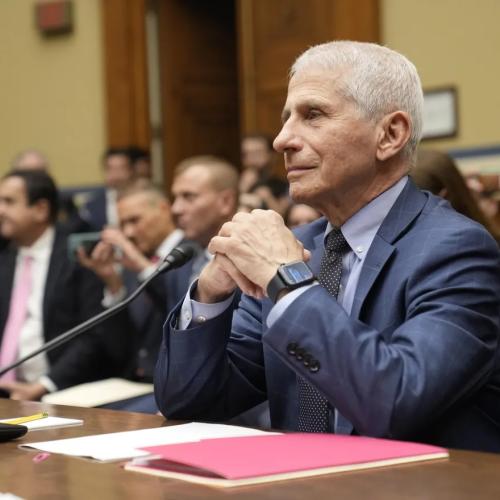
In his testimony to the House Oversight and Accountability Committee on Monday ... Dr. Anthony Fauci told members of Congress that the COVID guidelines he preached in 2020 had no scientific support. These disclosures are damning and maddening for all of us who had structured our lives around these rules for years. As a result, millions of people suffered needlessly. He also admitted in the January interview that there was little science that backed requiring children to wear masks. The real effect of social distancing which Fauci basically admitted Monday and in January's testimony was just an educated guess on how to deter COVID-19 devastated America's economy, small businesses and families. For what? Closing schools was devastating to kids. Pandemic closings resulted in two decades of learning loss. Anxiety and depression skyrocketed, especially among adolescents and teens. The real effect of social distancing ... devastated America's economy, small businesses and families. In the second quarter of 2020, 1.2 million jobs were destroyed. In June 2021, 6.2 million people did not work at all or worked fewer hours because their employers closed or lost business. Family-owned businesses were lost, savings wiped, all for rules that had no real scientific basis. On Monday, Fauci did concede that some COVID-19 preventative measures may have gone too far and led to harmful outcomes.
Note: Fauci was literally the highest paid federal employee within the US government, even higher than the president. Yet while he told the world that attacking him is attacking science, he lied about funding risky gain of function research on bat coronaviruses. In hearings earlier this year, he said “I don’t recall” over 100 times when asked important information on his role in COVID and pandemic policies. What does this say about our public health leaders?
In Oklahoma in 2009, 5-year-old Ryan Hammons would lie awake at night and plead: “Can I go home? Can I see my mom?” or “What happened to my children?” He was lying beside [his mother] one night, Cyndi Hammons remembers, when he said that he needed to tell her something. “I think I used to be somebody else,” he whispered. Ryan was waking up sobbing at night and describing things his mother couldn’t fathom: that he remembered living in Hollywood in a big white house with a swimming pool. That he once had three sons and a younger sister. That he drove a green car, and his wife drove a black one. Not long after, Ryan saw a man he recognized in one of his library books, a peripheral figure in a photograph of six men: “That’s me!” he told his mother. With the help of a production crew from the A&E series “The Unexplained,” they were able to identify the man as Marty Martyn, a movie extra and talent agent who died in 1964. Cyndi and Ryan traveled to California to meet Martyn’s daughter, Marisa Martyn Rosenblatt, who was 8 when her father died. She ultimately confirmed many of Ryan’s statements about Marty Martyn. She didn’t know that her father had driven a green car, or that he had a younger sister, but it turned out both claims were accurate. Marty Martyn’s death certificate cited his age as 59, but Ryan insisted he had died at 61; census records and marriage listings ... confirmed this, as did Martyn’s daughter. Since the 1960s, more than 2,200 children from across the world have described apparent recollections from a previous life. Sometimes a child presents enough identifying information for relatives or researchers to pinpoint a deceased person, but ... about a third of the cases in the database do not include such a match. The most pronounced and convincing cases ... tend to occur in children between the ages of 2 and 6. They might suddenly describe places they have never been, people they have never met, sometimes using words or phrases that seem beyond their vocabulary. Their descriptions of past-life recollections often fade away entirely by the time the child turns 7 or 8.
Note: A 2006 University of Virginia study found that memories of past lives are not uncommon in kids. These fascinating recollections are all documented in a database maintained by the Division of Perceptual Studies ... at the University of Virginia School of Medicine. Explore more positive stories like this about the mysterious nature of reality.
Time banks offer an alternative, powered by 21st-century technology, to the U.S. dollar. About 70 exist across the country — some with a few members, others with hundreds — to give value to work that members say often goes uncompensated in a traditional market economy. The Silver Spring Time Bank formed in 2015 and has about 300 members, said co-founder Mary Murphy. Last year, she said, 1,000 hours were exchanged for basic home repairs, dog walking, cooking and tailoring, among other services, without the exchange of money. “You get to save that money that you would have spent,” she said. “You get to meet somebody else in your community and get to know that person. That's a bonus.” Edgar S. Cahn, an 84-year-old law professor who had worked on civil rights and anti-poverty legislation in president Lyndon B. Johnson’s Justice Department, suffered a heart attack in 1980. He said doctors gave him two years to live, with “maybe two good hours a day. I thought: What do I do with two good hours a day?” he said, having beaten doctors’ expectations by nearly four decades. “I have to teach people to value themselves ... We’re all trained as human service professionals: 'How can I help you?'' ” he said. “None of us is trained to say: ‘How can you make a difference?’ I need you as much as you need me.” Cahn became a proselytizer for what he called the “time dollar” — a currency in which an hour of work is worth an hour of work, whether it’s performed by a maid, a mechanic or a mechanical engineer. In 1995, he founded the D.C. nonprofit TimeBanks USA, which developed the software used by many time banks around the world. Time banks can serve as small-business incubators and a way for seniors to remain active after retirement.
Note: Read more about the potential of time banking. Explore more positive stories like this in on reimagining the economy.
Recent trials of psilocybin, a close pharmacological cousin to LSD, have demonstrated that a single guided psychedelic session can alleviate depression when drugs like Prozac have failed; can help alcoholics and smokers to break the grip of a lifelong habit; and can help cancer patients deal with their existential distress at the prospect of dying. At the same time, studies imaging the brains of people on psychedelics have opened a new window onto the study of consciousness, as well as the nature of the self and spiritual experience. Perhaps the most significant new evidence for the therapeutic value of psychedelics arrived in a pair of phase 2 trials (conducted at Johns Hopkins and NYU and published in the Journal of Psychopharmacology in 2016) in which a single high dose of psilocybin was administered to cancer patients struggling with depression, anxiety and the fear of death or recurrence. Eighty percent of the Hopkins cancer patients who received psilocybin showed clinically significant reductions in standard measures of anxiety and depression, an effect that endured for at least six months after their session. Results at NYU were similar. Curiously, the degree to which symptoms decreased in both trials correlated with the intensity of the mystical experience that volunteers reported, a common occurrence during a high-dose psychedelic session. Few if any psychiatric interventions for anxiety and depression have ever demonstrated such dramatic and sustained results.
Note: This entire article by best-selling author Michael Pollan is filled with the results of excellent studies in this exciting new field. If the above link fails, here is an alternative link. Articles like this suggest that the healing potentials of mind-altering drugs are gaining mainstream scientific credibility.
Half of all the money contributed so far to Democratic and Republican presidential candidates - $176 million - has come from just 158 families, along with the companies they own or control. Who are these people? According to the report, most of these big contributors live in exclusive neighborhoods where they have private security guards instead of public police officers, private health facilities rather than public parks and pools. Most send their kids and grand kids to elite private schools rather than public schools. They fly in private jets and get driven in private limousines rather than rely on public transportation. They don't have to worry about whether Social Security or Medicare will be there for them in their retirement because they've put away huge fortunes. It's doubtful that most of these 158 are contributing to these campaigns out of the goodness of their hearts. They're largely making investments, just the way they make other investments. And the success of these investments depends on whether their candidates get elected, and will lower their taxes even further, expand tax loopholes, shred health and safety and environmental regulations so their companies can make even more money, and cut Social Security and Medicare and programs for the poor - and thereby allow these 158 and others like them to secede even more from the rest of our society. These people are, after all, are living in their own separate society. They want to elect people who will represent them, not the rest of us.
Note: As the Democrats and Republicans duke it out, the ultra-rich laugh all the way to the bank. What if instead of fighting each other, we worked together to expose the manipulations of the ultra-rich? This essay was written by former US Secretary of Labor Robert Reich. For more along these lines, see concise summaries of deeply revealing income inequality news articles from reliable major media sources.
The CDC pledges To base all public health decisions on the highest quality scientific data. In the case of influenza vaccinations and their marketing, this is not so. Promotion of influenza vaccines is one of the most visible and aggressive public health policies today. Although proponents employ the rhetoric of science, the studies underlying the policy are often of low quality, and do not substantiate officials claims. The vaccine might be less beneficial and less safe than has been claimed, and the threat of influenza appears overstated. Twenty years ago, in 1990, 32 million doses of influenza vaccine were available in the United States. Today [the number is] around 135 million doses. This enormous growth has not been fueled by popular demand but instead by a public health campaign. Drug companies have long known that to sell some products, you would have to first sell people on the disease. In the 1950s and 1960s, Merck launched an extensive campaign to lower the diagnostic threshold for hypertension, and in doing so enlarging the market for its diuretic drug, Diuril. Could influenza ... be yet one more case of disease mongering? Marketing influenza vaccines ... involves marketing influenza as a threat of great proportions. The CDCs website explains that Flu seasons ... can be severe, citing a death toll of 3000 to a high of about 49000 people. However, a far less volatile and more reassuring picture of influenza seems likely if one considers that recorded deaths from influenza declined sharply over the middle of the 20th century ... all before the great expansion of vaccination campaigns in the 2000s. Yet across the country, mandatory influenza vaccination policies have cropped up ... precisely because not everyone wants the vaccination, and compulsion appears the only way to achieve high vaccination rates.
Note: Read the entire revealing article at this link. The author clearly shows how fear and profit are the driving force behind flu vaccines and not good science and health. And the report available on this US government webpage states, "Since 1988, over 22,045 petitions have been filed with the VICP [Vaccine Injury Compensation Program] ... with 7,423 of those determined to be compensable. Total compensation paid over the life of the program is approximately $4.3 billion." For other information on health corruption, see the excellent resources in our Health Information Center.
The Coalition for Mercury-free Drugs (CoMeD) exposes communications between Centers for Disease Control (CDC) personnel and vaccine researchers revealing U.S. officials apparently colluded in covering-up the decline in Denmark's autism rates following the removal of mercury from vaccines. Documents obtained via the Freedom of Information Act (FOIA) show that CDC officials were aware of Danish data indicating a connection between removing Thimerosal (49.55% mercury) and a decline in autism rates. Despite this knowledge, these officials allowed a 2003 article to be published in Pediatrics that excluded this information, misrepresented the decline as an increase, and led to the mistaken conclusion that Thimerosal in vaccines does not cause autism. In Denmark, Thimerosal, a controversial mercury compound used as a preservative in certain vaccines, was removed from all Danish vaccines in 1992. The well-publicized Danish study published in Pediatrics 2003 claimed that autism rates actually increased after Thimerosal was phased out. This study subsequently became a cornerstone for the notion that mercury does not cause autism. However, one of the FOIA documents obtained from CDC clearly indicates that this study omitted large amounts of data showing autism rates actually dropping after mercury was removed from Danish vaccines.
Note: For the complete text of the article, which has been taken down from the Sacramento Bee website, click here. Read about a key scientific study which showed that monkeys given standard human vaccines developed autism symptoms, at this link. And an MSNBC/Associated Press report shows that the FDA rejected limits on thimerosal and that "most doses of flu vaccine still contain thimerosal."
European criticism of the World Health Organization's handling of the H1N1 pandemic intensified ... with the release of two reports that accused the agency of exaggerating the threat posed by the virus and failing to disclose possible influence by the pharmaceutical industry on its recommendations for how countries should respond. The WHO's response caused widespread, unnecessary fear and prompted countries around the world to waste millions of dollars. At the same time, the Geneva-based arm of the United Nations relied on advice from experts with ties to drug makers in developing the guidelines it used to encourage countries to stockpile millions of doses of antiviral medications. The first report ... came from the Social, Health and Family Affairs Committee of the Parliamentary Assembly of the Council of Europe, which launched an investigation in response to allegations that the WHO's response to the pandemic was influenced by drug companies that make antiviral drugs and vaccines. The second report, a joint investigation by the [British Medical Journal] and the Bureau of Investigative Journalism ... criticized 2004 guidelines the WHO developed based in part on the advice of three experts who received consulting fees from the two leading manufacturers of antiviral drugs used against the virus, Roche and GlaxoSmithKline.
Note:Explore extensive, eye-opening coverage from reliable sources revealing how the swine and avian flu "pandemics" were designed for corporate profit.
Imagine a global spying network that can eavesdrop on every single phone call, fax or e-mail, anywhere on the planet. It sounds like science fiction, but it's true. Two of the chief protagonists - Britain and America - officially deny its existence. But the BBC has confirmation from the Australian Government that such a network really does exist. The base is linked directly to the headquarters of the US National Security Agency (NSA) at Fort Mead in Maryland, and it is also linked to a series of other listening posts scattered across the world, like Britain's own GCHQ. The power of the network, codenamed Echelon, is astounding. Every international telephone call, fax, e-mail, or radio transmission can be listened to by powerful computers capable of voice recognition. They home in on a long list of key words, or patterns of messages. The network is so secret that the British and American Governments refuse to admit that Echelon even exists. But another ally, Australia, has decided not to be so coy. The man who oversees Australia's security services, Inspector General of Intelligence and Security Bill Blick, has confirmed to the BBC that their Defence Signals Directorate (DSD) does form part of the network. Asked if they are then passed on to countries like Britain and America, he said: "They might be in certain circumstances." They are looking for evidence of international crime, like terrorism. But the system is so widespread all sorts of private communications, often of a sensitive commercial nature, are hoovered up and analysed.
Note that this is a 1999 article, long before the revelations of Edward Snowden. The capability to monitor all communications has existed for a long time. For a powerful, well documented 20-page paper in the Federal Communications Law Journal providing strong evidence that this program is unconstitutional, click here.
Important Note: Explore our full index to revealing excerpts of key major media news articles on several dozen engaging topics. And don't miss amazing excerpts from 20 of the most revealing news articles ever published.