
















Financial News Articles
Below are key excerpts of revealing news articles on financial corruption from reliable news media sources. If any link fails to function, a paywall blocks full access, or the article is no longer available, try these digital tools.
For further exploration, delve into our comprehensive Banking Corruption Information Center.

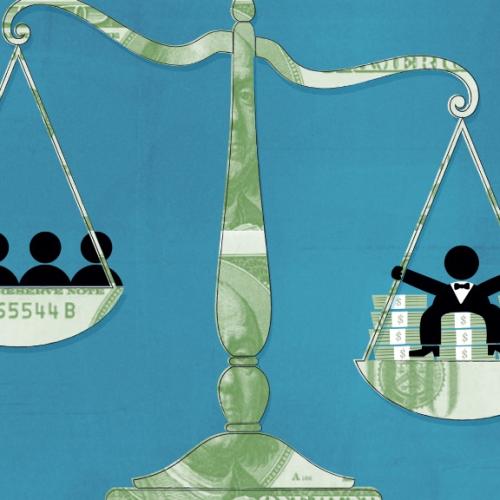
The most important--and unfortunately the least debated--issue in politics today is our society's steady drift toward a class-based system, the likes of which we have not seen since the 19th century. America's top tier has grown infinitely richer and more removed over the past 25 years. Few among them send their children to public schools; fewer still send their loved ones to fight our wars. They own most of our stocks, making the stock market an unreliable indicator of the economic health of working people. The top 1% now takes in an astounding 16% of national income, up from 8% in 1980. The tax codes protect them, just as they protect corporate America, through a vast system of loopholes. Incestuous corporate boards regularly approve compensation packages for chief executives and others that are out of logic's range. As this newspaper has reported, the average CEO of a sizeable corporation makes more than $10 million a year, while the minimum wage for workers amounts to about $10,000 a year, and has not been raised in nearly a decade. When I graduated from college in the 1960s, the average CEO made 20 times what the average worker made. Today, that CEO makes 400 times as much. Trickle-down economics didn't happen. Wages and salaries are at all-time lows as a percentage of the national wealth. This ever-widening divide is too often ignored or downplayed by its beneficiaries. A sense of entitlement has set in among elites, bordering on hubris.
Note: For some reason the Wall Street Journal has removed this article. You can read it on the website of the article's author at this link.
ENRON: The Smartest Guys in the Room [is] the inside story of one of historys greatest business scandals, in which top executives of Americas seventh largest company walked away with over one billion dollars while investors and employees lost everything. Based on the best-selling book ... this tale of greed, hubris and betrayal reveals the outrageous personal excesses of the Enron hierarchy and the moral vacuum that led CEO Ken Lay - along with other players including accounting firm Arthur Andersen, Chief Operating Officer Jeffrey Skilling and Chief Financial Officer Andy Fastow - to manipulate securities trading, bluff the balance sheets and deceive investors. By 2000, the company has grown into the largest natural gas merchant in North America, eventually branching out into trading other commodities. Jeff Skilling is named CEO, and the company stock skyrockets. Meanwhile, Skillings black box accounting results in declared earnings of 53 million dollars for a collapsing deal that doesnt profit a cent. And Enrons West Coast power desk has its most profitable month ever as California citizens become casualties of Enrons scheme to artificially increase demand for electricity, resulting in rolling blackouts and two deaths. When Enrons sleight of hand accounting and unethical trading eventually meet the realities of balance sheets that dont balance and products that dont exist, unwitting employees who have anchored their financial futures to the Enron ship watch in horror as water rushes in overhead.
Note: Watch this revealing documentary on this webpage. Enron was American's seventh-largest public company and controlled 25 percent of the nation's energy before it failed in 2002. Its stock plummeted from $90 a share to 9 cents a share in a matter of months after fraud was uncovered. For more along these lines, see concise summaries of deeply revealing corporate corruption news articles from reliable major media sources.
The news that the bankers Rothschild are to withdraw from the gold market, in which they have been a major player for two centuries, has been hailed as the end of an era. In one sense, of course, it is. But in another way it marks out the continuation of an even older tradition - the ability of the family which has founded one of the world's largest private banking dynasties to sustain their secretive fortune, which industry insiders count not in billions but in trillions, and keep it within the family. Secrecy has been a hallmark of the Rothschilds from the outset. The Rothschilds created the world of banking as we know it today. [They] invented, or at any rate popularised, the government bond, which allowed investors, big and small, to buy bits of the debts of sovereign states by purchasing fixed-interest bearer bonds. It brought investment in railways, the industrial revolution and ventures like the Suez Canal. The Rothschilds got a cut of everything. They made billions in the 1980s from Margaret Thatcher's privatisations of state-owned industries on which they advised. In France after their bank was nationalised by the Socialist president Francois Mitterrand they slowly built a new business which, under Baron David de Rothschild, has risen to the top ranks of the merger and acquisition league tables. They have pulled out of retail fund management - into which they went with much fanfare only three years back - and now they are pulling out of oil and gold in favour of the higher-margin areas of private banking and wealth management
Note: For some reason this article was removed from the website of the Independent, which is why the above link takes you to a cached version of this revealing article. For more on financial corruption, see the deeply revealing reports from reliable major media sources available here.
The Department of Defense, already infamous for spending $640 for a toilet seat...couldn't account for more than a trillion dollars in financial transactions, not to mention dozens of tanks, missiles and planes. The nonpartisan General Accounting Office has raised the volume of its perennial complaints about the financial woes at Defense, which recently failed its seventh audit in as many years. "Overhauling DOD's financial management operations represent a challenge that goes far beyond financial accounting," GAO chief David Walker told lawmakers. Recent government reports suggest the Pentagon's money management woes have reached astronomical proportions. A GAO report found Defense inventory systems so lax that the U.S. Army lost track of 56 airplanes, 32 tanks, and 36 Javelin missile command launch-units. When military leaders were scrambling to find enough chemical and biological warfare suits to protect U.S. troops, the department was caught selling these suits as surplus on the Internet "for pennies on the dollar," a GAO official said. "We are overhauling our financial management system," said Dov Zakheim, the Pentagon's chief financial officer. "The Pentagon has failed to address financial problems that dwarf those of Enron," said Rep. Henry Waxman, D-Los Angeles. Gregory Kutz, director of GAO's financial management division [said] "I've been to Wal-Mart. They were able to tell me how many tubes of toothpaste were in Fairfax, Va. And DOD can't find its chem-bio suits." Opposition to defense spending is portrayed as unpatriotic. Legislators are often more concerned about winning Pentagon pork than controlling defense waste.
Note: You can read the GAO Report (Page 17 on missing planes). Page two states, "To date, no major part of DOD has yet been able to pass the test of an independent audit." For an intriguing Online Journal article exposing the deep role of the Pentagon's former CFO (Chief Financial Officer) Zakheim in this corruption, click here. Why wasn't and isn't this front page headlines? Why are newspaper editors keeping this most vital information from the public?
Joseph Stiglitz, ex-chief economist of the World Bank, ... was in Washington for the big confab of the World Bank and International Monetary Fund. From sources unnamable (not Stiglitz), we obtained a cache of documents marked, 'confidential' and 'restricted'. Stiglitz helped translate one, a 'country assistance strategy'. There's an assistance strategy for every poorer nation, designed, says the World Bank, after careful in-country investigation. But according to insider Stiglitz, the Bank's 'investigation' involves little more than close inspection of five-star hotels. It concludes with a meeting with a begging finance minister, who is handed a 'restructuring agreement' pre-drafted for 'voluntary' signature. The Bank hands every minister the same four-step programme. Step One is privatisation. Stiglitz said that rather than objecting to the sell-offs of state industries, some politicians - using the World Bank's demands to silence local critics - happily flogged their electricity and water companies. After privatisation, Step Two is capital market liberalisation. Stiglitz calls this the 'hot money' cycle. Cash comes in for speculation in real estate and currency, then flees at the first whiff of trouble. A nation's reserves can drain in days. And when that happens, to seduce speculators into returning a nation's own capital funds, the IMF demands these nations raise interest rates to 30%, 50% and 80%. Step Three: market-based pricing - a fancy term for raising prices on food, water and cooking gas. Step Four: free trade. This is free trade by the rules of the World Trade Organisation and the World Bank, which Stiglitz likens to the Opium Wars. 'That too was about "opening markets",' he said.
Note: For an essay by John Perkins, an insider who was directly involved in these severe manipulations, click here. For deeply revealing reports from reliable major media sources on government collusion in financial corruption, click here.
Henry Ford [is] convinced that if Congress will complete and lease to him the water-power developments [at Muscle Shoals], he can make this whole section of the South more prosperous. Thomas A. Edison indorsed Mr. Fords views. He is very earnest in his support of Fords [proposal] to finance Muscle Shoals by an issue of currency ... directly by the Government. "If our nation can issue a dollar bond, it can issue a dollar bill," said Mr. Edison. "[When Congress authorizes] an issue of bonds, it must go out to the money brokers. We then must pay interest to the money brokers for the use of our own money. In all our great bond issues, the interest is always greater than the principal. All of the great public works cost more than twice the actual cost on that account. The difference between the bond and the bill is that the bond lets the money brokers collect twice the amount of the bond ... whereas the currency pays nobody but those who directly contribute. Both are promises to pay: but one promise fattens the usurer, and the other helps the people. It is the money broker, the money profiteer, the private banker, that I oppose. It is a terrible situation when the Government ... must go into debt and submit to ruinous interest charges at the hands of men who control the [issuance of currency]. The people must pay any way: why should they be compelled to pay twice as the bond system compels them? [If] Government will adopt this policy of increasing its national wealth without contributing to the interest collector ... you will see an era of progress and prosperity in this country such as could never have come otherwise. Mr. Edison reiterated his belief [that if] the currency method is tried in raising money for public improvements, the country will never go back to the borrow method.
Note: If the above link fails, you can read the a copy of the full, fascinating article at this link or this one. The entire article contains lots of amazing revelations of how big bankers keep us in debt. How fascinating that Ford and Edison, both ultra-wealthy businessmen, here are arguing strongly against the privately owned Federal Reserve system through which private bankers print US money and charge interest on it, and for the US government printing its own money. This would avoid US citizens having to pay the big bankers all of the interest on much of the national debt. For lots of evidence to support this way of thinking, click here.
The Federal Reserve moved with unprecedented force and speed Friday to pump huge amounts of cash into the financial system to ease disruptions that have escalated since the viral outbreak. The New York Federal Reserve Bank said it will offer $1 trillion of overnight loans a day through the end of this month to large banks. That is in addition to $1 trillion in 14-day loans it is offering every week. Wall Street analysts say the huge number is intended to calm markets by demonstrating that the Feds ability to lend short-term is nearly unlimited. The Fed is also buying Treasury bonds at a furious pace, and will soon run through the $500 billion in purchases it announced on Sunday. It is also accelerating its purchases of mortgage-backed securities. Most analysts expect they will buy more. All the Feds emergency steps are intended to pump cash into a financial system that has seen a spike in demand for dollars. Steven Friedman, a former economist at the New York Fed, [said] The Fed is trying to play the role of shock absorber. Theyve effectively thrown the kitchen sink at the markets and the economy, said Gennadiy Goldberg, senior U.S. rates strategist for TD Securities. Also Friday, the Fed said it would expand its currency exchanges with five central banks. The Fed provides dollars to overseas central banks because some business is conducted overseas in dollars and foreign banks also provide dollar-denominated loans to their customers.
Note: Take $1 trillion and divide it by the U.S. population of 330 million and you find that this amount is equivalent to $3,000 for every man, woman, and child in the US. And that is what the Fed is lending every day. Where is all this money coming from, and why is it going to the banks? For more along these lines, see concise summaries of deeply revealing news articles on the coronavirus from reliable major media sources. Then explore the excellent, reliable resources provided in our Banking Information Center.
The criminal justice system has given up all pretense that the crimes of the wealthy are worth taking seriously. In January 2019, white-collar prosecutions fell to their lowest level since researchers started tracking them in 1998. Since 2015, criminal penalties levied by the Justice Department have fallen from $3.6 billion to roughly $110 million. Illicit profits seized by the Securities and Exchange Commission have reportedly dropped by more than half. In 2018, a year when nearly 19,000 people were sentenced in federal court for drug crimes alone, prosecutors convicted just 37 corporate criminals. Tax evasion ... siphons up to 10,000 times more money out of the U.S. economy every year than bank robberies. In 2017, researchers estimated that fraud by Americas largest corporations cost Americans up to $360 billion annually between 1996 and 2004. Thats roughly two decades worth of street crime every single year. Over the last four decades, the agencies responsible for investigating elite and white-collar crime ... have seen their enforcement divisions starved into irrelevance. More than a third of the FBI investigators who patrol Wall Street were reassigned between 2001 and 2008. Even though auditing millionaires and billionaires is one of the most cost-effective government activities imaginablean independent report estimated in 2014 that it yielded up to $4,545 in recovered revenue per hour of staff timethe IRS investigated the returns of just 3 percent of American millionaires in 2017.
Note: For more along these lines, see concise summaries of deeply revealing news articles on government corruption and income inequality from reliable major media sources.
Ever since [Bill Clinton's] late-September visit to Africa with Kevin Spacey and Chris Tucker on his new benefactors customized Boeing 727 the question of the day has been: Who in the world is Jeffrey Epstein? Its a life full of question marks. He comes with cash to burn, a fleet of airplanes, and a keen eye for the ladies. Epstein is said to run $15 billion for wealthy clients, yet aside from Limited founder Leslie Wexner, his client list is a closely held secret. Hes been linked to ... Ghislaine Maxwell, daughter of the mysteriously deceased media titan Robert Maxwell, yet he lives the life of a bachelor, logging 600 hours a year in his various planes. He owns what is said to be Manhattans largest private house yet runs his business from a 100-acre private island in St. Thomas. Most everyone on the Street has heard of him, but nobody seems to know what the hell he is up to. Which is just the way he likes it. He is an enthusiastic member of the Trilateral Commission and the Council on Foreign Relations. In 1982 ... he set up his own shop, J. Epstein and Co., ...which is where the mystery deepens. [He] immediately began collecting clients, [but only] those with $1 billionplus. From the get-go, his business was successful. But the conditions for investing with Epstein were steep: He would take total control of the billion dollars, charge a flat fee, and assume power of attorney to do whatever he thought was necessary to advance his clients financial cause. There are no analysts or portfolio managers, just twenty accountants to keep the wheels greased and a bevy of assistants many of them conspicuously attractive young women to organize his hectic life.
Note: For more along these lines, see concise summaries of deeply revealing news articles on Jeffrey Epstein from reliable major media sources. Watch an excellent segment by Australia's "60-Minutes" team "Spies, Lords and Predators" on a pedophile ring in the UK which leads directly to the highest levels of government. A second suppressed documentary, "Conspiracy of Silence," goes even deeper into this topic in the US.
When the Federal Reserve needed Wall Street’s help with its pandemic rescue mission, it went straight to Larry Fink. The BlackRock cofounder, chairman, and chief executive officer has become one of the industry’s most important government whisperers. The company’s new assignment is a much bigger version of one it took on after the 2008 financial crisis, when the Federal Reserve enlisted it to dispose of toxic mortgage securities. This time it will help the Fed prop up the entire corporate bond market by purchasing, on the central bank’s behalf, what could become a $750 billion portfolio of debt. One part of the Fed’s plan is to buy bond exchange-traded funds. BlackRock itself runs ETFs under the iShares brand, and could end up buying funds it manages. “BlackRock is acting as a fiduciary to the Federal Reserve Bank of New York,” says a spokesman for the company. “As such, BlackRock will execute this mandate at the sole discretion of the bank.” The arrangement is bringing new attention to the company’s scale and ubiquity. “It’s impossible to think of BlackRock without thinking of them as a fourth branch of government,” says William Birdthistle, a professor at the Chicago-Kent College of Law. BlackRock’s growth raises questions over how big and useful a company can become before its size poses a risk. And then there are the potential conflicts. One arm of BlackRock knows what the Fed is buying, while other parts of the business participating in credit markets could benefit from that knowledge.
Note: Watch an excellent documentary showing how BlackRock, Vanguard, and several other institutions are the largest shareholders in almost every major corporation you can think of. For more along these lines, see concise summaries of deeply revealing news articles on corruption in government and in the financial industry from reliable major media sources.
Jeffrey Epstein was a very wealthy man, but exactly how wealthy and where that money came from remains shrouded in mystery. Newly unearthed emails last week shone light on Epstein’s role as freelance client development officer, acting as a channel between political figures and business titans, greasing up the former with lifestyles they could not afford and the latter with avenues of political influence. Figures in Epstein’s network of billionaires, politicians, celebrities, royalty and intellectuals were assembled into schemes of influence. The spheres of influence Epstein created, emails showed, relied simultaneously on access and gifts Between his collection of lavish homes in New York, Palm Beach and Paris, two private Caribbean islands, two jets and helicopter, Epstein held nearly $380m in cash and investments, according to his estate. That wealth arrived suddenly. Until the end of the 90s, Epstein was living in a two-bedroom apartment on Manhattan’s Upper East Side close to the river. It was only when Maxwell arrived from London that his lifestyle was dramatically elevated. Epstein moved to a townhouse on 68th Street and later to a 28,000-sq-ft mansion on 71st Street, later transferred to him by Wexner in 2011. Steven Hoffenberg, a former business partner of Epstein convicted of running a Ponzi scheme, claimed that Maxwell’s father, the disgraced press baron Robert Maxwell, introduced his daughter to Epstein in the late 1980s. A 2022 Miami Herald exposé showed complex Maxwell family transactions passing through companies in Jersey, the British Virgin Islands and Panama that it called “a decades-long modus operandi of financial deception”.
Note: There is significant evidence suggesting that Robert Maxwell was a superspy for Mossad, Israel's intelligence and covert operations unit. US attorney Alexander Acosta was once told Epstein “belonged to intelligence, and to leave it alone.” Read our comprehensive Substack investigation covering the connection between Epstein’s child sex trafficking ring and intelligence agency sexual blackmail operations.
Preschools and funeral homes, car washes and copper mines, dermatologists and datacentres – private equity is anywhere and everywhere that money changes hands. If it can in any way be marketed or monetised, private equity firms have bought it. By some estimates, these firms now control more than $13tn invested in more than 50,000 companies worldwide. “We cannot overestimate the reach of private equity across the global economy,” Sachin Khajuria, a former partner at Apollo Global Management, which manages half a trillion dollars in assets, wrote in 2022. More and more people, especially the relatively poor, may live almost their entire lives in systems owned by one or another private equity firm: financiers are their landlords, their electricity providers, their ride to work, their employers, their doctors, their debt collectors. Private equity firms and related asset managers “increasingly own the physical as well as financial world around us,” the scholar Brett Christophers writes. “All of our lives are now part of their investment portfolios.” In order to drive up profits, private equity-controlled dental chains have induced children to undergo multiple unnecessary root canals. One child even died as a result. Some of the most heinous accounts have come from private equity-owned treatment centres for young people with behavioural problems, where children have been physically abused, raped and killed. These cases are extreme, but they are not isolated.
Note: BlackRock and Vanguard manage over $11 trillion and $8 trillion respectively—an unprecedented concentration of financial power. We hear outrage about billionaires and oligarchs, but rarely about private equity firms, who are backed by both political parties and are drastically reshaping our economy, contributing to environmental destruction, and extracting wealth from communities in the US and all over the world. For more along these lines, read our concise summaries of financial inequality and financial industry corruption.
Global banks faced a fresh scandal about dirty money on Monday as they sought to limit the fallout from a cache of leaked documents showing they transferred more than $2 trillion in suspect funds over nearly two decades. Britain-based HSBC Holdings Plc, Standard Chartered Plc and Barclays Plc, Germany's Deutsche Bank AG and Commerzbank AG, and U.S.-headquartered JPMorgan Chase & Co and Bank of New York Mellon Corp were among the lenders named in the report by the International Consortium of Investigative Journalists and based on leaked documents. The report was based on 2,100 leaked suspicious activity reports (SARs), covering transactions between 1999 and 2017, filed by banks and other financial firms with the U.S. Department of Treasury's Financial Crimes Enforcement Network (FinCEN). Banks are required to file an SAR whenever handling funds that cause grounds for suspicion of criminal activity. The reports revealed broader problems with the monitoring system at the heart of global policing of money laundering and other criminal activity. Investors worried about the potential fallout for global banks, many of which have faced hefty fines in the past for lapses in controls and spent billions of dollars to bolster compliance. "It confirms what we already knew: that there are huge amounts of SARs being filed with relatively low numbers of cases brought through to prosecution, said Etelka Bogardi, a Hong Kong-based financial services partner at Norton Rose Fulbright. "It also brings out the point that managing financial crime risk goes beyond making SARs," Bogardi said.
Note: The original ICIJ report is titled Global banks defy U.S. crackdowns by serving oligarchs, criminals and terrorists. Compare with the title of the New York Times article on this, Banks Suspected Illegal Activity, but Processed Big Transactions Anyway. A search on this topic shows that headlines of almost all major media have watered this down, likely to not upset the big banks. For more along these lines, see concise summaries of deeply revealing news articles on financial industry corruption from reliable major media sources.
When this public health crisis first morphed into a financial one as well, the Federal Reserve sprang into action, pouring trillions of dollars into the financial system in less than a week; providing short-term loans to banks; slashing a key interest rate virtually to zero; announcing that the Fed would begin buying $700 billion worth of U.S. government bonds and mortgage-backed securities. The Fed gave itself the authority to purchase up to $1 trillion in commercial paper to support the flow of credit. An eight-second video from 2009 [shows] Ben Bernanke, the Fed chair at the time, explaining how the central bank comes up with the money to pull off these trillion-dollar maneuvers. “It’s not tax money,” Mr. Bernanke explained on “60 Minutes.” “We simply use the computer to mark up the size of the account.” Heads exploded. Many people replying to the tweet complained that we’re ... coming to the rescue of Wall Street instead of Main Street. “If the Fed can do this for the banks,” they wondered, “why can’t we find the money to pay for programs that would improve life for everyday Americans?” When called upon, the same computer that works for large banks is there for Main Street as well. But the Federal Reserve needs specific instructions before typing up dollars for the rest of us. Those instructions come in the form of legislation: When a bill becomes a law, the government is, in essence, telling the Fed how many dollars it is ordering up.
Note: For more along these lines, see concise summaries of deeply revealing news articles on banking corruption and the coronavirus pandemic from reliable major media sources.
Jeffrey Epstein ... helped JPMorgan orchestrate an important acquisition. He introduced executives to men who would become lucrative clients, like the Google co-founder Sergey Brin, and to global leaders, like Prime Minister Benjamin Netanyahu of Israel. At Epstein’s behest, JPMorgan set up accounts — into which he routinely transferred huge sums — for young women who turned out to be victims of his sex-trafficking operations. It wired his funds overseas. It even paid him millions of dollars. But in the summer of 2019, Epstein was arrested. Federal prosecutors charged him with sex trafficking. JPMorgan went into damage-control mode. It filed a report with federal regulators that retroactively flagged as suspicious some 4,700 Epstein transactions — totaling more than $1.1 billion and including hundreds of millions of dollars in payments to Russian banks and young Eastern European women who were brought to the United States. Banks are required to file such reports in real time to alert law enforcement to things like money laundering, sex trafficking and drug dealing. Doing it after the fact might have provided JPMorgan with legal cover, but it did nothing to help identify Epstein’s crimes as they were happening. The fallout for JPMorgan has been limited. In 2023, it paid $290 million to settle a lawsuit brought by roughly 200 of Epstein’s victims and an additional $75 million to resolve related litigation brought by the U.S. Virgin Islands.
Note: This article is also available here. According to a Guardian article, "Epstein introduced [JPMorgan] bank executives to some figures who would become clients, including the Google co-founder Sergey Brin, and to global leaders, such as the Israeli prime minister, Benjamin Netanyahu, Bill Gates, Elon Musk and the Emirati billionaire Sultan Ahmed bin Sulayem." Read our comprehensive Substack investigation covering the connection between Epstein’s child sex trafficking ring and intelligence agency sexual blackmail operations.
If economic inequality increases within a country, the risk of civil war breaking out grows. This is the finding from a study by the Chair of Economic History at the University of Tübingen. The study has been published in the Review of Income and Wealth. The calculations revealed a statistically significant connection between unequal distribution of income and the outbreak of civil wars. The results can be verified using historical events: for example, land was extremely unequally distributed in Russia before the October revolution of 1917—and this critically contributed to the outbreak of revolution and civil war, a marker that was also identified by the new benchmark with a correspondingly high probability. The new benchmark also makes it possible to predict the risk of civil war today: "In the U.S. the inequality in income distribution has risen sharply in the past 30 years. Accordingly, the risk of a civil war in the U.S. has risen drastically from 10% to 21%," says Baten. In Great Britain, China, India and Russia too, inequality has risen greatly in the same period. "We've checked what influence other variables had on the outbreak of civil wars," says Laura Radatz, co-author of the study. "For instance, the size of a country and its population naturally increase the probability that a civil war will break out somewhere in this country." The amount of economic growth in a country does not measurably influence the risk of a civil war, according to the study.
Note: For more along these lines, read our concise summaries of news articles on financial inequality.
Investment bankers have pressed health care companies on the front lines of fighting the novel coronavirus, including drug firms developing experimental treatments and medical supply firms, to consider ways that they can profit from the crisis. The largest voices in the health care industry stand to gain from billions of dollars in emergency spending on the pandemic, as do the bankers and investors who invest in health care companies. Over the past few weeks, investment bankers have been candid on investor calls and during health care conferences about the opportunity to raise drug prices. Executives joked about using the attention on Covid-19 to dodge public pressure on the opioid crisis. Health and Human Services Secretary Alex Azar previously served as president of the U.S. division of drug giant Eli Lilly and on the board of the Biotechnology Innovation Organization, a drug lobby group. During a congressional hearing ... Azar rejected the notion that any vaccine or treatment for Covid-19 should be set at an affordable price. “We can’t control that price because we need the private sector to invest,” said Azar. “The priority is to get vaccines and therapeutics. Price controls won’t get us there.” The initial $8.3 billion coronavirus spending bill passed in early March ... contained a provision that prevents the government from delaying the introduction of any new pharmaceutical to address the crisis over affordability concerns. The legislative text was shaped, according to reports, by industry lobbyists.
Note: For more along these lines, see concise summaries of deeply revealing news articles on the coronavirus pandemic and Big Pharma profiteering from reliable major media sources.
One of Washington's most prominent lobbying firms is on the verge of shuttering after becoming ensnared by special counsel Robert Mueller's investigation. Kimberley Fritts, the chief executive of the Podesta Group, told employees during a Thursday staff meeting that the firm would cease to exist at the end of the year. The developments come after the Podesta Group was tied last week to Mueller's indictments of Paul Manafort and Rick Gates, who pleaded not guilty after being charged with failing to file as foreign agents relating to a decade of work they did for ... a pro-Russia political party in the Ukraine. Mueller's special investigation team has also interviewed multiple people from the Podesta Group, which was recruited by Manafort and Gates to work along with another firm. Talk of potentially closing the Podesta Group marks a dramatic downfall of one of K Street's most iconic and well-connected firms. In its heyday, Podesta Group was the largest non-law firm lobbying organization in Washington. Tony Podesta, the firm's founder and chairman, helped fuel the company with work for foreign governments. He and his brother, John, founded the company almost three decades ago. John Podesta chaired Hillary Clinton's 2016 presidential campaign. He left the firm in 1993. Mueller is looking into whether the Podesta Group properly identified to federal authorities its foreign advocacy for ... a Brussels-based non-profit group that federal prosecutors have called a mouthpiece for pro-Russian Ukrainian politicians.
Note: The Podesta brothers were deeply implicated in the Pizzagate affair. Though many believe Pizzagate was just a "conspiracy theory," our careful research shows powerful evidence that the Podestas were indeed involved in a child sex abuse ring. Could it be that behind the curtains, some are taking action against the Podestas for their involvement in these child abuse rings? For some intriguing, yet difficult to verify evidence along these lines, see this webpage.
Wells Fargo acknowledged Friday that for six years about 570,000 of its customers were charged for auto insurance they didnt need, potentially driving some to default on their loan and have their cars repossessed. The San Francisco bank said it would start refunding about $80 million, or about $140 each, to customers next month. The revelation quickly sparked a backlash from lawmakers still angry after Wells Fargo admitted last year that thousands of its employees had created millions of fake credit card and bank accounts for customers without their knowledge. No wonder so many hard-working Americans believe the system is rigged against them in Wall Streets favor, Sen. Sherrod Brown, the ranking Democrat on the Banking Committee, said in a statement. Sen. Elizabeth Warren ... renewed her call for the Federal Reserve to force Wells Fargos board of directors to resign. There are surely deep ... problems at a bank when it opens millions of fake customer accounts and charges nearly a million customers for a financial product they dont need, Warren said in a statement. The Wells Fargo Board is ultimately responsible for that failure. Wells Fargo said the most recent scandal is centered on its auto lending business. Customers loan contracts require them to maintain auto insurance and allow the bank to buy it for them if there is no evidence that the customers have a policy, the bank said. But ... customers were being charged for auto insurance premiums even though they already had another policy.
Note: Read more about the massive fraud perpetrated by Wells Fargo. Steve Glazer, chairman of the California Senate Banking and Financial Institutions Committee, recently compared this bank's actions with the behavior of Enron when its culture of corruption initially came to light. For more along these lines, see concise summaries of deeply revealing banking corruption news articles from reliable major media sources.
Following widespread outrage and a blistering Senate Banking Committee hearing last week, Wells Fargo CEO John Stumpf has said hell forfeit his outstanding stock awards of about $41 million. Wells Fargos former retail-banking head, Carrie Tolstedt, has agreed to forfeit outstanding stock awards of about $19 million. The givebacks are being done in response to charges that the bank opened some 2 million fraudulent deposit and credit card accounts in its customers names. Wells Fargo had already agreed to pay $185 million to settle those charges with regulators, but, clearly, that wasnt enough. The public is worn out by Wall Streets bad behavior - and its also tired of watching low-level employees be scapegoated while top executives get off scot-free. Wells had fired more than 5,000 employees connected to the illegal sales practices, but done nothing to punish senior executives. No one is buying the story that a scandal this large was the work of rogue employees at the bottom of the totem pole. Part of the reason for the alleged unauthorized accounts was employees were pressured to meet unachievable sales goals. Wells has also pledged to end the controversial sales goal program for employees in the retail banking division. The financial meltdown of 2008 ... resulted out of extreme complexity - most politicians and citizens cant parse a credit default swap. Opening a bank account in someone elses name without their permission, however, is a wrong that everyone can understand.
Note: For more along these lines, see concise summaries of deeply revealing banking corruption news articles from reliable major media sources.
Important Note: Explore our full index to revealing excerpts of key major media news articles on several dozen engaging topics. And don't miss amazing excerpts from 20 of the most revealing news articles ever published.