




















Financial News Articles
Below are key excerpts of revealing news articles on financial corruption from reliable news media sources. If any link fails to function, a paywall blocks full access, or the article is no longer available, try these digital tools.
For further exploration, delve into our comprehensive Banking Corruption Information Center.

It's the dark heart of Britain, the place where democracy goes to die, immensely powerful, equally unaccountable. But I doubt that one in 10 British people has any idea of what the Corporation of the City of London is and how it works. As Nicholas Shaxson explains in his fascinating book Treasure Islands, the Corporation exists outside many of the laws and democratic controls which govern the rest of the United Kingdom. The City of London is the only part of Britain over which parliament has no authority. This is ... an official old boys' network. In one respect at least the Corporation acts as the superior body: it imposes on the House of Commons a figure called the remembrancer: an official lobbyist who sits behind the Speaker's chair and ensures that, whatever our elected representatives might think, the City's rights and privileges are protected. The mayor of London's mandate stops at the boundaries of the Square Mile. The City has exploited this remarkable position to establish itself as a kind of offshore state, a secrecy jurisdiction which controls the network of tax havens housed in the UK's crown dependencies and overseas territories. This autonomous state within our borders is in a position to launder the ill-gotten cash of oligarchs, kleptocrats, gangsters and drug barons. It has also made the effective regulation of global finance almost impossible.
Note: To understand how democracy is easily circumvented, read this full article. For lots more from reliable sources on the hidden background to the control over governments held by financial powers, click here.
Wall Street's total price tag on settlements with U.S. securities regulators for allegedly misleading investors about mortgage bonds churned out ahead of the financial crisis surged past $1 billion with a deal by Citigroup Inc. to pay $285 million ... to end civil-fraud charges by the Securities and Exchange Commission. The SEC claimed Citigroup sold slices of the $1 billion mortgage-bond deal without disclosing to investors that the bank was shorting $500 million of the deal, or betting its assets would lose value. Several Wall Street firms have settled similar claims by the SEC, which has generally stuck to the strategy used by the agency to get a $550 million settlement last year with Goldman Sachs Group Inc.. And the SEC's investigation of the Wall Street mortgage machine isn't over yet. Lorin Reisner, deputy enforcement director at the SEC, said civil mortgage-related cases against Goldman, J.P. Morgan Chase & Co., Countrywide Financial Corp., New Century Financial Corp. and other companies "read like an index to unlawful conduct in connection with the financial crisis." The SEC has collected a total of $1.03 billion through mortgage-bond-deal settlements. In addition to Citigroup, the total includes Goldman, J.P. Morgan, Royal Bank of Canada, Wells Fargo & Co. and Credit Suisse Group AG.
Note: For lots more from major media sources on the illegal profiteering of major financial corporations, click here.
Citigroup Inc. and Bank of America Corp. were the reigning champions of finance in 2006 as home prices peaked, leading the 10 biggest U.S. banks and brokerage firms to their best year ever with $104 billion of profits. By 2008, the housing markets collapse forced those companies to take more than six times as much, $669 billion, in emergency loans from the U.S. Federal Reserve. The loans dwarfed the $160 billion in public bailouts the top 10 got from the U.S. Treasury, yet until now the full amounts have remained secret. Fed Chairman Ben S. Bernankes [actions] included lending banks and other companies as much as $1.2 trillion of public money, about the same amount U.S. homeowners currently owe on 6.5 million delinquent and foreclosed mortgages. The largest borrower, Morgan Stanley, got as much as $107.3 billion, while Citigroup took $99.5 billion and Bank of America $91.4 billion, according to a Bloomberg News compilation of data obtained through Freedom of Information Act requests, months of litigation and an act of Congress. It wasnt just American finance. Almost half of the Feds top 30 borrowers, measured by peak balances, were European firms. Data gleaned [under the Freedom of Information Act] make clear for the first time how deeply the worlds largest banks depended on the U.S. central bank to stave off cash shortfalls. Even as the firms asserted in news releases or earnings calls that they had ample cash, they drew Fed funding in secret.
Note: For a treasure trove of information from reliable sources on the government transfer of public assets to private banks and financial corporations, click here.
The first top-to-bottom audit of the Federal Reserve uncovered eye-popping new details about how the U.S. provided a whopping $16 trillion in secret loans to bail out American and foreign banks and businesses during the worst economic crisis since the Great Depression. Among the [Government Accountability Office] investigation's key findings is that the Fed unilaterally provided trillions of dollars in financial assistance to foreign banks and corporations from South Korea to Scotland, according to the GAO report. The [report] also determined that the Fed lacks a comprehensive system to deal with conflicts of interest, despite the serious potential for abuse. In fact, according to the report, the Fed provided conflict of interest waivers to employees and private contractors so they could keep investments in the same financial institutions and corporations that were given emergency loans. For example, the CEO of JP Morgan Chase served on the New York Fed's board of directors at the same time that his bank received more than $390 billion in financial assistance from the Fed. The investigation also revealed that the Fed outsourced most of its emergency lending programs to private contractors, many of which also were recipients of extremely low-interest and then-secret loans.
Note: We don't normally use the website of a member of the U.S. Senate as a source, but as amazingly none of the media covered this vitally important story other than one blog on Forbes, we are publishing this here. The GAO report to back up these claims is available for all to see at this link. For how the media is so controlled, don't miss the powerful two-page summary with reports by many award-winning journalists at this link. For another good article on the Fed's manipulations, click here.
The more aggressively a bank lobbied before the financial crisis, the worse its loans performed during the economic downturn -- and the more bailout dollars it received, according to a study published by the National Bureau of Economic Research this week. The report, titled "A Fistful of Dollars: Lobbying and the Financial Crisis," said that banks' lobbying efforts may be motivated by short-term profit gains, which can have devastating effects on the economy. "Overall, our findings suggest that the political influence of the financial industry played a role in the accumulation of risks, and hence, contributed to the financial crisis," said the report, written by three economists from the International Monetary Fund. Data collected by the three authors -- Deniz Igan, Prachi Mishra and Thierry Tressel -- show that the most aggressive lobbiers in the financial industry from 2000 to 2007 also made the most toxic mortgage loans. They securitized a greater portion of debt to pass the home loans onto investors and their stock prices correlated more closely to the downturn and ensuing bailout. The banks' loans also suffered from higher delinquencies during the downturn.
Note: If the above link fails, click here. For lots more from reliable sources on corruption in the government bailouts of the biggest banks, click here.
Just under three years ago, people in the village of Gumbi in western Malawi went unexpectedly hungry. Not like Europeans do if they miss a meal or two, but that deep, gnawing hunger that prevents sleep and dulls the senses when there has been no food for weeks. Oddly, there had been no drought, the usual cause of malnutrition and hunger in southern Africa, and there was plenty of food in the markets. For no obvious reason the price of staple foods such as maize and rice nearly doubled in a few months. Unusually, too, there was no evidence that the local merchants were hoarding food. It was the same story in 100 other developing countries. There were food riots in more than 20 countries and governments had to ban food exports and subsidise staples heavily. A new theory is emerging among traders and economists. The same banks, hedge funds and financiers whose speculation on the global money markets caused the sub-prime mortgage crisis are ... taking advantage of the deregulation of global commodity markets [to make] billions from speculating on food and causing misery around the world. As food prices soar again to beyond 2008 levels, it becomes clear that everyone is now being affected. Food prices are now rising by up to 10% a year in Britain and Europe. What is more, says the UN, prices can be expected to rise at least 40% in the next decade.
Note: Remember that speculation is behind almost all of the economic bubbles and busts. The price of oil spiked a couple years ago almost purely because of speculators, while the oil companies raked in record profits. It looks like the speculators are now driving food prices as high as they can. For a treasure trove of reports from reliable sources investigating the many different strategies used by financial corporations to enrich themselves at the expense of common people, click here.
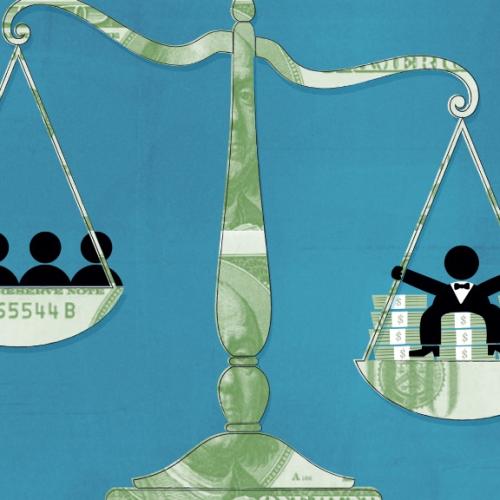
"The Conehead economy" [is] the idea that if the economy were a person, its growth over the past few decades would've turned it from a normal-looking individual into a conehead. Jacob Hacker and Paul Pierson get at this idea slightly differently [in their book Winner-Take-All Politics]. They've got a table showing how incomes would look if growth had been equally shared from 1979 to 2006 -- much as it was in the decades before 1979. If growth had been equally shared, the middle quintile would be making $64,395 today. Instead, they're making $52,100. That's a 23 percent raise those folks didn't get -- and that I'm sure they would've noticed. The top 1 percent ... made, on average, $1,200,300 in 2006. If growth had been equally shared in the three decades before that, however, their incomes would've been cut by more than half, down to $506,002. That's real, serious money we're talking about. The top 1 percent now accounts for 23.5 percent of the national income if you include capital gains. In 1979, they only had 9.8 percent of the nation's earnings. During that same period, tax rates on the richest Americans have actually dropped. So as the economy went one way -- toward more money going to the rich -- the tax system went the other.
Note: For lots more on income inequality from reliable sources, click here.
Inside the humdrum offices of a tiny trading firm called Tradeworx, workers ... tend high-speed computers that typically buy and sell 80 million shares a day. But on the afternoon of May 6, as the stock market began to plunge in the flash crash, someone here walked up to one of those computers and typed the command HF STOP: sell everything and shutdown. Across the country, several of Tradeworxs counterparts did the same. In a blink, some of the most powerful players in the stock market high-frequency traders went dark. The result sent chills through the financial world. After the brief 1,000-point plunge in the stock market that day, the growing role of high-frequency traders in the nations financial markets is drawing new scrutiny. Over the last decade, these high-tech operators have become sort of a shadow Wall Street from New Jersey to Kansas City, from Texas to Chicago. Depending on whose estimates you believe, high-frequency traders account for 40 to 70 percent of all trading on every stock market in the country. Some of the biggest players trade more than a billion shares a day. These are short-term bets. Very short. The founder of Tradebot, in Kansas City, Mo., told students in 2008 that his firm typically held stocks for 11 seconds. Tradebot, one of the biggest high-frequency traders around, had not had a losing day in four years, he said.
Note: For key reports on the dubious practices which underlay the financial crisis and the impoverishment of the public treasury, click here.
The [IRS] reports that the nation's 400 highest-earning households reported an average income of $345 million in 2007 up 31% from 2006 and that their average tax bill fell to a 15-year low. Bloomberg writes that the elite 400's average income more than doubled that year from $131.1 million in 2001, the year Congress adopted tax cuts urged by then-President George W. Bush. Each household in the top 400 of earners paid an average tax rate of 16.6 percent, the lowest since the agency began tracking the data in 1992. Their average effective tax rate was about half the 29.4 percent in 1993, the first year of President Bill Clinton's administration. The top 400 earners received a total $138 billion in 2007, up from $105.3 billion a year earlier. On an inflation-adjusted basis, their average income grew almost fivefold since 1992. Almost three-quarters of the highest earners' income was in capital gains and dividends taxed at a 15 percent rate set as part of Bush-backed tax cuts in 2003.
Note: For key reports from major media sources on income inequality, click here. And for a powerful summary of 10 top corporations which avoided taxes in most egregious ways, see the excellent list compiled by independent U.S. Senator Bernie Sanders at this link.
Mark Pittman, an investigative reporter for Bloomberg News ... filed a Freedom of Information Act request with the Federal Reserve Board, seeking the details of its unprecedented efforts to funnel money to the collapsing banks of Wall Street. That was in September 2008. Just more than a year later, Mr. Pittman ... died unexpectedly at age 52. But his cause has persevered. It is now known as Bloomberg L.P. v. Board of Governors of the Federal Reserve, an attempt to unlock the vault of the largest Wall Street rescue plan in decades or, as the legal briefs put it, to break down a wall of secrecy that the Fed has kept in place for nearly two years in its controversial use of public money to prop up financial institutions. The Federal Reserve has wrapped itself in secrecy since the turn of the 20th century, when a select group of financiers met at the private Jekyll Island Club off the eastern coast of Georgia and, forgoing last names to preserve their anonymity among the staff, drafted legislation to create a central bank. Its secrecy, of course, persists today, with Ben S. Bernanke, the Federal Reserve chairman, refusing to tell even Congress which banks received government money under the bailout. There is also a heated battle to force the Fed to disclose its role in the controversial attempt to save the insurance giant American International Group.
Note: Isn't it interesting that Pittman died at age 52 while trying to expose manipulations of the big bankers? For a one-minute video proving the existence of a secret weapon which can cause an undetectable heart attack, click here. For a concise, excellent background on the hidden role of the Federal Reserve, click here.
If you want to encourage the kind of conspiracy theories that have prospered in the wake of last years financial crisis those that describe a secret cabal of elites running the world try doing the following: Have a group of 30 high-powered economists, government officials and bankers meet under the auspices of an international group that shares ideas on how to run the global financial architecture. Have your Board of Trustees led by an influential former Federal Reserve chairman whos now working as a senior advisor to the president of the United States. Name the former vice chairman of bailout behemoth AIG as the groups Chairman and CEO (It helps that he [is] former governor of the Bank of Israel). Ensure that membership includes the likes of these: A former Treasury Secretary and president of Harvard who also now works as a top presidential economic advisor; Citigroups senior vice chairman; a former IMF deputy managing director and the current governor of the Bank of Israel; and top representatives of the worlds four most important central banks. Hold two days of closed-door meetings at the New York Fed. Do not publicize a list of attendees and leave everyone guessing about the agenda. These were the circumstances surrounding Fridays start to the 62nd plenary meetings of the Group of 30, whose formal name is The Consultative Group on International Economic and Monetary Affairs, Inc.
Note: The article interestingly then goes on to claim that this secret meeting of the world's top bankers is not really anything to worry about, that they are really working for the public good. If so, why not have the meeting open and widely covered by the press? For many other revealing articles from major media reports on secret societies and secret meetings of the most rich and powerful people in our world, click here.
Twice a year, the chairmen and chief executives of Europe's biggest banks gather in secret. They meet under the auspices of a hush-hush club formed after World War II, whose operations are so mysterious that even the grandees who attend it seem unclear what it's really called. One bank supremo told me its name was the Instituts d'Etudes Financieres ... another that it went by the moniker IIEB. Either way, what I can tell you is that it attracts a pretty high calibre of banker - and that its last meeting was just a few weeks ago at the plush London hotel, Claridges, where the main item on the agenda was the topical question of bankers' bonuses. Present were ... Stephen Green of HSBC, Philip Hampton of RBS, Marcus Agius of Barclays and David Mayhew of JP Morgan Cazenove, and their counterparts from Germany, Italy, France and so on. Now, let's be clear: the idea that banks would ever collude to solve a mutual problem would be an outrageous and unwarranted slur. That said, they would dearly love a collective agreement to cease hostilities on bankers' pay, because they know there is a one-to-one correlation between each million pound bonus they pay and damage to their reputations. But although they explored whether they could reach an entente on capping bankers' pay, they abandoned the ambition as a hopeless cause. Why? Because they can't get the Americans into the room. So what is the going rate for RBS's top profit generators? Last year, when the bonus pool was 900m [over $1.3 billion] for the investment bank, several hundred of its executives earned more than a million pounds each. [This year] quite a number of its top traders will be expecting $10m plus.
Note: You can bet that the money for this year's bonuses is coming out of taxpayers' pockets through the huge bailouts. So here is yet another secret meeting of the world's top bankers not being reported in the major media except for this BBC blog. For many other revealing articles from major media reports on secret societies and secret meetings of the most rich and powerful people in our world, click here.
JUDGE ANDREW NAPOLITANO, HOST: Despite growing pressure from the House and ordinary people, the Senate decided not to increase scrutiny on the Federal Reserve. They actually blocked a bid on procedural grounds to have the Government Accountability Office audit the Federal Reserve and issue a report. Here is Republican Senator Jim DeMint. Senator DeMint, ... Why should the Federal Reserve be audited? DEMINT: Well, the value of our dollar, our whole economic system, rides on [this] unelected, secret agency called the Federal Reserve. We're not sure what they're doing right now. And Ron Paul in the House with over half of the House signing up as cosponsors, and me and Bernie Sanders in the Senate are pushing the idea of a complete audit of the Federal Reserve, because frankly, a lot of us here in this country and around the world, are concerned that we're going to destroy the American dollar and the worldwide reserve currency. NAPOLITANO: How is it that legislation that has more than half the members of the House behind it and is proposed by a staunch conservative Republican like you and then independent socialists like Bernie Sanders is stopped on the floor of the Senate cold before you can even formally introduce it, before you can make a speech in favor of it? DEMINT: Well, if we could get the Federal Reserve under control, it would make it more difficult for the Obama administration, I think, to carry out the continued spending and growing of debt. Because one thing we're concerned about is the Federal Reserve ... will do what we call monetize the debt, basically print money, buy our own debt as a country, and devalue the dollar that way.
Note: For two powerful, short videos revealing efforts to expose the intriguing secrets of the Federal Reserve, click here and here. If you care about the financial health of the U.S. and its implications in our world, these are both must watch videos.
President Obama must stop the bailouts and start the prosecutions. It's time to focus on anti-poverty programs to protect the growing unemployed from hunger and homelessness. Stealth payments to billionaire bondholders must cease immediately. Since the mid-1970s, average Americans' wages have stayed flat when adjusted for inflation. Productivity rose, profits rose, but not wages. To compensate for stagnant wages and the desire to consume more each year, Americans worked more, retired later, spouses went to work, and many burned savings. Then they started borrowing. Debt became America's growth industry. The scheme collapsed because Americans' wages weren't sufficient to pay the interest on existing debts. The administration and the banks keep talking about a credit crisis, but there isn't one. Banks are lending. If you want a mortgage and can afford to pay it back, you can borrow at low rates today. But most Americans don't want more debt because it is a debilitating path to poverty. The average American family already pays 14 percent of annual income in interest to banks. To fix this fake crisis, there are fake discussions about what the government must do. The endlessly recycled plan to buy "troubled" assets isn't to get banks lending again, because they haven't stopped lending. The plan seeks for taxpayers to buy worthless assets at high prices to absorb rich investors' losses. That's it. It keeps coming back as a different plan, but with that same goal. There is no goal beyond that one goal: keep rich people from taking losses.
Note: For an extensive archive of key reports on the hidden realities of the Wall Street bailout, click here.
The revelation that Bernard Madoff brilliant investor (or so almost everyone thought), philanthropist, pillar of the community was a phony has shocked the world, and understandably so. The scale of his alleged $50 billion Ponzi scheme is hard to comprehend. Yet ... how different, really, is Mr. Madoffs tale from the story of the investment industry as a whole? The financial services industry has claimed an ever-growing share of the nations income over the past generation, making the people who run the industry incredibly rich. Yet, at this point, it looks as if much of the industry has been destroying value, not creating it. And its not just a matter of money: the vast riches achieved by those who managed other peoples money have had a corrupting effect on our society as a whole. Last year, the average salary of employees in securities, commodity contracts, and investments was more than four times the average salary in the rest of the economy. Earning a million dollars was nothing special, and even incomes of $20 million or more were fairly common. The incomes of the richest Americans have exploded over the past generation, even as wages of ordinary workers have stagnated. High pay on Wall Street was a major cause of that divergence. Wall Street’s ill-gotten gains corrupted and continue to corrupt politics, in a nicely bipartisan way. From Bush administration officials ... who looked the other way as evidence of financial fraud mounted, to Democrats who still haven’t closed the outrageous tax loophole that benefits executives at hedge funds and private equity firms ... politicians have walked when money talked. The pay system on Wall Street lavishly rewards the appearance of profit, even if that appearance later turns out to have been an illusion.
Note: This entire, penetrating article is well worth a read at the link above. For many revealing reports from reliable sources on the realities of the Wall Street bailout, click here.
The Bush administration backed off proposed crackdowns on no-money-down, interest-only mortgages years before the economy collapsed, buckling to pressure from some of the same banks that have now failed. It ignored remarkably prescient warnings that foretold the financial meltdown, according to an Associated Press review of regulatory documents. "Expect fallout, expect foreclosures, expect horror stories," California mortgage lender Paris Welch wrote to U.S. regulators in January 2006, about one year before the housing implosion cost her a job. Bowing to aggressive lobbying - along with assurances from banks that the troubled mortgages were OK - regulators delayed action for nearly one year. By the time new rules were released late in 2006, the toughest of the proposed provisions were gone and the meltdown was under way. The administration's blind eye to the impending crisis is emblematic of its governing philosophy, which trusted market forces and discounted the value of government intervention in the economy. Its belief ironically has ushered in the most massive government intervention since the 1930s. Many of the banks that fought to undermine the proposals by some regulators are now either out of business or accepting billions in federal aid to recover from a mortgage crisis they insisted would never come. In 2005, faced with ominous signs the housing market was in jeopardy, bank regulators proposed new guidelines for banks writing risky loans. Those proposals all were stripped from the final rules.
Note: For many revealing reports on the Wall Street bailout from reliable sources, click here.
I spent Sunday afternoon brooding over a [New York Times] front-page article, entitled ["Citigroup Saw No Red Flags Even as It Made Bolder Bets]. In searing detail it exposed ... how some of our countrys best-paid bankers were overrated dopes who had no idea what they were selling, or greedy cynics who did know and turned a blind eye. But it wasnt only the bankers. This financial meltdown involved a broad national breakdown in personal responsibility, government regulation and financial ethics. So many people were in on it: People who had no business buying a home, with nothing down and nothing to pay for two years; people who had no business pushing such mortgages, but made fortunes doing so; people who had no business bundling those loans into securities and selling them to third parties, as if they were AAA bonds, but made fortunes doing so; people who had no business rating those loans as AAA, but made fortunes doing so; and people who had no business buying those bonds and putting them on their balance sheets so they could earn a little better yield, but made fortunes doing so. Citigroup was involved in, and made money from, almost every link in that chain. And the banks executives, including ...the former Treasury Secretary Robert Rubin, were ... so ensnared by the cronyism between the banks risk managers and risk takers (and so bought off by their bonuses) that they had no interest in stopping it. These are the people whom taxpayers bailed out on Monday to the tune of what could be more than $300 billion.
Note: For many revealing reports on the Wall Street bailout from major media sources, click here.
Chase recently received $25 billion in federal funding. What effect will that have on the business side and will it change our strategic lending policy? It was Oct. 17, just four days after JPMorgan Chases chief executive, Jamie Dimon, agreed to take a $25 billion capital injection courtesy of the United States government, when a JPMorgan employee asked that question [during] an employee-only conference call. The JPMorgan executive who was moderating the employee conference call didnt hesitate to answer. What we ... think it will help us do is perhaps be a little bit more active on the acquisition side or opportunistic side for some banks who are still struggling. I think there are going to be some great opportunities for us to grow in this environment, and I think we have an opportunity to use that $25 billion in that way. Read that answer as many times as you want you are not going to find a single word in there about making loans to help the American economy. On the contrary: It is starting to appear as if one of Treasurys key rationales for the recapitalization program namely, that it will cause banks to start lending again is a fig leaf, Treasurys version of the weapons of mass destruction. In fact, Treasury wants banks to acquire each other and is using its power to inject capital to force a new and wrenching round of bank consolidation. Treasury would even funnel some of the bailout money to help banks buy other banks. And, in an almost unnoticed move, it recently put in place a new tax break, worth billions to the banking industry, that has only one purpose: to encourage bank mergers. As a tax expert, Robert Willens, put it: It couldnt be clearer if they had taken out an ad.
Note: Was the real purpose of the "bailout" to strengthen the biggest banks by enabling them to gobble up the smaller ones at the public's expense? No wonder the legislation was rushed through without discussion! For lots more highly revealing reports on the Wall Street bailout, click here.
For a few days an obscene proportion of the world's wealth and clout will be concentrated in one normally obscure Alpine town, [Davos, Switzerland]. Some 27 heads of state or government; 113 cabinet ministers; hundreds of chief executives, bankers, sovereign wealth fund managers, economists and the media: about 2,500 participants in all. So who's coming and what will they be chattering about? The official co-chairs of the Forum are mostly well-known names: Tony Blair, of JP Morgan; James Dimon, chairman and CEO of JP Morgan; KV Kamath, MD and CEO of India's ICICI Bank; Henry Kissinger, chairman of Kissinger Associates; Indra K Noovi, chairman and CEO of PepsiCo; David J O'Reilly, chairman and CEO of Chevron Corporation; and Wang Jianzhou, CEO of China Mobile Communications Corporation. The prominent role allotted to Mr Wang, while not entirely novel, is nonetheless significant. In 2008, for the first time, China will contribute more to the growth of the world economy than the United States. Double-digit growth in China should still just be possible this year, and it alone seems to stand between the world and a full-blown recession. Sovereign wealth funds (SWFs) from China and elsewhere have already been busy re-capitalising the West's stricken banks. The recycling of trillions of dollars of trade surpluses and petro dollars means that such deals will become more prevalent.
Note: Yet these meetings are kept largely secret. Why isn't the media giving lots more coverage to this gathering of some of the most powerful people on the planet? For other reliable, verifiable reports on secret meetings of the power elite of the world, click here.
The market for derivatives grew at the fastest pace in at least nine years to $516 trillion in the first half of 2007, the Bank for International Settlements said. Credit-default swaps, contracts designed to protect investors against default and used to speculate on credit quality, led the increase, expanding 49 percent to cover a notional $43 trillion of debt in the six months ended June 30, the BIS said in a report published late yesterday. Derivatives of debt, currencies, commodities, stocks and interest rates rose 25 percent from the previous six months, the biggest jump since the Basel, Switzerland-based bank began compiling the data. Investors have been turning to credit derivatives as a way to speculate on a growing risk of defaults amid record U.S. mortgage foreclosures. The money at risk through credit-default swaps increased 145 percent from last year to $721 billion, the report said. The amount at stake in the entire derivatives market is $11.1 trillion, according to the BIS, which was formed in 1930 to monitor financial markets and regulate banks. Derivatives are financial instruments derived from stocks, bonds, loans, currencies and commodities, or linked to specific events like changes in interest rates or the weather. The report is based on contracts traded outside of exchanges in over-the- counter market.
Note: Like most reporting in the major media, this article trivializes the massive size of the derivatives market. $516 trillion is equivalent to $75,000 for every man, woman, and child in the world! Do you think the financial industry is out of control? For lots more powerful, reliable information on major banking manipulations, click here. For a powerful analysis describing just how crazy things have gotten and giving some rays of hope by researcher David Wilcock, click here.
Important Note: Explore our full index to revealing excerpts of key major media news articles on several dozen engaging topics. And don't miss amazing excerpts from 20 of the most revealing news articles ever published.



